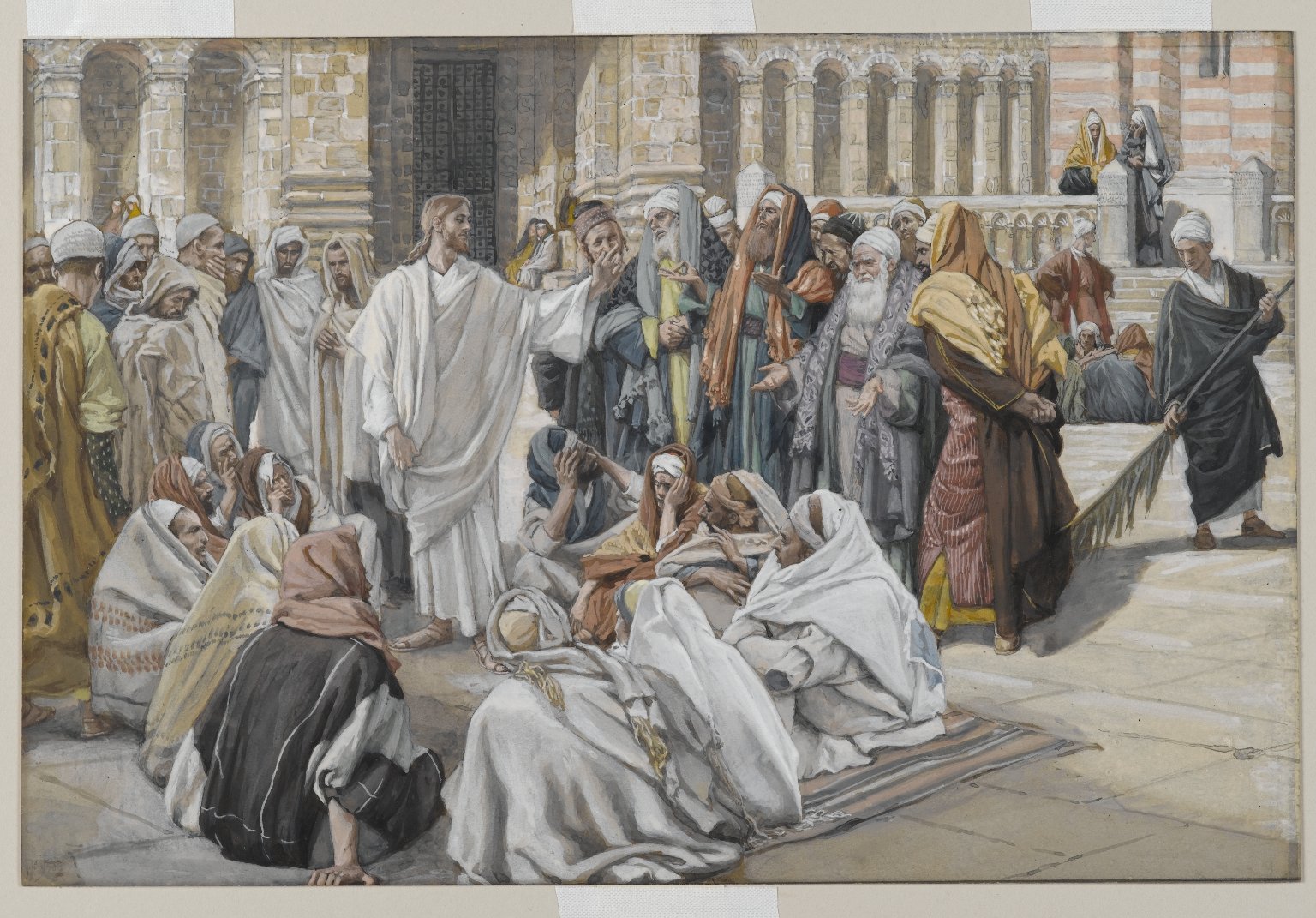
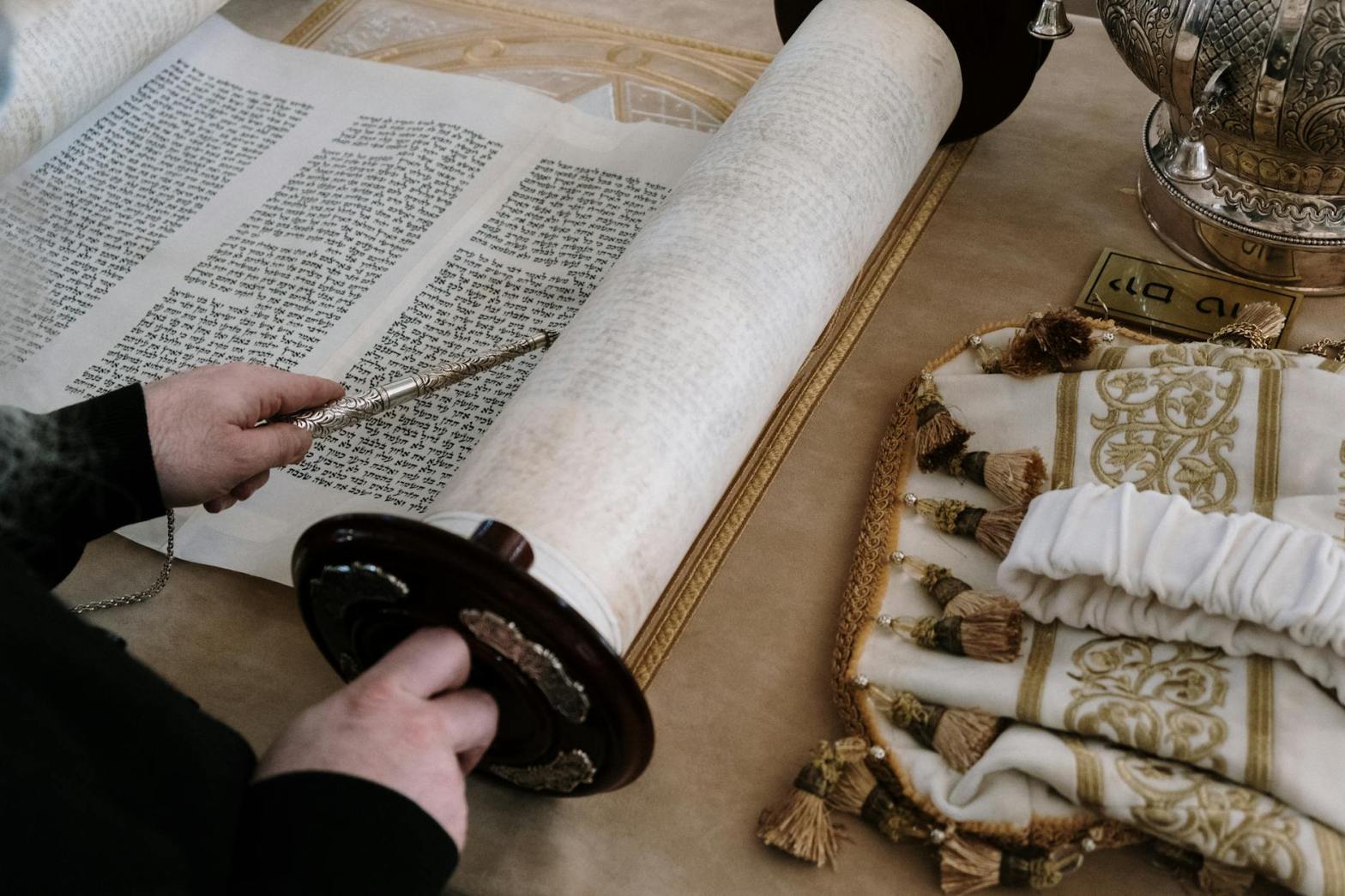
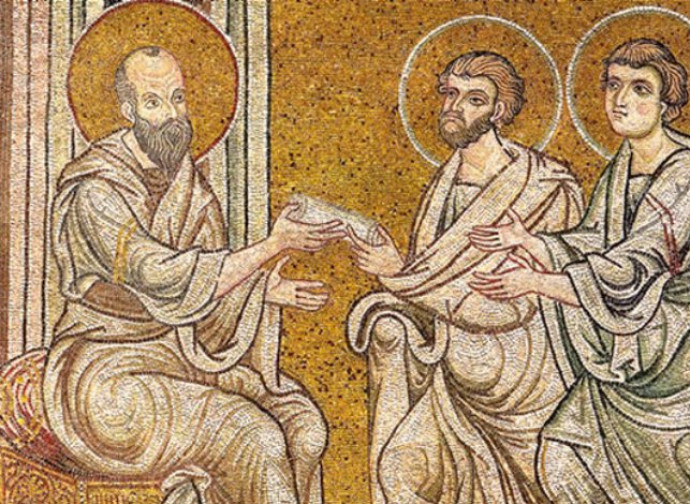
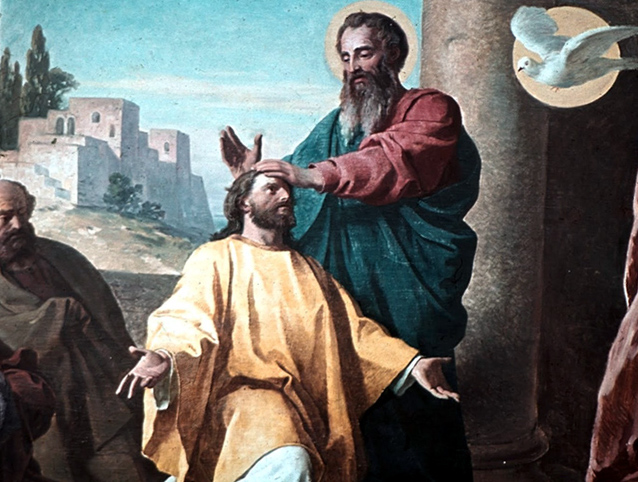
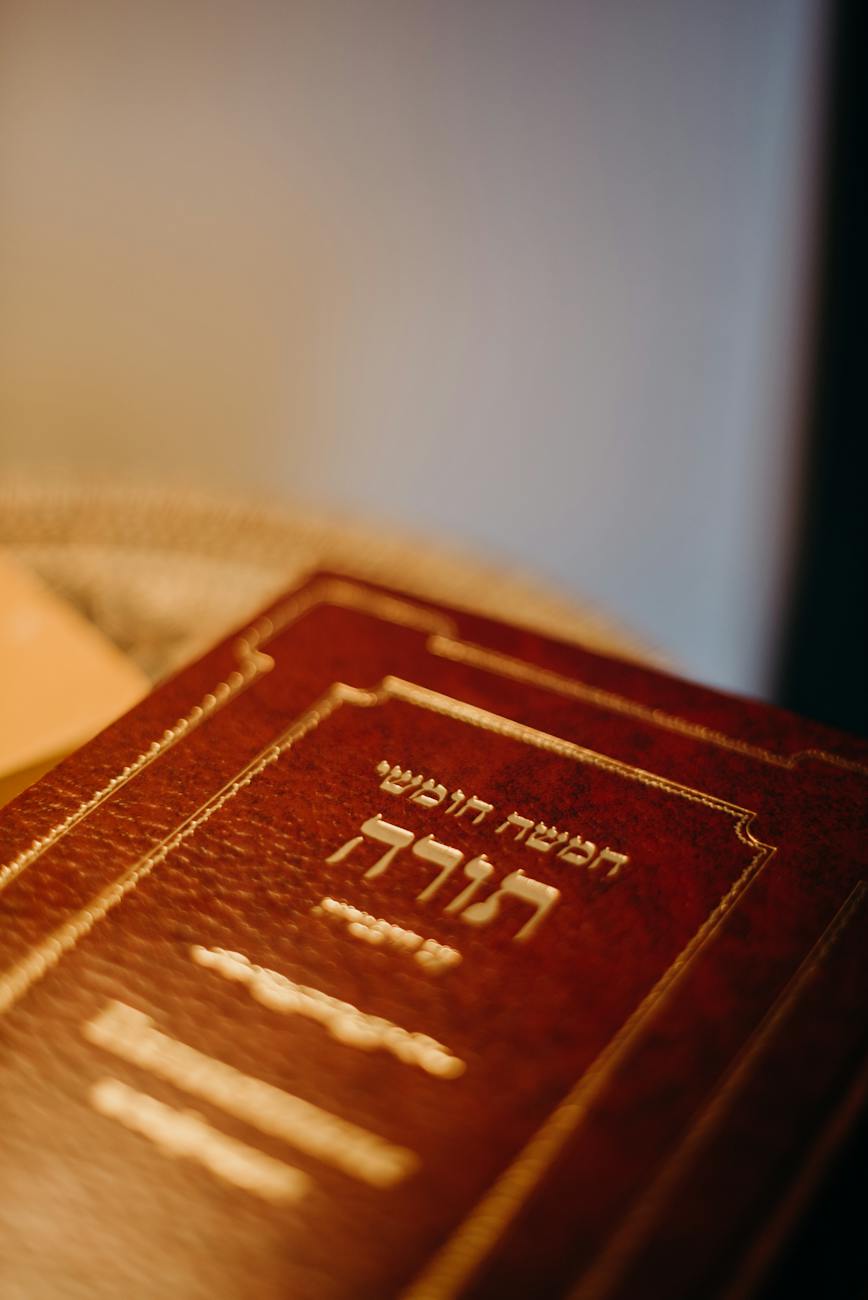
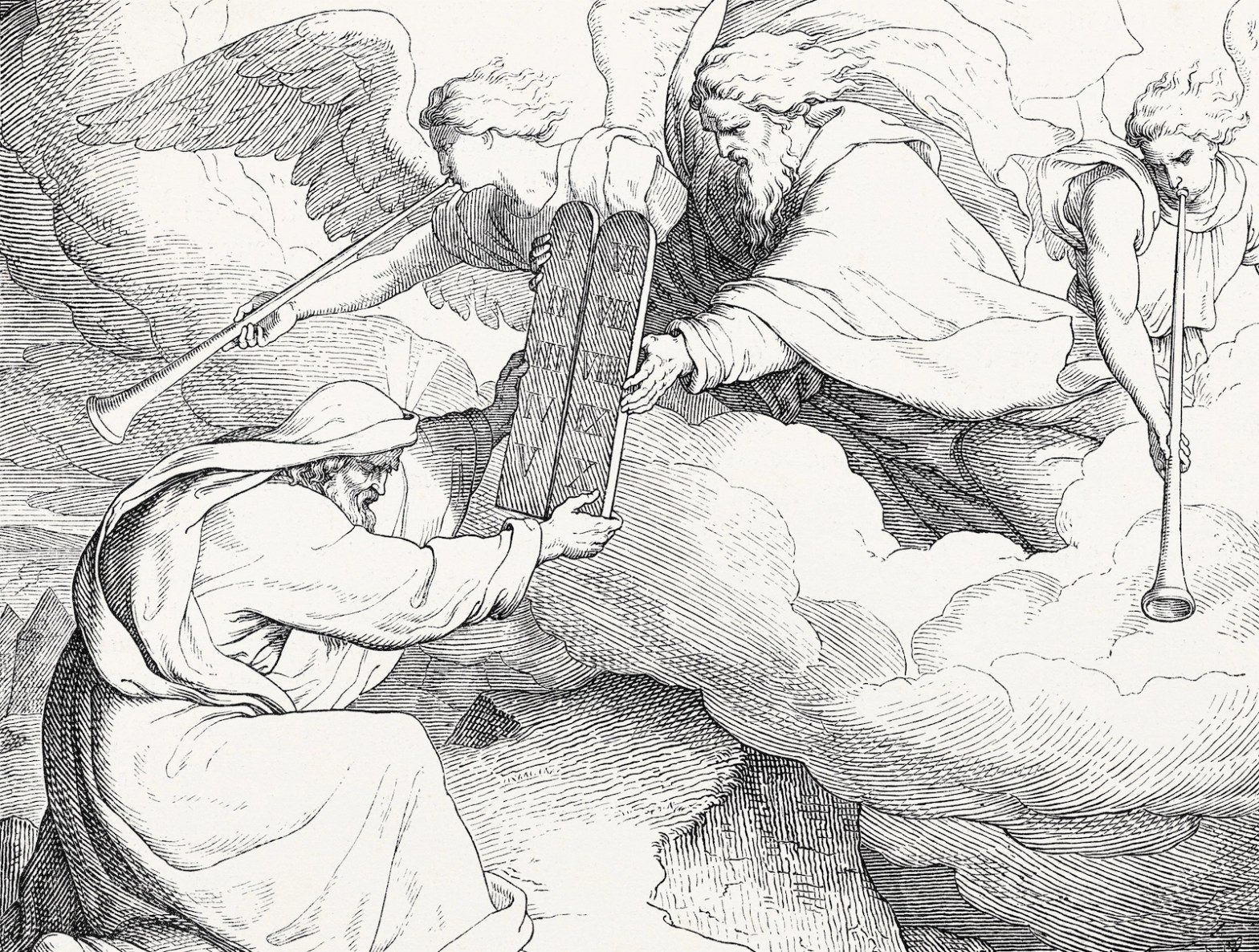
I think that one of the reasons the Pharisees and the disciples of Christ had so many arguments, as we are told by the gospel stories, is that they were both groups of orthodox Jews. And in the best tradition of the Jewish people, the Orthodox have a good old argument every now and again about the best way to observe the Law of Moses. Naturally, Christ, since He gave the Law to Moses in the first place, gets the better of these arguments and disputes. But that is not what the party of the Pharisees would tell us, if we could speak to them today. No, they would say, we must remain with the customs of our fathers. So then, what is this Law of Moses about which everybody was arguing? Let’s look at our first reading, which comes from Deuteronomy, which is greek for second-law: the law given to the people before their conquest and possession of the Holy Land.
“And now, Israel, pay good heed to the laws and the decrees I am making known to you. It is yours to observe them, if you would have life; if you would find your way into the land promised you by the Lord God of your fathers, and take possession of it. There must be no adding to this message of mine, no retrenching it; the commands I lay upon you are the commands of the Lord your God; keep them well. Your own eyes have witnessed what sentence the Lord passed against Beelphegor, purging out from among you all that worshipped at his shrine, while you, who remain faithful to the Lord, have lived to remember it. Be well assured that the laws and decrees I have given you come from the Lord Himself, and must still be observed when you have taken possession of the land that is to be yours. Keep them in honour and live by them; these are to be the arts, this the wisdom, that you teach the world, as men come to hear of these laws, and say to themselves, Surely they must be wise, surely they must be discerning folk, that belong to so great a nation as this! And indeed no other nation is so great; no other nation has gods that draw near to it, as our God draws near to us whenever we pray to Him. What other nation can boast that it has observances and decrees so rightly ordered as we have in this Law of ours, this law which I am setting before your eyes to-day?”
Moses talks about laws and customs he has personally taught them, and says that the observance of these traditions and customs is the condition of avoiding death and possessing the Land. Add nothing, Moses says, and remove nothing from this my legacy to you. And that is the important note for us in the first reading. Over the course of time, as it is the way with human societies, the pharisees and the scribes and the rabbis had added to the law of Moses and, even if they had done so for very good reasons, these were still non-essential accretions.
Moses had prescribed ritual purification for the priests of the tabernacle in the desert, which was later applied to the priests of the Temple in Jerusalem. The pharisees and their associates had taken these ritual washings unto themselves, although they were not all priests, and were using ritual washings in the home and in common life, as we clearly see in the narrative of the gospel today. Now, we could probably see the piety in this: they were seeking after the holiness of the Temple priests. And we can see the hygienic benefits: with all this washing of the hands and forearms before meals, and the showering after returning from the marketplace, they were probably healthier than other Jews and certainly non-Jews.
“…the Pharisees, and indeed all the Jews, holding to the tradition of their ancestors, never eat without washing their hands again and again; they will not sit down to meat, coming from the market, without thorough cleansing; and there are many other customs which they hold to by tradition, purifying of cups and pitchers and pans and beds. So the Pharisees and scribes asked Him, ‘Why do Thy disciples eat with defiled hands, instead of following the tradition of our ancestors?’ But He answered, ‘You hypocrites, it was a true prophecy Isaias made of you, writing as he did, This people does me honour with its lips, but its heart is far from me; their worship of me is vain, for the doctrines they teach are the commandments of men. You leave God’s commandment on one side, and hold to the tradition of man, the purifying of pitchers and cups, and many other like observances.’ And He told them, ‘You have quite defeated God’s commandment, to establish your own tradition instead…'”
But they made the mistake of associating these pieties of theirs with obedience to God, and the God Who had thundered the Law down to Moses was standing right there among them, as they accused His disciples of impiety and ignoring traditions. And He Who could see through the superficiality of their piousness, and into their hearts, was prepared to attack their hypocrisy. Those who persevere in uncharity and viciousness in their hearts, while appearing outwardly religious, cannot stand unscathed before the fire of divine love.
And so our Lord teaches us a very good lesson at the end of the gospel story today: it is this uncharity, this cruelty of the heart, and every other sin (and He lists several sins) – it is this that makes the heart unclean, and it comes from without. And you may wash and wash and wash your hands ritually, and you will probably live a long life on earth, but you will not necessarily acquire spiritual cleanness or purity before the Holy One, unless you turn away from sin and seek the true medicine that can purify and cleanse your heart of sin and malice. What is that true medicine? Let’s have a look at our second reading, from the apostle S. James.
“Whatever gifts are worth having, whatever endowments are perfect of their kind, these come to us from above; they are sent down by the Father of all that gives light, with whom there can be no change, no swerving from his course; and it was His will to give us birth, through His true word, meaning us to be the first-fruits, as it were, of all His creation. You know this, my beloved brethren, well enough. It is for us men to be ready listeners, slow to speak our minds, slow to take offence; man’s anger does not bear the fruit that is acceptable to God. Rid yourselves, then, of all defilement, of all the ill-will that remains in you; be patient, and cherish that word implanted in you which can bring salvation to your souls. Only you must be honest with yourselves; you are to live by the word, not content merely to listen to it. One who listens to the word without living by it is like a man who sees, in a mirror, the face he was born with; he looks at himself, and away he goes, never giving another thought to the man he saw there. Whereas one who gazes into that perfect law, which is the law of freedom, and dwells on the sight of it, does not forget its message; he finds something to do, and does it, and his doing of it wins him a blessing. If anyone deludes himself by thinking he is serving God, when he has not learned to control his tongue, the service he gives is vain. If he is to offer service pure and unblemished in the sight of God, who is our Father, he must take care of orphans and widows in their need, and keep himself untainted by the world.”
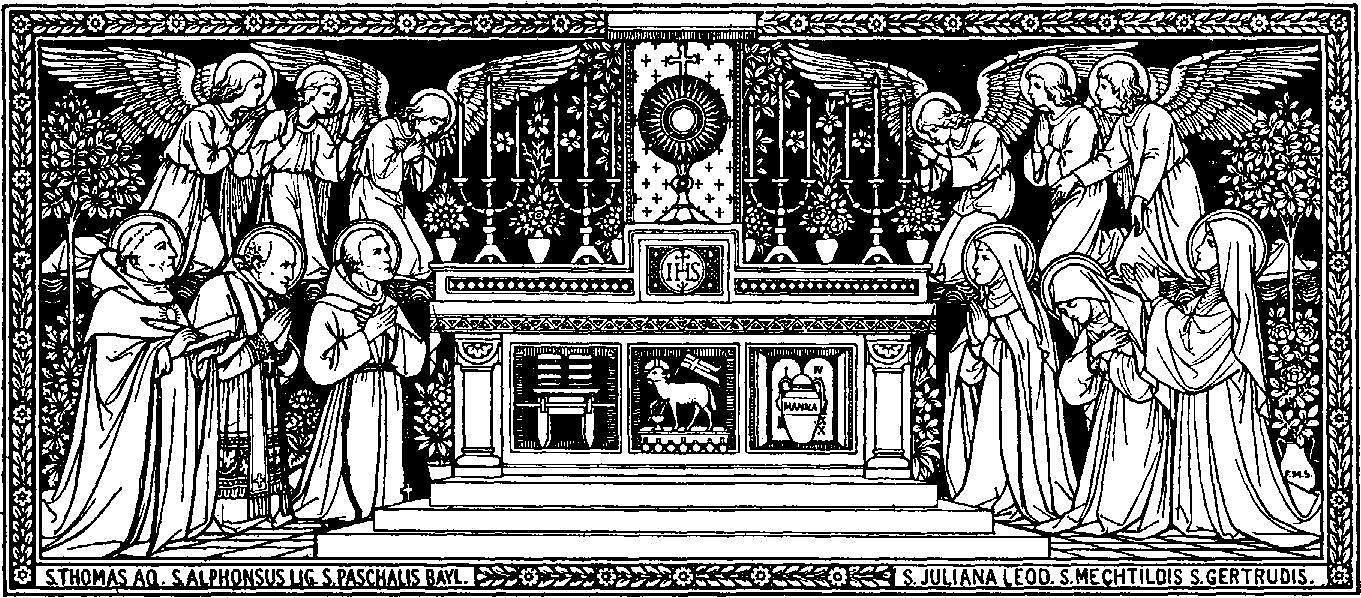
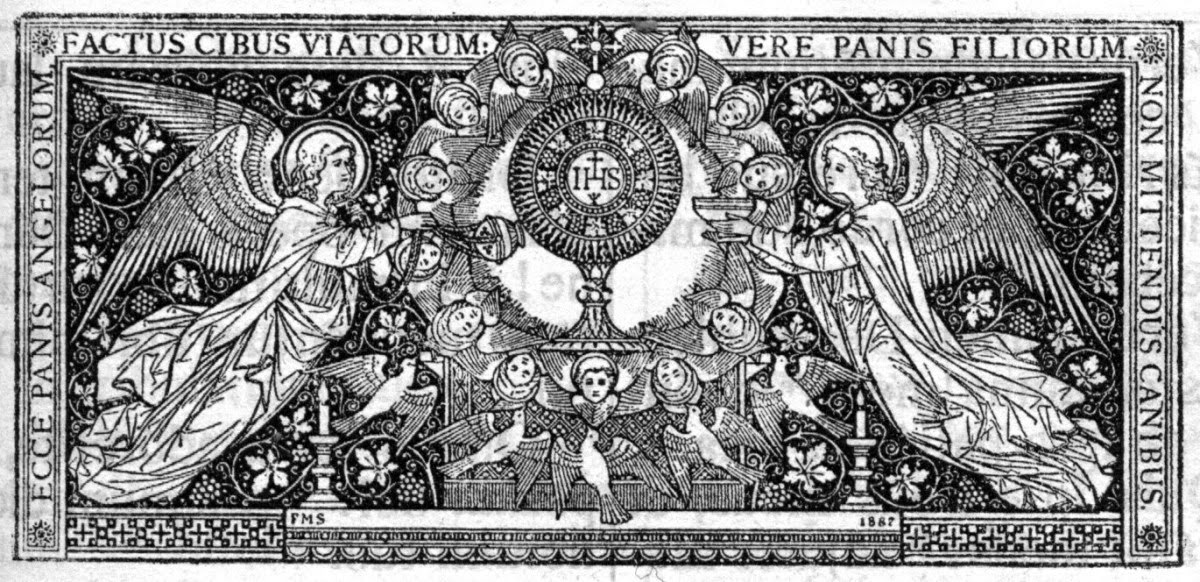
Every good gift, every perfect good, even the sanctifying grace that brings the purification we are looking for, comes from above from the Holy One, Who adopts us as His own children, plants His word within us as a seeding and nurtures the crop that will inevitably result, so that we should deliver the first-fruits of our produce to Him. And we all of us (hopefully) deliver those first-fruits of our personal devotion at Mass, every time we are here, offering it to Him in the offertory, placing it in that chalice the priest holds aloft while he says his secret prayers.
Just as Moses had required the people to make a commitment to God by following the commandments, James now asks that we submit to the word of the gospel planted within us, listening and obeying it. And James is clear that the true, pure and unspoilt religion is shown not by the superficialities of dress, accessories and numerous ritual washings, but as is made evident by the spirit of charity (towards widow and orphan, he says, but we can extend it further) and purity from the filth of sin and evil that always surrounds the Church, threatening to engulf her. But by the grace of God, she perseveres and stands in all holiness before the God Who loves her.
I had said that I would start a series of posts on prayer, after finishing up the short commentaries. Here’s a nice, old morning offering, to begin the day with:
O Lord God Almighty, behold me prostrate before Thee in order to appease Thee, and to honour Thy Divine Majesty, in the name of all creatures. But how can I do this who am myself but a poor sinner? Nay, but I both can and will, knowing that Thou dost make it Thy boast to be called Father of mercies, and for love of us hast given Thy only-begotten Son, Who sacrificed Himself upon the Cross, and for our sake doth continually renew that sacrifice of Himself upon our altars. And therefore do I – sinner, but penitent – before Thee, and, with the love of angels and of all Thy Saints, and with the tender affection of the Immaculate Heart of Mary, I offer to Thee in the name of all creatures the Masses which are now being celebrated, together with all those which have been celebrated, and which shall be celebrated to the end of the world. Moreover, I intend to renew the offering of them every moment of this day and of all my life, that I may thereby render to Thy infinite Majesty an honour and a glory worthy of Thee, thus to appease Thy indignation, to satisty Thy justice for our many sins, to render Thee thanks in proportion to Thy benefits, and to implore Thy mercies for myself and for all sinners, for all the faithful, living and dead, for Thy whole Church, and principally for its visible Head, the Sovereign Pontiff, and lastly for all poor schismatics, heretics, and infidels, that they also may be converted and save their souls.
And an addendum for priests:
Eternal Father, I offer to Thee the sacrifice which Thy beloved Son Jesus made of Himself upon the Cross, and which He now renews upon this altar; I offer it to Thee in the name of all creatures, together with the Masses which have been celebrated, and which shall be celebrated in the whole world, in order to adore Thee, and to give Thee the honour which Thou dost deserve, to render to Thee due thanks for Thy innumerable benefits, to appease Thy anger, which our many sins have provoked, and to give Thee due satisfaction for them; to entreat Thee also for myself, for the Church, for the whole world, and for the blessed souls in purgatory. Amen.
A short commentary should inevitably follow. The Catholic must live in prostration (in the Latin West, this is kneeling with the head bowed) before the Holy One, and so a day appropriately starts with a spiritual abnegation before the divine majesty. The language of appeasement is priestly language, which takes for granted that sin exists and that sin offends the God Who loves us; consequently He Who is offended must be appeased. Abnegation is again a priestly act; one of the famous sayings of the priestly soul of S. John the Baptist was, ‘He must increase, I must decrease.’ A God of justice will see offence acknowledged, confessed, punished. If that sounds horrid, we are not taking sufficient account of the seriousness of disordered sin in the history of the Hebrew and Christian religions. God brings order to creation, He even asked men and women in Adam to continue to bring order to creation, but we sinned and brought disorder and disharmony. This requires a daily repentance of sin, a daily conversion to God and the appeasement that is only completely made by the death of the Sinless One upon the Cross. And then we (all of us, clergy and laity) become the priests of the created world, taking up once more the original command to Adam to consecrate creation to the Holy One.
And that brings us to the reason for this prayer. Although most Catholics of the Western Church do not go to daily Mass, they are encouraged to do so, and this prayer is a preparation for attending a daily Mass. Within the ritual of the Mass stands the old, rugged Cross and the Mass was designed from the beginning to apply the merits of the Crucified One to men and women of every successive age of the Church’s history. Our daily acts of repentance and conversion to God are gathered together in what we call the penitential rite at the beginning of Mass, and (given that we confess sin regularly to a priest) this ritual allows us to stand blameless before the Holy One, before we receive the lessons of the readings and the Gospel and are admitted to Holy Communion. So, even if we are sinners, we are penitent sinners, and seek the appeasement that is brought to us by the Sacrifice of Christ, which Sacrifice we partake of in Holy Communion.
Making an offering is a priestly act that every Christian must perform, and this short morning offering gives us the words for it. We make offering to God of ourselves, and of all creation, for the whole Church, for those who have separated themselves from the Church (heretics and schismatics) and those who have either not approached the Church or have rejected her (infidels). It is still very much the teaching of the Church that, in so far as salvation may only be had through Christ and the Church is His instrument for that salvation, salvation may only be had through the Church.
The added prayer for the priest is very similar, but it is directed towards the actual offering of the Sacrifice of Christ, which only the ordained priest may perform.
And finally, here is my last short essay on the books of the Bible, part of a marathon read through the entire Knox English version of Holy Scripture, a copy of which I acquired when I worked at the cathedral in Nottingham. Monsignor Knox was a twentieth-century Anglican clergyman who became a Catholic priest, following an intellectual pathway comparable to that of the great Saint John Henry Newman in the century before. He was an excellent author and essayist in English and is well known for his homily collections on various subjects, his satires and even his murder mysteries. At one point, by the request of the English bishops, he produced by himself this excellent if idiosyncratic translation of Scripture, which has become known as the Knox version. You can get a new and well-bound copy here.
To begin this short post on Apocalypse, let’s have a quick look at the traditional origin of this book, which is now frequently thrown in doubt by biblical scholarship. I shall take this from the bishop Eusebius’ church history. This is what he says in Book III of that history:
“It is said that in this persecution [of the Emperor Domitian] the Apostle and evangelist John, who was still alive, was condemned to dwell on the island of Patmos in consequence of his testimony to the divine word. Irenæus, in the fifth book of his work Against Heresies, where he discusses the number of the name of Antichrist which is given in the so-called Apocalypse of John, speaks as follows concerning him: ‘If it were necessary for his name to be proclaimed openly at the present time, it would have been declared by him who saw the revelation. For it was seen not long ago, but almost in our own generation, at the end of the reign of Domitian.‘ To such a degree, indeed, did the teaching of our faith flourish at that time that even those writers who were far from our religion did not hesitate to mention in their histories the persecution and the martyrdoms which took place during it.”
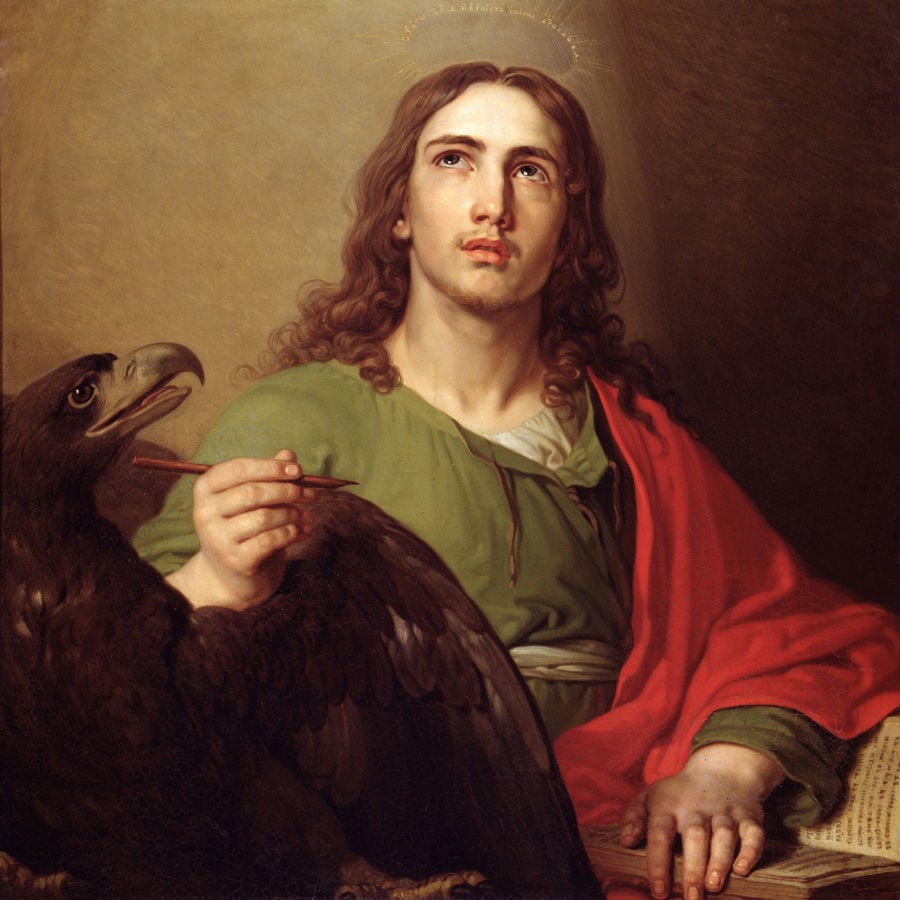
So, then, Saint Irenaeus of Lyon, who lived within two generations of Saint John, passed on a tradition that the Apostle received the revelation or apocalypse in the reign of Domitian, while he was exiled to the island of Patmos. He would later return to action in Asia Minor, ending up in the west at Ephesus. It would be natural for him to receive messages to carry back to the several churches in Asia Minor. Right. On to the book, and there are messages to carry back to churches in Asia:
“Thus John writes to the seven churches in Asia, Grace and peace be yours, from Him Who is, and ever was, and is still to come, and from the seven spirits that stand before His throne; and from Jesus Christ, the faithful witness, First-born of the risen dead, Who rules over all earthly kings. He has proved His love for us, by washing us clean from our sins in His own blood, and made us a royal race of priests, to serve God, His Father; glory and power be His through endless ages, Amen. Behold, He comes with clouds about Him, seen by every eye, seen by those who wounded Him, and He shall bring lamentation to all the tribes of earth. So it must be, Amen. ‘I am Alpha, I am Omega, the beginning of all things and their end,’ says the Lord God; ‘He who is, and ever was, and is still to come, the Almighty.’ I, John, your brother, who share your ill-usage, your royal dignity, and your endurance in Christ Jesus, was set down on the island called Patmos, for love of God’s word and of the truth concerning Jesus. And there, on the Lord’s day, I fell into a trance, and heard behind me a voice, loud as the call of a trumpet, which said, ‘Write down all thou seest in a book, and send it to the seven churches in Asia, to Ephesus, and Smyrna, and Pergamum, and Thyatira, and Sardis, and Philadelphia, and Laodicea.”
Apocalypse, 1: 4-11
It’s worth including this whole block of text because of its inclusion of a basic Christian creed: Christ is risen, He reigns over all forever. Behold, He comes with clouds, he comes with clouds descending… now listen to this lovely old Wesleyan hymn, which is a summary of the return of Christ as given by Apocalypse:
Following this listing of the churches is a frightful description of Christ, as seen in the great vision, and it is similar to those wonderful visions of prophets like Jeremias and Ezechiel:
“…One who seemed like a son of man, clothed in a long garment, with a golden girdle about His breast. The hair on His head was like wool snow-white, and His eyes like flaming fire, His feet like orichalc melted in the crucible, and His voice like the sound of water in deep flood. In His right hand were seven stars; from His mouth came a sword sharpened at both its edges; and His face was like the sun when it shines at its full strength. At the sight of Him, I fell down at His feet like a dead man; and He, laying His right hand on me, spoke thus: ‘Do not be afraid; I AM before all, I AM at the end of all, and I live. I, Who underwent death, am alive, as thou seest, to endless ages, and I hold the keys of death and hell.’“
Apocalypse, 1: 13-18
I do so love that Christ uses the same language here in his fearsome aspect that he used in the Gospels, when He also terrified men like John by walking over the water to them on a stormy sea. He at once explains that the seven stars in his hand represent seven angels that have the care of the seven churches, which are represented as candlesticks here. There follow the messages to the churches. To summarise, Ephesus has done well since it first received the Gospel and had even rejected the Nicolaitan heresy, but has suffered a loss of charity; Smyrna has done well and will soon suffer persecution; Pergamum has remained faithful in a pagan atmosphere but has lost some of its Christians to the Nicolaitan heresy; Thyatira has remained largely faithful but has been infected with a gnostic religion centering on a woman (named Jezabel here); Sardis has declined greatly and there remain only a few faithful Christians there; Philadelphia has remained faithful and will soon receive several Jewish converts; Laodicea is accused of being lukewarm, which I take to mean lacking in devotion to the faith and trusting in its own prosperity. Chapter four gives us a vision of the Throne:
“And all at once I was in a trance, and saw where a throne stood in heaven, and One sat there enthroned. He who sat there bore the semblance of a jewel, jasper or sardius, and there was a rainbow about the throne, like a vision of emerald. Round it were twenty-four seats, and on these sat twenty-four elders, clothed in white garments, with crowns of gold on their heads. Lightnings came out from the throne, and mutterings, and thunders, and before it burned seven lamps, which are the seven spirits of God; facing it was a whole sea of glass, like crystal. And in the midst, where the throne was, round the throne itself, were four living figures, that had eyes everywhere to see before them and behind them. The first figure was that of a lion, the second that of an ox, the third had a man’s look, and the fourth was that of an eagle in flight. Each of the four figures had six wings, with eyes everywhere looking outwards and inwards; day and night they cried unceasingly, ‘Holy, holy, holy is the Lord God, the Almighty, who ever was, and is, and is still to come.’“
Apocalypse 4: 2-8
Many of our Mass texts come from the book of Apocalypse, for this book is about the unceasing divine worship in heaven, of which our Mass is a participation. Hence, above, we see the twenty-four elders in white and the four great seraphs who present the worship of the Holy One in the immediate vicinity of the Throne. The vision continues with the discovery of a scroll/book in the hand of the Holy One, a scroll/book written inside and out and sealed with seven seals – a book of judgement and punishment, no doubt. Only one person could open this scroll and disclose its content: Christ Himself, the Bridge between God and mankind, here presented in a new vision: that of the Lamb of God.
“But there was no one in heaven, or on earth, or under the earth, who could open the scroll and have sight of it. I was all in tears, that none should be found worthy to open the scroll or have sight of it; until one of the elders said to me, ‘No need for tears; here is One who has gained the right to open the book, by breaking its seven seals, the Lion that comes from the tribe of Juda, from the stock of David.’ Then I saw, in the midst, where the throne was, amid the four figures and the elders, a Lamb standing upright, yet slain (as I thought) in sacrifice. He had seven horns, and seven eyes, which are the seven spirits of God, that go out to do His bidding everywhere on earth. He now came, and took the scroll from the right hand of Him Who sat on the throne, and when He disclosed it, the four living figures and the twenty-four elders fell down in the Lamb’s presence. Each bore a harp, and they had golden bowls full of incense, the prayers of the saints. And now it was a new hymn they sang, ‘Thou, Lord, art worthy to take up the book and break the seals that are on it. Thou wast slain in sacrifice; out of every tribe, every language, every people, every nation Thou hast ransomed us with Thy blood and given us to God.'”
Apocalypse, 5: 3-9
As in the letter to the Hebrews, Christ receives His great authority as a result of His voluntary self-sacrifice. The rest of the chapter is about divine worship, not only of the Holy One Who sits upon the throne, but of the Lamb as well. Chapter six describes the result of the opening of the scroll of judgement/vengeance, a sequence of plagues upon the world. The following notable vision results from the breaking of the fifth of the seven seals on the scroll, and describes the pending reward of the Christian martyrs, who had given their lives for the faith. I call it notable because it points directly to the Mass again, where the sacrifice of the Lamb is offered upon an altar that contains the relics of the Saints, often including martyr Saints.
“And when He broke the fifth seal, I saw there, beneath the altar, the souls of all who had been slain for love of God’s word and of the truth they held, crying out with a loud voice, ‘Sovereign Lord, the Holy, the True, how long now before Thou wilt sit in judgement, and exact vengeance for our blood from all those who dwell on earth?’ Whereupon a white robe was given to each of them, and they were bidden to take their rest a little while longer, until their number had been made up by those others, their brethren and fellow servants, who were to die as they had died.“
Apocalypse, 6: 9-11
In the next vision, in chapter seven, we find a fuller description of the martyrs of the Church who had suffered through the persecutions of Saint John’s time (‘the great afflication’), a great multitude indeed. The Church has always greatly honoured those men and women who have payed the ultimate price for their allegiance to Christ.
“And then I saw a great multitude, past all counting, taken from all nations and tribes and peoples and languages. These stood before the throne in the Lamb’s presence, clothed in white robes, with palm-branches in their hands, and cried with a loud voice, ‘To our God, who sits on the throne, and to the Lamb, all saving power belongs.’ And all the angels that were standing round the throne, round the elders and the living figures, fell prostrate before the throne and paid God worship; ‘Amen,’ they cried, ‘blessing and glory and wisdom and thanksgiving and honour and power and strength belong to our God through endless ages, Amen.’ And now one of the elders turned to me, and asked, ‘Who are they, and whence do they come, these who are robed in white?’ ‘My Lord,’ said I, ‘thou canst tell me.’ ‘These,’ he said, ‘have come here out of the great affliction; they have washed their robes white in the Blood of the Lamb. And now they stand before God’s throne, serving Him day and night in His temple; the presence of Him Who sits on the throne shall overshadow them. They will not be hungry or thirsty any more; no sun, no noonday heat, shall fall across their path. The Lamb, Who dwells where the throne is, will be their Shepherd, leading them out to the springs whose water is life; and God will wipe away every tear from their eyes.’“
Apocalypse, 7: 9-17
The seals all broken on the scroll, a dead silence falls upon the great assembly of worshippers, and then we discover the angel that is mentioned at Mass during the Eucharistic Prayer (the Roman Canon) offering a burning of incense to God which is composed of the prayers of Christians:
“There was another angel that came and took his stand at the altar, with a censer of gold; and incense was given him in plenty, so that he could make an offering on the golden altar before the throne, out of the prayers said by all the saints. So, from the angel’s hand, the smoke of the incense went up in God’s presence, kindled by the saints’ prayer. Then the angel took his censer, filled it up with fire-brands from the altar, and threw it down on to the earth; thunder followed, and mutterings, and lightning, and a great earthquake.”
Apocalypse, 8: 3-5
This same angel apparently starts off the plagues that will afflict the earth. I often say that the whole theme of the Old Testament is the ending of idolatry, but we could say that this is the theme of the whole of Scripture – ending idolatry is the gift of the Hebrews and the Jews to the world of men. The New Testament continues this theme (even drawing non-Jews out of idolatry and towards the worship of the one, true God), and here Saint John tells us that in spite of the great plagues, most of the inhabitants of the world refuse to give up their idolatrous acts and the sins that proceeded from these acts:
“The rest of mankind, that did not perish by these plagues, would not turn away from the things their own hands had fashioned; still worshipped evil spirits, false gods of gold and silver and brass and stone and wood, that can neither see, nor hear, nor move. Nor would they repent of the murders, the sorceries, the fornications, and the thefts which they committed.”
Apocalypse, 9: 20-21
Chapters ten and eleven are reminiscent of Ezechiel’s own descriptions of swallowing a word of prophecy that is to be delivered to the people and then of measuring the Temple of God. And there is mention of the two olive trees or candlesticks in the book of Zacharias, a book that was used multiple times by the Gospel writers. If I read it correctly, these two tree-witnesses to God were the twin ministries of the governor/administrator and the Temple high-priest, which had been erected with the establishment of the Second Temple under the priest Ezra (described by Zacharias), but which had now died together with the Temple in AD 70, under the Romans (who must be the great beast coming up out of the abyss). It appears that this two-tree system is to be restored before the establishment of the divine sovereignty, which is sung about at this point.
“Then the seventh angel sounded, and with that, a great cry was raised in heaven, ‘The dominion of the world has passed to the Lord of us all, and to Christ His anointed; He shall reign for ever and ever, Amen.’ And the twenty-four elders who sit enthroned in God’s presence fell prostrate, worshipping God and crying out, ‘Lord God Almighty, Who art, and ever wast, and art still to come, we give Thee thanks for assuming that high sovereignty which belongs to Thee, and beginning Thy reign. The heathen have vented their rage upon us, but now the day of Thy retribution has come; the time when Thou wilt judge the dead, rewarding Thy servants, prophets and holy men and all who fear Thy Name, little or great, and destroying the corrupters of the world.”
Apocalypse, 11: 15-18
But how will all this be? What made all this possible? In chapter twelve we receive the answer in the great vision of the Immaculate (the Blessed Virgin) and her eternal foe.
“And now, in heaven, a great portent appeared; a woman that wore the sun for her mantle, with the moon under her feet, and a crown of twelve stars about her head. She had a child in her womb, and was crying out as she travailed, in great pain of her delivery. Then a second portent appeared in heaven; a great dragon was there, fiery-red, with seven heads and ten horns, and on each of the seven heads a royal diadem; his tail dragged down a third part of the stars in heaven, and flung them to earth. And he stood fronting the woman who was in childbirth, ready to swallow up the child as soon as she bore it. She bore a Son, the Son Who is to herd the nations like sheep with a crook of iron; and this Child of hers was caught up to God, right up to His throne…”
Apocalypse, 12: 1-5
And so heaven calls out again to declare the reign of God, as before, but this is here qualified by the vision of the birth of the Child, and the defeat of the ancient serpent (by the sacrifice of Christ, which has enabled the martyrs to triumph). The serpent is the enemy of the Lady’s spiritual children:
“Then I heard a voice crying aloud in heaven, ‘The time has come; now we are saved and made strong, our God reigns, and power belongs to Christ, His anointed; the accuser of our brethren is overthrown. Day and night he stood accusing them in God’s presence; but because of the Lamb’s blood and because of the truth to which they bore witness, they triumphed over him, holding their lives cheap till death overtook them. Rejoice over it, heaven, and all you that dwell in heaven; but woe to you, earth and sea, now that the devil has come down upon you, full of malice, because he knows how brief is the time given him.'”
Apocalypse, 12: 10-12
Now the vision deals with the malice of the devil worked out upon the inhabitants of the earth. Chapter thirteen now describes the beast that received the authority and power of the defeated serpent and established a particular religion that centred on it – an anti-Christian religion of rebellion against the reign of God – the kingdom of God of the Gospels, which is the Church.
“And he was given power of speech, to boast and to blaspheme with, and freedom to work his will for a space of forty-two months. So he began to utter blasphemy against God, blasphemy against His Name, against His dwelling-place and all those who dwell in heaven. He was allowed, too, to levy war on the saints, and to triumph over them. The dominion given to him extended over all tribes and peoples and languages and races; all the dwellers on earth fell down in adoration of him, except those whose names the Lamb has written down in his book of life, the Lamb slain in sacrifice ever since the world was made.“
Apocalypse, 13: 5-8
There is here an exhortation to Christians to remain true and faithful to the Christian faith and the Christian religion, reminiscent of the warnings in the letter to the Hebrews and elsewhere in the New Testament. The great persecutions of the nascent Church resulted in a great temptation for Christians to give up the fight and return to traditional religions, or to the protected Jewish religion. The beast must always represent the cruel governments and corrupt cultures and societies that draw people away from the Christian religion. But the chapter ends with the famous reference to the number 666, which it seems clear referred to the persecuting Roman authority of Saint John’s time.
“Here is room for discernment; let the reader, if he has the skill, cast up the sum of the figures in the beast’s name, after our human fashion, and the number will be six hundred and sixty-six.”
Apocalypse, 13: 18
But the challenge to the Church is not unanswered and chapter fourteen shows a vision of Christ and his company of 144,000 martyrs, attended now by consecrated virgins. Christians are bidden by several angels to remain true to God in the midst of the reign of the beast, ‘by keeping true to God’s commandments and the faith of Jesus.’ This is followed by another great judgement of the earth by several angels with sharp sickels for reaping, and more plagues for the followers of the beast. In chapter seventeen, we find the vision of the so-called whore of Babylon – pagan Rome – that had so gutted the Church in Saint John’s time.
“And now one of the angels that bear the seven cups came and spoke to me. ‘Come with me,’ he said, ‘and I will shew thee how judgement is pronounced on the great harlot, that sits by the meeting-place of many rivers. The kings of the world have committed fornication with her; all the dwellers on earth have been drunk with the wine of her dalliance. Then, in a trance, he carried me off into the wilderness, where I saw a woman riding on a scarlet beast, scrawled over with names of blasphemy; it had seven heads, and ten horns. The woman went clad in purple and scarlet, all hung about with gold and jewels and pearls, and held a golden cup in her hand, full to the brim with those abominations of hers, with the lewdness of her harlot’s ways. There was a title written over her forehead, ‘The mystic Babylon, great mother-city of all harlots, and all that is abominable on earth.’ I saw this woman drunk with the blood of saints, the blood of those who bore witness to Jesus; and I was filled with great wonder at the sight.”
Apocalypse, 17: 1-6
This woman and her beast fortunately stand no chance against Christ and his legions of martyrs. This woman might as well represent every other anti-Christian being or institution that tortures the Church. For in the midst of that torture, Saint John continues to call for perseverance in the Faith.
“After this I saw another angel, entrusted with great power, come down from heaven; earth shone with the glory of his presence. And he cried aloud, ‘Babylon, great Babylon is fallen; she has become the abode of devils, the stronghold of all unclean spirits, the eyrie of all birds that are unclean and hateful to man. The whole world has drunk the maddening wine of her fornication; the kings of the earth have lived in dalliance with her, and its merchants have grown rich through her reckless pleasures.’ And now I heard another voice from heaven say, ‘Come out of her, my people, that you may not be involved in her guilt, nor share the plagues that fall upon her.’“
Apocalypse, 18: 1-4
I suppose there are limits to inculturation, and there comes a time when the Church must pull up the drawbridges and lock the gates against the evils of the culture surrounding her, to avoid sharing in its guilt, etc. Chapter eighteen seems to indicate a particular destruction of the fortunes of Rome, perhaps as a result of a natural disaster that briefly ruined the trade interests of the City or such things as the great fire of Rome, which many thought old 666 himself (the wretched emperor Nero) had started. In chapter nineteen, heaven declares triumph over the great harlot of Rome and Christ reappears in glorious vision to finally make war with the beast and conquer it and its many followers.
“Then, in my vision, heaven opened, and I saw a white horse appear. Its rider bore for his title, the Faithful, the True; He judges and goes to battle in the cause of right. His eyes were like flaming fire, and on his brow were many royal diadems; the name written there is one that only He knows. He went clad in a garment deep dyed with blood, and the Name by which He is called is the Word of God; the armies of heaven followed Him, mounted on white horses, and clad in linen, white and clean. From His mouth came a two-edged sword, ready to smite the nations; He will herd them like sheep with a crook of iron. He treads out for them the wine-press, whose wine is the avenging anger of almighty God. And this title is written on his cloak, over His thigh, ‘The King of kings, and the Lord of lords.’“
Apocalypse, 19: 11-16
The beast is taken captive and tossed into a lake of fire, and it comes the turn of the dragon/serpent. Chapter twenty describes its imprisonment and final defeat, its joining the beast in the fiery lake. And this is to be followed by the establishment of the throne of judgement for Christ and the salvation of all those whose names are found in the Book of Life. And finally, in chapter twenty-one, the new Jerusalem descends from on high, a Jerusalem from out of the visions of the Hebrew prophets (think Ezechiel), with the water gushing out the east of it.
“And I, John, saw in my vision that holy city which is the new Jerusalem, being sent down by God from heaven, all clothed in readiness, like a bride who has adorned herself to meet her Husband. I heard, too, a voice which cried aloud from the throne, ‘Here is God’s tabernacle pitched among men; He will dwell with them, and they will be His own people, and He will be among them, their own God. He will wipe away every tear from their eyes, and there will be no more death, or mourning, or cries of distress, no more sorrow; those old things have passed away.’ And He who sat on the throne said, ‘Behold, I make all things new.’ (These words I was bidden write down, words most sure and true.) And He said to me, ‘It is over. I AM Alpha, I AM Omega, the beginning of all things and their end; those who are thirsty shall drink—it is my free gift—out of the spring whose water is life.’“
Apocalypse, 21: 2-6
Clearly, this new Jerusalem, called the Bride of Christ, is Holy Church herself, also the Body of Christ. There follows a detailed description of the new Jerusalem, a city of pure gold, but with foundations of precious and semi-precious stone and actual pearly gates. A city with no Temple, for it is the Temple, enshrining within itself the eternal presence of God, which is a life-giving source of such potency that there is no requirement for sun or moon. The gates are ever open, all peoples flock to the city and there is no uncleanness within. The final chapter further describes the spring gushing forth from the side of the City/Temple. And, hello!, at the other end of the Bible, there now appears once more the Tree of Life, forbidden to the children of Adam in Genesis, on account of their rebellion. The rebellion of mankind against God, and every other profanation is now ended.
“He shewed me, too, a river, whose waters give life; it flows, clear as crystal, from the throne of God, from the throne of the Lamb. On either side of the river, mid-way along the city street, grows the tree that gives life, bearing its fruit twelvefold, one yield for each month. And the leaves of this tree bring health to all the nations. No longer can there be any profanation in that city; God’s throne (which is the Lamb’s throne) will be there, with His servants to worship Him, and to see His face, His name written on their foreheads. There will be no more night, no more need of light from lamp or sun; the Lord God will shed His light on them, and they will reign for ever and ever.”
Apocalypse, 22: 1-5
The Tree of Life I would say is the sacramental life of the Church; it is the Body upon the Cross. We must continue to wash your clothes in the Blood of the Lamb to have access to that fount of grace, that spring of life. Christ has the last word. Patience, He says, and persevere; avail yourself of the Sacraments, there is no room for idolatry and other sins; I AM; my bride calls for me and I am on the way; come to me and receive everything as a free gift.
“‘Patience, I am coming soon; and with Me comes the award I make, repaying each man according to the life he has lived. I AM Alpha, I AM Omega, I AM before all, I AM at the end of all, the beginning of all things and their end. Blessed are those who wash their garments in the Blood of the Lamb; so they will have access to the tree which gives life, and find their way through the gates into the city. No room there for prowling dogs, for sorcerers and wantons and murderers and idolaters, for anyone who loves falsehood and lives in it. I, Jesus, have sent My angel to give you the assurance of this in your churches; I, the root, I, the Offspring of David’s race, I, the bright Star that brings in the day. The Spirit and My bride bid Me come; let everyone who hears this read out say, ‘Come.’ Come, you who are thirsty, take, you who will, the water of life; it is My free gift.“
Our readings this weekend demonstrate invitations by God to a chosen people, who are always given the freedom to either accept or decline. But if they do accept, they do so not on their own conditions but on His. We should remember that in the relationships that God arranges with an elect people, He paints Himself as the Bridegroom and the People consequently become the Bride. It follows that the relationship involves the mutual give-and-take that characterises faithful marriage. With that in mind, let’s have a look at the gospel message, which terminates our month-long read through chapter six of the Gospel of S. John: the Holy Communion chapter.
“Jesus said to them, ‘Believe Me when I tell you this; you can have no life in yourselves, unless you eat the flesh of the Son of Man, and drink His blood. The man who eats My flesh and drinks My blood enjoys eternal life, and I will raise him up at the last day. My flesh is real food, My blood is real drink. He who eats My flesh, and drinks My blood, lives continually in Me, and I in him. As I live because of the Father, the living Father who has sent Me, so he who eats Me will live, in his turn, because of Me. Such is the bread which has come down from heaven; it is not as it was with your fathers, who ate manna and died none the less; the man who eats this Bread will live eternally.‘ He said all this while He was teaching in the synagogue, at Capharnaum. And there were many of His disciples who said, when they heard it, ‘This is strange talk, who can be expected to listen to it?’ But Jesus, inwardly aware that His disciples were complaining over it, said to them, ‘Does this try your faith? What will you make of it, if you see the Son of Man ascending to the place where He was before? Only the spirit gives life; the flesh is of no avail; and the words I have been speaking to you are spirit, and life. But there are some, even among you, who do not believe.’ Jesus knew from the first which were those who did not believe, and which of them was to betray Him. And He went on to say, ‘That is what I meant when I told you that nobody can come to Me unless he has received the gift from My Father.’ After this, many of His disciples went back to their old ways, and walked no more in His company. Whereupon Jesus said to the Twelve, ‘Would you, too, go away?’ Simon Peter answered Him, ‘Lord, to whom should we go? Thy words are the words of eternal life; we have learned to believe, and are assured that Thou art the Christ, the Son of God.’“
We know how often Christ declared in that chapter, ‘I AM the Bread of Life.’ Last week, we saw that Christ as Wisdom has designed for His Church that she become a temple of His glory, that every Christian soul should be a temple of the Holy Spirit. This level of intimacy in a relationship takes the concept of human marriage to its very extreme. First, He (the Bridegroom) gives Himself entirely to us (the Bride), body and soul, through His great Sacrifice on the Cross, and then through the Sacrament of Holy Communion. Second, He invites us who believe in Him to give ourselves entirely to Him, body and soul.
If we have heard this idea before, it’s because it is the subject of the spiritual theology of the Catholic Church and is very present in our catechisms and very evident in the life and teachings of the Saints of the Church. ‘Are you willing to enter into this relationship with Me?’ He asks in the gospel reading today. ‘You have seen my miracles? Can I not do this inconceivable thing? Does it upset you if I do? Would you take the risk and have eternal life?’ And the horrifying thing is that He permits us to say No, and watches sadly as the people He loves turn their backs on Him. And He remains unapologetic and clear about this doctrine of the Holy Eucharist.
In the first reading, He invited the Hebrews to an earlier covenant relationship through Joshua, the captain of the people after the death of Moses. Look at the response of that people, in that time; they have escaped slavery in Egypt and seen the great miracles of the Holy One and, having passed through the wilderness on the way to the Holy Land, they now expect greater things. ‘We will be His people,’ they say, ‘and He our God.’
“‘…You crossed Jordan, and made your way to Jericho. And the men of Jericho withstood you, Amorrhite and Pherezite, Chanaanite and Hethite, Gergesite and Hevite and Jebusite, but I gave you the mastery over them. I sent hornets in your path, and drove two kings of the Amorrhites out of their countries, before they could suffer from bow or sword of yours. I have given you lands that others had tilled, cities to dwell in, not of your building, vineyards and oliveyards, not of your planting. And now, will you fear the Lord, giving Him full and loyal service, will you banish the gods your fathers obeyed in Egypt, or in Mesopotamia, and serve the Lord only? If the Lord’s service mislikes you, choose some other way. Shall it be the gods your fathers worshipped in Mesopotamia, or the gods of the Amorrhites, in whose land you dwell? I and mine will worship the Lord.’ And with that, the whole people cried in answer, ‘Never will we forsake the Lord, and yield ourselves to alien gods! Never will we forsake the Lord our God, Who rescued us and our fathers from slavery in Egypt, Who did signal miracles under our very eyes, Who protected us on our long journey, so beset by enemies, Who dispossessed all these tribes, of native Amorrhite stock, to make room for us here. Serve we the Lord; he is our own God.‘”
This response, which Christ was looking for in the gospel story, comes not from the majority of the crowds of people He had fed wonderfully with a few bits of bread and a couple of fish only a little while before. It comes from the impulsive fisherman who was probably dismayed to see the people shaking their heads and going away. He makes the commitment to the theology of the Eucharist with characteristic emotion, speaking for the other Apostles as usual, ‘There is nowhere else to go but to You, for You are the Holy One of God.’ And that is what you and I should do as Catholics, in the midst of a world of unbelief, atheism and despair. We are to look at the Man on the Cross and say to Him, ‘Stay with us always, for we shall never leave You.’ This is a marriage which should last forever.
And speaking of marriage, let’s have a look at S. Paul’s instructions to husbands and wives in our second reading today. Keep in mind here that he’s addressing a first-century Greco-Roman church, where women didn’t have the same social standing as men, and where slavery was a fact of life. Nevertheless, the Apostle says that wives should give the respect to their husbands that the Church gives to Christ, and that husbands should love their wives with the love God has for the Church.
“Give thanks continually to God, Who is our Father, in the Name of our Lord Jesus Christ; and, as you stand in awe of Christ, submit to each other’s rights. Wives must obey their husbands as they would obey the Lord. The man is the head to which the woman’s body is united, just as Christ is the head of the Church, He, the Saviour on whom the safety of His body depends; and women must owe obedience at all points to their husbands, as the Church does to Christ. You who are husbands must shew love to your wives, as Christ shewed love to the Church when He gave Himself up on its behalf. He would hallow it, purify it by bathing it in the water to which His word gave life; He would summon it into His own presence, the Church in all its beauty, no stain, no wrinkle, no such disfigurement; it was to be holy, it was to be spotless. And that is how husband ought to love wife, as if she were his own body; in loving his wife, a man is but loving himself. It is unheard of, that a man should bear ill-will to his own flesh and blood; no, he keeps it fed and warmed; and so it is with Christ and his Church; we are limbs of His body; flesh and bone, we belong to Him.”
Letter of S. Paul to the Ephesians, 5: 20-30 [link]
Modern feminism doesn’t like this language of submission, but given what I’ve already said and what Paul has written you may be able to see that the submission of husband and wife is mutual. If God can die shamefully on a cross for His Church and give of Himself to her every day in Holy Communion, husbands can rub their faces into the ground for the sake of their wives. Or, in the language of the reading, they can love their wives as they love their own bodies. So, every one of us who is or has been married has or has had the opportunity to live this mystery of Holy Communion everyday. This mystery of divine love, given to men in sacrament – God given to men, in order that men may be made gods.
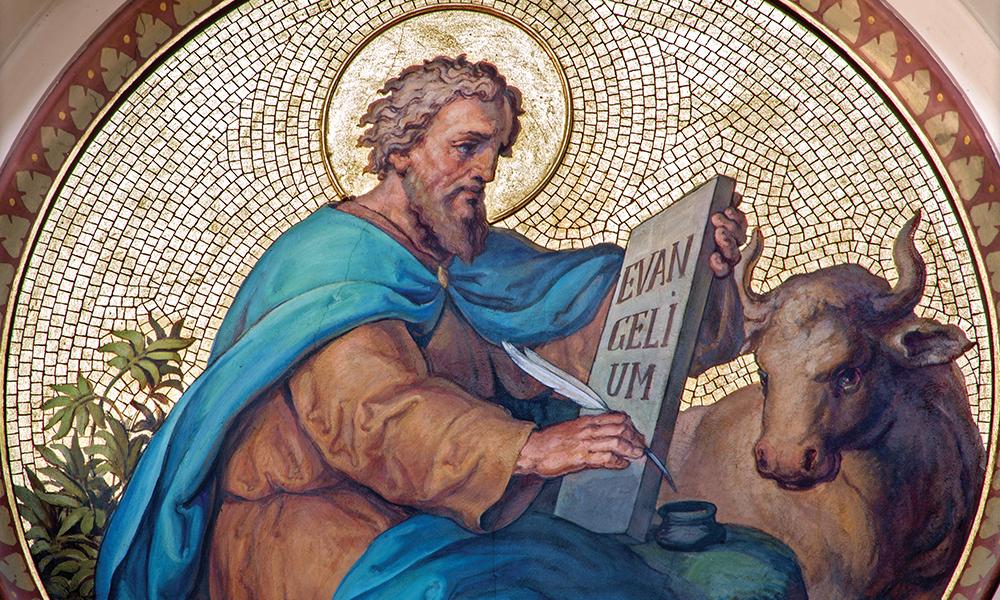
The Gospel of Saint Luke, third and longest of the lot, is particularly interesting for the way it is arranged, with much of the material in the Gospels of Saint Matthew and Saint Mark, but reordered to form a different narrative. At the same time, Luke added new material the other two Gospels don’t contain, such as the infancy narratives of Christ, and his source (because of the detail provided) can be none other than the Blessed Virgin herself, who was certainly well known to the early Church, and probably from the beginning honoured as the Queen Mother. Consequently, this post ends with a picture depicting the legend of Saint Luke, known to have been a Greek physician but also a painter and the creator of the first icon or image of the Blessed Virgin. On with the summary…
I’ve already mentioned the infancy narratives, and Luke gives us some of the great hymns of the early Church, the Benedictus, the Magnificat and the Nunc Dimittis. The first is the song of Zachary, and is recited every morning in the Divine Office:
“‘Blessed be the Lord, the God of Israel; He has visited His people, and wrought their redemption. He has raised up a sceptre of salvation for us among the posterity of His servant David, according to the promise which He made by the lips of holy men that have been His prophets from the beginning; salvation from our enemies, and from the hand of all those who hate us. So He would carry out His merciful design towards our fathers, by remembering His holy Covenant…“
Gospel of S. Luke, 1: 68-72
And covenant/testament is the strong idea throughout the Gospels. The new covenant in the Blood of Christ is founded on the old covenant mentioned here – the covenant made with the people through the Law-giver Moses. The second, the Magnificat, is the song of the bride of the Lord, here Mary and through twenty centuries, Holy Church, as given by the prophet Isaias (61: 10-11). It is recited every evening in the Divine Office:
“And Mary said, ‘My soul magnifies the Lord; my spirit has found joy in God, who is my Saviour, because He has looked graciously upon the lowliness of His handmaid. Behold, from this day forward all generations will count me blessed; because He who is mighty, He whose name is holy, has wrought for me His wonders… He has protected His servant Israel, keeping His merciful design in remembrance, according to the promise which He made to our forefathers, Abraham and his posterity for evermore.”
Gospel of S. Luke, 1: 46-49, 54-55
Again that covenant, that promise made by God with Abraham and solemnised with Moses at mount Horeb. As Christians, we must be very concerned with this heritage of ours from the early Christian Church, which was a Jewish community and adopted the rest of us as non-Jewish converts to Christ. The last of the great hymns in this first part of Luke’s Gospel is the Nunc dimittis, which is the cry of joy of the old man Simeon, who had been awaiting his union with God and had been told that he must first witness the arrival of the Messias:
“Simeon too was able to take him in his arms. And he said, blessing God: ‘Ruler of all, now dost thou let thy servant go in peace, according to thy word; for my own eyes have seen that saving power of thine which thou hast prepared in the sight of all nations. This is the light which shall give revelation to the Gentiles, this is the glory of thy people Israel.’ The father and mother of the child were still wondering over all that was said of him, when Simeon blessed them, and said to His mother Mary, ‘Behold, this child is destined to bring about the fall of many and the rise of many in Israel; to be a sign which men will refuse to acknowledge…'”
Gospel of S. Luke, 2: 28-34
Already, a prediction of the incoming of the Gentiles into the inheritance of the Hebrew people. The speech to Mary continues, and it is obviously something that only she could have recited to Luke. Luke is also different from Matthew and Mark in that he provides more of what we call historical information, wishing to tie his narratives to particular personalities and events. So, we get the precise moment of the commencement of the ministry of Saint John the Baptist:
“It was in the fifteenth year of the emperor Tiberius’ reign, when Pontius Pilate was governor of Judaea, when Herod was prince in Galilee, his brother Philip in the Ituraean and Trachonitid region, and Lysanias in Abilina, in the high priesthood of Annas and Caiphas, that the word of God came upon John, the son of Zachary, in the desert. And he went all over the country round Jordan, announcing a baptism whereby men repented, to have their sins forgiven…”
Gospel of S. Luke, 3: 1-3
Chapter three is then all about Saint John the Baptist, and then chapter four about the the beginning of Christ’s ministry, the multiple exorcisms and other miracles, all of this before He called the Apostles to Him. This happens in chapter five, where the challenges from the religious authorities begin, as they complain to Him that His followers do not fast and pray like the followers of John the Baptist and those of the Pharisees. No, He replied, for He was right there and they would fast and pray when he had left them. Here we find the hints of a renewal of the ancient religion, for Christ says that new structures would have to replace the old ones, or the old ones would burst apart:
“And He told them this parable; ‘Nobody uses a piece taken from a new cloak to patch an old one; if that is done, he will have torn the new cloak, and the piece taken from the new will not match the old. Nor does anybody put new wine into old wine-skins; if that is done, the new wine bursts the skins, and there is the wine spilt and the skins spoiled. If the wine is new, it must be put into fresh wine-skins, and so both are kept safe. Nobody who has been drinking old wine calls all at once for new; he will tell you, The old is better.”
Gospel of S. Luke, 5: 36-39
The old religious observance had become a stricture, and the focus had become on fulfilling it to the letter, without quite understanding the heart of it – detailed observance of the Law had come to precede acts of charity in some cases. New wine-skins were required to contain the new wine of the Gospel message and the charity that underlay that message – a new Church to replace the old church of the Hebrew nation. As these arguments, about such things as the Sabbath observance continued, Christ gained more followers and He now appointed the rest of the Apostles, in chapter six. Where Matthew had presented the Sermon on the Mount with Christ sitting on a high place (Gospel of S. Matthew, chapters five through seven), Luke now presents much of the same material in a Sermon on the Plain, with Christ standing on a level place:
“With them He went down and stood on a level place; a multitude of His disciples was there, and a great gathering of the people from all Judaea, and Jerusalem, and the sea-coast of Tyre and Sidon. These had come there to listen to Him, and to be healed of their diseases; and those who were troubled by unclean spirits were also cured; so that all the multitude was eager to touch Him, because power went out from Him, and healed them all. Then He lifted up His eyes towards His disciples, and said; ‘Blessed are you who are poor; the kingdom of God is yours. Blessed are you who are hungry now; you will have your fill. Blessed are you who weep now; you will laugh for joy. Blessed are you, when men hate you and cast you off and revile you, when they reject your name as something evil, for the Son of Man’s sake…”
Gospel of S. Luke, 6: 17-22
Chapter seven sees Christ making His headquarters at Capharnaum, His centre while in Galilee, probably at the house of Saint Peter. In chapter seven, He validates Saint John’s ministry and condemns the hard-heartedness of the religious leaders of the time. There would always be those who refused to believe, no matter who the prophet would be. They would not be pleased with John’s asceticism and they would not be pleased with His own pastoral charm:
“‘I tell you, there is no greater than John the Baptist among all the sons of women; and yet to be least in the kingdom of heaven is to be greater than he.’ It was the common folk who listened to him, and the publicans, that had given God his due, by receiving John’s baptism, whereas the Pharisees and lawyers, by refusing it, had frustrated God’s plan for them. And the Lord said, ‘To what, then, shall I compare the men of this generation? What are they like? They put me in mind of those children who call out to their companions as they sit in the market-place and say, You would not dance when we piped to you, you would not mourn when we wept to you. When John came, he would neither eat nor drink, and you say, He is possessed. When the Son of Man came, He ate and drank with you, and of Him you say, Here is a glutton; He loves wine; He is a friend of publicans and sinners. But wisdom is vindicated by all her children.”
Gospel of S. Luke, 7: 28-35
The hinge moment of Christ’s ministry in the Gospel of S. Luke, the Transfiguration, takes place very early on, compared to the Gospel of S. Matthew, here in chapter nine. Before it but especially after it, Christ is focused upon His self-sacrifice and is continuously moving toward Jerusalem. He first began to talk about His suffering and death to His Apostles here:
“There was a time when He had gone apart to pray, and His disciples were with Him; and He asked them, ‘Who do the multitude say that I am?’ They answered, ‘John the Baptist; others say Elias; others, that one of the old prophets has returned to life.’ Then He said to them, ‘But who do you say that I am?’ And Peter answered, ‘Thou art the Christ whom God has anointed.’ And He laid a strict charge upon them, bidding them tell no one of it; ‘The Son of Man,’ He said, ‘is to be much ill-used, and rejected by the elders and chief priests and scribes, and be put to death, and rise again on the third day.’ And He said to all alike, ‘If any man has a mind to come my way, let him renounce self, and take up his cross daily, and follow Me. He who tries to save his life will lose it; it is the man who loses his life for My sake, that will save it. How is a man the better for gaining the whole world, if he loses himself, if he pays the forfeit of himself? If anyone is ashamed of acknowledging me and my words, the Son of Man will be ashamed to acknowledge him, when He comes in His glory, with His Father and the holy angels to glorify Him. Believe me, there are those standing here who will not taste of death before they have seen the kingdom of God.’ It was about a week after all this was said, that He took Peter and John and James with Him, and went up on to the mountain-side to pray. And even as He prayed, the fashion of His face was altered, and His garments became white and dazzling; and two men appeared conversing with him, Moses and Elias, seen now in glory; and they spoke of the death which He was to achieve at Jerusalem.”
Gospel of S. Luke, 9: 18-31
It’s now all about the great Sacrifice to crown all the sacrifices of old. So bent is He upon Jerusalem that his Samaritan friends refuse to host him, simply because of their old enmity towards the Jews and Jerusalem. The healing and exorcising ministry of the seventy-two missionaries is introduced by Luke late, in chapter ten, and his final condemnation of Galilee for its bad reception of the Gospel is given here. In chapters eleven and twelve, the condemnations of the rigid religious observances of the Pharisees multiply, and the words of encouragement for the Christians who would face the hostility of these religionists follow:
“‘I will tell you who it is you must fear; fear Him who has power not only to kill but to cast a man into hell; Him you must fear indeed. Are not sparrows sold five for two pence? And yet not one of them is forgotten in God’s sight. As for you, He takes every hair of your head into His reckoning; do not be afraid, then; you count for more than a host of sparrows. And I tell you this; whoever acknowledges Me before men, will be acknowledged by the Son of Man in the presence of God’s angels; he who disowns Me before men, will be disowned before God’s angels. There is no one who speaks a word against the Son of Man but may find forgiveness; there will be no forgiveness for the man who blasphemes against the Holy Spirit. When they bring you to trial before synagogues, and magistrates, and officers, do not consider anxiously what you are to say, what defence to make or how to make it; the Holy Spirit will instruct you when the time comes, what words to use.‘”
Gospel of S. Luke, 12: 5-12
Christ had not, after all, come to make peace with the spirit of the world, but rather to restore all things to God; and this would require a brutal dissension or rebellion against that spirit of the world, which is opposed to the reign of God. His ardent desire for His self-sacrifice is again evident here, and he calls it a new baptism which he would be given. This is made abundantly clear when He declares that those who know what is required by God will have more expected of them by God. That I take to mean as saying that more will be expected of Christians than of anybody else, and more of the priests and bishops than of the laity. For to those to whom more has been given, much more will be required.
“‘Yet it is the servant who knew his Lord’s will, and did not make ready for him, or do his will, that will have many strokes of the lash; he who did not know of it, yet earned a beating, will have only a few. Much will be asked of the man to whom much has been given; more will be expected of him, because he was entrusted with more. It is fire that I have come to spread over the earth, and what better wish can I have than that it should be kindled? There is a baptism I must needs be baptized with, and how impatient am I for its accomplishment! Do you think that I have come to bring peace on the earth? No, believe me, I have come to bring dissension.”
Gospel of S. Luke, 12: 47-53
Chapters thirteen and fourteen are full of classical Christian teaching and fiery criticisms against the rigidity of Jewish observances such as that of the Sabbath. Then, His determination for His upcoming Passion and a terrible condemnation on the priesthood of the Jerusalem Temple:
“And He said to them, ‘Go and tell that fox [Herod], Behold, to-day and to-morrow I am to continue casting out devils, and doing works of healing; it is on the third day that I am to reach My consummation. But to-day and to-morrow and the next day I must go on my journeys; there is no room for a prophet to meet his death, except at Jerusalem. Jerusalem, Jerusalem, still murdering the prophets, and stoning the messengers that are sent to thee, how often have I been ready to gather thy children together, as a hen gathers her brood under her wings, and thou didst refuse it! Behold, your house is left to you, a house uninhabited. I tell you, you shall see nothing of me until the time comes, when you will be saying, Blessed is He that comes in the Name of the Lord.'”
Gospel of S. Luke, 13: 32-35
The goody-goody Pharisees keep getting upbraided for the superficiality of their religion in these chapters, and the resulting hypocrisy of their observance. In chapter fifteen, when they challenge Christ’s familiarity with sinners, He serves them the parable of the lost sheep and, in quick succession, the parable of the prodigal son. The Pharisees who were fond of material riches are served the parable of the rich man and Lazarus in chapter sixteen. The Pharisees who felt that they were particularly close to God for being more observant of the Law of Moses were served the parable of the Pharisee and the publican:
“‘Two men went up into the temple to pray; one was a Pharisee, the other a publican. The Pharisee stood upright, and made this prayer in his heart, I thank thee, God, that I am not like the rest of men, who steal and cheat and commit adultery, or like this publican here; for myself, I fast twice in the week, I give tithes of all that I possess. And the publican stood far off; he would not even lift up his eyes towards heaven; he only beat his breast, and said, God, be merciful to me; I am a sinner. I tell you, this man went back home higher in God’s favour than the other; everyone who exalts himself shall be humbled, and the man who humbles himself shall be exalted.'”
Gospel of S. Luke, 18: 10-14
Utter humility then, and the heart of a child, are requisites for the Saint. On the journey in earnest into Jerusalem, Christ passes through Jericho and there makes two disciples who were likely still known in the early Church, and told their stories to Luke. These were the former blind man, Bar-Timaeus, and the tax-collector Zacchaeus. Now, Christ arranges his entry into Jerusalem and thereafter is based on the mount of olives, just east of the Holy City, whose distant fate he could already see, for she would be entirely destroyed by the Romans within a few decades:
“And as He drew near, and caught sight of the city, He wept over it, and said: ‘Ah, if thou too couldst understand, above all in this day that is granted thee, the ways that can bring thee peace! As it is, they are hidden from thy sight. The days will come upon thee when thy enemies will fence thee round about, and encircle thee, and press thee hard on every side, and bring down in ruin both thee and thy children that are in thee, not leaving one stone of thee upon another; and all because thou didst not recognize the time of My visiting thee.'”
Gospel of S. Luke, 19: 41-44
Now, the antagonism between Christ and the Sadducees, who were the party of the Temple priests, and the scribes intensifies, as He first cleanses the Temple of money-lenders and animal-sellers (who provided the material for the Temple sacrifices), and then tells them the parable of the vine-dressers who would not honour the lord of the vineyard, when he sent servants after servants and finally his own son. They try to find fault with His theology and His knowledge of the Law, but are unsuccessful. Chapter twenty-one provides more information about the destruction of Jerusalem and also of the end of all things. The rest of this gospel book is about the arrangements for the so-called Last Supper, and the following Passion of Christ, His burial and Resurrection. Here is the finale, an abbreviation of the forty days between Resurrection and Ascension, to which Luke would eventually add his second great contribution, the Acts of the Apostles:
“‘So it was written,’ He told them, ‘and so it was fitting that Christ should suffer, and should rise again from the dead on the third day; and that repentance and remission of sins should be preached in His name to all nations, beginning at Jerusalem. Of this, you are the witnesses. And behold, I am sending down upon you the gift which was promised by My Father; you must wait in the city until you are clothed with power from on high.’ When He had led them out as far as Bethany, He lifted up His hands and blessed them; and even as He blessed them He parted from them, and was carried up into heaven. So they bowed down to worship Him, and went back full of joy to Jerusalem, where they spent their time continually in the temple, praising and blessing God.”
This is a difficult one. The Song of Songs is probably the hardest to understand in its place in the canon of Sacred Scripture – even more so than Ecclesiastes. It seems to be a series of love letters thrown back and forth between various couples, with no obvious point. Could it be taken as words between a human soul and the God Who pursues her and draws her continually to Himself? Could it represent the Blessed Virgin herself who, as the spouse of the Holy Ghost, is mystically the Sulamite girl who is the focus of much of this set of poems? Let’s have a look. This book is attributed generally to the Israelite king Solomon, so I’ll stick his picture to this post.
“A kiss from those lips!” Thus it begins, and already it would have youngsters giggling in secondary school. It is well known that King Solomon had a harem of thousands of women. Being one of the most glamorous of the monarchs of the Levant in his time, he would certainly have had. And the women in the harem would probably vie among themselves for the attentions of the king.
“Dark of skin, and yet I have beauty, daughters of Jerusalem. Black are the tents they have in Cedar; black are Solomon’s own curtains; then why not I? Take no note of this Ethiop colour; it was the sun tanned me, when my own brothers, that had a grudge against me, set me a-watching in the vineyards. I have a vineyard of my own that I have watched but ill.”
Song of Songs, 1: 4-5
The king doesn’t seem to have minded having liaisons with foreign women, even from African tribes, whether this is an actual woman of the harem or if some young lady is dreaming the whole thing. The chronicles of the kings demonstrate that many of these marriages were made for diplomatic reasons.
“Still bewildered, fairest of womankind? Nay, if thou wilt, wander abroad, and follow with the shepherds’ flocks; feed, if thou wilt, those goats of thine beside the shepherds’ encampment. My heart’s love, prized above all my horsemen, with Pharao’s wealth of chariots behind them! Soft as doves are thy cheeks, thy neck smooth as coral. Chains of gold that neck must have, inlaid with silver.”
Song of Songs, 1: 7-10
A little later, his affection for this one lady is given with the line:
“A lily, matched with these other maidens, a lily among the brambles, she whom I love!”
Song of Songs, 2: 2
I have seen some of these lines used of the Blessed Virgin, the Virgin most fair, in such devotions as to the Holy Rosary, in the meditations for the final mysteries of the Assumption and the Coronation of the Virgin. So, arise, arise, she must be raised to heaven. She is often called by Catholic tradition the Spouse of the Holy Spirit, or His most decorated habitation.
“I can hear my true love calling to me: ‘Rise up, rise up quickly, dear heart, so gentle, so beautiful, rise up and come with me. Winter is over now, the rain has passed by. At home, the flowers have begun to blossom; pruning-time has come; we can hear the turtle-dove cooing already, there at home. There is green fruit on the fig-trees; the vines in flower are all fragrance. Rouse thee, and come, so beautiful, so well beloved, still hiding thyself as a dove hides in cleft rock or crannied wall. Shew me but thy face, let me but hear thy voice, that voice sweet as thy face is fair.'”
Song of Songs, 2: 10-14
In some of the poetry of the Catholic mystics, such as the great Saint John of the Cross and his Dark Night of the Soul, we hear strong echoes of the pining of the human soul for the God that completes her, and often finding Him elusive, even as in these lines from chapter three.
“In the night watches, as I lay abed, I searched for my heart’s love, and searched in vain. Now to stir abroad, and traverse the city, searching every alley-way and street for him I love so tenderly! But for all my search I could not find him. I met the watchmen who go the city rounds, and asked them whether they had seen my love; then, when I had scarce left them, I found him, so tenderly loved; and now that he is mine I will never leave him, never let him go, till I have brought him into my own mother’s house, into the room that saw my birth.”
Song of Songs, 3: 1-4
Blush we past the intimacy of chapter four and some of chapter five, to find that the gentleman lover has departed once more. In Catholic spiritual theology, we find the Saints often talking about sequences of consolations (union with God) and desolations (God seemingly vanished). This is a strong theme in the teachings of Saint Ignatius Loyola of the Jesuits and also among the works of the great Carmelites of the sixteenth century. The very real sentiment of the presence of God in the soul is often followed swiftly by a strong intimation of his having departed. This departure is what we mean when we talk about the dark night of the soul: the dark night of desolation, when God has apparently left, is experienced for different amounts of time, and for such as Saint Teresa of Calcutta (aka. Mother Teresa) it has lasted decades. After the high intoxication of the presence of God, this period of apparent draught can be extremely painful:
“I rose up to let him in; but my hands dripped ever with myrrh; still with the choicest myrrh my fingers were slippery, as I caught the latch. When I opened, my true love was gone; he had passed me by. How my heart had melted at the sound of his voice! And now I searched for him in vain; there was no answer when I called out to him. As they went the city rounds, the watchmen fell in with me, that guard the walls; beat me, and left me wounded, and took away my cloak. I charge you, maidens of Jerusalem, fall you in with the man I long for, give him this news of me, that I pine away with love.”
Song of Songs, 5: 5-8
The rest of chapter five is a wistful memory of what is lost. The next chapter is the quiet appreciation of the hidden gentleman lover for this one lady, fairest of all, who is searching him out. If we consider that, especially in the several prophecies, God is always given as a husband to the nation of Israel, which is his bride, we may understand why this little book of poetry has been retained in the canon of Sacred Scripture. And this has been carried over by Apostles such as Saint Paul to the Christian Church. And there is further and more personal aspect at which I have hinted earlier: Catholic theology calls every human soul female, in that she is betrothed to her Saviour.
“Who is this, whose coming shews like the dawn of day? No moon so fair, no sun so majestic, no embattled array so awes men’s hearts. But when I betook me to the fruit garden, to find apples in the hollows, to see if vine had flowered there, and pomegranate had budded, all unawares, my heart misgave me… beside the chariots of Aminadab. Come back, maid of Sulam, come back; let us feast our eyes on thee. Maid of Sulam, come back, come back!“
Song of Songs, 6: 9-12
And I shall end with this end of the book. What is more precious than this relationship of love between husband and wife, between God and people, God and individual soul which is sung about throughout the Bible? Ask a Saint of the Church what they would want the most of all. The great Dominican sage, Saint Thomas of Aquino, had this answer: ‘Non nisi Te, Domine.’ None other than Thyself, o Lord. [link]
“Solomon had a vineyard at Baal-Hamon; and when he gave the care of it to vine-dressers, each of these must pay a thousand silver pieces for the revenue of it. A vineyard I have of my own, here at my side; keep thy thousand pieces, Solomon, and let each vine-dresser have his two hundred; not mine to grudge them. Where is thy love of retired garden walks? All the countryside is listening to thee. Give me but the word to come away, thy bridegroom, with thee; hasten away like gazelle or fawn that spurns the scented hill-side underfoot.”
The Greek term deutero-nomos is literally ‘the second law.’ We may be aware that God gave the prophet Moses a law on Mount Horeb/Sinai after the dramatic escape from Egypt; this is outlined at the end of the book of Exodus, and throughout the book of Numbers, and is a first Law for the observance of the people, to train them in the mind of God as they passed through the wilderness of Sinai and wandered for forty years through the wilderness of Seir. But, at the end of the book of Numbers, the people had arrived in the plains of Moab, which were directly opposite the Holy Land, across the Jordan on the East. They had already taken much of Moab by storm and the land there had been partitioned among three of the tribes of the people: Ruben, Gad and part of Manasses.
Now they have prepared an invasion force, which Moses will not lead, since he is to be punished for his bad faith (in the desert of Seir, when the people suffered great thirst, and he joined them in complaining to God) with death in the land of Moab, on mount Nebo. Before he left them, Moses appointed a new captain for them, his disciple Joshua/Iosue, the son of Nun. And he gave them the second law, the deutero-nomos, which would guide their lives while they were no longer wandering in the desert, but settled in the Holy Land that they would soon conquer and distribute to the nine and a half remaining of the twelve tribes. Thus Deuteronomy – the last book of the Torah – that has governed the lives of the Hebrews since then, and the lives of the Jews (and in a different way, the Christians) until now.
The book begins with Moses recapping the history of the people from the time they left mount Horeb in Sinai until their then current location on the plains of Moab. He describes their acclamation of the first Law and their consequent prosperity in numbers, their procession to Cadesh-Barnea and the first discouragement given by the scouts the tribes had sent into the Holy Land to take a measure of the crops, the defences of the Canaanite tribes and the chances of conquest there. This had occasioned the great revolt against Moses’ leadership that resulted in the destruction of significant portions of the tribe of Ruben, among other rebels:
“Faction raised its head in the camp against Moses, against Aaron, the Lord’s chosen priest; and now earth gaped, swallowing up Dathan, overwhelming Abiron and his conspiracy; fire broke out in their company, and the rebels perished by its flames.”
Psalm 105(106): 16-18
Another result of these factions among the people was the punishment of the forty-years wandering through the desert before they could finally make progress towards the lands of Moab (which are across the river Jordan from the Holy Land). By then, the first generation of the people had perished in the wilderness and those who had been children at the Exodus found themselves easily overcoming and exterminating powerful Syrian tribes, led by the Amorrhite kings Sehon of Hesebon and Og of Basan. This resulted in the settlement of the vast Amorrhite country to the east of the Dead Sea, and the country also of Basan to the east of Sea of Kinereth (later Galilee), all rebuilt and given over to those three tribes, Ruben, Gad and half the tribe of Manasses. This history of Moses ends with his exhortation to the people to keep the terms of the second Law, in order to avoid losing the plot and ending in their own destruction as a people. Thus begins the law book, in chapter five of Deuteronomy, lasting until chapter twenty-five. It begins with the Ten Commandments, which are thereafter expanded in content and applied directly to diverse situations. This begins with the famous Shemaa of the Hebrew and the Jewish people, beloved of Christ and the Apostles, and still recited/sung by Jewish communities today in synagogue:
“Listen then, Israel; there is no Lord but the Lord our God, and thou shalt love the Lord thy God with the love of thy whole heart, and thy whole soul, and thy whole strength. The commands I give thee this day must be written on thy heart, so that thou canst teach them to thy sons, and keep them in mind continually, at home and on thy travels, sleeping and waking; bound close to thy hand for a remembrancer, ever moving up and down before thy eyes; the legend thou dost inscribe on door and gate-post.”
Deuteronomy, 6: 4-9
The Jewish people still follow these rules literally, binding portions of the Law upon their foreheads, and upon their doors and gate-posts. The very soul of the Law is complete dedication and devotion to the Lord, the God of Israel, to the exclusion of every other deity that the people would find during the course of their stay in the Holy Land. Obedience of the Law was to be a sign of that devotion and their love for the God Who had claimed them as His own. The Hebrews had not earned the Land in any way; it was a promise made to their ancestors, Abraham, Isaac and Jacob, and the Canaanites are given to have forfeited the land themselves at the command of God, because of their own idolatry and moral perversion. The Land was and is a gift, and a pledge.
“But do not flatter thyself, when the Lord thy God destroys them thus at thy onslaught, do not flatter thyself it was for any merit of thine He gave thee possession of this land thou hast invaded, when in truth it was the wickedness of those other nations that brought them to ruin. No, if thou dost invade and conquer their lands, it is for no merit of thine, no right dispositions of thine; they are to perish at thy onslaught in punishment of their own ill-deeds, and because the Lord must needs fulfil the promise which He made on oath to thy fathers, Abraham, Isaac and Jacob. Be well assured thou hadst no claim to the possession of this fair land the Lord thy God is bestowing on thee, a stiff-necked nation as thou art.”
Deuteronomy 9, 4-6
Avoidance of idolatry (and of the related superstitious practices of soothsaying and divination, in chapter eighteen) was to be the condition of their continued possession of this gift of land, and idolatry was to be utterly condemned and exterminated from their society, to the extent that any idolater would be put to death by an act of the whole people:
“Somewhere, unworthy sons of Israel are seducing their fellow-citizens, bidding them follow the worship of alien gods untried. Careful and anxious be thy search, to find out the truth of the matter; and if it proves that the report was true, and the foul deed has been done, then, without delay, put all the inhabitants of that city to the sword, and destroy it, with all that is in it, even the cattle in its byres. Make a pile in the streets of all its household store, and burn that with the city itself, as forfeit to the Lord thy God. Let it be a ruin for all time, never to be rebuilt.”
Deuteronomy, 13: 13-16
The law book begins with a command to the people as a whole to support the tribe of the Levites (such as through the tithing system in chapter fourteen), which was to receive no inheritance of property, since God Himself was to be their inheritance – they had been appointed for sacred duty, and as a symbol of holiness among the people. Holiness of the people as a whole was to be another result of the second Law, which reiterated the purity conditions of the first Law, which included the dietary regulations. The jubilee year regulations and the great calendar festivals are reproduced in chapters fifteen and sixteen, and a government of judges and magistrates was required to settle disputes; this local government system in the various regions would still be subordinate to a higher court of the priests and Levites at the religious centre of the people (eventually Jerusalem) – a hierarchical system that was erected by Christ in the Christian Church as well. Severe rules are presented against homicide in chapter nineteen and various other offences in chapters twenty-one through twenty-five, including the stoning of unruly children!
“Is there a son so rebellious and unmanageable that he defies his parents’ bidding, and will not brook restraint? Such a son they must bring by force to the city gate, where the elders are assembled, and make complaint to them, ‘This son of ours is rebellious and unmanageable; he pays no heed to our remonstrances, but must ever be carousing, ever at his wantonness and his cups.’ Thereupon the citizens shall stone him to death, so that you may be rid of this plague, and every Israelite that hears of it may be afraid to do the like.“
Deuteronomy, 21: 18-21
Now that is an extreme result of the fourth commandment: Honour thy father and thy mother, etc. This is quickly followed by the curse which Christ accepted upon Himself on our behalf:
“When a man is guilty of a capital crime, and his sentence is to hang on a gallows, his body must not be left to hang there on the gibbet, it must be buried the same day. God’s curse lies on the man who hangs on a gibbet, and the land which the Lord thy God gives thee for thy own must not suffer pollution.”
Deuteronomy, 21: 22-23
There follows, in conclusion to the book of the Law, the command that the people are to surrender the first-fruits of their labour to God, in addition to the tithing system outlined earlier, for the support of the Levites and of foreigners, orphans and widows, with the following prayer:
“I have stripped my house, thou wilt tell Him, of all that I had vowed away, given it to Levite or to wanderer, to orphan or to widow, as Thou badest me; I have not neglected Thy will, or forgotten Thy commands. None of it has been eaten when I was in mourning, or set apart when I was defiled, or devoted to the dead; no, I have obeyed the Lord my God, and done all Thy bidding. Look down, then, from that sanctuary of Thine, that dwelling-place high in heaven, and bless Thy people Israel; bless the land Thou hast given us, that land, all milk and honey, which Thou didst promise to our fathers before us.”
Deuteronomy, 26: 13-15
Once the Holy Land had been settled, a rite of blessing and cursing was to take place in the ancient sanctuary of Shechem, north of Jerusalem. This is described in detail in chapter twenty-seven and is comparable to the anathemas proclaimed against grave sin by the Church. The following description of blessings associated with the fulfilment of the Law and accompanying curses in chapter twenty-eight illustrate well what Saint Paul called the burden of the Law in the letter to the Galatians and elsewhere:
“There is a passage in Scripture which, long beforehand, brings to Abraham the good news, ‘Through thee all the nations shall be blessed;’ and that passage looks forward to God’s justification of the Gentiles by faith. It is those, then, who take their stand on faith that share the blessing Abraham’s faithfulness won. Those who take their stand on observance of the Law are all under a curse; ‘Cursed be everyone (we read) who does not persist in carrying out all that this book of the law prescribes.’“
Galatians, 3: 8-10
That last is Saint Paul actually quoting this part of Deuteronomy. Chapter twenty-eight describes in detail the almost total destruction of the people that would follow a general apostasy from God among them. The remainder of the book deals with the solemn appointment of Joshua/Iosue as captain of the people in the Conquest, the great song of Moses predicting the eventual destruction of the people and their later restoration, and then a final blessing on the tribes by Moses and his death on mount Nebo. The scene is now set for the crossing of the Jordan and the conquest of the Holy Land.
How do you summarise the first and greatest of the books of the Torah? Let’s put it into the following portions: (i) the Creation and the early prehistory, (ii) the story of Abraham, and (iii) the son of Israel and the heads of the tribes
The most significant theme of the first three or four chapters is that God created all things in six ‘days’ as a setting and environment for a genus of creatures to whom He granted His own image: an intellect and a will by which they would govern the Creation around them as an extension of God’s own government of all things, in a joint exercise of love, intellect and will. The primordial garden is a Creation in union with the Holy One, contrasted with the darkness beyond, and the gardener creature Adam was charged with both the upkeep of the Garden (naming the creatures) and and the defence of it from the evil beyond. This is why the Garden is always there, and as Christ once said to his interlocutors: the kingdom of God (the Garden) is all around you. At a crucial point, Adam is given Eve as a helper in this task.
“So the Lord God took the man and put him in His garden of delight, to cultivate and tend it. And this was the command which the Lord God gave the man, ‘Thou mayest eat thy fill of all the trees in the garden except the tree which brings knowledge of good and evil; if ever thou eatest of this, thy doom is death.’ But the Lord God said, ‘It is not well that man should be without companionship; I will give him a mate of his own kind.’ And now, from the clay of the ground, all the beasts that roam the earth and all that flies through the air were ready fashioned, and the Lord God brought them to Adam, to see what he would call them; the name Adam gave to each living creature is its name still. Thus Adam gave names to all the cattle, and all that flies in the air, and all the wild beasts; and still Adam had no mate of his own kind. So the Lord God made Adam fall into a deep sleep, and, while he slept, took away one of his ribs, and filled its place with flesh. This rib, which he had taken out of Adam, the Lord God formed into a woman; and when he brought her to Adam, Adam said, ‘Here, at last, is bone that comes from mine, flesh that comes from mine; it shall be called Woman, this thing that was taken out of Man.'”
Genesis, 2: 15-23
But we know the sad story of their fall. At first, the defence of the garden fails and the enemy enters in the form of the serpent. For some reason, it is the woman who becomes the focus of the serpent’s plan and is convinced that the forbidden fruit will bring her and Adam not death but the knowledge that will make them gods, capable of independence from the Holy One. Following this original sin of pride, the source of eternal life is shut away from humanity, and is only opened again through Christ, in the last chapter of the book of Apocalypse/Revelation. For men cannot be permitted to live forever in a state of sin and separation from God – He will not allow us to be destroyed utterly.
“And now the Lord provided garments for Adam and his wife, made out of skins, to clothe them. He said, too, ‘Here is Adam become like one of ourselves, with knowledge of good and evil; now he has only to lift his hand and gather fruit to eat from the tree of life as well, and he will live endlessly.’ So the Lord God drove him out from that garden of delight, to cultivate the ground from which he came; banished Adam, and posted His Cherubim before the garden of delight, with a sword of fire that turned this way and that, so that he could reach the tree of life no longer.”
Genesis, 3: 21-24
We see in the following story of the fratricide, when the priest Abel’s sacrifice was accepted by God and his brother Cayin in jealousy slays him, the ongoing effect of the separation of humanity from God, and the cry of the Creation that fell with mankind into death and decay and here is forced to swallow the blood of the first wilful murder. As the story continues, we find that the depravity of mankind has grown, and even worsened by the continual involvement of demonic figures (sons of God, or fallen angels), who after that serpent in the garden took the form of monsters and brought forth children by human mothers. This intolerable situation of perversion of the original Creation became the reason first for a diminution of the lifetime of human beings and then for the Flood.
“Time passed, and the race of men began to spread over the face of earth, they and the daughters that were born to them. And now the sons of God saw how beautiful were these daughters of men, and took them as wives, choosing where they would. But God said, ‘This spirit of mine shall not endure in man for ever, he is but mortal clay; his life-time shall be a hundred and twenty years.’ Giants lived on the earth in those days, when first the sons of God mated with the daughters of men, and by them had children; these were the heroes whose fame has come down to us from long ago. And now God found that earth was full of men’s iniquities, and that the whole frame of their thought was set continually on evil; and He repented of having made men on the earth at all. So, smitten with grief to the depths of His heart, He said, ‘I will blot out mankind, my creature, from the face of the earth, and with mankind all the beasts and the creeping things and all that flies through the air; I repent of having made them.'”
Genesis, 6: 1-7
But the story of salvation continued. Long ago, God had told Adam and Eve that the son of a human mother would crush the head of the serpent and destroy his pride. And in the midst of boundless sin and destruction, Noach and his family appear as faithful and devout. They survive the flood, and Noach receives the first covenant-agreement from God.
“God said to Noe, and to Noe’s sons: ‘Here is a covenant I will observe with you and with your children after you, and with all living creatures, your companions, the birds and the beasts of burden and the cattle that came out of the Ark with you, and the wild beasts besides. Never more will the living creation be destroyed by the waters of a flood; never again a flood to devastate the world. This,’ God said, ‘shall be the pledge of the promise I am making to you, and to all living creatures, your companions, eternally; I will set My bow in the clouds, to be a pledge of My covenant with creation. When I veil the sky with clouds, in those clouds My bow shall appear, to remind me of My promise to you, and to all the life that quickens mortal things; never shall the waters rise in flood again, and destroy all living creatures. There, in the clouds, My bow shall stand, and as I look upon it, I will remember this eternal covenant; God’s covenant with all the life that beats in mortal creatures upon earth.’ Such was the pledge God gave to Noe of His promise to all living things.”
Genesis, 9: 8-17
In a long line through Noach’s son Shem, whose family gives us the name Shemites/semites, we find the patriarch of the Hebrews, Abram, a man who is able to place great faith and trust in the Holy One. This allows him to put one foot in the primordial garden of Eden, recovering the original faith of Adam and beginning the reliance upon God that would bless his family and eventually bring from it Miryam, the mother in the flesh of the Holy One, through Whom all the tribes of mankind would be permitted to re-enter into Eden and recover the original purpose for Creation. To provide for this extraordinary plan, Abram is given the Land where his people would be established in the future. Abram is a priest, and he builds an altar to the Promise:
“When Abram had parted from Lot, the Lord said to him, ‘Look about thee, turn thy eyes from where thou art to north and south, to east and west. All the land thou seest I make over to thee, and to thy posterity for ever. And to that posterity I will grant increase, till it lies like dust on the ground, past all counting. Up, then, and journey through the land at thy ease, the length and breadth of it; to thee I will give it.’ So Abram moved his tent, and went to live by the valley of Mambre, at Hebron, and there he built an altar to the Lord.”
Genesis, 13: 14-18
You may have heard it said that the Old Testament is the story of Israel’s ongoing struggle against polytheism and idolatry, and that it was mostly a struggle with self. Because polytheism was the way of men everywhere in ancient times, even as it very much is today and increasingly so. It was a tendency of the chosen People to copy the culture they found themselves surrounded by and re-assume the idolatry that their ancestors had rejected. I believe this was the reason for the several tests of Abram, before the great promises of the Land were made to him in the second great covenant.
“So Abram put his faith in God, and it was reckoned virtue in him. And now God said to him, ‘I AM the Lord, who brought thee out from Ur of the Chaldees, to give thee possession of this land instead.’ And when he asked, ‘Lord God, what assurance may I have, that it is mine?’ the Lord answered, ‘Bring me a three-year-old heifer, a three-year-old she-goat, and a three-year-old ram, and a turtle-dove, and a pigeon.’ All these he brought to him, and cut them in half, laying the two halves of each on opposite sides, except the dove and the pigeon; he did not divide these. The whole day long Abram stood there, driving away the carrion-birds as they swooped down on the carcases; but when the sun set, deep sleep fell upon him, and in the darkness a great dread assailed him. So a voice came to him, ‘This thou must know, that thy race will live as strangers in a land not their own, reduced to slavery and ill-used for four hundred years. But I am there to pass judgement on the nation which enslaves them; and when this is done, they shall come back rich in possessions. For thyself, thou shalt be buried with thy fathers, grown old in comfort; but the fourth generation will have come before these return hither; the wickedness of the Amorrhites has not reached its full term.’ So the sun went down, and when the darkness of night came on, a smoking furnace was seen, a torch of fire that passed between the pieces of flesh. And the Lord, that day, made a covenant with Abram; ‘I will grant this land, he told him, to thy posterity, with its borders reaching up to the river of Egypt, and the great river Euphrates; the land of the Cinites, and the Cenezites, and the Cedmonites, the Hethites and the Pherezites, the Raphaim, too, and the Amorrhites, and the Chanaanites, and the Gergesites, and the Jebusites.'”
Genesis, 15: 6-21
This promise of Land was followed by one of great posterity so that the Holy One made a play on Abram’s name, calling him Ab-raham, or Father-of-many (chapter 17). But the threat of polytheism and idolatry lay continually about, and in the book of Genesis itself, we find that Abraham was taught devotion to the one God gradually, in the course of all those stories about him that we know so well: the gift of Isaac, and the almost-sacrifice of Isaac. Abraham wished to preserve his son from the pollution of idolatry in the Holy Land and sent to Haran in Mesopotamia, to find a wife among his own clan, where the true God was worshipped (although, as one among others). Then, later on, Isaac is called to obedience of the God of his father Abraham, as if asked to choose this Deity over others he was probably surrounded with and attracted to. In fact, he is favoured as a result of Abraham’s devotion, rather than his own:
“From there he went to Bersabee; and here, the same night, he had a vision of the Lord, who said to him, ‘I am the God of thy father Abraham; fear nothing, I am with thee. I mean to bless thee, and give increase to thy posterity, in reward of Abraham’s true service.’ So he built an altar, and invoked the Lord’s name, and pitched his tent there, and bade his servants dig a well.”
Genesis, 26: 23-25
And when it came to Isaac’s twin sons, Jacob and Esau, we find the old problem of infidelity to the God of Abraham, for Esau (to his parents’ displeasure) married outside religion and so risked and endangered the blessing of God on the children of Abraham. Isaac’s reaction was to send Jacob off to find a wife in Mesopotamia, once more. When Jacob had the vision of the staircase going to Heaven, he was in flight from his brother Esau (who meant to kill him), and he renamed the place he was at (Luza) as Beth-El (literally, the house of God), and promised God to be faithful only to Him if He were to protect him from Esau’s rage:
“When he awoke from his dream, Jacob said to himself, ‘Why, this is the Lord’s dwelling-place, and I slept here unaware of it!’ And he shuddered; ‘What a fearsome place is this!’ said he. ‘This can be nothing other than the house of God; this is the gate of Heaven.’ So it was that, when he rose in the morning, Jacob took the stone which had been his pillow, and set it up there as a monument, and poured oil upon it; and he called the place Bethel, the House of God, that was called Luza till then. And there he took a vow; ‘If God will be with me,’ he said, ‘and watch over me on this journey of mine, and give me bread to eat and clothes to cover my back, till at last I return safe to my father’s house, then the Lord shall be my God.’“
Genesis, 28: 16-21
Through tribulation therefore, the ancient patriarchs were led towards devotion to the one God. Later, in chapter 31, we discover that Jacob’s uncle Laban, whose daughters he had married, was himself either a polytheist or a syncretist, for when Jacob travelled back to the Holy Land from Mesopotamia, his wife Rachel smuggled away some of her father’s household gods:
“Upon this, Jacob waited no longer; he mounted his children and wives on the camels, and set out on his journey; taking with him all his possessions, his cattle and all the wealth he had gained in Mesopotamia; he would return to his father Isaac, and the land of Chanaan. Meanwhile, in the absence of her father Laban, who had gone to shear his sheep, Rachel stole his household gods from him. Jacob had given his father-in-law no warning of his flight, and it was not till he and all that belonged to him had gone away, and crossed the Euphrates, and were making for the hills of Galaad, that a message came to Laban, three days too late, Jacob has fled.”
Genesis, 31: 17-22
And then we arrive at the point at which Jacob (now renamed Israel by God) decided to permanently consecrate not only himself but his entire family to the one God at Bethel. The rest of the Old Testament is the story of Jacob’s children falling away from and reconciling themselves to the one God, and that’s one reason for the importance of the story of our Hebrew ancestors in the Faith: we have the same human inclinations to turn away from God, and we must repeatedly turn back towards Him. The picture below is the foundation story for Bethel (the end of Genesis 28).
“In the meanwhile, too, God had said to Jacob, ‘Bestir thyself, go up to Bethel, and make thy dwelling there; there build an altar to the God who revealed himself to thee when thou wast in flight from thy brother Esau.’ Whereupon Jacob summoned all his household; ‘Cast away, he told them, whatever images of alien gods you have among you, purify yourselves, and put on fresh garments. We must leave this, and go up to Bethel; there we must build an altar to the God who listened to me in time of trouble, and escorted me on my journey.’ So they gave him all the images of alien gods that were in their possession, the rings, too, which they wore on their ears, and he buried them under the mastic-tree, close to the town of Sichem. Thus they set out on their journey, and God inspired terror into the hearts of all who dwelt around them, so that they durst not pursue them as they went. Jacob, then, with all his clan, made their way to Luza, which is now called Bethel, and built an altar there. It was he who called the place Bethel, the house of God, because it was there God appeared to him when he was in flight from his brother.”
Genesis, 35: 1-7
So Jacob, the grandson of the faithful Abraham, grew in prosperity as a result of the blessing he inherited from Abraham, and brought his whole family to a high degree of monotheism. From now on in the books, only the Hebrew God is referred to, by Jacob and by Joseph his son. Pious Jews and Catholics refuse to pronounce the ancient name of God, which simply means to be, or I am, and when pronounced in Hebrew sounds like the wind in the trees (the breath of God?). Jews simply replace the Holy Name as they read with Adonai, which means my Lord; a similar use is also found in good Catholic bibles.
The book of Genesis ends with the Joseph story, where we discover the wickedness of Jacob’s sons, and in particular the first three, Ruben, Simeon and Levi. Ruben had had incestuous relations with one of his father’s wives, Bala, and Simeon and Levi had led a genocide on a people called the Hevites, and brought dishonour to the family. Lastly, the whole lot of them had managed to sell their half-brother Joseph into slavery in Egypt and convinced the old man that he had been killed in the wild. Joseph, who inherited the priesthood of Abraham and was finally granted the birthright forfeited by his eldest brothers by his father, is rescued from slavery and becomes a prince of Egypt. His sons Manasseh and Ephraim become the heads of the most prosperous of the twelve tribes of Israel in later days.
“In these years before the famine came, Joseph’s wife Aseneth, daughter of Putiphare that was priest at Heliopolis, bore him two sons. He called his first-born Manasses, Oblivion; God has bidden me forget all my troubles, said he, forget my home. The second he called Ephraim, as if he would say of God, Hiphrani, he has made me fruitful, in this land where I was once so poor. So the first seven years passed, years of plenty for Egypt; and now, as Joseph had prophesied, seven years of scarcity began; famine reigned all over the world, but everywhere in Egypt there was bread to be had. When food grew scarce, there was ever a cry made to Pharao for bread, and still he would answer, ‘Betake yourselves to Joseph, do what he bids you.’“
Genesis, 41: 50-55
The book of Genesis ends with blessings for all the sons but those first three. And the blessing on the fourth son, Judah, is memorable, and this is later very important to the claim of King David to the kingship of all Israel (for David was of the tribe of Judah), and is also central to the Messiah’s claim to kingship of all nations (and all things), as David’s son. Here is the blessing on Judah:
“But thou, Juda, shalt win the praise of thy brethren; with thy hand on the necks of thy enemies, thou shalt be reverenced by thy own father’s sons. Juda is like a lion’s whelp; on the hills, my son, thou roamest after thy prey; like a lion couched in his lair, a lioness that none dares provoke. Juda shall not want a branch from his stem, a prince drawn from his stock, until the day when He comes who is to be sent to us, He, the Hope of the nations. To what tree will he tie his mount; the ass he rides on? The vine for him, the vineyard for him; when he washes his garments, it shall be in wine, all his vesture shall be dyed with the blood of grapes. Fairer than wine his eyes shall be, his teeth whiter than milk.”
Genesis, 49: 8-12
Similar language was later used by King David, when he composed the famous Messianic psalm, Psalm 109 (110), which the priests and Religious recite every Sunday evening at Evening Prayer:
To the Master I serve the Lord’s promise was given, Sit here at my right hand while I make thy enemies a footstool under thy feet. The Lord will make thy empire spring up like a branch out of Sion; thou art to bear rule in the midst of thy enemies. From birth, princely state shall be thine, holy and glorious; thou art my son, born like dew before the day-star rises. The Lord has sworn an oath there is no retracting, Thou art a priest for ever in the line of Melchisedech.”
Psalm 109 (110): 1-4
And Christ Himself quotes this psalm in his famous defence to the Pharisees:
“Then, while the Pharisees were still gathered about Him, Jesus asked them: ‘What is your opinion concerning Christ? Whose son is he to be?’ They told Him, ‘David’s.’ ‘How is it then,’ said He, ‘that David is moved by the Spirit to call him Master, when he says: The Lord said to my Master, Sit on my right hand while I make thy enemies a footstool under thy feet?David calls Christ his Master; how can he be also his son?‘ None could find a word to say in answer to Him, nor did anyone dare, after that day, to try Him with further questions.”
Gospel of S. Matthew, 22: 41-46
Reading the book of Genesis is always easy, because the language used is so simple, and the narrative style is story-telling. The book of Exodus is very similar. I would start to worry when I get to Leviticus, the priestly book; the liturgical detail there is extremely detailed. The picture below is of the patriarch Jacob blessing his grandsons by Joseph, shown on the right. Joseph tried to present them by putting the older boy Manasses on Jacob’s right, so he would get the blessing of the first-born. But Jacob crossed his arms over and gave his right-hand blessing to the younger boy, Ephraim, from whom would come the greatest of the tribes of Israel in her heyday.
Here’s an old prayer-card image of the Apostle Saint Jude, aka. Thaddaeus, better known to us today as the patron Saint of hopeless causes. One of Jude’s letters – a rather short one – sits in our collection in the New Testament. This letter has a common theme that it shares with other early letters, that of the spirit of anti-Christ, which ever threatens belief in Christ, and seeks to draw believers back to the world. In this case though, anti-Christ may have infiltrated the Christian community itself:
“Godless men, long since destined thus to incur condemnation, have found their way secretly into your company, and are perverting the life of grace our God has bestowed on us into a life of wantonness; they even deny Jesus Christ, our one Lord and Master… they pollute nature, they defy authority, they insult august names…. Such men sneer at the things they cannot understand; like the brute beasts they derive knowledge only from their senses, and it serves to corrupt them…Godless and sinners, with how many ungodly acts they have defied God, with how many rebellious words have they blasphemed him! Such men go about whispering and complaining, and live by the rule of their own appetites; meanwhile, their mouths are ready with fine phrases, to flatter the great when it serves their ends. But as for you, beloved, keep in mind the warnings given you long since by the apostles of our Lord Jesus Christ; how they told you, that mocking spirits must needs appear in the last age, who would make their own ungodly appetites into a rule of life.”
Epistle of S. Jude, 4, 8, 10, 15-18
It sounds a little like our present anti-Christian culture, doesn’t it? I think this has always been so. It has been at rare moments in history that the Church has had any sort of moral claim on society in general without the heavy arm of the secular law on her side. But, even then, there will always be those who mock the moral life of the Christians and our beliefs, and do so openly. The solution to living in such a situation is first to build up the spiritual life of the Christian community…
“It is for you, beloved, to make your most holy faith the foundation of your lives, and to go on praying in the power of the Holy Spirit; to maintain yourselves in the love of God, and wait for the mercy of our Lord Jesus Christ, with eternal life for your goal.”
Epistle of S. Jude, 20-21
…and then challenge the rival philosophies and even go so far as to avoid the company of those who refuse to be corrected.
“To some you must give a hearing, and confute them; others you must pluck out of the fire, and rescue them; others again you can only pity, while you shun them; even the outward fringe of what the flesh has defiled must be hateful to you.”
Epistle of S. Jude, 22-23
Right, then, it’s time to see if we remember all the Apostles by name. Let’s set them all out with a memory assist:
B – Bartholomew A – Andrew P – Philip T – Thomas I – Iochanna (John), Iacob (James the Greater), Iacob (James the Lesser), Iuda (Jude Thaddaeus), Iuda the traitor (Judas Ish-kariot) S – Simon (called Peter), Simon the Zealot M – Matthew
The Wisdom of Solomon is traditionally attributed to the king of that name, although Scripture scholars have attempted to throw doubt on that (as Scripture scholars are wont to do). But let’s use the traditional attribution to keep things simple. There are three great themes of the book: (i) the triumph of the Just (often used in Masses of the Dead, when we assume that the Deceased is numbered among the Just); (ii) the glory of personified Wisdom, usually given the aspect of a desirable woman, to be courted and embraced; and (iii) the action of Divine Wisdom in the history of the Israelite nation. Let’s go through the whole thing, in summary fashion.
First, there’s an introduction to Wisdom in chapter one, and then there is the introduction to the Just Man, who is hated by schemers and villains, who wish to destroy him and humiliate him. This terrifying chapter two is brought to life by the treatment of Christ by his tormentors: the Temple priests (and their party of the Sadducees):
“Where is he, the just man? We must plot to be rid of him; he will not lend himself to our purposes. Ever he must be thwarting our plans; transgress we the law, he is all reproof, depart we from the traditions of our race, he denounces us. What, would he claim knowledge of divine secrets, give himself out as the son of God? The touchstone, he, of our inmost thoughts; we cannot bear the very sight of him, his life so different from other men’s, the path he takes, so far removed from theirs! No better than false coin he counts us, holds aloof from our doings as though they would defile him; envies the just their future happiness, boasts of a divine parentage. Put we his claims, then, to the proof; let experience shew what his lot shall be, and what end awaits him. If to be just is to be God’s son indeed, then God will take up his cause, will save him from the power of his enemies. Outrage and torment, let these be the tests we use; let us see that gentleness of his in its true colours, find out what his patience is worth. Sentenced let him be to a shameful death; by his own way of it, he shall find deliverance.“
Wisdom, 2: 12-20
But such Just people, who suffer patiently and treasure Wisdom in their hearts, have a great reward coming their way, because although they seem to have succumbed to weakness, suffering and death, their life is hidden with God in heaven. For about the first time in the Old Testament, we find hints of resurrection, a life beyond the grave and eternal beatitude. This is one of the readings at funeral Masses:
“But the souls of the just are in God’s hands, and no torment, in death itself, has power to reach them. Dead? Fools think so; think their end loss, their leaving us, annihilation; but all is well with them. The world sees nothing but the pains they endure; they themselves have eyes only for what is immortal; so light their suffering, so great the gain they win! God, all the while, did but test them, and testing them found them worthy of Him. His gold, tried in the crucible, His burnt-sacrifice, graciously accepted, they do but wait for the time of their deliverance; then they will shine out, these just souls, unconquerable as the sparks that break out, now here, now there, among the stubble. Theirs to sit in judgement on nations, to subdue whole peoples, under a Lord whose reign shall last for ever. Trust Him if thou wilt, true thou shalt find Him; faith waits for Him calmly and lovingly; who claims His gift, who shall attain peace, if not they, His chosen servants?“
Wisdom, 3: 1-9
Of course, the men of this world do not understand all of this. For them, the death of the Just Man (or Woman), deprived as he is of worldly honours and worldly fortunes, is shameful and an object of contempt and derision. This was the curse that fell upon the Jewish priests after the Resurrection of Christ. Within forty years of the Ascension and the first Christian Pentecost (in AD 70), the Jerusalem Temple was no more and has never been rebuilt.
“Did they know it, the death of the just man, with its promise early achieved, is a reproach to the wicked that live yet in late old age. But what see they? Here is a man dead, and all his wisdom could not save him. That the Lord planned all this, and for the saving of him, does not enter their minds. What wonder if the sight fills them with contempt? And they themselves, all the while, are earning the Lord’s contempt; they themselves, doomed to lie there dishonoured among the dead, eternally a laughing-stock! How they will stand aghast, when he pricks the bubble of their pride! Ruins they shall be, overthrown from the foundation, land for ever parched dry; bitter torment shall be theirs, and their name shall perish irrecoverably.”
Wisdom, 4: 16-19
Chapter five goes further into the rewards of the Just, and we can see in this some of the rewards Christ Himself promises to his disciples and primarily to the Apostles. Wearing crowns and judging the tribes of Israel, receiving very much in return for the sacrifice of family and property, etc.
“It is the just that will live for ever; the Lord has their recompense waiting for them, the most high God takes care of them. How glorious is that kingdom, how beautiful that crown, which the Lord will bestow on them! His right hand is there to protect them, His holy arm to be their shield.“
Wisdom, 5: 16-17
Chapter six begins the picture of Wisdom personified as a desirable woman, to be embraced at all cost, particularly by kings and governors, those who have the care of the people, as King Solomon did.
“The bright beacon of wisdom, that never burns dim, how readily seen by eyes that long for it, how open to their search! Nay, she is beforehand with these her suitors, ready to make herself known to them; no toilsome quest is his, that is up betimes to greet her; she is there, waiting at his doors. Why, to entertain the very thought of her is maturity of the mind; one night’s vigil, and all thy cares are over. She goes her rounds, to find men worthy of her favours; in the open street unveils that smiling face of hers, comes deliberately to meet them.“
Wisdom, 6: 13-17
It is in chapter seven that the author seems to identify himself as Solomon, hence the book’s attribution of authorship. This chapter points back to the beginning of the reign of King Solomon, when legendarily he had requested Wisdom from God as more desirable to him than anything worldly. The next two chapters and this one continues the glorification of Wisdom in the chapter six. Chapter ten begins the final phase of the book, which is an account of the history of the Israelite nation, from Abraham to Moses and the passage through the Red Sea and the period of wandering in the wilderness and being fed with manna, as being facilitated by divine Wisdom. I shall only put three quotes from this section down, but a complete reading would allow for a devotional meditation on the care of God for His people. First, we have Abraham and his nephew Lot:
“And when the nations went their several ways, banded in a single conspiracy of wickedness, of one man’s innocence she still took note; Abraham must be kept irreproachable in God’s service, and steeled against pity for his own child. Here was another innocent man, Lot, that owed his preservation to Wisdom, when godless folk were perishing all around him. Escape he should, when fire came down upon the Cities of the Plain; those five cities whose shame is yet unforgotten, while smoke issues from the barren soil, and never tree bears seasonable fruit, and the pillar of salt stands monument to an unbelieving soul. Fatal neglect of Wisdom’s guidance, that could blind their eyes to the claims of honour, and leave the world such a memorial of their folly, as should make the record of their sins unmistakable! But those who cherish her, Wisdom brings safely out of all their striving.”
Wisdom, 10: 5-9
The rest of the book is about the plagues that were inflicted upon the Egyptians before the flight of the Israelites into the wilderness. The Egyptians are excoriated for their idolatry, and this is not infrequently given to be the cause of their treatment, quite apart from their abuse of the Israelites – worship animals and animals will be used by divine Wisdom to inflict injury upon you. Idolatry is the great foe, the great villain, of the people of the Old Testament, as it is even for us today. It is all too easy to find other things to worship and trust in, than the God Who stands above all.
“For Israel, only a test of their faith; only a father’s correction; for Egypt, as from a king, stern scrutiny and stern doom. Tidings from far away, that racked the Egyptians no less than their own former sufferings; anguish redoubled, as they groaned over the memory of things past! That the same plague of thirst which had tortured themselves should be the source of Israel’s rejoicing! Then indeed they felt the Lord’s power, then indeed they wondered at the revenge time had brought; wondered at Moses, whom their insolence had long ago disinherited, when they exposed him with the other children. Thirst, that had been Egypt’s enemy, had no terrors for the just. So lost to piety were these Egyptians, such foolish reasonings led them astray, that they worshipped brute reptiles, and despicable vermin. And swarms of brute beasts thou didst send to execute thy vengeance, for the more proof that a man’s own sins are the instrument of his punishment. Thy power knows no restraint, the power that created an ordered world out of dark chaos. It had been easy to send a plague of bears upon them, or noble lions; or to form new creatures, of a ferocity hitherto unknown, breathing fiery breath, churning out foul fumes, terrible sparks darting from their eyes, so that men would die of fear at their very aspect, without waiting for proof of their power to do harm.”
Wisdom, 11: 11-20
Chapter sixteen has a beautiful and wonder-filled description of the gift of manna, the material which fell from the sky and was baked into cakes for the people for forty long years. But in chapter seventeen, the gaze of the author returns to the Egyptians, and the whole chapter is about the superstitious and fear-filled darkness that engulfed that idolatrous nation, even as (chapter eighteen now) light shone on the Israelites, being cared for by divine Wisdom:
“Brightest of all, that light shone on Thy chosen people. These neighbours of theirs, heard but not seen, the Egyptians must congratulate on their escape from the common doom, thank them for letting vengeance be, and ask forgiveness for past ill-will. To these Thou gavest, not darkness, but a pillar of burning fire, to be the guide of their unfamiliar journey, a sun, all gracious welcome, that brought no harm. A fitting punishment it was for the Egyptians, this loss of light; fitting that they should be imprisoned in darkness, who had kept Thy own sons in prison; Thy own sons, through whom that Law, which is light unfailing, was to be given to the world.”
Wisdom, 18: 1-4
And on that recommendation of the Torah – the Law of Moses – I shall end this post. What’s the lesson of this book? Treasure Wisdom, embrace Wisdom, and Wisdom will embrace you, protect you, grant you virtues, such as prudence and right judgement. These virtues will colour your life upon earth, and will bring you the reward of the Just – a light-filled future life beyond this world.
“See, where Wisdom has built herself a house, carved out for herself those seven pillars of hers! And now, her sacrificial victims slain, her wine mingled, her banquet spread, this way and that her maidens are dispatched, to city keep and city wall, bidding her guests make haste. ‘Simple hearts,’ she says, ‘draw near me;’ and to all that lack learning this is her cry, ‘Come and eat at my table, come and drink of the wine I have brewed for you; say farewell to your childishness, and learn to live; follow all of you in the path that leads to discernment.'”
We’re still working our way through the Holy Communion chapter of the Gospel of S. John in our gospel readings. You have heard for yourselves how many times the Holy One said in the course of this gospel story, I AM the bread of life, eat Me, I AM the bread of life, eat Me, I AM the bread of life, you must eat me if you want to live eternally… if He must repeat Himself to make His point, so shall we.
So, then, the Church has taught us that we are Temples of the Holy Spirit. Many of us were taught that as seven-year-olds, preparing for Confession and FHC. Now, what’s the first line of the first reading today? ‘Wisdom has prepared herself a house, erected her seven pillars, laid her table for the feast, invited visitors, saying, Come to the feast, leave folly (childishness) and sin, acquire true understanding.’ Seven pillars? Another thing Holy Church has taught us is that there are seven gifts of the Holy Spirit. Let’s list them from the Catechism: (i) Wisdom!, (ii) Understanding!, (iii) and this follows from the first two, Counsel, for we can give counsel to others and receive it from them only according to the wisdom and understanding we have acquired. (iv) Fortitude. If we have acquired wisdom, it is because we have judged it valuable to do so; and something that precious we shall have the fortitude to secure and defend. (v) Knowledge, for true knowledge is acquired at the feet of divine Wisdom, whence we learn about the world from the point of view of its Creator. (vi) Piety, which is an adherence to the traditions of the people and, in our case, the teaching of Holy Church concerning faith, morals and divine worship; we acquire this while seated continually at the feet of the Holy One, in prayer and devotion. And the seventh gift of the Holy Spirit is (vii) the Fear of the Lord – not a fear, that is, that we have of those who can and will destroy us, but the pious fear of a child for their parent, a fear of falling away from the parent and losing their protection, a fear full of trust, a loving fear, a fear that is rewarded with a glimpse at the Sacred Heart, Who declares that He has loved us from all eternity.
So, we are walking Temples of God, and we must carefully support our walls with these seven strong pillars, and the Holy One living within our hearts will find in us His especial delight. Let us clean out the Temple frequently with the devotion of our lives; S. Paul suggests again the second reading… live your lives in an intelligent manner, a rational manner.
“See then, brethren, how carefully you have to tread, not as fools, but as wise men do, hoarding the opportunity that is given you, in evil times like these. No, you cannot afford to be reckless; you must grasp what the Lord’s will is for you. Do not besot yourselves with wine; that leads to ruin. Let your contentment be in the Holy Spirit; your tongues unloosed in psalms and hymns and spiritual music, as you sing and give praise to the Lord in your hearts. Give thanks continually to God, Who is our Father, in the Name of our Lord Jesus Christ;”
Letter of S. Paul to the Ephesians, 5: 15-20 [link]
The Apostle is speaking of the Church living through evil times in the middle of the first century (his own experience), but a quick look at our 2000-year history will show us that the Church always lives through evil times, and despite even the wickedness and profligacy of her very shepherds she survives. Paul says that in wicked days, we should discern carefully what the will of God is. We should know not to fall into hopeless addictions, and seek to improve ourselves daily; and we should be a strong community of prayer – he says that we should be singing psalms and hymns together (even without the organ, he would probably add), and afterwards continue the singing in our hearts. He wants us to be a liturgical people, so that the hymns we sing together on a Sunday, or whenever else we come together for Mass, continue to resound in our hearts for the rest of the week.
But let’s come back to Divine Wisdom and her many living Temples, and her feast which she holds within them…
“‘I Myself am the living bread that has come down from heaven. If anyone eats of this bread, he shall live for ever. And now, what is this Bread which I am to give? It is My flesh, given for the life of the world.’ Then the Jews fell to disputing with one another, ‘How can this man give us His flesh to eat?’ Whereupon Jesus said to them, ‘Believe Me when I tell you this; you can have no life in yourselves, unless you eat the flesh of the Son of Man, and drink His blood. The man who eats My flesh and drinks My blood enjoys eternal life, and I will raise him up at the last day. My flesh is real food, My blood is real drink. He who eats My flesh, and drinks My blood, lives continually in Me, and I in him. As I live because of the Father, the living Father Who has sent Me, so he who eats Me will live, in his turn, because of Me.'”
Here’s the Holy One in the gospel reading saying that Holy Communion is the condition of gaining eternal life with God. And those good Jews about Him sneered at Him and said, How is He going to give us Himself to eat? They have a natural horror of cannibalism, and they don’t yet have the theology of the Eucharist. And yet, even today, there are Christians who look pityingly at us and at our Blessed Sacrament and sneer similarly: Is that what you Catholics think?
And He stands there and says, ‘the eternal life of My Father flows through Me, and you will eat Me if you wish to have it. For I AM the Way and the Life, and nobody comes to the Father except through Me.’
The first letter we have of S. John’s is not a very long letter at all, and has many features from the Gospel of Saint John, such as the theology of light and dark, good and evil and attachment to Christ. It is marvellously black and white, the constant theme being that if you love God, you keep His commandments (also a feature of his Gospel), and that if you don’t keep those commandments and still claim to love God, you’re a bit of a liar.
The whole letter is a warning against idolatry and apostasy, big problems at the time of its writing, because of the increasing vehemence of the persecuting Roman authorities as they attacked the early Christians in various places for ‘impiety’ – that is, the abandonment of the state religion and particularly the worship of Caesar. Simultaneously, the Apostles and early bishops already had to deal with heretics like Simon Magus and the ebionites, and continue the battle against the judaisers who wished all Christians to be circumcised Jews first. Appropriately, John ends his letter with the stern warning:
“Beware, little children, of false gods.”
I John 5: 7
The second preserved letter we have is a really short one. Really short. It has one message: cling to the true faith, there will be false prophets and you will know them when they deny that Christ came in human flesh, this is the spirit of anti-Christ, stay clear of it or lose your heavenly reward.
And there it is. Saint John identifies himself as an elder of a church that is not specified, and he is addressing another church, possibly as the last surviving Apostle. All the others had been by then martyred. He addresses this second church as a lady:
“I, the presbyter, send greeting to that sovereign lady whom God has chosen; and to those children of hers who are my friends in the truth, loved, not by me only, but by all those who have recognized the truth.”
II John 1
The warning about the anti-Christ is as simple as my summary above. Many Christians think that there is a single figure called anti-Christ who will arrive at a particular moment and cause significant damage to the Church. But it seems to me that John is speaking of a spirit of anti-Christ, a rival religious or political movement that specifically denies that the second person of the most blessed Trinity was made incarnate as a human being (as defined by the Creed), in order to bring about our salvation:
“Many false teachers have appeared in the world, who will not acknowledge that Jesus Christ has come in human flesh; here is the deceiver you were warned against, here is Antichrist. Be on your guard, or you will lose all you have earned, instead of receiving your wages in full. The man who goes back, who is not true to Christ’s teaching, loses hold of God; the man who is true to that teaching, keeps hold both of the Father and of the Son.
II John 7-9
Whereas John repeats the teaching that has made his Gospel famous – that we must love Christ by keeping His commandments – his last solemn warning is that we not even entertain the preachers and teachers who bring with them the above anti-Christian idea (that Our Lord has not come in human flesh). We know of historical persons who have presented this idea, and we may know people today who do so. John would call them anti-Christ, and that is terrible. We could compare his warning to those made by Saint Paul to his churches to remain in the traditions he had given them and not attempt to go beyond them, such as this one:
“Stand firm, then, brethren, and hold by the traditions you have learned, in word or in writing, from us.”
II Thessalonians 2: 14
The third preserved letter of S. John is another tiny one, this time from Saint John to a new Christian called Gaius, and it’s interesting to discover that, like Saint Paul, John calls his converts his children. It would seem to have been an early tradition for the Apostles and their successors, the bishops and the priests, to have a parent-children relationship with the young churches. This tradition has continued today, when we call our bishops and priests Father.
“I have no greater cause for thankfulness, than when I hear that my children are following the way of truth.”
III John 4
The first part of the letter is a eulogy to Gaius, who has been very charitable to the church he was at that time serving and other correspondents seem to have informed John about it. The rest of the letter seems to be parish politics: John is sending the letter privately to avoid an obnoxious member of the church called Diotrephes, who seems to have had the power to exclude both John himself and Gaius. I wonder who he was: bishop or priest?
Anyway, we get a flash of the Jewish distinction between good and evil from the first letter of Saint John before the end: choose good and God is with you, choose evil and you’re taking your character from the devil:
“Beloved, choose the right pattern, not the wrong, to imitate. He who does right is a child of God; the wrong-doer has caught no glimpse of him.”
Here’s the slightly controversial Old Testament book called Ecclesiastes, or Qoheleth. The word ecclesia in Greek means ‘assembly’ and, like the other book called Ecclesiasticus, was designed to be read to an assembly. As indeed was most of Scripture. The Hebrew word Q’hal has a similar meaning, but some scholars treat ‘Qoheleth’ as a proper name. My own Bible translation, the Knox version, translates it as Spokesman, which of course is more accurate.
This ‘spokesman’ identifies himself as son of King David and one-time king of Jerusalem and therefore the book is traditionally given to be the work of King Solomon. It is a Wisdom book – it glorifies divine Wisdom and finally the commandments of God. I called it controversial because it is unlike any other book in the Bible in that it hardly ever refers to God, and the few references are often seen by scholars as later additions to engraft this rather odd book into the canon of Scripture. The Spokesman describes himself as a student of human nature and an observer of all things under the sun, the words ‘under the sun’ repeated multiple times throughout. That makes this a book part of a general study of science, and we know that King Solomon was devoted to the study of the natural world, alongside everything else (III Kings, 4: 32-34). So, let’s jump right in with some general observations about this book.
“I was a king in my day, I, the Spokesman; Israel my realm, Jerusalem my capital. And it was my resolve to search deep and find out the meaning of all that men do, here under the sun; all that curse of busy toil which God has given to the sons of Adam for their task. All that men do beneath the sun I marked, and found it was but frustration and lost labour, all of it; there was no curing men’s cross-grained nature, no reckoning up their follies.”
Ecclesiastes, 1: 12-15
The whole book almost is an expression of frustration, and so in a way discouraging. No matter what you do, says the writer, if you practice virtue or live in sin, you still end your life in the same way, with death and the grave. The book evidently has no understanding of the life beyond, reward beyond this life and any pleasure in virtue aside from the life of virtue itself – there is no apparent gain one may have from any action performed here below that can be carried beyond the grave. Therefore, what’s the point in trying? Hence the frustration. A scientist studies systems to discover their ends – what they were intended to produce and enable – and when he cannot find this design result, after long investigation, he lapses into frustration. This is the spirit I find in this book.
“Next, I thought to give the rein to my desires, and enjoy pleasure, until I found that this, too, was labour lost. Wouldst thou know how I learned to find laughter an empty thing, and all joy a vain illusion; how I resolved at last to deny myself the comfort of wine, wisdom now all my quest, folly disowned? For I could not rest until I knew where man’s true good lay, what was his life’s true task, here under the sun.”
Ecclesiastes, 2: 1-4
So, the writer has discovered that even bodily pleasures are vain and unfulfilling, so he took up a severe asceticism and made the study of wisdom his primary activity. But even this seemed fruitless, for it profited nothing to the wise man to transcend the common end of all mortal beings. The writer makes the same observation we’ve seen in books like Job – that evil men thrive and good men suffer – and asks what’s the point of practising virtue at all. We’re all being driven towards the grave anyway, along with every other kind of mortal being.
“I marked, too, how wrong was done instead of right, injustice instead of justice, there under the sun’s eye; and I told myself that God would give judgement one day between the just and the sinners, and all things would reach their appointed end then. I told myself that God’s purpose with the sons of men was to test them …… And that they might see they were only like the beasts … After all, man comes to the same ending as the beasts; there is nothing to choose between his lot and theirs; both alike are doomed to die. They have but one principle of life; what has man that the beasts have not? Frustration everywhere; we are all making for the same goal; of earth we were made, and to earth we must return.“
Ecclesiastes, 3: 16-20
Dear me, it’s all dismal. The Spokesman decides that the best we can do with our lives is to enjoy ourselves while we still can. Does this sound familiar? It’s the song of our nihilist society today. How can this position possibly be drawn into the conventional Hebrew faith of trust in God and the quest for justice? There must be some reason the Fathers have retained this book in our canon of Sacred Scripture. At this point, we discover some good advice for social living:
” Better to be in partnership with another, than alone; partnership brings advantage to both. If one falls, the other will give support; with the lonely it goes hard; when he falls, there is none to raise him. Sleep two in one bed, each shall warm the other; for the lonely, there is no warmth. Two may withstand assault, where one is no match for it; a triple cord is not lightly broken. There is more hope for a wise servant that is in hard straits, than for a dotard king that foresight has none… Look well what thou art doing when thou goest into God’s house; present thyself there in a spirit of obedience. Obedience is far better than the sacrifice made by fools, that are guilty of unwitting sacrilege.”
Ecclesiastes, 4: 9-13, 17
Ahah – the first reference to God. Despite everything – despite the frustration of living – you must keep up the religious observances of the people. The next chapters continues the theme of honouring God, and sounds vaguely similar to Christ warning us not to use many words in prayer, for God knows what we need already. This fifth chapter notes that injustice committed is still watched over by the Eternal One, even it seems to be meaningless to the unjust. There is certainly a moral element here, for although the writer again states that man can do no more than take enjoyment from the work of his hands in this life, he speaks of the futility of hoarding one’s money away when one cannot take it beyond the grave. Could he mean that the wealth should be shared? Anyhow, the ongoing theme is the unfulfilling nature of riches and wealth, what chapter six calls ‘a full mouth and an empty belly.’ Frustration, frustration, all around. What is the point of living and working? Chapter seven begins a typical set of instructions for the wise, which we would recognise from the books of Proverbs and of the Wisdom of Solomon: keep man’s final end always in mind, search for wisdom, control your tongue, accept your station in life as given by God, avoid evil, fear God and cultivate the traditions of the past (piety), etc. It seems that all this must be honoured without looking for a reward, material or otherwise.
“Whatever lies in thy power, do while do it thou canst; there will be no doing, no scheming, no wisdom or skill left to thee in the grave, that soon shall be thy home. Then my thought took a fresh turn; man’s art does not avail, here beneath the sun, to win the race for the swift, or the battle for the strong, a livelihood for wisdom, riches for great learning, or for the craftsman thanks; chance and the moment rule all. Nor does man see his end coming; hooked fish or snared bird is not overtaken so suddenly as man is, when the day of doom falls on him unawares.”
Ecclesiastes, 9: 10-12
Do what you can, while you have the opportunity. For we cannot plan our opportunities. Above all, we do not know when we ultimately lose all opportunities, when death takes us, as it will inevitably do. Chapter ten is a long ridicule of foolishness and idleness in the face of the above advice to use every opportunity. So, the effect so far is the value of the virtue of diligence exercised without the hope of reward. This type of activity performed during youth will stand one in good stead when the illness and infirmity of old age make such things more difficult and frustration increases (as may have happened to the writer himself).
“Only be thy years never so many, never so happy, do not forget the dark days that are coming, the long days, when frustration will be the end of it all. While thou art young, take thy fill of manhood’s pride, let thy heart beat high with youth, follow where thought leads and inclination beckons, but remember that for all this God will call thee to account. Rid thy heart, then, of resentment, thy nature of ill humours; youth and pleasures, they are so quickly gone!”
Ecclesiastes, 11: 8-10
The final chapter speaks of the increasing physical and mental dissipation of old age, and the flight from this life on earth. How would I sum up this book? It is a call to duty towards God and towards society, working while there is still time to work and hoping for no reward for it. If reward does come, take enjoyment of it but do not hoard away, for nobody can take wealth beyond the grave. And all will finally fall before the judgement of God. This is the summary of the book, given by the book itself:
“Fear God, and keep his commandments; this is the whole meaning of man. No act of thine but God will bring it under His scrutiny, deep beyond all thy knowing, and pronounce it good or evil.“
This fourth book of the Torah is mixed material. It begins with a detailed census of the people who found themselves at the foot of Mount Sinai, being entered into a serious covenant with the God of their forefathers. This was done in the second year after the escape from Egypt, and counts a surprising 603,550 fighting men (not counting women and children). The registry also notes the names of tribal and clan chieftains in that early period and the marching order of the tribes, for the community was still mobile, travelling from place to place in the desert. When they ended that march and set up camp, there was a detailed prescription based on compass points for the building of the tribal camps (all this in the first two chapters of the book). Speaking of marches, though – and Numbers is the book of marching through the desert – let’s have a look at the marching psalm:
“Let God bestir Himself, needs must His foes be scattered, their malice take flight before His coming. Vanish the wicked at God’s presence as the smoke vanishes, as wax melts at the fire, while the just keep holiday and rejoice at the sight of Him, glad and content. Sing, then, in God’s honour, praise His Name with a psalm; a royal progress through the wilderness for the God Whose Name tells of omnipotence! Triumph in His presence; he is a father to the orphan, and gives the widow redress, this God who dwells apart in holiness. This is the God who makes a home for the outcast, restores the captives to a land of plenty, leaves none but the rebels to find their abode in the wilderness. O God, when Thou didst go forth at the head of Thy people, on that royal progress of Thine through the desert, how the earth trembled, how the sky broke at God’s coming, how even Sinai shook, when the God of Israel came…! See where God comes, with chariots innumerable for His escort; thousands upon thousands; comes from Sinai to this His sanctuary… Blessed be the Lord now and ever, the God who bears our burdens, and wins us the victory. Give praise to the Lord God in this solemn assembly, sons of Israel! Here is Benjamin, youngest of the tribes, that marches in the van; here are the chieftains of Juda with their companies, chieftains, too, from Zabulon, chieftains from Nephtali. Shew Thy power, O God, shew Thy Divine power, perfect Thy own achievement for us; to honour Thy temple at Jerusalem, kings shall bring gifts before Thee. Tame the wild beasts of the marshes, fierce bulls that lord it over the peaceful herd of nations; down fall they, bringing silver pieces for their ransom. Scatter the nations that delight in war, till Egypt sends hither her princes, till Ethiopia makes her peace with God. Kingdoms of the earth, raise your voices in God’s honour, sing a psalm to the Lord; a psalm to God, who mounts on the heavens, the immemorial heavens, and utters His word in a voice of thunder. Pay honour to God, the God Whose splendour rests over Israel, who holds dominion high among the clouds. Awe dwells about Him in His holy place! The God of Israel gives His people strength and courage; blessed be God!”
Psalm 67(68)
Aaron, the brother of Moses, now appears as the appointed high-priest. The members of their tribe, the Levites, were to be the servants or assistants of Aaron’s family, which alone provided priests for the new rites. The major Levitical clans included those of Gerson, Caath and Merari. The Levites were consecrated in a special way, with all their possessions, as God’s very own, set apart as the first-borns of the entire community. Moreover, they were not to be fighting men, but entirely given over to the care of the sacred: the bearing of the tabernacle and all its associated equipment. The book sets out the details of the dedication gifts given to the tabernacle, for the hallowing of the altar, etc. Let’s put that down here, to provide an idea of what this ancient accounting system looked like. This is only for the tribe of Judah, but chapter seven sees it fit to repeat the lines for every tribe (although the offering was the same in every case):
“The first day, Nahasson son of Aminadab, of Juda, made his offering; a silver dish of a hundred and thirty, and a silver bowl of seventy sicles’ weight, by sanctuary reckoning, both full of flour kneaded with oil for sacrifice; a gold saucer weighing ten sicles, full of incense; a bullock, a ram, and a yearling he-lamb for burnt-sacrifice; a goat to make amends for fault; and for a welcome-offering, two oxen, five rams, five goats, and five yearling he-lambs. Such was the gift of Nahasson son of Aminadab…”
Numbers, 7: 12-17
There is significant ritual material in Numbers. For example, chapter five is a detailed rite for the humiliation of a woman suspected of adultery, and chapter six details the solemn Nazirite vow of consecration that characterised the lives of famous men like Samson, Samuel and John the Baptist, and probably Christ Himself. Chapter fifteen produces general ritual detail for sacrifices, and chapter twenty-eight and twenty-nine provide particular ritual detail for daily, monthly and regular sacrifices. Chapter nineteen details the preparation of lustral water, which was intended to purify people and property that had somehow been defiled, such as by contact with dead bodies.
Moses’ trouble with government of the people becomes evident, as there were far too many of them seeking interpretations of the Law from him continuously and grumbling endlessly about the monotonous nature of the food in the desert and the discomfort of constant travelling. Each group sedition was accompanied by horrible plagues that caused much death among the community, and finally resulted in their wandering through the wilderness until a whole generation of people had passed away. Moses own brother and sister, Aaron and Myriam, at one point challenged his leadership of the people (chapter twelve). With regard to guiding them through the wilderness, Moses had sought the assistance of his brother-in-law, Hobab son of Raguel (Jethro), a professional desert wanderer. Later, seventy-two elders were chosen to share the government of the people with Moses (chapter eleven). The troubles continued to grow. After Moses sent scouts into the Holy Land to provide an account of what could be expected before the Israelite invasion began; almost every returning scout (apart from Caleb and Iosue/Joshua) discouraged the people, who were once more aching to return to the comforts of Egypt. The result was calamitous:
“Then the Lord said, ‘At thy request, I forgive. But as I am the living Lord, whose glory must spread wide as earth, these men who have been witnesses of My greatness, of all the marvellous deeds I did, in Egypt and in the desert, yet must needs challenge My power half a score of times, and disobey My will, these shall never see the land I promised to their fathers; it shall never be enjoyed by those who slighted Me. My servant Caleb was of another mind; he took My part, and I will allow him to enter the land which he surveyed, and leave his race an inheritance there. The sons of Amalec and Chanaan may rest secure in their mountain glens; tomorrow you must move camp, and go back to the desert by the Red Sea.”
Numbers, 14: 20-25
This was not enough for a small band of Levites, who also resented Moses’ leadership of the people. Core/Korah, together with Dathan and Abiron. The whole episode is presented in chapter sixteen, and the dreadful sequel – the seditionists found themselves falling into the depths as the ground opened up beneath their camp – designed to imprint the challenge they had made to the authority of the high-priest in the people’s minds for generations. Other Levites, who wished to usurp the priesthood of Aaron’s family, were incinerated. An unspecified plague followed and the chapter ends with the claim that 14,700 had died in just this altercation. Another rebellion took place when the people had arrived at Cades (Kadesh-Barnea), and were in great thirst – at this point Moses and Aaron themselves lost faith and were cursed to not enter the Promised Land themselves (chapter twenty) – nevertheless, water famously burst forth from a rock when they found a new spring. The final rebellion mentioned here is in chapter twenty-one, where the people tire of the march and call to return to Egypt again; poisonous serpents and (in a story referenced by Christ in the Gospels) Moses fashions the famous bronze serpent to cure them.
The remainder of the book consists of the attempts to arrive at the Holy Land from the south, attempts that were frustrated by native tribes like the Edomites. Other tribes, like the Aradites and the Amorrhites and the people of Basan, were destroyed. Chapters twenty-two through twenty-four tell the tale of the prophet Balaam, representing the fear of the Moabite king, Balac, in whose lands the Israelites were now arriving in copious numbers, swollen with their conquests. By the end of the book of Numbers, the Madianites had been destroyed and Moabite land had been entirely taken by Israel, to the point where the Israelite tribes of Ruben, Gad and Manasses claimed these territories as their own (chapter thirty-two). Moses began a new census (chapter twenty-six) of the people as they camp in the plains of Moab, across the Jordan from Jericho and the Holy Land. Surprisingly, after all the plagues, and the forty-year wandering through the desert, etc. the number of survivors compares favourably with that from the beginning of the book: 601,730 fighting men (excluding women and children).
The final notes cover the people’s itinerary through the wilderness, from Egypt to the plains of Moab (chapter thirty-three), the divinely-provided boundaries of the land of Israel, once the invasions have taken place and a list of men who would one day divide up this conquered land among the tribes (chapter thirty-four). The last chapters of the book deal with the care of the Levites, who alone among all the tribes would not inherit land, their existence being entirely tied up with the care of the sacred, (chapter thirty-five) and marriage being confined to persons within the same tribe, to preserved tribal inheritance of property (chapter thirty-six).
And this is where I’ll stop. It has been a long post, but it’s an eventful book and central to the identity of the Hebrews and the later Jews.
The first letter of the Apostle Saint Peter that is preserved in our New Testament was addressed to Christians of Asia Minor, what is now called ‘Turkey.’ As we can see from the map just below, in Greek times, Pontus and Bithynia were on the north, sitting on the Black Sea, Galatia was the great central area, Cappadocia was on the south-east and Pisidia was west central and south-west. The west of the land-mass was simply called Asia, to distinguish it from Europa, which began across the Bosphorus, the strait connecting the Black Sea with the Mediterranean. Great churches dotted this land, many of them claiming their origin in the missionary work of early Saints like Saint Paul. Some people today seem to doubt that the Peter who wrote this letter was the Apostle himself, who is called the first bishop of both Antioch (which can be seen on the lower right of the map, in upper Syria) and of the mother city of Rome itself and, through his commission from Christ, the prince of the Apostles and the point of unity of the Church. But far greater men than I have accepted this to be the work of the Apostle and I have no problems with the idea. So, onwards!
This letter is absolutely full of gold, and much of it is familiar to those of us who pay attention to the liturgy of the Church, both Holy Mass and the Divine Office of prayer, which are peppered with references to the two letters of Peter that we have. First, there’s the idea of impending tribulations and sufferings to be borne, but to those who persevere the reward and inheritance will be worth it:
“We are to share an inheritance that is incorruptible, inviolable, unfading. It is stored up for you in heaven; and meanwhile, through your faith, the power of God affords you safe conduct till you reach it, this salvation which is waiting to be disclosed at the end of time. Then you will be triumphant. What if you have trials of many sorts to sadden your hearts in this brief interval? That must needs happen, so that you may give proof of your faith, a much more precious thing than the gold we test by fire; proof which will bring you praise, and glory, and honour when Jesus Christ is revealed.”
I Peter, 1: 4-7
The Christian theology of suffering takes shape in this early period of the Church, because of the immense persecution coming not only from the Jewish authorities in the Holy Land, but in waves high and low from the Roman authorities. All this Christ had predicted, and the promise of a reward beyond this world is His, but the Apostles and bishops were strong in their preaching and in their ongoing support of the people, going themselves with the people to trial, torture and execution. They were tested by fire, all together and shine down like gold through the smoke of history. This salvation, this glory beyond the present world, was what the prophets were tirelessly preaching; they were not talking about the endless and tiresome prattling and warfare for possession of the Holy Land that continues today. Oh, no! This world will pass away. What will remain?
“Salvation was the aim and quest of the prophets, and the grace of which they prophesied has been reserved for you. The Spirit of Christ was in them, making known to them the sufferings which Christ’s cause brings with it, and the glory that crowns them; when was it to be, and how was the time of it to be recognized? It was revealed to them that their errand was not to their own age, it was to you. And now the angels can satisfy their eager gaze; the Holy Spirit has been sent from heaven, and your evangelists have made the whole mystery plain, to you instead. Rid your minds, then, of every encumbrance, keep full mastery of your senses, and set your hopes on the gracious gift that is offered you when Jesus Christ appears. Obedience should be native to you now; you must not retain the mould of your former untutored appetites. No, it is a holy God Who has called you, and you too must be holy in all the ordering of your lives; You must be holy, the scripture says, because I am holy.“
I Peter, 1: 10-16
That last bit is from the eleventh chapter of Leviticus, but remember that Christ also said that we should be perfect, as God the Father is perfect (end of the Gospel of S. Matthew, chapter five). All things are indeed passing away, all flesh is as grass: here today, gone tomorrow. What remains is charity. Another name for which is love.
“Purify your souls with the discipline of charity, and give constant proof of your good will for each other, loving unaffectedly as brethren should, since you have all been born anew with an immortal, imperishable birth, through the word of God who lives and abides for ever. Yes, all mortal things are like grass, and all their glory like the bloom of grass; the grass withers, and its bloom falls, but the word of the Lord lasts for ever. And this word is nothing other than the gospel which has been preached to you.”
I Peter, 1: 22-25
And then, there’s a little ecclesiology (church science), where the Apostle says that we are a priestly nation, a holy nation, living stones, built upon a foundation stone once rejected, but from whom we inherit through baptism our being a royal priesthood, a people of God, desired by him, called out of the darkness of the world that surrounds us!
“Draw near to Him; He is the living antitype of that stone which men rejected, which God has chosen and prized; you too must be built up on Him, stones that live and breathe, into a spiritual fabric; you must be a holy priesthood, to offer up that spiritual sacrifice which God accepts through Jesus Christ. So you will find in scripture the words, ‘Behold, I am setting down in Sion a corner-stone, chosen out and precious; those who believe in him will not be disappointed.‘ Prized, then, by you, the believers, he is something other to those who refuse belief; the stone which the builders rejected has become the chief stone at the corner, a stone to trip men’s feet, a boulder they stumble against. They stumble over God’s word, and refuse it belief; it is their destiny. Not so you; you are a chosen race, a royal priesthood, a consecrated nation, a people God means to have for himself; it is yours to proclaim the exploits of the God who has called you out of darkness into his marvellous light.“
I Peter, 2: 4-9
Now that is part of one of the prefaces of Holy Mass that we hear frequently just before the Eucharistic prayer. We see here what it means for Christians to each have a priestly role: it is in offering that spiritual sacrifice, a personal offering of praise and thanksgiving, which is acceptable to God through Christ. This is what makes every Christian a priest. Christ alone makes the offering acceptable, which gives the Church something rather exclusive in this world – she is a chosen race, a consecrated nation, etc. The Apostle accepts the social situation in his time, which included the subjection of some people to others, as something that is yet beyond the Church’s ability to oppose and change, but speaks of the benefits of suffering in subjection, for all suffering is redemptive when offered up to God in prayer.
“Give all men their due; to the brethren, your love; to God, your reverence; to the king, due honour. You who are slaves must be submissive to your masters, and shew all respect, not only to those who are kind and considerate, but to those who are hard to please. It does a man credit when he bears undeserved ill treatment with the thought of God in his heart. If you do wrong and are punished for it, your patience is nothing to boast of; it is the patience of the innocent sufferer that wins credit in God’s sight.“
I Peter, 2: 17-20
And the suffering of Christ is itself a model for that patient suffering Peter expects of the Church. Part of this message includes wives, especially of non-Christian husbands, who must bring about a change in the hearts of their husbands through lives of virtue. I’m sure we can turn that around and speak of Christian husbands who must work for the salvation of their wives.
“You, too, who are wives must be submissive to your husbands. Some of these still refuse credence to the word; it is for their wives to win them over, not by word but by example; by the modesty and reverence they observe in your demeanour. Your beauty must lie, not in braided hair, not in gold trinkets, not in the dress you wear, but in the hidden features of your hearts, in a possession you can never lose, that of a calm and tranquil spirit; to God’s eyes, beyond price.”
I Peter, 3: 1-4
The rest of chapter three is a counsel for virtuous living and encouragement towards suffering on account of virtue, being prepared always to give account of our hope in eternal life, the reason why we are prepared to suffer loss in this world, unlike everybody else. Christ is again the model for this.
“On the upright, the Lord’s eye ever looks favourably; His ears are open to their pleading. Perilous is His frown for the wrong-doers. And who is to do you wrong, if only what is good inspires your ambitions? If, after all, you should have to suffer in the cause of right, yours is a blessed lot. Do not be afraid or disturbed at their threats; enthrone Christ as Lord in your hearts. If anyone asks you to give an account of the hope which you cherish, be ready at all times to answer for it, but courteously and with due reverence. What matters is that you should have a clear conscience; so the defamers of your holy life in Christ will be disappointed in their calumny. It may be God’s will that we should suffer for doing right; better that, than for doing wrong.”
I Peter, 3:12-17
There’s some nice advice about charity in chapter four, such as the wonderful Charity draws the veil (or covers over) over a multitude of sins, and the ungrudging sharing of possessions, where possible. All the acts of mercy and charity of the Church are given opportunity by God Himself, and the performance of these works gives glory to God.
“The end of all things is close at hand; live wisely, and keep your senses awake to greet the hours of prayer. Above all things, preserve constant charity among yourselves; charity draws the veil over a multitude of sins. Make one another free of what is yours ungrudgingly, sharing with all whatever gift each of you has received, as befits the stewards of a God so rich in graces. One of you preaches, let him remember that it is God’s message he is uttering; another distributes relief, let him remember that it is God who supplies him the opportunity; that so, in all you do, God may be glorified through Jesus Christ; to him be the glory and the power through endless ages, Amen.”
I Peter, 4: 7-11
The final chapter of this fine letter is first a charge to the priests of the pronvinces of Asia Minor, that they should be shepherds worthy of the Prince of shepherds. The younger priests to respect the older:
“Be shepherds to the flock God has given you. Carry out your charge as God would have it done, cordially, not like drudges, generously, not in the hope of sordid gain; not tyrannizing, each in his own sphere, but setting an example, as best you may, to the flock. So, when the Prince of shepherds makes Himself known, your prize will be that crown of glory which cannot fade. And you, who are young, must defer to these, your seniors. Deference to one another is the livery you must all wear; God thwarts the proud, and keeps his grace for the humble.”
I Peter, 5: 2-5
That humility and deference to one another is a lesson hard learnt, as we know from the Gospel, when Christ had to repeatedly counsel humility to the Apostles, and at one point said that those in the Christian community who would be masters must commit to being the servants of the others. And now there is that famous counsel about temptation that we hear often in the Sacred Liturgy:
“Be sober, and watch well; the devil, who is your enemy, goes about roaring like a lion, to find his prey, but you, grounded in the faith, must face him boldly…“
I Peter, 5: 8-9
The letter was probably dictated at Rome, which was referred to by early Christians as Babylon in its pagan turmoil. Peter speaks of Saint Mark, the evangelist, who was his assistant for a long time in Rome, before travelling to Alexandria to erect the Coptic Church there.
And I shall end with the end of this letter:
“The Church here in Babylon, united with you by God’s election, sends you her greeting; so does my son, Mark. Greet one another with the kiss of fellowship. Grace be to all of you, friends in Christ Jesus. Amen.“
We continue this weekend with a discourse on the divine providence, because of the readings we have been given. The first reading tells of the prophet Elijah, in flight from the wicked queen of Israel, Jezebel, who wished to have him killed; in distress and on the way to the mountain upon which Moses received the ten commandments, the prophet now is fed miraculously by an angelic figure.
“…when Achab told Jezabel of what Elias had done, how he had put all her prophets to the sword, she sent Elias a message, ‘The gods punish me as I deserve, and more, if by this time tomorrow I have not sent thee the way yonder prophets went.’ Whereupon he took fright, and set out upon a journey of his own devising; made his way to Bersabee in Juda, and left his servant to wait there, while he himself went on, a whole day’s journey, into the desert. Betaking himself there, and sitting down under a juniper tree, he prayed to have done with life. ‘I can bear no more, Lord,’ he said; ‘put an end to my life; I have no better right to live than my fathers.’ With that, he lay down and fell asleep under the juniper tree; but all at once an angel of the Lord roused him, bidding him awake and eat. Then he found, close to where his head lay, a girdle-cake and a pitcher of water; so he ate and drank and lay down to sleep again. But once more the angel of the Lord roused him; ‘Awake and eat,’ said he, ‘thou hast a journey before thee that will tax thy strength.’ So he rose up, and ate and drank; strengthened by that food he went on for forty days and forty nights, till he reached God’s own mountain, Horeb.”
We have also been working the last few Sunday through the sixth chapter of the Gospel of S. John, which is crucial for our understanding of the Holy Eucharist and Holy Communion, for much of its content is reproduced by the Church in the Catechism for that Sacrament. So, to recap the gospel stories of the last few weeks, Christ first manages to feed five thousand men (not counting the women and the children) with five loaves and two fish, the enormity of which miracle causes a large crowd to chase after Him, hoping for a repeat of that miracle, by which they would be able to prove Him to be the great Prophet-king they were expecting to appear, the successor of King David whom they called Messiah. Just before His great exposition of the theology of the Holy Eucharist, Christ sends the Apostles across the sea of Galilee, into a massive storm that they cannot battle, and then walks across the water to them. When he gets to their boat, it’s smooth sailing to Capharnaum, on the western shore of the sea.
Both these miracles are significant to our understanding of Holy Communion – for the miraculous feeding establishes the ability of God to look after our physical bodies while we seek our spiritual food, and the calming of the storm suggest that if we receive and keep our Lord in the boat (through Holy Communion) we should be able to weather any storm that this life may send us. But these stories are also meant by the Evangelist S. John to introduce the rest of the chapter, in which Christ tells a crowd of Jews favourable to Him that they would have to eat Him somehow, to have the life of God flowing through them; the uncomfortable sequel to this doctrine of Christ is that many of His disciples leave His side, just as so very many Christians have abandoned communion with the Apostolic Church in the last five hundred years over the exact same subject. So, let’s have a quick look at the gospel for this weekend.
“The Jews were by now complaining of His saying, ‘I am Myself the bread which has come down from heaven.’ ‘Is not this Jesus,’ they said, ‘the son of Joseph, whose father and mother are well known to us? What does he mean by saying, I have come down from heaven?’ Jesus answered them, ‘Do not whisper thus to one another. Nobody can come to Me without being attracted towards Me by the Father who sent Me, so that I can raise him up at the last day. It is written in the book of the prophets, And they shall all have the Lord for their teacher; everyone who listens to the Father and learns, comes to Me. (Not that anyone has seen the Father, except Him Who comes from God; He alone has seen the Father.) Believe me when I tell you this; the man who has faith in Me enjoys eternal life. It is I Who am the bread of life. Your fathers, who ate manna in the desert, died nonetheless; the Bread which comes down from heaven is such that he who eats of it never dies. I Myself am the living Bread that has come down from heaven. If anyone eats of this bread, he shall live for ever. And now, what is this bread which I am to give? It is My flesh, given for the life of the world.’ Then the Jews fell to disputing with one another, ‘How can this Man give us His flesh to eat?‘ Whereupon Jesus said to them, ‘Believe Me when I tell you this; you can have no life in yourselves, unless you eat the flesh of the Son of Man, and drink His blood. The man who eats My flesh and drinks My blood enjoys eternal life, and I will raise him up at the last day. My flesh is real food, My blood is real drink.'”
The fickle crowd of followers is already smarting because Christ had said that they should have to eat Him to have life. Some of them are from Nazareth, and once again we hear them say, Hey, that’s the Carpenter’s son! What’s so special about Him? But He replies at once that He the Carpenter’s son is the only way to the Father, the only means of resurrection from death. He is the only One Who, coming from the Father, knows about the Father and can therefore communicate knowledge of the Father to those who want it. And, even then, that knowledge is insufficient, for the other necessity for eternal life is an actual eating of the Bread of life. Not any manna in the desert – which Moses fed the Israelites with – or any miraculous banquet of bread and fish – such as they had just had on the Eastern side of the sea of Galilee. No, He says that it is He Who is the living Bread, through Whose flesh the eternal life of God is imparted to the men and women who commune with Him – who receive Him in Holy Communion.
Do we perhaps see the reason for the Incarnation, for God’s becoming man? He had to, in order to raise men and women up from death, through Holy Communion. So, as in the actual practice of the Church, we come to belief in Christ as the way to the Father, make a statement of that belief in the Creed, and then receive Holy Communion, to complete the deal. And we do this every time we come to Holy Mass. Why then aren’t more Catholics with us at Mass?
“No base talk must cross your lips; only what will serve to build up the faith, and bring a grace to those who are listening; do not distress God’s holy Spirit, whose seal you bear until the day of your redemption comes. There must be no trace of bitterness among you, of passion, resentment, quarrelling, insulting talk, or spite of any kind; be kind and tender to one another, each of you generous to all, as God in Christ has been generous to you. As God’s favoured children, you must be like Him. Order your lives in charity, upon the model of that charity which Christ shewed to us, when He gave Himself up on our behalf, a sacrifice breathing out fragrance as He offered it to God. As for debauchery, and impurity of every kind, and covetousness, there must be no whisper of it among you; it would ill become saints; no indecent behaviour, no ribaldry or smartness in talk; that is not your business, your business is to give thanks to God. This you must know well enough, that nobody can claim a share in Christ’s kingdom, God’s kingdom, if he is debauched, or impure, or has that love of money which makes a man an idolater.”
Letter of S. Paul to the Ephesians, 4: 29 – 5: 6 [link]
Once more, S. Paul tells us in our second reading that, once we have achieved this nearness to God (in HC), our behaviour must reflect it, through an extremity of charity to both God and man, so that we become icons of the love of God for mankind. Look at that list of sins and vices S. Paul has drawn up for us. Consider that we are made temples of the Holy Spirit in our baptism, and then you can see why Paul thinks we shouldn’t grieve the Spirit of God Who live within us. Even quarrelling and insults are intolerable to the Holy Spirit.
That must be what Christ meant in the Gospel of S. Matthew when He said, Be perfect, as your Heavenly Father is perfect.
Pictured above is the interior of one of the greatest churches we ever built, the great Hagia Sophia of Constantinople, now unfortunately desecrated multiple times and (as I understand) functioning as a mosque. Hagia Sophia is Greek for Sancta Sapientia in Latin, or Holy Wisdom in English. That church was built to honour the Wisdom of God (of which human wisdom is only a shadow) and it was built appropriately with the greatest skill available in the sixth century to an enormous size. Even today, this gigantic structure is extraordinary to behold and would not be easy to replicate. So much has the Church honoured divine Wisdom in every age.
The first book proper of the Wisdom literature in Holy Scripture (the book of Psalms contains much material that would be classified as Wisdom material, as also does the Torah) is the book of Proverbs. Other books in this series would include the Wisdom of Solomon, Ecclesiastes and large portions of Ecclesiasticus. We know of the repute King Solomon had given to wisdom, as given by the books of the Kings and the Chronicles; the introduction to this book introduces its content as the proverbs of Solomon himself, although there are shorter sections towards the end that are given to other authors, Agur son of Jacé (chapter thirty) and King Lamuel (chapter thirty-one). The book itself begins with nine chapters extolling divine Wisdom, which mankind is meant to possess and make his own, before the proverbs begin properly. And there is the value of tradition, so often despised in our present culture in the West:
“True wisdom is founded on the fear of the Lord; who but a fool would despise such wisdom, and the lessons she teaches? Heed well, my son, thy father’s warnings, nor make light of thy mother’s teaching; no richer heirloom, crown or necklace, can be thine. Turn a deaf ear, my son, to the blandishments of evil-doers that would make thee of their company.”
Proverbs, 1: 7-9
This continues for some few pages, always about children taking lessons from their parents, accepting advice from their elders. Here’s a rather famous bid from chapter six:
“Keep true, my son, to the charge thy father gives thee, nor make light of thy mother’s teaching; wear them ever close to thy heart, hang them like a locket upon thy breast; be these, when thou walkest abroad, thy company, when thou liest asleep, thy safeguard, in waking hours, thy counsellors. That charge is a lamp to guide thee, that teaching a light to beckon thee; the warnings correction gave thee are a road leading to life.”
Proverbs, 6: 20-23
Similar language is used elsewhere in the Bible with respect to the divine Law, so demonstrates the importance of tradition to the Hebrew and Jewish (and by extension, the Christian) communities. There follows these lines and across chapter seven a warning against the temptress that threatens always to seduce and draw the young and inexperienced away from the prudent counsel of their elders. Meanwhile, divine Wisdom is waiting to be had, precious above all else, bringing justice in her wake:
“And, all the while, the Wisdom that grants discernment is crying aloud, is never silent; there she stands, on some high vantage-point by the public way, where the roads meet, or at the city’s approach, close beside the gates, making proclamation. To every man, high and low, her voice calls: ‘Here is better counsel for the simpleton; O foolish hearts, take warning! Listen to me, I have matters of high moment to unfold, a plain message to deliver. A tongue that speaks truth, lips that scorn impiety; here all is sound doctrine, no shifts, no evasions here. No discerning heart, no well-stored mind, but will own it right and just. Here is counsel, here is instruction, better worth the winning than silver or the finest gold; wisdom is more to be coveted than any jewel; there is no beauty that can be matched with hers.“
Proverbs, 8: 1-11
A little later comes the more well-known extract that is often used by the Church in reference to Christ, as the Divine Word that existed from all eternity with the Father, as given by the beginning of the Gospel of Saint John:
“The Lord made me his when first he went about his work, at the birth of time, before his creation began. Long, long ago, before earth was fashioned, I held my course. Already I lay in the womb, when the depths were not yet in being, when no springs of water had yet broken; when I was born, the mountains had not yet sunk on their firm foundations, and there were no hills; not yet had he made the earth, or the rivers, or the solid framework of the world. I was there when he built the heavens, when he fenced in the waters with a vault inviolable, when he fixed the sky overhead, and levelled the fountain-springs of the deep. I was there when he enclosed the sea within its confines, forbidding the waters to transgress their assigned limits, when he poised the foundations of the world, I was at his side, a master-workman, my delight increasing with each day, as I made play before him all the while; made play in this world of dust, with the sons of Adam for my play-fellows.”
Proverbs 8: 22-31
You could imagine this as being in the minds of the Church Fathers who established and defended the Christian creed containing the words, through Him all things were made… And now come the actual proverbs, which are many and not well-organised. There are general themes, such as honesty and the reward for dishonesty (silence is preferably to false talk):
“Lying lips that hide malice, foolish lips that spread slander, what a world of sin there is in talking! Where least is said, most prudence is. Silver refined is the just man’s every word, and trash the sinner’s every thought. The just man’s talk plays the shepherd to many, while the fool dies of his own starved heart.”
Proverbs, 10: 18-21
“Honesty shuns the false word; the sinner disappointment gives and gets. The upright heart is protected by its own innocence; guilt trips the heel of the wrong-doer.”
Proverbs, 13: 5-6
“Better a penny honestly come by than great revenues ill gotten. Heart of man must plan his course, but his steps will fall as the Lord guides them. Speaks king, speaks oracle; never a word amiss. Scale and balance are emblems of the Lord’s own justice; no weight in the merchant’s wallet but is of divine fashioning.”
Proverbs, 16: 8-11
“Out comes bribe from bosom, and the godless man turns justice aside from its course.”
Proverbs, 17: 23
And the value of a good and virtuous wife, the basis of a successful household:
“Crowned is his brow, who wins a vigorous wife; sooner let thy bones rot than marry one who shames thee.”
Proverbs, 12: 4
“It is by woman’s wisdom a home thrives; a foolish wife pulls it down about her ears.”
Proverbs, 14:1
“A good wife found is treasure found; the Lord is filling thy cup with happiness. (A good wife cast away is treasure cast away; leave to fools, and godless fools, the adulterous embrace.)”
Proverbs, 18: 22
“Protected by her own industry and good repute, she greets the morrow with a smile. Ripe wisdom governs her speech, but it is kindly instruction she gives. She keeps watch over all that goes on in her house, not content to go through life eating and sleeping. That is why her children are the first to call her blessed, her husband is loud in her praise: Unrivalled art thou among all the women that have enriched their homes.”
Proverbs, 31: 25-29
And that hard work helps avoid idleness, an evil to be mocked:
“A just man cares for the safety of the beasts he owns; the wicked are heartless through and through. Till field and fill belly; idle pursuits are but foolishness. (Sit long enjoying thy wine, and there is no strong fortress will win thee renown.)”
Proverbs, 12: 10-11
“Idleness finds ever a hedge of thorns in its path; the man of duty walks on unhampered.”
Proverbs, 15:19
“Love not thy sleep, or poverty will overtake thee unawares; the open eye means a full belly.”
Proverbs, 20: 13
“‘What, go abroad?’ says Sloth; ‘there is a lion there; trust me, a lion’s dam loose in the street.’ Sloth turns about, but keeps his bed, true as the door to its hinge. With folded hands the sluggard sits by, too idle to put hand to mouth. Wiser than seven sages is the sluggard in his own thought.”
Proverbs, 26: 13-16
And that children must be disciplined through corporal punishment for their own good, if they be without wisdom:
“Chasten thy son still, nor despair of his amendment; still let the death of him be far from thy thoughts.”
Proverbs, 19: 18
“Boyhood’s mind is loaded with a pack of folly, that needs the rod of correction to shift it.”
Proverbs, 22: 15
“Wisdom comes of reproof, comes of the rod; leave a child to go its own way, and a mother’s care is wasted. Thrive the godless, there will be wrongs a many; but the just will yet see them put down. A son well schooled is rest well earned; great joy thou shalt have of him.”
Proverbs, 29: 15-17
Good Christian behaviour finds its source in the Wisdom literature of the Hebrews. Hence, in this book will have been found prudential decisions on a variety of human behaviours, from the basics of Christian charity (19: 17) to the use of wine and strong drink (20: 1 and 23: 31), to the cultivation of a good reputation (22: 1). Compare Proverbs 13: 7 (some are rich that have nothing) to Christ’s parable of the rich man with a barn full of good things, who will the next day be called from this life; while Proverbs 14:7 presents the human reality that wealth never lacks friends. And compare Proverbs 24: 1 (not for thee to emulate wrong-doers) to Christ’s command that we turn the other cheek. And compare Proverbs 25: 21-22 (hungers thy enemy? here is thy chance; feed him) with Christ’s famous command that we love even our enemies. Wisdom literature was ready fodder for the rabbinic movement of the late Jewish period in the practical application of the Torah, a tradition in which Christ Himself stood as Teacher of the Law. And, of course, the Will of God and His favour trumps every attempt by human beings at obtaining prudent counsel:
“Wisdom is none, prudence is none, counsel is none that can be matched against the Lord’s Will; well armed thy horse may be on the eve of battle, but the Lord sends victory.”
Now, however, let’s get through the excellent book of Job, so useful to those of us who suffer greatly and without remedy, and find it difficult to understand why the good God doesn’t arrive with some relief at the very least, or even complete healing? Doesn’t God wish our happiness at all times? Well, the theme of the book seems to be that suffering and personal calamity can be rather arbitrary, rather than (as the ancient mind was accustomed to think) representing God’s vengeance descending to punish somebody for his or her sins or, indeed, the sins of his or her parents, grandparents, etc. To set up the scene, the book of Job presents the character of Job as specifically Just in the Hebrew sense – one who obeys the Law of God in every respect, and actually goes a step further and attempts to make satisfaction not only for his own personal sins, but for the sins of his children. He strained therefore to keep his family safe spiritually, and always at one with God. And then, when his integrity and his faith were called into question – as lasting only as long as he is prosperous and enjoys divine blessing – God decides to test Job and prove his love. And Job’s first reaction is quite famous; having lost all his possessions and his children, he is patient.
“Then rose up Job, and rent his garments about him; and he shaved his head bare, and fell down to earth to do reverence. ‘Naked I came,’ said he, ‘when I left my mother’s womb, and whence I came, naked I must go. The Lord gave, the Lord has taken away; nothing is here befallen but what was the Lord’s Will; blessed be the Name of the Lord.‘ In all this, Job guarded his lips well, nor challenged with human folly God’s wisdom.”
Job, 1: 20-22
But this was before Job lost his health and could hardly sit up for pain. Then, in great despair, he still defended God before his own wife:
“Little comfort his own wife gave him; ‘What,’ she said, ‘still maintaining thy innocence? Better thou shouldst renounce God, and have done with living.’ ‘Spoken like a foolish wife,’ Job answered. ‘What, should we accept the good fortune God sends us, and not the ill?‘ So well, even now, did Job guard his lips.”
Job, 2: 9-10
For, you see, of one thing Job was certain – he had committed no sin against the Law of God and did not therefore deserve any punishment. Like his friends, who now visited him – Eliphaz the Themanite, Baldad the Suhite, and Sophar the Naamathite – Job still saw all suffering as retribution from God for sins committed. These friends of his seem determined, therefore, to convict Job of sin or at least to get him to confess that he has sinned. This repeated onslaught, that travels across almost the whole book, finally breaks Job’s patient suffering – feeling forced to defend his innocence, he starts to question the justice of God Himself, in inflicting punishment with no provocation. He ends up attempting to, in the words of the Englishman C. S. Lewis, put God in the dock. Let’s summarise the position of Eliphaz the Themanite:
“‘No more we hear now of that fear of God, that life perfectly lived, which once gave thee confidence, gave thee strength to endure! And, sure enough, ruin never fell yet on the innocent; never yet was an upright soul lost to memory. The men that traffic in wrong-doing, that sow a crop of mischief they themselves must reap at last, these I have seen undone; one breath, one blast of the divine anger withers them quite, and they are gone.”
Job, 4: 6-9
It’s an odd thing to say: that those innocent of wrong-doing have never suffered ruin. Really? Which community was he living in? It does go on and on a bit. Job responds by asking the three to convict him of sin, even in the midst of his wretchedness. If he had been guilty of wrongdoing, Job asks rhetorically, why wouldn’t God simply forgive him, a poor little nothing in the grand scheme of things…? Then Baldad the Suhite jumps in and his position is not unlike that of Eliphaz – Job must be guilty of sin, he must make satisfaction, and God will bless him once more, as before.
“‘Can sentence undeserved come from God, unjust award from the Almighty? What if these children of thine committed some fault, and He allowed justice to take its course? For thyself, thou hast but to keep early tryst with God, make thy plea to His omnipotence. Then, if thou comest before Him innocent and upright, He will give thee audience betimes; He will establish thee in thy possessions again, as one that enjoys His favour. A poor thing thy old prosperity will seem, matched with the abundance He gives thee now.'”
Job, 8: 3-7
And Job retorts that he knows all of that, as one who has ever feared God and worked hard to remain innocent and upright. Job now begins to challenge God’s justice, as applied to his particular case. At this point (chapter nine), he doesn’t feel ready to challenge God’s judgement/condemnation, but he wishes to protest the severity of the sentence; he says that the suffering imposed is far in excess of any sin he may have committed. So, what says Sophar the Naamathite? Well, you know it…
“‘Ready to speak should be ready to listen; glibness will not make an innocent man of thee. Must all keep silence till thou hast done; shall none make answer to thy raillery? Still thou wilt have it that all thy dealings are upright, that thy heart, as God sees it, is pure. Would He but speak one word in thy ear, make thee His confidant! Would He but reveal to thee the secrets of His Wisdom, in its ordered variety! Then wouldst thou learn that the penalty He is exacting of thee is less, far less, than thy sins deserve.'”
Job, 11: 2-6
Well, poor Job. He still knows that he has done nothing that warrants punishment according to the Law of God. At this point now, he again calls God forth to defend either Job, or to defend the infliction of suffering upon Job as a punishment. For how is it that an innocent man must suffer when wicked men live in great comfort?
“‘…a man such as I will still cry upon God, and have Him answer the summons; the simplicity of the upright was ever a laughing-stock, and indeed, it is but a rushlight, despised by shrewd and prosperous folk, but it waits its turn. Meanwhile, see how well the robbers store their houses, braving God’s anger, and yet in all things He lets them have their way! Dost thou doubt it? The very beasts will tell thee, the birds in air will be thy counsellors; the secret is known in every cranny of the earth, the fish in the sea will make it known to thee; none doubts, I tell thee, that all this is the Lord’s doing…'”
Job, 12: 4-9
Yes, indeed, God permits evil and the comforts of wicked men. The Bible often mentions this. The question posed here is whether God can be questioned about this as being a matter of His execution of justice. If God permits injustice to exist, is God Himself unjust? Job wants God to answer for this situation, and to answer personally (chapter thirteen). Now, the three visitors, who had at first tried to convict Job of sin, begin to treat Job’s daring to call God to account for injustice. Job calls them out for tossing words around, and not bothering to share or assist with his grief.
“But Job answered: ‘Old tales and cold comfort; you are all alike. Words are but wind; there is no end to them, and they cost thee nothing. Believe me, I could do as well, were you in my case, talk the language of consolation, and mock you all the while, speak of encouragement; my lips should tremble with a show of pity. But here is grief words cannot assuage, nor silence banish; grief that bows me down till my whole frame is lifeless; these furrowed cheeks are the witness of it. And now a false accuser dares me to my face and baits me!”
Job, 16: 1-9
That false accuser is the one Scripture calls Satan. Job is still protesting his innocence and seems to be annoyed that his friends will not accept his claim. He still wants an answer from God for the injustice of his condition. Chapter nineteen is a wonderfully long Leave me alone to his friends, and yet they persist. Eliphaz would have Job repent and fall in with seemingly unjust punishments for sins Job must acknowledge, even if he is convinced that he is innocent (chapter twenty-two). Their position is given altogether by Baldad in the short:
“Then answered Baldad the Suhite: ‘Ay, but what power, ay, but what terrors He wields, who reigns peacefully, there in high heaven! He, the Lord of countless armies, He, whose light dazzles every eye! And shall man, born of woman, win his suit, prove his innocence, when he is matched with God? Dim shews the moon, tarnished the stars, under His eye; and what is man but waste and worm in his presence?“
Job, 25
So, should we be permitted to question God in the matter of undeserved suffering? We now have Job’s final address, calling upon God to account for his suffering.
“‘As sure as He is a living God, He, the Omnipotent, who so refuses me justice, who makes my lot in life so bitter; while life is in me, while He still grants me breath, never shall these lips justify the wrong, never this tongue utter the lie! Gain your point with me you shall not; I will die sooner than abandon my plea of innocence. That claim, once made, I will not forgo; not one act in all my life bids conscience reproach me. Count him a knave that is my enemy, every detractor of mine a friend of wrong!'”
Job, 27: 2-7
Chapter twenty-eight is a discourse on divine Wisdom, and the joy of acquiring it/her, such as we have already had from the Wisdom of Solomon and parts of Ecclesiasticus. But the most compelling part of this final discourse of Job’s is his self-defence, as he describes his works of mercy in detail (chapter thirty-one). This then is how he ends:
“‘O that my cause might be tried; that He, the Almighty, would grant my request, that He, my judge, would write my record down; how proudly I would bear it with me, shoulder-high, wear it as a crown! I would proclaim it wherever I went, fit for a king’s eyes to read. Can these lands of mine bear testimony against me, can their furrows tell a sad tale of harvests enjoyed, and no price paid for them, of labourers cruelly treated? Then thistles for wheat, thorns for barley may it yield me.“
Job, 31: 35-40
I still don’t think that Job has ever yet committed any act of disrespect toward the God he loves. He remains faithful, in spite of everything. What he does of course is declare that he is innocent (which he is, as per the story), that his reduced condition is an unfair and unjust reward for his life of virtue, and he asks Almighty God to account for this by defending this treatment of Job. Job knows that all things happen because God permits them, so God is ultimately responsible for Job’s state in life, and Job wants to know why he has suffered so much. Daring he is, but has he committed a sin? The suddenly-introduced Eliu the Buzite son of Barachel certainly thinks he has. Appearing out of nowhere in chapter thirty-two, Eliu condemns the three friends of Job as not having treated Job’s arguments well, or his challenge to God. Eliu seems to me to be the voice of the Old Testament when he says that Job cannot expect to match himself against God in any type of court scene.
“‘But there is no substance in thy plea; I tell thee, man cannot be matched with God. What, wouldst thou complain that He does not meet these charges of thine? Know, then, that God warns us once, but does not repeat His warning. Sometimes in visions of the night, when deep sleep falls upon men as they lie abed, He speaks words of revelation, to teach them the lesson they need. This is one means by which He will turn a man away from his designs, purge him of his pride; and so the grave is disappointed, the sword misses its prey.'”
Job, 33: 12-18
So, all imposed suffering is instructive, to save men from a spiritual death. This was the lesson given us by the writers of the chronicles and by the prophets, especially during and after the exile of the Judaites to Babylon. So, Job, however innocent he may be, must be able to draw instruction from this episode of his life, rather than plead his innocence before God. Again, see this:
“‘Listen to me, then, discerning hearts! From God, the Almighty, far removed is all wickedness, is every thought of wrong; He treats men only as they deserve, giving due reward to each. What, should Almighty God pervert justice by condemning the innocent? Is the care of the wide earth entrusted to some other; is not the Maker of the world Himself the world’s judge? He has but to turn His thought towards men, reclaiming the spirit He once breathed into them, and all life would fail everywhere; mankind would return to its dust.'”
Job, 34: 10-15
Eliu is uncovering here the flaw in Job’s approach – that he is calling God to account – and Eliu calls this blasphemy. The rest of his address is a glorification of Almighty God. But chapter thirty-eight is what we’ve all been waiting for, for God appears in a whirlwind to answer Job’s summons. Job seems to still be in the divine favour, for God calls him out for his daring, but still does show up in all His Majesty. God in a lengthy discourse declares that Job doesn’t have the big picture, because he is not intimately involved in the working of the Creation, as God is. God repeats what Eliu already has – that no mortal man dares match himself with God and survive the ordeal. And Job promptly returns to his humble patience at the beginning of the book:
“All this the Lord said to Job, and added besides, ‘What is this? One that would match himself with God, so easily put down! Nay, God thou didst challenge, God thou must refute.‘ And thus Job made the Lord answer: ‘So vain a pleader, I have no suit to make; finger on lip I will listen. Once and again I have spoken the word I would fain unsay; more I dare not.'”
Job, 39: 31-35
Job’s is finally the triumph, for he is vindicated in his innocence, and by God Himself, as he had requested, when accused of sin by his three friends. He is convicted only of his foolishness in calling God to account, but his humble retraction has made satisfaction. His friends (but not Eliu) are condemned for speaking badly about God, probably about the way divine Justice is administered. The books ends with Job being restored to prosperity in family and possessions. And like other similar books, like Tobit and Judith, he lives happily ever after, to long life.
The book of Esther contains a charming and, to be honest, a little frightening story about a devastating pogrom against the Jewish exiles in Mesopotamia, and throughout the vast Persian empire, probably also including the valiant band of returnees to Juda and Jerusalem, who were in the process of restoring the City and the Temple there. What is charming is the story of the Jewess Esther, Mordecai’s kinswoman (cousin), who finds herself selected to replace the Persian high queen Vasthi, and so able to influence the king himself, at a moment that was crucial for the survival of her people the Jews. Thus did Esther become one of the greatest of the heroines of the Hebrew nation, and the inspiration behind the most colourful of the festivals in the Jewish calendar – Purim – in about February time. What is frightening is the vengeance demanded by even Esther (which is a little surprising even for the Persian king, her husband) against the enemy of the Jewish people, the Macedonian Aman (aka. Haman), and his entire family, following which the Jews take revenge upon their enemies, killing thousands all over the Persian empire.
Anyway, here are a few clips. The first chapter is about the removal of the old queen Vasthi, who had refused to appear at the order of the king, who wanted to show her off to his visitors. The second chapter introduces Mardochaeus (aka. Mordecai) and his kinswoman Edissa (aka. Esther). She was acquired by the king to replace Vasthi, and he was yet unware that she belonged to the Hebrew nation. Meanwhile, Mardochaeus, as Esther’s protector, hung about outside the gates of the royal palace, where he was able to find out about an insurrection against the king, possibly instigated by Aman himself, who by this time had squirmed his way into being the chief advisor to the king.
“And it was while Mardochaeus haunted the palace gates that two of the royal chamberlains, Bagathan and Thares, door-keepers both at the palace entry, grew disaffected, and would have made a murderous attack on the king’s person. Mardochaeus came to hear of it, and told queen Esther; she, naming him as her informant, told her husband. The charge was investigated, and found true; the two conspirators were hanged, and the circumstance was put on record, being entered in the king’s own archives.“
Esther, 2: 21-23
Mardochaeus was noted for his loyalty to the king, but nothing more is done in his regard. The third chapter tells of the ascendancy of Aman son of Amadathi, who must have been planning to use this to overthrow the king. The loyal Mardochaeus was something of a spanner in the works and had to be gotten rid of. Aside from his straightforwardness, Mardochaeus also refused to bend knee to anybody but the eternal God. And Aman liked to be genuflected to, apparently. And thus began his attack on all Jews, for refusing to thus give divine worship to earthly powers.
“Aman, when he heard their story, and proved the truth of it for himself, that Mardochaeus would neither bow nor bend, fell into a great passion of rage; and, hearing that he was a Jew, he would not be content with laying hands on Mardochaeus only; the whole race, throughout all Assuerus’ dominions, should be brought to ruin for it. It was in the twelfth year of the reign, in Nisan, the first month of it, that the lot (which the Hebrews call Pur) was cast into the urn in Aman’s presence, to determine the day and month when he would make an end of the Jews; and the month chosen was the twelfth month, Adar.”
Esther, 3: 5-7
And here we seen the origins of the festival of Purim, for Aman had decided by pur (lot, plural purim) when the Jews would be exterminated. And, using his high position, he managed to get the royal seal on his genocidal warrant. In chapter four, Esther discovers that imminent disaster threatens her people and Mardochaeus warns her that she even would not be exempt from the measures to be taken. Meanwhile nobody could see the king without being invited by him. Esther now mustered all her courage for a surprise visit, which would mean almost certain death for her. Fortunately, she had uncommon charm.
“The third day came, and Esther put on her royal robes; and, so clad, made her appearance before the king’s palace, within the royal (that is, the inner) court. There sat the king on his throne, in the palace council chamber, facing the main door; he saw Esther, his queen, standing there without, and the sight of her won his heart. Out went the golden sceptre he bore, and as she drew near to kiss the tip of it, ‘Why, Esther,’ said he, ‘what is thy errand? Ask me for half my kingdom, and it is thine.’ ‘My lord king,’ she answered, ‘do me the honour of dining with me to-day; I have a feast prepared; and bring Aman with thee.’ The king, without more ado, had Aman summoned to wait, there and then, on Esther’s pleasure; and both of them went to the feast she had prepared.”
Esther, 5: 1-5
At this point, Esther was probably bent already upon the destruction of Aman, but she had to be very careful indeed, for he was high in the estimation of the king. And she knew her own place. She had evidently planned to draw both the king and Aman into a position of comfort before making her plea for the Jews. It was at the second feast she had arranged for the two that she dropped the bombshell. But, in his false sense of security, Aman prepared to harass the man he hated, the man who could spoil his plans:
“‘More,’ [Aman] said; ‘it was but this day queen Esther gave the king a banquet, and would have me and none other for his fellow-guest; to-morrow I must dine with her again, with the king present.’ ‘All this is mine,’ he said, ‘and all this is nothing to me, while I yet see Mardochaeus sitting there at the palace gate.’ But they had a remedy for this, his wife Zares and those friends of his. ‘Have a gallows made, fifty cubits high, so that tomorrow thou canst bid the king have Mardochaeus hanged on it. Then thou mayst go light-hearted enough, to feast with the king.’ This counsel Aman liked well, and he gave his men orders to have a high gallows in readiness.”
Esther, 5: 12-14
Unfortunately for him, that very night, by some divine power, the king was reminded of Mardochaeus’ spirit of loyalty to him and he realised that the man had not been rewarded for it. In a wonderful display of Old Testament humour, Aman, as the second in command, was given the task of rewarding the man that he had shortly before been planning to have hung. Still humiliated by this, he was carried off to Esther’s second feast, where he met his doom.
“The king rose angrily from his place, left the banqueting-room, and went out to walk in the garden, among his trees. With that, Aman rose too, intent on winning his pardon from queen Esther; doubt he might not that the king was bent on his undoing. Thus minded, he fell sprawling across the couch on which Esther lay; and so the king found him, when he returned from garden to banqueting-room. ‘What,’ cried he, ‘will he ravish the queen before my eyes, and in my own house?’ And before the words were out of his mouth Aman was gagged and blindfold. And now Harbona, one of the chamberlains in attendance on the king’s person, came forward; ‘What of the gallows,’ said he, ‘fifty cubits high, that stands there by Aman’s house, ready for Mardochaeus, that saved the king’s life?’ ‘Let Aman himself hang on it,’ said the king. So Aman was hanged on the gallows he had raised for Mardochaeus; and with that, the king’s angry mood was appeased.”
Esther, 7: 7-10
Unfortunately, the measures set in place by Aman could not be rescinded by the king. Rather, because of the laws of the Persian people, they had to be remedied. Instead of calling off the attack on the Jews, the king empowered them to defend themselves against their attackers (chapter eight). The date set by Aman, arranged by lot, now arrived: the thirteenth day of Adar (last month of the Hebrew year). The Jews, now armed for battle, for two days put the fear of God into their enemies. Meanwhile, Mardochaeus, newly honoured by the king for his forgotten loyalty, established the feast of Purim.
“So Mardochaeus wrote to all the king’s Jewish subjects, near and far, setting all this out and bidding them observe both the fourteenth and the fifteenth, year by year, as the days of Jewry’s vengeance, when weeping and lament gave place to mirth and gladness. There was to be feasting on both days, and on both days rejoicing; dainties should be exchanged, and gifts made to the poor. So the will they then had and the orders Mardochaeus sent became a yearly rite; to recall how Amadathi’s son, Aman the Agagite, thought to vent his enmity against the Jews by murderously destroying them, and how he consulted Pur, the lot; how Esther sought audience with the king, praying for a royal decree that should thwart his design, and make his malice fall on his own head; and how Aman and his sons went to the gallows. This feast has ever been known as the feast of Purim, because of Aman’s lot-taking.”
Esther, 9: 20-26
And that is the story of Esther. The rest of the book, in my Knox translation, contains fragmentary texts that have been collected from various versions of the book of Esther. The Greek version of the Septuagint, which comes from a different Hebrew tradition than the versions known to the Jews, contains more material, which has been passed on to us through the Latin translations. Thus, chapter ten tells of a dream Mardochaeus had early on, which foretold the success of Esther. Chapter thirteen reproduces an edict of the king that condemned the Jews and the prayer of Mardochaeus on behalf of his people. Chapter fourteen contains Esther’s own prayer for her people, which sounds very much like sections of Baruch. The final chapter is the king’s edict cancelling the attack on the Jews and restoring their freedom to them.
It’s the feast day of the Transfiguration! So, let’s get through the second letter of the Apostle Saint Peter, sent much later in his ministry as bishop of Rome, for he hints at his upcoming death. The Apostle here demonstrates a high theology of grace, the benefit on the Church of her embracing the God-Man, whose humanity is the channel for all of us of the immense bounty of God’s grace, which manifests in us a life of virtue:
“See how all the gifts that make for life and holiness in us belong to His divine power; come to us through fuller knowledge of Him, whose own glory and sovereignty have drawn us to Himself! Through Him God has bestowed on us high and treasured promises; you are to share the divine nature, with the world’s corruption, the world’s passions, left behind. And you too have to contribute every effort on your own part, crowning your faith with virtue, and virtue with enlightenment, and enlightenment with continence, and continence with endurance, and endurance with holiness, and holiness with brotherly love, and brotherly love with charity.”
II Peter, 1: 3-7
The graces we receive and the virtues they produce in turn enable us to grow in our knowledge of Christ and of God. The first part of the letter is therefore a rousing call to the life of virtue. Very touching here, as the Apostle speaks of his life now coming to an end, is his memory of the glory of Christ, that he and the two sons of Zebedee had witnessed on the mountain at the Transfiguration. This is the voice of the Apostles as witnesses, when they tell us what they saw and heard and that we cannot see and hear ourselves.
“We were not crediting fables of man’s invention, when we preached to you about the power of our Lord Jesus Christ, and about His coming; we had been eye-witnesses of His exaltation. Such honour, such glory was bestowed on Him by God the Father, that a voice came to Him out of the splendour which dazzles human eyes; ‘This,’ it said, ‘is My beloved Son, in Whom I am well pleased; to Him, then, listen.’ We, His companions on the holy mountain, heard that voice coming from heaven, and now the word of the prophets gives us more confidence than ever. It is with good reason that you are paying so much attention to that word; it will go on shining, like a lamp in some darkened room, until the dawn breaks, and the day-star rises in your hearts.”
II Peter, 1: 16-19
Yes, indeed, the Apostolic account of the Transfiguration is one of the most memorable accounts in the Gospels. Following this claim of true Apostolic witness, the Apostle reminds us that there exists false witness as well, men who claim to know more about Christ than His own Apostles. We’re all too familiar with people today who claim to know better than Holy Church what Christ would think about this, that and the other. Thus, the Apostle says:
“So, among you, there will be false teachers, covertly introducing pernicious ways of thought, and denying the Master who redeemed them, to their own speedy undoing. Many will embrace their wanton creeds, and bring the way of truth into disrepute, trading on your credulity with lying stories for their own ends. Long since, the warrant for their doom is in full vigour; destruction is on the watch for them. God did not spare the angels who fell into sin; he thrust them down to hell, chained them there in the abyss, to await their sentence in torment.”
II Peter, 2: 1-4
God allows even His angels to rebel against Him and their punishment is instantaneous. What then of the men who dare the same type of rebellion? Or try to justify sinful lifestyles, while sneering at the teaching of the Church, which they do not understand.
“Such men, like dumb creatures that are born to be trapped and destroyed, sneer at what they cannot understand, and will soon perish in their own corruption; they will have the reward their wickedness has deserved. To live in luxury while the day lasts is all their pleasure; what a stain they are, what a disfigurement, when they revel in the luxury of their own banquets, as they fare sumptuously at your side! Their eyes feast on adultery, insatiable of sin; and they know how to win wavering souls to their purpose, so skilled is all their accursed brood at gaining its own ends.“
II Peter, 2: 12-14
The Apostle is speaking here not generally about worldly men, but particularly about Christians who, having been baptised, have fallen back upon their old lives. Here’s some language that we would be less likely than Saint Peter to use of Catholics who have fallen away from the Faith:
“That they should have been rescued, by acknowledging our Lord and Saviour Jesus Christ, from the world’s pollution, and then been entangled and overpowered by it a second time, means that their last state is worse than the first. Better for them, never to have found their way to justification, than to have found it, and then turned their backs on the holy law once handed down to them. What has happened to them proves the truth of the proverb, The dog is back at his own vomit again. Wash the sow, and you find her wallowing in the mire.”
II Peter, 2: 20-22
The use of the words ‘their last sate is worse than the first’ takes us back to the horrifying picture Christ Himself in the gospels drew of the exorcised soul that was re-inhabited by the devil that had once possessed it, but this time he has brought some of his fellows.
“‘The unclean spirit, which has possessed a man and then goes out of him, walks about the desert looking for a resting-place, and finds none; and it says, I will go back to my own dwelling, from which I came out. And it comes back, to find that dwelling empty, and swept out, and neatly set in order. Thereupon, it goes away, and brings in seven other spirits more wicked than itself to bear it company, and together they enter in and settle down there; so that the last state of that man is worse than the first.‘”
Gospel of S. Matthew, 12: 43-45
At the end, the Apostle deals with the accusation that the Church does not know the exact moment of the return of Christ, and the associated mockery. He states that time means nothing to God, and suggests perhaps that the question of when and how should not concern us as much as should the certainty of the arrival of that dreadful Day of the Lord and the perfection that we should struggle to acquire in the waiting.
“But one thing, beloved, you must keep in mind, that with the Lord a day counts as a thousand years, and a thousand years count as a day. The Lord is not being dilatory over His promise, as some think; He is only giving you more time, because His will is that all of you should attain repentance, not that some should be lost. But the day of the Lord is coming, and when it comes, it will be upon you like a thief. The heavens will vanish in a whirlwind, the elements will be scorched up and dissolve, earth, and all earth’s achievements, will burn away. All so transitory; and what men you ought to be! How unworldly in your life, how reverent towards God, as you wait, and wait eagerly, for the day of the Lord to come, for the heavens to shrivel up in fire, and the elements to melt in its heat!“
II Peter, 3: 8-12
And that is a good point to end. The letter is a call to virtue and to adherence to the Church, and so to work towards acquiring the promises made to her by Christ.
This Gospel is my favourite of the four, if I am allowed to pick a favourite. It is unlike the others because its very construction is unique. It provides a more personal description of Christ, which is appropriate, for it was written by the Apostle who called himself the Beloved Disciple (of Christ). He undoubtedly enjoyed a special relationship with the God-man, and we know from the Old Testament that God does indeed have favourites. If Saint John had enjoyed a special closeness to Christ, he would have had a deeper insight into the mysteries of the Faith. And there’s certainly evidence of that in the Gospel and in the first letter of Saint John also. But let’s jump into the Gospel…
Traditionally, Saint John wrote his gospel long after the others had, and he intended his effort to be supplemental to the other gospels. This is why he adds much new material, even eye-witness testimony from one who was there and witnessed everything. Additionally, Saint John was already reacting, at the end of the first century, to Christian heresies about the natural of the Person of Christ made by such people as Cerinthus and the Ebionites, who were very strong in the region of Ephesus, where John was, and who denied the divinity of Christ and the virgin birth. We see hints of this gnostic challenge to the Church in the first letter of Saint Paul to Saint Timothy, and John (being an eyewitness to and intimate with Christ) was the perfect person to refute the heretics; from him we get the wonderful hymn at the top of his Gospel:
“At the beginning of time the Word already was; and God had the Word abiding with Him, and the Word was God. He abode, at the beginning of time, with God. It was through Him that all things came into being, and without Him came nothing that has come to be. In Him there was life, and that life was the light of men. And the light shines in darkness, a darkness which was not able to master it. A man appeared, sent from God, whose name was John. He came for a witness, to bear witness of the light, so that through him all men might learn to believe. He was not the Light; he was sent to bear witness to the light.
There is One who enlightens every soul born into the world; He was the true Light. He, through whom the world was made, was in the world, and the world treated Him as a stranger. He came to what was His own, and they who were His own gave Him no welcome. But all those who did welcome Him, He empowered to become the children of God, all those who believe in His Name; their birth came, not from human stock, not from nature’s will or man’s, but from God.
And the Word was made flesh, and came to dwell among us; and we had sight of His glory, glory such as belongs to the Father’s only-begotten Son, full of grace and truth.”
Gospel of S. John, 1: 1-14
‘We had sight of His glory…‘ There is that sentiment of providing eye-witness testimony throughout this Gospel, and rightly so. At the very end of the Gospel, John signs it off, saying, ‘It is the same disciple that bears witness of all this and has written the story of it; and we know well that his witness is truthful.’ (Gospel of S. John, 21:24) The rest of this post contains some of the unique elements of Saint John’s Gospel, which give a better picture of Christ than the other Gospels. But, before that, John describes Saint John the Baptist as something of a mystic: not only did he see the vision of the Holy Spirit coming down upon Christ at His baptism, but he had been told by God Himself that he would see that vision and so be able to identify Christ.
“Next day, John saw Jesus coming towards him; and he said, ‘Look, this is the Lamb of God; look, this is He Who takes away the sin of the world. It is of Him that I said, One is coming after me who takes rank before me; He was when I was not. I myself did not know who he was, although the very reason why I have come, with my baptism of water, is to make him known to Israel.’ John also bore witness thus, ‘I saw the Spirit coming down from heaven like a dove, and resting upon him. Till then, I did not know him; but then I remembered what I had been told by the God who sent me to baptize with water. He told me, ‘The man who will baptize with the Holy Spirit is the man on whom thou wilt see the Spirit come down and rest.’ Now I have seen Him, and have borne my witness that this is the Son of God.'”
Gospel of S. John, 1: 29-34
That is not made as clear by the other Gospels. John the Evangelist certainly got the story from Saint Andrew, who was originally a disciple of John the Baptist, and is a part of this narrative in the first chapter. In chapter two, John also tells us of the story of the Wedding at Cana – one of the great epiphanies of Christ – which is followed almost immediately by the expulsion of the businessmen in the Temple and the great prediction that would reappear in Christ’s trial for blasphemy much later on: ‘Destroy this temple, and in three days I will raise it up again.’ The next few chapters speak of the growing number of Christ’s disciples, and also the increasing difficulty the Jewish people had with Christian doctrine. In chapter three, Christ has a dialogue with the Pharisee Saint Nicodemus about baptism and about the true mission of the Messiah:
“The Father loves His Son, and so has given everything into His hands; and he who believes in the Son possesses eternal life, whereas he who refuses to believe in the Son will never see life; God’s displeasure hangs over him continually.“
Gospel of S. John, 3: 35-36
This is the original description of the Christian doctrine of salvation, which is often mentioned by Saint Paul in his letters – that the figure of the Messiah is central to the whole concept of being saved. With the other Gospels, it could be claimed that Christ never directly claims to be the Messiah. Not with Saint John, though, for in the next chapter, about the conversion of a whole community of Samaritans, He makes a complete disclosure.
“‘Believe me, woman,’ Jesus said to her, ‘the time is coming when you will not go to this mountain, nor yet to Jerusalem, to worship the Father. You worship you cannot tell what, we worship knowing what it is we worship; salvation, after all, is to come from the Jews; but the time is coming, nay, has already come, when true worshippers will worship the Father in spirit and in truth; such men as these the Father claims for His worshippers. God is a spirit, and those who worship Him must worship Him in spirit and in truth.’ ‘Yes,’ said the woman, ‘I know that Messias (that is, the Christ) is to come; and when he comes, he will tell us everything.’ Jesus said to her, ‘I, who speak to thee, am the Christ.’“
Gospel of S. John, 4: 21-26
It becomes even more clear in the next chapter, when a cripple is healed on the Sabbath, when Jews are forbidden to work, and Christ has a chance to defend His work of mercy:
“And Jesus answered them, ‘My Father has never ceased working, and I too must be at work.’ This made the Jews more determined than ever to make away with Him, that He not only broke the sabbath, but spoke of God as His own Father, thereby treating Himself as equal to God. And Jesus answered them thus: ‘Believe me when I tell you this, The Son cannot do anything at His own pleasure, He can only do what He sees His Father doing; what the Father does is what the Son does in His turn. The Father loves the Son, and discloses to Him all that He Himself does. And He has greater doings yet to disclose to Him, for your astonishment; just as the Father bids the dead rise up and gives them life, so the Son gives life to whomsoever He will. So it is with judgement; the Father, instead of passing judgement on any man Himself, has left all judgement to the Son, so that all may reverence the Son just as they reverence the Father; to deny reverence to the Son is to deny reverence to the Father Who has sent Him. Believe me when I tell you this, the man who listens to My words, and puts his trust in Him who sent Me, enjoys eternal life; he does not meet with rejection, he has passed over already from death to life.”
Gospel of S. John, 5: 17-24
So they understood well, and very early, that He was making the blasphemous claim to be God Himself, the Holy One in their midst. And He predicts the raising of Saint Lazarus, which would so terrify them later on. Chapter six, following, begins the doctrine of the Holy Eucharist, as still taught by the Church, prefacing it with the miracle of the feeding of the multitude. Even then there were protestors (good Jews, undoubtedly) against the doctrine, and He let them go their way. It’s worth repeating the whole thing in full:
“But Jesus told them, ‘It is I who am the Bread of Life; he who comes to Me will never be hungry, he who has faith in Me will never know thirst. (But you, as I have told you, though you have seen me, do not believe in me.) All that the Father has entrusted to Me will come to Me, and him who comes to Me I will never cast out. It is the will of Him who sent Me, not My own will, that I have come down from heaven to do; and He who sent Me would have Me keep without loss, and raise up at the last day, all He has entrusted to Me. Yes, this is the will of Him who sent Me, that all those who believe in the Son when they see Him should enjoy eternal life; I am to raise them up at the last day.’ The Jews were by now complaining of His saying, I am myself the bread which has come down from heaven. ‘Is not this Jesus,’ they said, ‘the son of Joseph, whose father and mother are well known to us? What does he mean by saying, I have come down from heaven?’ Jesus answered them, ‘Do not whisper thus to one another. Nobody can come to Me without being attracted towards Me by the Father who sent Me, so that I can raise him up at the last day. It is written in the book of the prophets, And they shall all have the Lord for their teacher; everyone who listens to the Father and learns, comes to Me. (Not that anyone has seen the Father, except Him Who comes from God; He alone has seen the Father.) Believe me when I tell you this; the man who has faith in me enjoys eternal life. It is I who am the bread of life. Your fathers, who ate manna in the desert, died none the less; the bread which comes down from heaven is such that he who eats of it never dies. I Myself am the living bread that has come down from heaven. If anyone eats of this bread, he shall live for ever. And now, what is this bread which I am to give? It is My flesh, given for the life of the world. Then the Jews fell to disputing with one another, ‘How can this man give us his flesh to eat?’ Whereupon Jesus said to them, ‘Believe me when I tell you this; you can have no life in yourselves, unless you eat the flesh of the Son of Man, and drink His blood. The man who eats My flesh and drinks My blood enjoys eternal life, and I will raise him up at the last day. My flesh is real food, My blood is real drink. He who eats My flesh, and drinks My blood, lives continually in Me, and I in him. As I live because of the Father, the living Father who has sent Me, so he who eats Me will live, in his turn, because of Me. Such is the bread which has come down from heaven; it is not as it was with your fathers, who ate manna and died none the less; the man who eats this bread will live eternally.’ He said all this while He was teaching in the synagogue, at Capharnaum. And there were many of His disciples who said, when they heard it, ‘This is strange talk, who can be expected to listen to it?’ But Jesus, inwardly aware that His disciples were complaining over it, said to them, ‘Does this try your faith? What will you make of it, if you see the Son of Man ascending to the place where He was before? Only the spirit gives life; the flesh is of no avail; and the words I have been speaking to you are spirit, and life. But there are some, even among you, who do not believe.’ Jesus knew from the first which were those who did not believe, and which of them was to betray Him. And he went on to say, ‘That is what I meant when I told you that nobody can come to Me unless he has received the gift from My Father. After this, many of His disciples went back to their old ways, and walked no more in His company.“
Gospel of S. John, 6: 35-67
Talk about repetition! How many times did He repeat that the Bread is He, that He is the Bread? Five times? It was that hard, and it’s just as hard today, and has caused hopeless division in the Church in modern times. John seems to suggest that even the Apostle Judas did not believe it here, and it may be wondered if he ever did. The chapter ends with a very sad Jesus asking the Apostles if they wanted to leave, too. All of them must have been shaken by the sermon, too, but as at Caesarea Philippi, it is the impetuous Saint Peter who made profession and declared that there was nowhere else to go. From chapter seven, and it is probable that it was since he had chased the businessmen out of the Temple (and so questioned the authority of the Sadducees in Jerusalem), there clearly emerges that there was a plot against His life. The people themselves were afraid to make allegiance to Him, because of the probable retribution they would face from the religious authorities, who could (at least) maliciously banish them from the synagogues (Gospel of S. John, 9:22) and perhaps even from the Temple – Saint John calls this motive a fear of the Jews. The further dialogues with the Pharisees strengthen the case for blasphemy, as Christ now claims to be far older even than the patriarch Abraham.
“And the Jews said to Him, ‘Now we are certain that thou art possessed. What of Abraham and the prophets? They are dead; and thou sayest that a man will never taste death to all eternity, if he is true to thy word. Art thou greater than our father Abraham? He is dead, and the prophets are dead. What dost thou claim to be?’ ‘If I should speak in My own honour,’ Jesus answered, ‘such honour goes for nothing. Honour must come to Me from My Father, from Him Whom you claim as your God; although you cannot recognize Him. But I have knowledge of Him; if I should say I have not, I should be what you are, a liar. Yes, I have knowledge of Him, and I am true to His word. As for your father Abraham, his heart was proud to see the day of My coming; he saw, and rejoiced to see it.’ Then the Jews asked Him, ‘Hast thou seen Abraham, thou, who art not yet fifty years old?’ And Jesus said to them, ‘Believe Me, before ever Abraham came to be, I AM.“
Gospel of John, 8: 52-58
And the miracles did continue on, all this time. Chapter nine is a long, long retelling of a old story of the man born blind, who recovered his sight marvellously, and was probably one of the earliest Christians, able to tell his story to such people who would record it – like Saint John, here. And once more, Christ reveals His identity to this poor man, now banished from the synagogue. Where could he go now, to fulfil his religious duties?
“And they cast him out from their presence. When Jesus heard that they had so cast him out, He went to find him, and asked him, ‘Dost thou believe in the Son of God?’ ‘Tell me who He is, Lord,’ he answered,’ so that I can believe in Him.’ ‘He is One Whom thou hast seen,’ Jesus told him. ‘It is He Who is speaking to thee.’ Then he said, ‘I do believe, Lord, and fell down to worship Him.’ Hereupon Jesus said, ‘I have come into this world so that a sentence may fall upon it, that those who are blind should see, and those who see should become blind.’“
Gospel of S. John, 9: 34-41
In chapter ten, Christ calls Himself the Good Shepherd, and reinforces the blasphemy claim again by declaring that He and the Father are one, and that He is in the Father and the Father in Him. And this after they asked Him to state clearly that He was the Christ. Pathetically, they kept picking up stones to stone Him for blasphemy, and each time He slipped away. It didn’t help their desire to kill Him that He now raised Lazarus to life, and the spectacular nature of the miracle, which took place on the fourth day after the man died, caused even more conversions to the Christian movement and confounded the attempts of the religious authorities to side-line Christ (Gospel of S. John, 12: 17-19). Everything was now building up towards the formal charge and the trial. Now the Sadducees, the Temple priests themselves, plotted his execution.
“So the chief priests and Pharisees summoned a council; ‘What are we about?’ they said. ‘This man is performing many miracles, and if we leave him to his own devices, he will find credit everywhere. Then the Romans will come, and make an end of our city and our race.’ And one of them, Caiphas, who held the high priesthood in that year, said to them, ‘You have no perception at all; you do not reflect that it is best for us if one man is put to death for the sake of the people, to save a whole nation from destruction.’ It was not of his own impulse that he said this; holding the high priesthood as he did in that year, he was able to prophesy that Jesus was to die for the sake of the nation; and not only for that nation’s sake, but so as to bring together into one all God’s children, scattered far and wide. From that day forward, then, they plotted his death…”
Gospel of S. John, 11: 47-53
Christ now entered into Jerusalem, and began to teach openly in the Temple, and a thunderous Voice from the sky declares for Him. Thereupon, He declares the prophesied and long-awaited prophetic Day of the Lord:
“‘And now My soul is distressed. What am I to say? I will say, Father, save me from undergoing this hour of trial; and yet, I have only reached this hour of trial that I might undergo it. Father, make Thy name known.’ And at this, a Voice came from heaven, ‘I have made it known, and will yet make it known.’ Thereupon the multitude which stood listening declared that it had thundered; but some of them said, ‘An angel has spoken to him.’ Jesus answered, ‘It was for your sake, not for Mine, that this utterance was made. Sentence is now being passed on this world; now is the time when the prince of this world is to be cast out. Yes, if only I am lifted up from the earth, I will attract all men to Myself.'”
Gospel of S. John, 12: 27-32
For several chapters now, John focuses on the Last Supper, which stretches from chapter thirteen, to beyond chapter seventeen, and includes the office of humility called the Washing of the Feet and the desertion of Judas (chapter 13), the identification and the ministry of the Holy Spirit (chapter 14), the command of love within the Church (‘love one another as I have loved you‘) that Saint John never ceased to preach until his death (chapter 15), the final farewell (chapter 16), and what I consider to be part of the ordination prayer of Christ the High-priest for the first priests of the Church (chapter 17). The narrative of the dreadful torture and death are quickly covered in chapters eighteen and nineteen, with another autobiographical and personal signature from the Apostle S. John:
“And so the soldiers came and broke the legs both of the one and of the other that were crucified with Him; but when they came to Jesus, and found Him already dead, they did not break His legs, but one of the soldiers opened His side with a spear; and immediately blood and water flowed out. He who saw it has borne his witness; and his witness is worthy of trust. He tells what he knows to be the truth, that you, like him, may learn to believe. This was so ordained to fulfil what is written, ‘You shall not break a single bone of His.’ And again, another passage in scripture says, ‘They will look upon the Man whom they have pierced.”
Gospel of S. John, 19: 32-37
We learn to believe through the eye-witness testimony of the Apostles and others, ordinary and practical men who saw extraordinary things that they could find not credit properly. This same phrase reappears when John arrives at the Tomb with Peter, to find the clothes that had covered the body, and probably the marks that had been left behind. Now, think of the Turin shroud.
“Upon this, Peter and the other disciple [whom Jesus loved] both set out, and made their way to the Tomb; they began running side by side, but the other disciple outran Peter, and reached the tomb first. He looked in and saw the linen cloths lying there, but he did not go in. Simon Peter, coming up after him, went into the tomb and saw the linen cloths lying there, and also the veil which had been put over Jesus’ head, not lying with the linen cloths, but still wrapped round and round in a place by itself. Then the other disciple, who had reached the tomb first, also went in, and saw this, and learned to believe.”
Gospel of S. John, 20: 3-8
Peter’s dignity as first of the Apostles required that he enter the tomb first, but it is evidently John who believed in the resurrection before Peter. Saint Mary Magdalene and the Apostle Saint Thomas became the centre of the resurrection narrative because of testimonies such as John gives in this chapter twenty of his Gospel, she for her extraordinary love and grief, rewarded with the first appearance of the risen Christ, he for his initial and rather scientific disbelief, rewarded with a blessing to bestow upon Christians of later ages:
“Thomas answered, ‘Thou art my Lord and my God.’ And Jesus said to him, ‘Thou hast learned to believe, Thomas, because thou hast seen Me. Blessed are those who have not seen, and yet have learned to believe.'”
Gospel of S. John, 20: 28-29
This chapter (and indeed all of this Gospel) is then about learning the believe, and this last line is the reason for John writing his Gospel at all – that those who have not seen may yet learn to believe. The final chapter is a rather surreal return to the Sea of Galilee and the story of another miraculous catch of fish, with a connection to the Eucharist (Christ brought the bread once more, as in chapter 6, and miraculously provided the fish), and then the triple requirement of Saint Peter to declare his love for Christ, Whom he had thrice denied to his shame during the Passion. And there I shall conclude this supremely long post, with portions of my favourite Gospel. And here’s a nice picture of the Beloved Disciple reclining upon the breast of his Master.
“Jesus had one disciple, whom He loved, who was now sitting with his head against Jesus’ breast…“
Let’s identify in our readings this weekend not only the miraculous provision of food for the elect people of God, but also the preparation that was required for them to receive it. This was not an easy story at all, miracle or not, and it still isn’t an easy lesson to learn. Let me make the comparison I usually make with the Israelites emerging from Egypt. The usual picture we get from this procession into the desert under the guidance of Moses and Aaron is that the people were free – free!! – from slavery. But… were they really free? The comparison is this: when we Christians, especially as adult converts, prepare for baptism or reception into full communion by rejecting the world and the devil and all their empty promises, etc., we are in a very real way coming out of Egypt. The comparison is made in the Catechism of the Catholic Church.
And what is the great temptation of the first few months and years after baptism or reception, or indeed throughout our lives as Christians? You see it in the first reading this weekend; the temptation is to go back to our vomit, to return to the physical comforts of Egypt, unable to deal with the stringency of the rule of God in the community of the Church. Those of us old enough to remember will know that Catholic life was even more demanding before the 1960s. The more demanding the Church is, the more tempting it is to return to the world. ‘Why can we not return to Egypt, instead of suffering with God in the desert? Why can we not rely on the provision of human society, instead of placing our trust on a divine providence that may never come.’ But will it come? This is a matter of faith, and it is the strength of that faith that draws forth a miracle. But even the miracle is a test.
“It was now the fifteenth day of the second month since they had left Egypt, and the Israelites, one and all, there in the desert, were loud in their complaints against Moses and Aaron. ‘It would have been better,’ they told them, ‘if the Lord had struck us dead in the land of Egypt, where we sat down to bowls of meat, and had more bread than we needed to content us. Was it well done to bring us out into this desert, and starve our whole company to death?’ But the Lord said to Moses, ‘I mean to rain down bread upon you from heaven. It will be for the people to go out and gather enough for their needs day by day; and so I shall have a test, whether they are ready to follow my orders or not.'”
In this first reading from Exodus, the people who don’t yet know the God of their ancestors Abraham, Isaac and Jacob must be taught faith, and they’re not learning the lesson very well. If you read through the Exodus narrative, they keep on grumbling against God, against Moses, against Aaron, against their apparently foolish mistake in leaving Egypt behind. In this state of trembling between belief and unbelief, God arrives with a sigh and the bread falls from heaven. Filled up again, will they now seek to follow His direction for them? We see a continuation of this story in the gospel reading, where the same God is now standing as a man in the place of Moses, and He has a mind to further the teaching of Moses.
“Jesus answered them, ‘Believe Me, if you are looking for Me now, it is not because of the miracles you have seen; it is because you were fed with the loaves, and had your fill. You should not work to earn food which perishes in the using. Work to earn food which affords, continually, eternal life, such food as the Son of Man will give you; God, the Father, has authorised Him.’ ‘What shall we do, then,’ they asked Him, ‘so as to work in God’s service?’ Jesus answered them, ‘This is the service God asks of you, to believe in the Man whom He has sent.’ So they said to Him, ‘Why then, what miracle canst Thou do? We must see it before we trust Thee; what canst Thou effect? Our fathers had manna to eat in the desert; as the scripture says, He gave them bread out of heaven to eat.’ Jesus said to them, ‘Believe Me when I tell you this; the bread that comes from heaven is not what Moses gave you. The real bread from heaven is given only by My Father. God’s gift of bread comes down from heaven and gives life to the whole world.’ ‘Then, Lord,’ they said, ‘give us this bread all the while.’ But Jesus told them, ‘It is I Who am the Bread of Life; he who comes to Me will never be hungry, he who has faith in Me will never know thirst.”
At the beginning of this chapter six of the gospel of S. John, five thousand hungry men were fed with a few loaves and fishes, not unlike when the bread fell from heaven for Moses and his people. Like the Israelites of old, the Jews of the gospel have their minds fixed on the needs of this world – bread and fish, and water. He Who had earlier told them to seek first the Kingdom of God and righteousness, and everything else will arrive in due course – He Who had said this now asks them to look beyond the physical needs of their bodies to their spiritual good – to the food that comes from heaven that feeds not their bodies but their souls.
But they cannot see that far. ‘Moses gave us the bread from heaven,’ they say, ‘what can you do?,’ forgetting in a way that He had just fed at least five thousand of them with practically nothing. And He says to them, What you need is Me! The Gospel of S. John says this over and over again. God Incarnate says to pharisees and scribes and herodians and Romans, What you need is Me! Obey my commandments, show that you love me, here I am, I am yours, take life which is yours to be had… This chapter six of the Gospel of S. John, is the invitation to Holy Communion. I AM the real food, God says, the true bread, and you who eat of me will live eternally, for the life of God flows through me, and you shall have that life.
And S. Paul will tell us in our second reading what the result of Holy Communion should be: we cannot return to Egypt, to live the type of aimless life of the unbelievers, we must give up the old way of life, set aside the old self which is so easily corrupted especially with bodily impurity, we must be constant renewed and reconverted to God, walking boldly into the desert, for He will not let us die there.
“This, then, is my message to you; I call upon you in the Lord’s name not to live like the Gentiles, who make vain fancies their rule of life. Their minds are clouded with darkness; the hardness of their hearts breeds in them an ignorance, which estranges them from the divine life; and so, in despair, they have given themselves up to incontinence, to selfish habits of impurity. This is not the lesson you have learned in making Christ your study, if you have really listened to Him. If true knowledge is to be found in Jesus, you will have learned in His school that you must be quit, now, of the old self whose way of life you remember, the self that wasted its aim on false dreams. There must be a renewal in the inner life of your minds; you must be clothed in the new self, which is created in God’s image, justified and sanctified through the truth.”
Letter of S. Paul to the Ephesians: 4: 17-24 [link]
An immediate problem faced by readers of the book of Judges is that, despite its traditional position after Exodus, Deuteronomy and Numbers, the people in the book of Judges do not seem to have moral guidance. And some of the stories contained in this narrative are horrendous, the atrocities they contain are astonishing. It could be that the Mosaic religion being still in a formative stage had not quite built the system of instruction it would later have, or indeed generated the charismatic figures of prophets and kings. Even the sacred author, writing probably at a much later time, apologises in many places for the evils described by saying several times that:
“This was in the days before any king ruled in Israel, when men lived by the best light they had.”
Judges, 21: 24
Obviously coming from a different tradition, and one that sought to glorify the Israelite hero Iosue/Joshua, the book of Joshua had made very quick work of the settlement of the Holy Land, accomplished in Joshua’s own life-time and divided out among the tribes by himself and the high-priest Eleazar. But now, in the book of Judges, we are given a rather different sequence of events. Many of those great bloodbaths of Joshua have not quite occurred and the tribes are often portrayed as either not able to take over the lands that have been assigned to them or are living in some type of peaceful coexistence with the inhabitants of the land. Anyhow, the land is taken, but much more slowly than in the book of Joshua. The Canaanite residents in the book of Judges are truly a force to reckon with, and in the places where coexistence became necessary, this is noted in a negative manner by the author of the book of Judges and portrayed as a sort-of ongoing temptation and test by God of the Israelites’ fidelity to Him.
“And now the Lord’s angel removed from Galgal to the place that is called Lamentation. And his message was, ‘I have taken you away from Egypt, and brought you to this land in fulfilment of the promise I made to your fathers, an oath irrevocable. But you, too, had your part to play; you were to make no terms with the men who dwelt in it, you were to overthrow every altar of theirs. How is it that you have disobeyed My command? With good reason I have spared them utter destruction, so that there may be enemies at your side, and gods of the enemy, ready to compass your downfall.’ And all the sons of Israel wept aloud at the angel’s message; that is why the place was called Lamentation.”
Judges, 2: 1-4
And the rest of the book is a narrative of the people repeatedly falling into the trap of idolatry, worked through their association and intermarriage with the enemies at their side, and when they fell in worship before the gods of the enemy, their downfall was certain. And each time they called for assistance and God was able to raise up warrior captains (rulers or judges of the people), both men and women, who could lead armies composed of men from various combinations of the twelve tribes, to deliver portions of the Israelite people from subjugation to various tribes and princes.
So, when the Mesopotamians invaded under Chusan-Rasathaim, Othoniel son of Cenez was the great hero. And when Eglon of Moab attacked with the aid of the Ammonites and the Amelecites, Aod son of Gera (a Benjaminite), rose to the occasion. Other judges quickly followed: Samgar son of Anath, Debbora wife of Lapidoth, Gedeon son of Ioas, Abimelech son of Gedeon, Thola son of Phua, Iair the Galaadite, and Iephte son of Galaad. It seems meaningless to name all these judges, whom we hardly ever hear off at Mass or in Bible study. But we must understand that these were popular heroes of the Hebrew nation, to which our Lord, His Mother and the Holy Apostles belonged. It’s worth recognising at least a few of the names, such as the prophetess Debbora and her song of victory, and Gedeon, who raided and destroyed a vast camp of Madianites with only three hundred men and a bag of tactics. And then after Abesan of Bethlehem, Ahialon of Zabulon and Abdon son of Illel of Pharathon, we come to the legendary Nazarite, Samson son of Manue the Danite, who judged Israel for twenty years and whom primary school children could tell us about in great detail.
The last part of the book is a type of appendix that tells firstly of the origins of the Danite religion in the north of the Holy Land (a syncretist religion that seems to have included the national religion of Israel, with origins in chapters seventeen and eighteen) and the near destruction of the tribe of Benjamin for sexual immorality and murder. Both of these, as mentioned above, are apologised for by the writer of Judges as an unfortunate state of events that existed before there was a king to unite the tribes of Israel, at a time when the people didn’t have a common catechism and acted according to their own local wisdom.
“It was in Rohob their city lay, and the men of Dan rebuilt it to make their home in it, calling it Dan, after their ancestor that was Israel’s son, and Lais no longer. And there they set up the image; the tribe of Dan had its own priests down to the day when it went into exile, descended from Moses’ son Gersam, and his son Jonathan. All the time God’s house was at Silo, there in Dan stood Michas’ image. So it was in the old days, before a king ruled in Israel.”
Judges, 18: 28-31
The tabernacle was at Silo (aka. Shiloh) and the priests of Aaron’s family (the only ones permitted by the Law of Moses) officiated there, but the Danites had acquired an order of priests of Moses’ family, giving worship to an idol. Interesting. The book ends with the terrible civil war that was raised against the tribe of Benjamin by all the others, who had been horrified by the abuse and murder of a woman, who happened to be the wife of a Levite from the territory of Bethlehem-Juda (chapters nineteen to twenty-one). Thousands seem to have died in the battle, until only six hundred men of Benjamin remained, every other member of that tribe being ruthlessly destroyed. The end of the book is the ugly search for wives for the six hundred, so that the tribe might have a chance to survive after all. I’d rather pass over that now and get over to the book of Ruth, which tells of the immediate generations before the advent of King David. If this was ‘the best light men had,’ it was an evil time. But at least we received the heroic stories, such as of Samson. Here he is, killing a thousand Philistines with the jawbone of an ass in a recent film:
This book is a history of the original settlement of the Holy Land by the Israelites, and is interesting in the similarities it has to the more recent settlement of the Holy Land by the Jews, followed by the establishment of the Zionist State of Israel. If today we hear loud cries of ‘Colonialism!’ and ‘Genocide!’ and ‘Settlers!,’ well, what must the Canaanites of old have thought when the Israelites arrived in their hundreds of thousands from Egypt, followed by extraordinary stories of the God of heaven working miracles on their behalf? The difference in approach is clear: Joshua had arrived from the great power of Egypt with a formidable number of men, arranged as a proper army, and must have struck fear into the hearts of the settled peoples; whereas the modern State of Israel did begin with small and peaceful colonies of Jews who had to unite together and create a military guard when surrounding tribes of Arabs began to grow in envy of their prosperity.
Following on from the Book of Deuteronomy, Joshua (a contraction of Yehoshua, which also contracts in the Greek to Yesous, anglicised as Jesus) was the new captain of the people, inheriting the job from Moses, who had died on the wrong side of the Jordan river, in the hills of Moab. Joshua began by planning the overthrow and destruction of the ancient city of Jericho from the camp in Setim in Moab, sending out spies, who were assisted by the treachery of the prostitute Rachab, who hid them in her home while they were being searched for and later signalled for the beginning of the Hebrew attack. Now, Joshua acquired the respect of the people by repeating on a smaller scale the great miracle of Egypt – the crossing of the Red Sea. Here, Joshua led the people through the river Jordan on a dry bank, as the waters piled up to the north (image above). There was already a lot of formal ritual in this passage of the river, for the priests carrying the Ark of the Covenant were to stand in mid-stream until after the people had passed over, the hundreds of thousands of them. Representatives from every tribe were to witness the majesty of this miracle and, in a further ritual element, new representatives from each tribe were to collect twelve large rocks from where the priests stood in the river, one each, to commemorate the crossing.
The crossing took place just before the Passover celebration that year, and the Israelites camped at Galgal, not far from Jericho, where the Abrahamic commitment to the physical circumcision of the men was renewed (it had fallen into general neglect during the wandering in the wilderness). After the Pasch, began the great ritual attack on Jericho. For six days, trumpets would sound and the army once circled the city, which was now in a state of siege. On the seventh day, they went around seven times and, with a great trumpeting and a shouting of the people, the walls of the city came down.
The rest of the conquest narrative covers a series of bloodbaths, as several Canaanite towns apparently had their populations removed and slaughtered. We must keep in mind that this book is more of a Jewish hagiography of Joshua than a proper history, and although it demonstrates apparent genocides, later narratives show the presence of tribes of Canaanites living in harmony with the Israelites, and periodically causing them to descend into paganism and idolatry.
Long ago, in the book of Numbers, more than forty years before in the timeline, Moses had sent scouts into the Holy Land from Seir in the south, among other things to measure the strength of the people living there. They had come back with a discouraging message:
“Forty days had passed before they returned from their survey, after traversing the whole country, to find Moses and Aaron and all the people of Israel still in the desert of Pharan, by Cades. To these and to the whole multitude they made their report, and shewed them what fruit the land yielded. And this was the story they told: ‘When we reached the land where our errand lay, we found it indeed a land all milk and honey, as this fruit will prove to you; but it is a powerful race that dwells in it, with strong walled cities; such were the sons of Enac, whom we saw there. The south is occupied by Amelec, the mountain parts by Hethites, Jebusites and Amorrhites; by the sea, and round the Jordan river, the Chanaanites are in possession.'”
Numbers, 13: 26-30
The result of this had been the great sedition against Moses that had ended with the curse of God on the people, that they should not see the Holy Land, but should die in the wilderness, only their children entering in. Hence, they wandered for forty years. Moses and Joshua, receiving the command of God, had obviously realised that the Holy Land was already well-populated and that the residents would have to be dispossessed, in an almost complete replacement. To prevent recurring wars as that people attempted to recover the land, these people would have to be exterminated. Hence the series of horrendous bloodbaths, as cities were taken and entire populations destroyed with their belongings. Only one of the local tribes, the Gabaonites, was shrewd enough to negotiate peace with Joshua. The other Canaanite kings formed alliances against him. From the ruins of Jericho, and their camp at Galgal, there were new attacks on a series of cities: starting at Hai (near Bethel), which was burnt to the ground, a rescue of the Gabaonites led to the conquest of Jerusalem, Hebron, Jerimoth, Lachis and Eglon, as those kings had allied against Gabaon. Thus, as the sun and moon poetically ceased their movement in the heavens, Joshua and his army destroyed almost all resistance in the middle country and the hill-country of what would soon become the territory of the tribes of Judah and Simeon.
In quick succession, Maceda, Lebna, Lachis, Gazer, Eglon, Hebron and Dabir were emptied of people, and the Israelite army returned to their camp at Galgal. This was all in the south country. A second alliance of the Canaanite kings in the north country followed, and a great army, with cavalry and chariots, was destroyed by the Israelites at Merom, giving Joshua all that we would call Galilee and the plain of Jezreel, even the mountains around Hermon and the lower part of the Lebanon range. The book tells that thirty one kings in total were slaughtered and their domains taken. The rest of the book tells of the partitioning of this territory among the tribes, according to the desires of God and of Moses. The united army was now disassembled and the rest of the conquest would thenceforth be managed locally, for pockets of resistance remained, such as of the Philistine and Gessurite country to the south-west and Maarites and Giblites in the north-west, and the Jebusites in the hill-country of Judah. The Israelite camp had moved from Galgal to Silo for the partitioning of the land and, by the end of the book, had arrived at Sichem in the mid-country.
The book ends with the death of Joshua at 110, the last general captain of united Israel until the monarchy was instituted with King Saul. He was buried in the city of of Thamnath-Saraa, where he had himself chose to live in for his last days. The bones of the patriarch Joseph, which had been brought from Egypt, were buried at the new religious centre (for the tabernacle was there located) at Sichem. Meanwhile, the second high-priest, Eleazar, the son of Aaron, died and was buried at a place called Gabaath in the country of Ephraim.
And that is the book of Joshua, if anything a lesson in geography, with some memorable ritual/liturgical elements, such as the one for the bringing down of city walls. And the great slaughters, to demonstrate to the Israelites/Hebrews/Jews of all time that this was their country, God fighting to win it for them.
Almost twenty years ago, the Holy Father Benedict XVI named 2009-2010 as a Year of Priests, which was crucial for its time, because it created a great enthusiasm among young gentlemen, and for a time the seminaries began to fill up, and the priesthood received a renewed focus especially on social media. After the ongoing disclosure of serious abuses (from 2002 onwards) committed against young people and children by priests around the world, the Holy Father’s critics thought it out of place to celebrate the priesthood for a year, but he who has done more than other modern popes to remedy the problem of safeguarding in parishes and dioceses worldwide knew that the ideal of the priesthood needed to be placed before the eyes of the Church again. And it was marvellous. The ideal of priesthood is none other than Our Lord Himself, and the above icon was reproduced in many ways and used from 2009.
And that leads us to the letter to the Hebrews, which is a demonstration of Christ as high-priest. Until a few decades ago, we had no trouble attributing this wonderful letter to Saint Paul, because the last bit of it is so obviously Saint Paul. But this is stylistically different from most of the letter, and scholarly consensus now denies Paul authorship of this letter. The result is most evident in our modern lectionaries used at Mass since 1969, where S. Paul’s name is now removed from references to this letter. We’ve perhaps taken scientific means of textual analysis a little too seriously. But for the purposes of this reading, I’ll assume what the vast majority of Catholics – Saints and scholars – have always assumed and say that Saint Paul could very well assume different forms and address different audiences in his letters, changing his manner of composition. I have a very good impression of this great Christian pharisee and scholar and I wouldn’t put it past him to be capable of this. I called this letter wonderful because it addresses a Hebrew audience and is concerned with making a very particular argument. And in this short essay, I’ll try to reproduce that. The letter begins famously enough.
“In old days, God spoke to our fathers in many ways and by many means, through the prophets; now at last in these times He has spoken to us with a Son to speak for Him; a Son, whom He has appointed to inherit all things, just as it was through Him that He created this world of time; a Son, who is the radiance of His Father’s splendour, and the full expression of His being; all creation depends, for its support, on His enabling word. Now, making atonement for our sins, He has taken His place on high, at the right hand of God’s majesty, superior to the angels in that measure in which the Name He has inherited is more excellent than theirs.”
Hebrews, 1: 1-4
The fathers mentioned here are the Hebrew patriarchs and the generations that followed them and we have a wonderful initial picture of Christ in His new glory after the Cross, which gave Him a particular place in His humanity, and a Name that is higher even than the angels. In the second chapter, the Apostle says that the first covenant (given through Moses) was given by angelic means, but the second covenant (that of Christ) has been given by the Lord Himself, without mediation, and sealed with the obvious gifts of the Holy Spirit. And that gives it a greater weight.
“The Old Law, which only had angels for its spokesmen, was none the less valid; every transgression of it, every refusal to listen to it, incurred just retribution; and what excuse shall we have, if we pay no heed to such a message of salvation as has been given to us? One which was delivered in the first instance by the Lord Himself, and has been guaranteed to us by those who heard it from his own lips? One which God Himself has attested by signs and portents, manifesting His power so variously, and distributing the gifts of His Holy Spirit wherever He would?”
Hebrews, 2: 2-4
The Apostle then interprets Psalm 8 as referring to this exaltation of the human nature of Christ, made only little less than the angels but exalted beyond them because of His sacrifice. And this suffering He endured for our sake is His crown and gives Him the ability to assist us in our own suffering, because together with His Incarnation as a human being it gave Him the function of high-priesthood for all humanity. Being human allows Him to be our high-priest. Chapter three honours Christ as the Founder of the Church, and the Apostle now uses Psalm 94(95) to call his Hebrew audience to firm allegiance to Christ. Do not harden your hearts, he says.
“Take care, brethren, that there is no heart among you so warped by unbelief as to desert the living God. Each day, while the word Today has still a meaning, strengthen your own resolution, to make sure that none of you grows hardened; sin has such power to cheat us. We have been given a share in Christ, but only on condition that we keep unshaken to the end the principle by which we are grounded in Him. That is the meaning of the words, ‘If you hear His voice speaking to you this day, do not harden your hearts, as they were hardened once when you provoked Me…'”
Hebrews, 3: 12-15
Those who had provoked God in the desert centuries ago (according to Psalm 94(95)) had done so by rejecting Moses and the Old Law, which had been given by angels; the price of rejecting a covenant given by the Lord Himself in person would be higher. As at every time in the history of the Church, there would have been wavering Christians of the Hebrew tradition who would be tempted to fall away from Christ and back into an earlier observance. This is their warning: deserting Christ is not an act to be treated lightly, it would be giving up the rest that God promises in Psalm 94(95). This is what chapter four begins with. That chapter ends with a possible reason for Christians of Saint Paul’s time falling away from the Church – persecution and social humiliation.
“We can claim a great High Priest, and One Who has passed right up through the heavens, Jesus, the Son of God. It is not as if our High Priest was incapable of feeling for us in our humiliations; He has been through every trial, fashioned as we are, only sinless. Let us come boldly, then, before the throne of grace, to meet with mercy, and win that grace which will help us in our needs.”
Hebrews, 4: 14-16
To Hebrew (Jewish) Christians of that time, such humiliations came from the Greeks and the Romans, but especially from non-Christian Jews. Chapter five describes further the function of the Jewish high-priest, and how well Christ fulfils that function in the Church – because of His humanity, which makes Him our representative, except for His sinlessness (which just means that He sacrifices for us only, not for Himself and for us, as the usual high-priests did).
“The purpose for which any high priest is chosen from among his fellow men, and made a representative of men in their dealings with God, is to offer gifts and sacrifices in expiation of their sins. He is qualified for this by being able to feel for them when they are ignorant and make mistakes, since he, too, is all beset with humiliations, and, for that reason, must needs present sin-offerings for himself, just as he does for the people. His vocation comes from God, as Aaron’s did; nobody can take on himself such a privilege as this. So it is with Christ. He did not raise Himself to the dignity of the high priesthood; it was God that raised Him to it, when He said, ‘Thou art My Son, I have begotten Thee this day…'”
Hebrews, 5: 1-5
Chapter five ends with a bit of a scolding to those whose faith was weak and faltering and chapter six continues with theme of apostasy – Christians leaving the Church.
“We can do nothing for those who have received, once for all, their enlightenment, who have tasted the heavenly gift, partaken of the Holy Spirit, known, too, God’s word of comfort, and the powers that belong to a future life, and then fallen away. They cannot attain repentance through a second renewal. Would they crucify the Son of God a second time, hold him up to mockery a second time, for their own ends? No, a piece of ground which has drunk in, again and again, the showers which fell upon it, has God’s blessing on it, if it yields a crop answering the needs of those who tilled it; if it bears thorns and thistles, it has lost its value; a curse hangs over it, and it will feed the bonfire at last.”
Hebrews, 6: 4-8
Scary. It speaks of final and obdurate apostasy. The Apostle now presents as a model of faithfulness the patriarch Abraham, who accepted in the absence of visible circumstances (he and his wife were barren) the promise of God that he would be the father of many tribes of people. And just as God made that promise to Abraham in distant centuries, He also made an oath to Christ our high-priest in Psalm 109(110), and through Him to the Church. This must be the ground of our own faith. Chapter seven suggests that Christ’s priesthood precedes the Levitical priesthood of the Hebrews (established through Moses), because of its connection to Melchisedech, the priest who was associated with the patriarch Abraham. Christ anyway, being like King David of the tribe of Juda, was not of the traditional hereditary Levitical priesthood, which was connected to the tribe of Levi. Christ’s priesthood is of a different and more ancient Order.
“Now, there could be no need for a fresh priest to arise, accredited with Melchisedech’s priesthood, not with Aaron’s, if the Levitical priesthood had brought fulfilment. And it is on the Levitical priesthood that the Law given to God’s people is founded. When the priesthood is altered, the Law, necessarily, is altered with it. After all, He to whom the prophecy relates belonged to a different tribe, which never produced a man to stand at the altar; our Lord took His origin from Juda, that is certain, and Moses in speaking of this tribe, said nothing about priests. And something further becomes evident, when a fresh priest arises to fulfil the type of Melchisedech, appointed, not to obey the Law, with its outward observances, but in the power of an unending life…“
Hebrews, 7:11-16
Christ’s priesthood has therefore abrogated the Hebrew priesthood, returning things to an older system represented by the priest-king Melchisedech. And together with it, the Old Law associated with the Levitical priesthood has passed away to allow a more ancient Law to be restored, possibly that of the beginning of Genesis. This has echoes of Christ’s teaching on marriage and divorce, which He had said was more primitive than Moses’ dispensations. The rest of chapter seven speaks of the temporary nature of the Old Covenant and its inevitable replacement with Christ’s New Covenant. Chapter eight begins an analogy of Christ the high-priest interceding for the Church with the Hebrew high-priest interceding for the Hebrews. The Hebrew system, with tabernacle and Temple, was based on a heavenly model that Moses had seen on the mountain. And Christ has taken the religion of the tabernacle and Temple back to what Moses had seen of heaven. The type created on earth had now reached its end.
“This High Priest of ours is one who has taken His seat in heaven, on the right hand of that throne where God sits in majesty, ministering, now, in the sanctuary, in that true tabernacle which the Lord, not man, has set up. After all, if it is the very function of a priest to offer gift and sacrifice, he too must needs have an offering to make. Whereas, if he were still on earth, he would be no priest at all; there are priests already, to offer the gifts which the law demands, men who devote their service to the type and the shadow of what has its true being in heaven. (That is why Moses, when he was building the tabernacle, received the warning, Be sure to make everything in accordance with the pattern that was shewn to thee on the mountain.)“
Hebrews, 8: 1-5
The letter was certainly written before the Temple was destroyed by the Romans in AD 70. If Saint Paul had survived that, he would have altered this passage with a greater certainty of the passing away of both the old religion and the Old Law, properly replaced with the Christian religion and Law, as given by the rest of chapter eight. Chapter nine has a fuller description of elements of the Hebrew religious rites of the Jerusalem Temple and how the Christian ritual supersede and transcend them.
“The sanctuary into which Jesus has entered is not one made by human hands, is not some adumbration of the truth; He has entered heaven itself, where He now appears in God’s sight on our behalf. Nor does He make a repeated offering of Himself, as the High Priest, when He enters the sanctuary, makes a yearly offering of the blood that is not His own. If that were so, He must have suffered again and again, ever since the world was created; as it is, He has been revealed once for all, at the moment when history reached its fulfilment, annulling our sin by His sacrifice. Man’s destiny is to die once for all; nothing remains after that but judgement; and Christ was offered once for all, to drain the cup of a world’s sins; when we see Him again, sin will play its part no longer, He will be bringing salvation to those who await His coming.”
Hebrews, 9: 24-28
If we keep in mind that this was written for a Hebrew/Jewish audience, we would understand why the Apostle goes into such detail about the abrogation of the Old Law, replaced with the Law of Christ. He uses Psalm 39(40) to demonstrate the inevitability of the end of the animal sacrifices of the Old Law.
“No, what these offerings bring with them, year by year, is only the remembrance of sins; that sins should be taken away by the blood of bulls and goats is impossible. As Christ comes into the world, He says, ‘No sacrifice, no offering was thy demand; thou hast endowed me, instead, with a body. Thou hast not found any pleasure in burnt-sacrifices, in sacrifices for sin. See then, I said, I am coming to fulfil what is written of me, where the book lies unrolled; to do thy will, O my God.‘ First He says, ‘Thou didst not demand victim or offering, the burnt-sacrifice, the sacrifice for sin, nor hast thou found any pleasure in them; in anything, that is, which the law has to offer, and then:—I said, See, my God, I am coming to do thy will.’ He must clear the ground first, so as to build up afterwards. In accordance with this divine will we have been sanctified by an offering made once for all, the body of Jesus Christ.”
Hebrews, 10: 3-10
He had to clear the ground of animal sacrifices to make His own great sacrifice. Given this Sacrifice, we cannot remain forever in wilful sin, but must persevere in the observance of purity and await the promises associated with the following of the commandments of Christ. Perseverance in the faith seems to be the goal of this exhortation by the Apostle.
“Do not throw away that confidence of yours, with its rich hope of reward; you still need endurance, if you are to attain the prize God has promised to those who do His will. Only a brief moment, now, before He Who is coming will be here; He will not linger on the way. It is faith that brings life to the man whom I accept as justified; if he shrinks back, he shall win no favour with me. Not for us to shrink away, and be lost; it is for us to have faith, and save our souls.“
Hebrews, 10: 35-39
Perseverance in faith. Chapter eleven summons up the faith of Abel, the faith of Enoch, the faith of Noah, the faith of Abraham and Sara, the faith of Isaac and Jacob, the faith of Moses, the faith of Israel under the Judges, the faith of Samuel and David, the faith of the Hebrew prophets. All these believed without seeing the end of their faith, a faith they suffered for and accomplished marvels with; we Christians know that end – it is Christ and the Church.
“Theirs was the faith which subdued kingdoms, which served the cause of right, which made promises come true. They shut the mouths of lions, they quenched raging fire, swords were drawn on them, and they escaped. How strong they became, who till then were weak, what courage they shewed in battle, how they routed invading armies! There were women, too, who recovered their dead children, brought back to life. Others, looking forward to a better resurrection still, would not purchase their freedom on the rack. And others experienced mockery and scourging, chains, too, and imprisonment; they were stoned, they were cut in pieces, they were tortured, they were put to the sword; they wandered about, dressed in sheepskins and goatskins, amidst want, and distress, and ill-usage; men whom the world was unworthy to contain, living a hunted life in deserts and on mountain-sides, in rock-fastnesses and caverns underground. One and all gave proof of their faith, yet they never saw the promise fulfilled; for us, God had something better in store. We were needed, to make the history of their lives complete.“
Hebrews, 11: 33-40
And in such fashion as the great men and women of the Old Testament worked wonders, suffered and died for the faith they had, so must we be prepared to do for the Christian faith, keeping Christ always before us. This is the flow of chapter twelve, which also gives us our heavenly goal – no longer the glory of God on Mount Horeb and the trumpet blasts of unseen angels, but something greater.
“The scene of your approach now is mount Sion, is the heavenly Jerusalem, city of the living God; here are gathered thousands upon thousands of angels, here is the assembly of those first-born sons whose names are written in heaven, here is God sitting in judgement on all men, here are the spirits of just men, now made perfect; here is Jesus, the spokesman of the new covenant, and the sprinkling of his blood, which has better things to say than Abel’s had.”
Hebrews, 12: 22-24
The rest of the letter, chapter thirteen, is a short exhortation to Christian virtue, a final exhortation against apostasy. If I were to summarise the whole letter, I would use these words: the authority of the Son of God, Christ our Lord, who took on our lowly human nature and through His great sacrifice was raised higher even than the angelic natures, is an authority that cannot be rejected for it has replaced the authority of the Hebrew priesthood, abrogating it and restoring a more ancient system – one that is based in heaven, with Christ ministering as priest there; Christ’s Sacrifice gave Him a particular high-priestly role of service to His fellow human beings, and brought to an end both the Old Law and the Old religion of the Hebrews; with the one great Sacrifice of Christ completed, all Christians need do is persevere in faith and in keeping the commandments of Christ, until He arrives in glory. We have great models of faith in the Old Testament to inspire us and Christ Himself stands before us, beckoning us towards the heavenly Jerusalem and the eternal worship of the one God. I shall end this essay with Paul’s usual words of farewell. He obviously wrote these words in Rome, and mentions his favourite spiritual son, Saint Timothy.
“I entreat you, brethren, bear patiently with all these words of warning; it is but a brief letter I am sending you. You must know that our brother Timothy has been set at liberty; if he comes soon, I will bring him with me when I visit you. Greet all those who are in authority, and all the saints. The brethren from Italy send you their greetings. Grace be with you all, Amen.“
Moving on to the end of the long list of prophetic books, I have arrived at Malachy’s short work, which was a later prophecy of the second Temple period, after the return from exile in Babylon. This is the pre-eminent Messianic prophecy. In the very first chapter, we hear of the malignancy of the Hebrew priesthood, whose sacrifices were never quite worthy of God. After all, God even declares that a purer sacrifice is being offered him by the gentiles. In this, the Church sees herself, for although Jewish in structure, she is now almost entirely gentile in the hearts that populate her:
“To you, priests, that care so little for My renown. Ask you what care was lacking, when the bread you offer at My altar is defiled, ask you what despite you have done Me, when you write down the Lord’s table a thing of little moment? What, no harm done, when victim you offer in sacrifice is blind? No harm done, when it is lame or diseased? Pray you, says the Lord of hosts, make such a gift to the governor yonder, will he be content? Will he make favourites of you? Ay, says the Lord of hosts, the guilt is yours. To the divine presence betake you, and sue for pardon; which of you finds favour with him? Never a man of you but must be paid to shut door, light altar-fire; no friends of Mine, says the Lord of hosts, no gifts will I take from such as you. No corner of the world, from sun’s rise to sun’s setting, where the renown of Me is not heard among the Gentiles, where sacrifice is not done, and pure offering made in My honour; so revered is My Name, says the Lord of hosts, there among the Gentiles…“
Malachias, 1: 7-11
The sacrifice of the Gentiles coming a few centuries in the future is, of course, the One Sacrifice of Christ. The condemnation of the priests continues into chapter two, which condemns them for not teaching the people well, which had resulted in old evils returning to the restored community after the exile. The great evil mentioned here seems to be the dismissing or divorcing of Hebrew wives in order to make room for foreign wives from other religions, which as we know from Ezra and Nehemiah was a major preoccupation of the enforcers of the Law of Moses in the restored Jewish community.
“Faithfully they handed on tradition, the lie never on their lips; safe and straight was the path they trod at my side, and kept many from wrong-doing. No utterance like a priest’s for learning; from no other lips men will expect true guidance; is he not a messenger to them from the Lord of hosts? That path you have forsaken; through your ill teaching, how many a foothold lost! Nay, says the Lord of hosts, you have annulled My covenant with Levi altogether. What wonder if I have made you a laughing-stock, a thing contemptible in all men’s sight, priests that so ill kept my command, gave award so partially? [Have we not all one Father, did not one God create us all? No room, then, for brother to despise brother, and unmake the covenant by which our fathers lived.] Here is great wrong in Juda, here are foul deeds done by Israel and Jerusalem! Juda, that was once content to be set apart for the Lord, has profaned that holy estate, has taken wives that worship a god he knew not.“
Malachias, 2: 6-10
We must remember that the great and ongoing problem in the Old Testament was idolatry; the law against taking foreign wives was not simply about ‘watering down’ the blood of the patriarch Abraham but also about allowing idolatry to thrive within the Holy Land and among the families of the Chosen People. And now we come to the prediction of the Messiah, and the Herald of the Messiah, even Eliyas (Elijah).
“See where I am sending an angel of Mine, to make the way ready for My coming! All at once the Lord will visit His temple; that Lord, so longed for, welcome herald of a divine covenant. Ay, says the Lord of hosts, He is coming; but who can bear the thought of that advent? Who will stand with head erect at His appearing? He will put men to a test fierce as the crucible, searching as the lye that fullers use. From His judgement-seat, He will refine that silver of his and cleanse it from dross; like silver or gold, the sons of Levi must be refined in the crucible, ere they can offer the Lord sacrifice duly performed. Then once more the Lord will accept the offerings of Juda and Jerusalem, as He did long since, in the forgotten years. Come I to hold assize, not slow to arraign the sorcerer, the adulterer, the forsworn, all of you that deny hired man his wages, widow and orphan redress, the alien his right, fearing no vengeance from the Lord of hosts.“
Malachias, 3: 1-5
All of this judgement and redress is designed to answer the call for justice, which is given at the end of this chapter, for good and honest people wondered (as they do today) why good people suffer and bad people thrive. And did Christ not indeed answer this question amply, with His emphasis on charity and care of the poor and the downtrodden, and finally by His joining the suffering poor and being downtrodden Himself?
“Complain you did: ‘Who serves God serves Him for nothing; what reward is ours for keeping command of His, attending with sad mien the Lord of hosts? Here are proud folk more to be envied than we, ill-doers that yet thrive, abusers of His patience that escape all harm!‘ So they used to talk among themselves, His true worshippers, till at last the Lord gave them heed and hearing; and now He would have a record kept in His presence of all that so worshipped Him, all that prized His renown.”
Malachias, 3: 14-16
And then comes the wonderful ending of this book – all about the Day of the Lord – when evil will be finally condemned and the Just will find reward. Little would Malachy have known that that dread Seat of Judgement would be a wooden cross.
“Trust me, a day is coming that shall scorch like a furnace; stubble they shall be before it, says the Lord of hosts, all the proud, all the wrong-doers, caught and set alight, and neither root nor branch left them. But to you that honour My Name there shall be a sunrise of restoration, swift-winged, bearing redress; light-hearted as frisking calves at stall you shall go out to meet it, ay, and trample on your godless enemy, ashes, now, to be spurned under foot, on that day when the Lord of hosts declares Himself at last. Yours to keep the law ever in mind, statute and award I gave to assembled Israel through Moses, that was My servant. And before ever that day comes, great day and terrible, I will send Elias to be your prophet; he it is shall reconcile heart of father to son, heart of son to father; else the whole of earth should be forfeit to My vengeance.”
“After this, Jesus retired across the sea of Galilee, or Tiberias, and there was a great multitude following Him; they had seen the miracles He performed over the sick. So Jesus went up on to the hill-side, and there sat down with His disciples. It was nearly the time of the Jews’ great feast, the paschal feast. And now, lifting up His eyes and seeing that a great multitude had gathered round Him, Jesus said to Philip, ‘Whence are we to buy bread for these folk to eat?’ In saying this, He was putting him to the test; He Himself knew well enough what He meant to do. Philip answered Him, ‘Two hundred silver pieces would not buy enough bread for them, even to give each a little.’ One of His disciples (it was Andrew, Simon Peter’s brother) said to Him, ‘There is a boy here, who has five barley loaves and two fishes; but what is that among so many?‘ Then Jesus said, ‘Make the men sit down.’ There was no lack of grass where they were; so the men sat down, about five thousand in number. And Jesus took the loaves, and gave thanks, and distributed them to the company, and a share of the fishes too, as much as they had a mind for. Then, when they had all had enough, He told His disciples, ‘Gather up the broken pieces that are left over, so that nothing may be wasted.’ And when they gathered them up, they filled twelve baskets with the broken pieces left over by those who had eaten. When they saw the miracle Jesus had done, these men began to say, ‘Beyond doubt, this is the Prophet who is to come into the world.’ Knowing, then, that they meant to come and carry Him off, so as to make a king of Him, Jesus once again withdrew on to the hill-side all alone.”
It’s good, every now and then, to be brought back around to the greatest gift that the Church has possessed from the very beginning: the divine sustenance, the true bread from heaven, the most Holy Eucharist. To make all the necessary connections this weekend, I shall once more return to the garden of Eden, and the origins of the race of men. In the beginning, as demonstrated by the book of Genesis, mankind lived in perfect harmony with the mind of God, in perfect dependence upon the divine providence. This was ruptured by the sin of our first parents, a sin of pride and disobedience which basically told God that we could live independently of Him, that we could do it on our own, that we could be gods like Him. When the Christian Church began to lift her head in the midst of the Roman Empire, one of the first of the criminal charges levelled against her was impiety – impiety towards the general idea of human religions. The Church had dared to say that she relied not upon human beings like Caesar (for he was no god, as no secular authority can be) and human societies like the Roman society (sufficiency built on collaboration among people). Rather, the Church would place all her hopes upon the God Who loves her.
The Church thus rejected the temptation of the serpent in the garden, and rejects it constantly, and so places her many hearts within the Sacred Heart, reliant entirely upon Him. This devout attitude was foreshadowed in the work of the great men and women of both the Old Testament period and the New, whom we call Saints. We see one of these Saints, the prophet Elisha (here Eliseus), also multiplying bread in the first reading today.
“Once, too, a man came from Baal-Salisa, bringing with him twenty barley loaves, his first-fruit offering, and nothing besides except some fresh grain in his wallet. Eliseus would have a meal set before the company, and when his servant asked how this would suffice for a hundred mouths, he said again, ‘Set it before the company for their meal; they shall eat, the Lord says, and leave some over.’ And when he set it before them, eat they did and leave they did; so the Lord’s promise was fulfilled.”
The fourth (or second) book of Kings, 4: 42-44 [link]
All these miracles of feeding multitudes of people in the desert are meant to call to the general mind of the people the miraculous feeding of the Israelites with manna when they had emerged from slavery in Egypt. I should again mention (as I often do) the general principle that the biblical processions into the desert imply: the drawing of the people from the sufficiency of the cities and towns and into the scarcity of the desert, the drawing of the people from the security of human provision to the insecurity of dependence upon God. Note again that slavery in Egypt was more comfortable than life in the desert; this is obvious from the multiple time Moses had to prevent the Israelites from running back to Egypt for reasons of discomfort.
We are meant to learn a lesson from these stories. None of us would think it prudent today to walk for any amount of time into, say, the Sahara desert and expect to be fed miraculously. But the Church has her own means of leading her children into the desert, and has in the past commanded very severe seasonal fasts, such as the present Lenten sacrifices but more tedious, and also several more. Our Latin church has softened considerably since the middle of the twentieth century, but other Eastern churches still have rigorous rules of fasting and abstinence. It is the constant advice of the Saints we honour that it is by giving up the comforts of this world and our dependence upon them that we find divine sustenance, that we find the Union with God that is the goal of our Christian existence.
This is why most of the Saints in the history of the Church (who were not martyred for the Faith) have come from the numerous Religious Orders, which have codified into their statutes and codes the rules of fasting and abstinence that have led men and women into the desert with Christ, where He has fed them miraculously. We could also suggest that it is partly because of the laxity in religious practice of the Church in the last several decades that the Church has been increasingly secularised, and that the Religious Orders have lost thousands of members and are many of these Orders are dying.
Basically, it could be said that we are as a community now back in Egypt, enslaved with the passions of the world of our time, waiting for another Moses to call us to travel three days in the desert to find God again. We must find a measure of detachment from the things of this world, so that we may soar heavenward. This is truly a martyrdom: to deny ourselves physical and material comforts so that our only true possession becomes God Himself. The great martyrs of the Church took this shedding of possessions to its logical extreme, giving even their very lives. Not all of us will find that strength of mind, that strength of devotion. But we must nevertheless move forward into the desert again, as a community, as a church, guided by the Successor of S. Peter.
The second reading speaks of this unity of Christians in our procession of faith, a unity that is characterised by mutual charity (our love for each other), generosity of heart, with one and the same hope, united in love to the Holy One, God our Lord, Who is Father of all, and to Whom be glory for endless ages.
“Here, then, is one who wears chains in the Lord’s service, pleading with you to live as befits men called to such a vocation as yours. You must be always humble, always gentle; patient, too, in bearing with one another’s faults, as charity bids; eager to preserve that unity the Spirit gives you, whose bond is peace. You are one body, with a single Spirit; each of you, when he was called, called in the same hope; with the same Lord, the same faith, the same baptism; with the same God, the same Father, all of us, who is above all beings, pervades all things, and lives in all of us.”
Coming to the end of the Pauline corpus of the New Testament, i.e. the set of letters that we have in the New Testament that are traditionally attributed to Saint Paul, the second to last (or the last, if as scholars tend to do today you discount the letter to the Hebrews) is the rather short letter to Philemon. The main characters here are Philemon, a Christian householder, and Onesimus, a servant of Philemon’s who seems to have displeased his master and fled away from him, and found his way to the side of Paul, who (he may have expected) would send just this type of message back to Philemon. Paul begins by commending Philemon for his charitable work, and then makes this charity the basis of his main request: that Onesimus be pardoned for whatever he had done. Paul calls Onesimus ‘the child of my imprisonment,’ for he has probably received the slave into the Christian religion while himself suffering one of his frequent periods of imprisonment.
“I prefer to appeal to this charity of thine. Who is it that writes to thee? Paul, an old man now, and in these days the prisoner, too, of Jesus Christ; and I am appealing to thee on behalf of Onesimus, the child of my imprisonment. He did thee an ill service once; now, both to thee and to myself, he can be serviceable, and I am sending him back to thee; make him welcome, for my heart goes with him.”
Philemon, 9-12
So Philemon is requested that he accept back his servant, and to forgive all, for Onesimus is now more than a slave/servant; he is also a Christian and so a brother in Christ.
“Do not think of him any longer as a slave; he is something more than a slave, a well loved brother, to me in a special way; much more, then, to thee, now that both nature and Christ make him thy own.”
Philemon 16
Paul promises to settle any debts that Onesimus may have with Philemon on his own account. If anything, this short letter demonstrates the Christian fellowship of those of different social strata, here between freemen and their slaves, something that we may recognise from other letters that deal with good Christian behaviour in the milieu of the ancient world, where the order of slaves and slave-owners was very much taken as a given and was yet beyond reform. Churchmen like Paul would have had to beg in this fashion for the welfare of slaves.
And the letter demonstrates the heart of the Apostle Saint Paul, trying his best to obtain a good result for one of his dear sons.
So, we’re back at the tail-end of the sixth century before Christ, and Jewish companies are returning to Juda and Jerusalem from exile all over the Persian empire, but especially from Babylon. We looked at some of these groups in the book of Ezra, and the second Temple had been erected and the city revived. Nevertheless, because of the opposition of the local Persian government of the satraps, the defences of the City had not been restored, especially the great walls that had been levelled in 587 BC, when the City was overrun by the Chaldeans. Enter Nechemyah, a Jew who was high in the favour of the Persian emperor, and was convinced that it was he who would restore Jerusalem’s defences.
The second book of Esdras (aka. Nehemiah) was originally appended to the first book (aka. Ezra), and covers the time period from the initial return of the Jewish exiles from Babylonia under the successor of King David called Zorobabel (an ancestor of Christ) to a much later time, when Nehemiah (the Jewish cup-bearer to the Persian king in Babylonia) was appointed temporarily to be governor of Juda. As Zorobabel and the high-priest Josue had restored the Temple with resistance from the local government, although to a far poorer level than Solomon’s magnum opus, Nehemias was able against much opposition to restore the walls of Jerusalem, which had lain in ruin for almost a century. With the walls restored, self-confidence returned to the people, and the book of Nehemias ends with a great festival.
Second Esdras begins and ends as a type of dear-diary of the governor Nehemiah, with some later addition of long lists of names of the leading men of the time, both chieftains and tribal leaders, and priests and levites serving the Temple. All of this was intended to establish continuity between the new community of Jews returned from exile and the old Hebrew community before the kingdom of Juda was destroyed by the neo-Babylonian empire. Nehemias introduces himself and his deep pain at discovering, decades after the first Jews returned to Jerusalem and Juda, that they had fallen into dissipation, and the Law of Moses was once more being ignored. But, first and crucially, the Holy City still had no walls and so was defenceless to attack.
“I was visited by a kinsman of mine, Hanani, who brought with him certain travellers just come from Juda. So I asked them how it went with Jerusalem, and with the Jews still left there, survivors of the exiles who returned. Survivors there are, said they, in various parts of the province, left over from the days of the exile. But they are in great distress, and count for nothing; Jerusalem is but broken walls and charred gates. For a long time after hearing this news I kept my house, all tears and lament; I fasted, and sought audience with the God of heaven in prayer.“
II Esdras, 1: 2-4
The atmosphere of insecurity resulting from the absence of walls on a city in those days, and likely frequent raids by wandering tribes, must have left the people in a constant state of fear and agitation. Nehemiah said his prayer and then used his position of influence with the Persian king to establish himself as governor of Juda, and so able to confound the enemies of the Jewish people, who had stopped them from rebuilding the City’s defences.
“‘What wouldst thou have of me?’ the king asked. And I, first praying to the God of heaven, made answer thus, ‘Did I but stand so high in the royal favour, my request would be that thou wouldst send me to Judaea, to this city where my father lies buried, and give me leave to rebuild it.’ No question had the king to ask, or his consort that was there beside him, but how long my journey would last? When did I think to return? So the king was content to let me go, and it was for me to name the time of my absence. Then I said, ‘May it please the king’s grace to entrust me with letters for the governors of the country beyond Euphrates, bidding them see me safe on my way to Judaea; a letter, moreover, to Asaph, the ranger of the royal forest, bidding him supply me with timber for coping the gates of the temple palace and the city walls, and roofing my own house besides.’ All this, by God’s favour, the king granted me.“
II Esdras, 2: 4-8
With such papers and permissions, Nehemiah had all the confidence he needed and would brook no further opposition. Having scouted the walls himself on his arrival, he mustered all the strength of the people to rebuild the walls in sections. Some of the enemies of the people are named here:
“When word came to Sanaballat the Horonite, and Tobias the Slave, that was of Ammon’s breed, and Gosem the Arabian, all was mockery and disdain; ‘Here are fine doings!’ they said. ‘Are you for rebelling against the king’s majesty?’ But I had my answer ready for them: ‘The Master we serve is the God of heaven; He will be our helper. Leave us to set about our task of building; for you there is no right of possession, no privilege, no citizenship here at Jerusalem.’“
II Esdras, 2: 19-20
Nothing could be clearer: the Jews had returned to the land they belonged to. These others had no rights of possession and no privilege in Jerusalem – no claim at all. Chapter three is a description of the rebuilding of the walls. The reaction of the three mentioned above is first utter derision and then dismay at Nehemiah’s success (chapter four). Nehemiah himself, shaking off his dignity as governor by royal right, joined in the work of labour, colourfully describing the state of alert that the builders were in, justly fearing an attack from their enemies in the midst of the building work.
“And so, when word came to our enemies that we had been forewarned, God threw all their plot into confusion. Back we went to our several posts at the wall; and thenceforward the warriors among us were divided into two companies; one of these remained at work, while behind them, under the clan chiefs of Juda, the rest stood arrayed for battle, with lance and shield, bow and breastplate. And even while they were at work, built they or loaded or carried loads, it was one hand to work with, and one closing still on a javelin; nor was there ever a workman but must build with his sword girt at his side. And the men that blew the trumpets were close beside me…”
II Esdras, 4: 15-18
In chapter five, Nehemiah deals with issues of justice and equity, for rich Jews were exploiting poor Jews in the new colonial setting (colonies of Jews living among the ‘people of the land’). For tasks like this, apparently condoned by the Jewish leaders and by the Temple priests, Nehemiah had to exercise all his authority as imperial governor, as well as his growing religious authority as ruler of the people. It makes me wonder what happened to Zorobabel and the Davidic succession. In chapter six, we hear of treacherous attempts on Nehemiah’s life by the above-mentioned enemies. Nehemiah provides us with a wonderful description of the origins of the synagogue services that would quickly develop from this point and that would eventually inspire part of Holy Mass in the liturgy of the Christian church, as readings of Scripture and homiletics.
“And there in the open space before the Water-gate he proclaimed the law, before men and women and such younger folk as could take it in, from daybreak to noon, and all listened attentively while the reading went on. A wooden pulpit had been erected to carry the sound better, and at this the scribe Esdras stood; with him were Mathathias, Semeia, Ania, Uria, Helcia and Maasia on his right, Phadaia, Misael, Melchia, Hasum, Hasbadana, Zacharia and Mosollam on his left. Esdras was plainly seen, as he opened the book, by all the people underneath. When he had opened it, all rose; and when he blessed the name of the Lord, the great God, all lifted their hands and answered, Amen, amen; and with that they bowed down and worshipped with their faces close to the ground. Then the Levites came forward, Josue, Bani, Serebia, Jamin, Accub, Sebthai, Odia, Maasia, Celita, Azarias, Jozabed, Hanan and Phalaia; these enjoined silence on the people, as they stood there in their places for the reading of the law. And they read out the book of the law, clear and plain to give the sense of it, so that all could understand the reading. And now the governor, Nehemias, with Esdras, priest and scribe, and these Levites who interpreted to the people what was read, must needs remind them that it was a feast-day set apart to the Lord; there must be no lamenting and weeping; already the whole multitude were in tears, as they listened to the words of the law. ‘Go home,’ said Nehemias, ‘and regale yourselves with rich meat and honeyed wine, sharing your good things with those who have none. There must be no sadness on this day, the Lord’s feast-day. To rejoice in the Lord, there lies our strength.’ The Levites, too, called for silence everywhere; ‘Peace there,’ no lamenting, ‘they said, this is a day of rejoicing.’ So all the throng dispersed, to eat and drink and share their good things with glad hearts, the message of the law made plain to them.”
II Esdras, 8: 3-12
In this extract, the priest-scribe Esdras (aka. Ezra) emerges again. He must be the same Esdras as in the book of first Esdras, the priest who fought for the execution of the Law of Moses in the new circumstances of the returned exiles. Here he continues this work, with the support of the new governor. In the early centuries of the Church, deacons had similar roles of crowd control and creative exposition of the Law to the Levites in this picture. Deacons even today value the explanation of Scripture to the people as primary to their vocation and mission. The ceremony described above is associated with the Day of Atonement or Yom Kippur, as given at the top of the chapter, which mentions the ‘seventh month.’ Chapter eight ends with the practice of living in tents, associated with the feast of Tabernacles, also held during the seventh month of the Hebrew calendar (September time). Chapter nine presents a long account of the history of the salvation of the people, starting with their liberation from Egypt, all this forming part of a new covenant that the people make with God, promising to keep faithful to the Law in all its many observances, including especially not associating with non-Jews. Chapter ten lists the signatories of the covenant document Nehemiah had had prepared (with the assistance of scribe Esdras), and describes the restoration of the several liturgical offices of the Temple cult, instituted by King David and King Solomon, and the remuneration of the Levites and Aaronites, whose liturgical role prevented them from earning their living elsewise.
One of the problems given by this book is the insufficient numbers of returning Jews. Either a small number only had been permitted to return to Juda by the Persians or, which is more likely, the Jews who had been for decades exiled from Juda had become comfortable in their exile and did not wish to return to the insecurities of the Holy Land when the opportunity had finally arrived. And here, with the original extent of the walls rebuilt and the City of Jerusalem thus enclosed, it became more obvious that the small number of Jews could not populate the City easily. Nehemiah sought to get more people into the City and the ‘common folk,’ who may have preferred the countryside, had to be pulled in.
“The rulers must needs have their dwelling in Jerusalem; the common folk had their residence assigned by lot, every tenth man going to live in the holy city, while the other nine remained in the country parts; whoever offered of his own free will to be a Jerusalem-dweller earned the blessings of his fellow-citizens. And these were the leading men of the colony that lived at Jerusalem, leaving the rest, the people at large, the priests, the Levites, the Nathinaeans, and the line of Solomon’s servants, to occupy the country parts, each in the cities allotted to them.”
II Esdras, 11: 1-3
So, this book is about the restoration of the City walls, and that city defences, which gave the Jews a better chance to defend themselves. This and the recommitment to the Law in the great liturgical service of chapter eight and the covenant of chapter nine, were designed to bring prosperity back to the people, and we may assume that the community grew in strength after these events. But the leadership of the people in this period of restoration was always wanting. After the establishment of the twin responsibilities of governor and high-priest given by, for example, Zacharias, we hear of Nehemiah’s discovery of the unremedied security problems at the beginning of this book and then his trouble with restoring social justice in chapter five, and now the end of the book describes how, despite the attempts of the priest-scribe Esdras, given at the end of I Esdras, there was still intermarriage and mixed marriages in existence among the Jews. Chapter thirteen is all about controlling and eliminating the association of the Jews with the tribes surrounding them; this is the same way I Esdras also ended. This began with the prohibitions of the Law of Moses, but continued on to the illogic of the growing dispute with the Samaritans and the opposition of Jew and Gentile that marks even the New Testament, and still persists today. Nehemiah, for his several efforts, expects to be rewarded by God.
“Thus it was mine to rid Israel of the alien-born, to marshal priests and Levites for their due service, to plan the offering of wood at appointed times, and of the first-fruits. Not unremembered, my God, be all this, not unrewarded.“
Saint Titus, who is often grouped together with Saint Timothy, the bishop of Ephesus, was Saint Paul’s representative on the island of Crete. Titus was a disciple and companion of Saint Paul, and became the first bishop of Crete, during which ministry he must have received this letter from his old teacher. We know from Paul’s letters that Titus, besides being his companion, ran various errands for him as a sort of apostolic legate and diplomat, notably to the Church in Corinth. But here, in the letter, Titus is addressed as the bishop of Crete, with instructions to establish a body of clergy.
“If I left thee behind me in Crete, it was to put all in order, where order is still needed. It is for thee to appoint presbyters, as I enjoined, in each city, always looking for a man who is beyond reproach, faithful to one wife; one whose children hold the faith, not accused of reckless living, not wanting in obedience. A bishop, after all, since he is the steward of God’s house, must needs be beyond reproach. He must not be an obstinate or quarrelsome man, one who drinks deep, or comes to blows, or is grasping over money. He must be hospitable, kindly, discreet, upright, unworldly and continent. He must hold firmly to the truths which have tradition for their warrant; able, therefore, to encourage sound doctrine, and to shew the wayward their error.”
Titus, 1: 5-9
There was not much of a difference between priests and bishops in those days and Paul equates them here; differences were to emerge later on. Obviously the candidate for their common priesthood had to be prudent, well-behaved at all times, an example to the world, constant in faith and a lover of tradition, therefore able to correct those in error. Paul is particularly upon the warpath against certain Jewish-Christian teachers, who were intent on judaising gentile Christians, by insisting on circumcision, dietary regulations, and Jewish purity laws etc. for them, against the teaching of the Apostles.
“Be strict, then, in taking them to task, so that they may be soundly established in the faith, instead of paying attention to these Jewish fables, these rules laid down for them by human teachers who will not look steadily at the truth. As if anything could be unclean for those who have clean hearts! But for these men, defiled as they are by want of faith, everything is unclean; defilement has entered their very thought, their very consciences.”
Titus, 1: 13-15
Saint Paul’s advice for lay Catholics is similar to what we can be seen in the letters to Saint Timothy: they are to be sober, modest, temperate, teaching others by good example. Titus himself is to be their model and example in virtuous living, so that the enemies of the Church may find no ammunition against Christians. The call to holiness, to good living, to justice, etc. is universal and not simply to the Jews; so the Church is to show example, and so increase her number through encouragement and correction.
“The grace of God, our Saviour, has dawned on all men alike, schooling us to forgo irreverent thoughts and worldly appetites, and to live, in this present world, a life of order, of justice, and of holiness. We were to look forward, blessed in our hope, to the day when there will be a new dawn of glory, the glory of the great God, the glory of our Saviour Jesus Christ; who gave Himself for us, to ransom us from all our guilt, a people set apart for Himself, ambitious of noble deeds. Be this thy message, lending all authority to thy encouragement and thy reproof. Let no man lightly esteem thee.”
Titus, 2: 11-15
The last third of the letter speaks of Christians being good citizens in the non-Christian society they find themselves in, joining honourable service, treating fellow-citizens with courtesy and with great patience, remembering that not long ago (before their conversions) they had partaken of the same errors. Through their good behaviour, the world would benefit. Those who refuse to be corrected are to be warned once, then twice and then completely ignored for it. That sounds pastoral enough for a bishop.
“Give a heretic one warning, then a second, and after that avoid his company; his is a perverse nature, thou mayest be sure, and his fault has been admitted on his own confession.”
Reading through the book of Haggai, we discovered a prophet who encouraged the Successor of David and the Successor of Zadoc the priest to rebuild Jerusalem and the Temple, when the Jews had arrived in Juda from exile in Babylon at the end of the sixth century BC, and had done their best to secure their homeland until the Roman period. The beginning of this restoration took place under the Persian king Cyrus II, who had permitted the Jews to return and had established the Successor of David, Zorobabel, as the ethnic governor of the province across the river that had Jerusalem as its centre. As we are told by also by the prophet Zacharias, this government was closely associated with the Temple high-priesthood, in the person of the first high-priest after the return, Josue son of Josedec. Two crowns, Zacharias had said.
But where does Ezra come in? It seems clear that the return of Jewish groups from Babylonia to the Holy Land took place not all at once, but in multiple expeditions, every one authorised by the Persian authorities, whose documents were carefully carried over to function as securities. Often enough the Persian satraps, who governed the territory ‘west of the river (Euphrates)’ on behalf of the Persian emperor, reacted to these permissions and securities with anger and disbelief, probably dreading the reestablishment of a Jewish state, which would threaten the status quo of the time. If that sounds familiar, something similar to the harassment the Jews in the Holy Land suffered in Ezra’s day occurred in the twentieth century also; but in our day, the Jews were able to better defend themselves. However, to go back, Ezra would have led one expedition of people, some time after the arrival of Zorobabel and the high-priest Josue, who are not mentioned again in the Ezra narrative. Then, much later, Nehemiah would arrive to rebuild the defences of the Holy City. But that comes in a future post.
The book of Ezra, or I Esdras, begins with the command of the Persian emperor Cyrus (likely the one at the end of the book of Daniel) that the Jews may return and rebuild. Clan chieftains immediately prepare to leave, carrying with them priests and Levites, for the restoration of the Temple cult. By the command of the emperor, they also carried with them much gold and silver for the enrichment of the City and Temple and the old sacred vessels and appurtenances of the Temple which had been carried away into Babylonia seventy years earlier. All this was carefully recorded by the priests who received them into the Temple vault in Jerusalem:
“…now, at the orders of the Persian king Cyrus, Mithridates son of Gezabar must bring them out again, and give full account of them to Sassabasar, chief of the tribe of Juda. And this was the count made: gold trays thirty, and silver trays a thousand, knives twenty-nine, cups of gold thirty… baser cups of silver four hundred and ten… and a thousand other appurtenances; in all, of gold and silver appurtenances, five thousand four hundred. All these were taken back to Jerusalem by Sassabasar and the exiles who returned with him from Babylon.“
I Esdras, 1: 8-11
The second chapter gives lengthy lists of the families and leading men who returned to Jerusalem, some of them wealthy enough to make further donations to the Temple cult of their own funds. They also travelled with herds of animals, some transport animals, other designated for the sacrificial offerings at the restored Temple. Chapter three now introduce the successor of David as a principal of the clan chiefs, and alongside him the high-priest Josue as a principal of the levitical families. The great focus on genealogies demonstrates how important it was for the returning exiles that their local governor be of the dynasty of King David, their high-priest of the family of Zadoc, and their priests be of the house and family of Aaron the brother of Moses. There is also mention of the hostility of the neighbouring tribes, who initially prevented the rebuilding of the Temple, so that the regular sacrifices were made on an open-air altar, without the security of Temple and Temple precincts. Anyway, and at once, the Jews re-established the religious cycle of seasons and again observed the feast of Tabernacles.
“No more they dared to do, with hostile nations threatening them all around, than erect God’s altar on its ruined base; here, morning and evening, burnt-sacrifice was offered, and with that daily offering, with the due observance of each day as it came, they held the feast of Tent-dwelling. After that, burnt-sacrifice went on uninterruptedly, on the feast days set apart for the Lord, and on other days, too, when gifts were brought to the Lord out of devotion.”
I Esdras, 3: 3-5
Even in the midst of the refounding of the Temple and the re-establishment of the sacred rites, we hear the laments of the older men, who remembered the Temple that had been destroyed seventy years ago – this new one was probably far smaller and certainly far poorer than the one Solomon had built at the height of the power, wealth and acclaim of the Israelite kingdoms. So, joy was mixed with misery:
“Among the priests and Levites and chiefs of clans there were many older men who had seen the earlier temple when it stood built there. In their eyes, that was the Temple, and they cried aloud in lament, while these others shouted and huzza’d for joy. Shouts of folk rejoicing, and cries of folk lamenting, none could tell them apart; it was all a confused uproar of men’s voices, that echoed far away.”
I Esdras, 3: 12-13
All this was quickly brought to a halt by the regional government of the satraps who, as mentioned above, were surprised and annoyed with the attempt to restore Jerusalem. They were able to apply to a successor of Cyrus the Persian, Artaxerxes, and convince him that the Jews were a seditious people (chapter four) and that a new Jerusalem would create political problems. And so, the rebuilding programme was put on hold for several years, until a more favourable emperor, Darius, appeared. Then, the prophets Aggaeus and Zacharias began to push again for the rebuilding of the Temple. Chapter five presents the suit that the Jews in Jerusalem made to the emperor Darius, who promptly (chapter six) discovered Cyrus’ archived permissions for the restoration of Jerusalem and renewed the order. And so, in about 520 BC, the second Temple appeared on Mount Moriah:
“As for the elders of the Jews, they built on, and all went favourably; true prophets were Aggaeus and Zacharias son of Addo; higher and higher the fabric rose, with the God of Israel for its speed, with Cyrus for its speed, and Darius, (and Artaxerxes), kings of Persia. It was on the third day of the month Adar, in the sixth year of king Darius, that they finished God’s house; great joy had priest and Levite, great joy had all the returned exiles, as they consecrated God’s house together.”
I Esdras, 6: 14-16
Adar was the last month of the year (roughly February), so the Temple was finished in time for the Passover in the first month, as the sixth chapter carefully documents. And all of that sets the scene for the Ezra (aka. Esdras) narrative, which begins by giving this respected priest and scribe (copier of the Torah) a genealogical line that establishes him as Levite and of the family of Aaron:
“This Esdras was descended through Saraias, Helcias, Sellum, Sadoc, Achitob, Amarias, Azarias, Maraioth, Zarahias, Ozi, Bocci, Abisue, Phinees and Eleazar from Aaron, that was the first priest of all. He was a scribe, well versed in the law given to Israel by the Lord God through Moses; and now he came from Babylon armed, under God’s favour, with all the powers he had asked from the king. Some of the common folk made the journey to Jerusalem with him, as well as priests, Levites, singers, door-keepers and Nathinaeans. This was in the seventh year of king Artaxerxes;”
I Esdras, 7: 1-7
If this Artaxerxes is the one whose rule began in 465 BC, Ezra arrived when the second Temple had long been standing. He too carried papers from the Persian king, commanding that the Temple cult be supported by the regional Persian government in Juda – Ezra also carried substantial amounts of gold and silver for the Temple vault (chapter seven), such as caused him to fear for the security of his group. But he shied away from requesting an armed escort, for he wanted to demonstrate the power of divine protection.
“There, by the Ahava river, I proclaimed a fast; we would do penance, and ask of the Lord our God a safe journey for ourselves, for the children who went with us, and for all that was ours. I would have asked the king for an escort of horsemen to defend us from attack, but shame withheld me; had we not boasted in the king’s presence that our God graciously protected all who had recourse to Him, that only faithless servants of his brought down on themselves the constraining power of his vengeance? So fast we did, to win the favour we asked of God, and all went well.”
I Esdras, 8: 21-23
The rest of chapter eight is about the arrival of this second group in Jerusalem and the carefully documented enrichment of the Temple. The rest of this book is concerned with the genealogical purity of the returned Jewish community. As commanded by the Law of Moses, the Jews should not have contracted marriage with non-Jews, and Ezra as scribe was aware not only of this law, but also of the quickly-discovered fact that many of the Jews had done just that in the decades since the first arrivals and the establishment of the Temple. Ezra was concerned that this would bring down renewed wrath upon the people:
“When all this was done, a complaint was brought to me by the chieftains, against priest and Levite and common folk alike. They had not kept themselves apart from the old inhabitants of the land, Chanaanite, Hethite, Pherezite, Jebusite, Ammonite, Moabite, Egyptian and Amorrhite, or from their detestable practices; foreign wives and daughters-in-law had contaminated the sacred stock of Israel, and the chief blame for this lay with the rulers and magistrates themselves. At this news I tore cloak and tunic both, plucked hair from head and beard, and sat there lamenting. Such as feared God’s warnings, defied by these restored exiles, rallied to my side; and still I sat lamenting until the time came for the evening sacrifice. Then, at the time of the evening sacrifice, I rose up from my posture of grief; cloak and tunic still torn about me, I fell on my knees and stretched out my hands to the Lord my God. And thus I prayed: ‘O my God, I am all confusion, I am ashamed to lift my eyes towards thee; so deep, head-deep, are we sunk in the flood of our wrong-doing, so high, heaven-high, mounts the tale of our transgressions…'”
I Esdras, 9: 3-6
Clearly, ‘purity of stock’ had been an all-consuming concern among the diminished and exiled population, who were fearful of vanishing away into the nations. Intermarriage always waters down social customs and causes a breakdown of particular communities, and this would have been observed by the exiled communities – what we would today call the Jewish diaspora. But for those who had returned to Juda, that had ceased to be important, and the newer arrivals from the exile, like Ezra, were shocked by the existence of multiple cases of intermarriage. Chapter nine continues Ezra’s fearful prayer that this situation of intermarriage not bring further destruction. The final chapter records his success at getting the Jews to put away their foreign wives and families. And that’s the end of the book.
“Meet together they did, all the men of Juda and Benjamin, within the three days prescribed (that is, on the twentieth day of the ninth month), at Jerusalem. There they sat, a whole people, in the open space before the house of God, their spirits cowed by guilt, and by the rain that was falling. And the priest Esdras rose up and spoke to them. ‘There is guilt among you,’ he said; ‘by mating with aliens you have made the reckoning against Israel heavier yet. Confess your fault to the Lord God of your fathers, and obey His will; separate yourselves from the peoples that live around you, from the foreign wives you have married.’ At that, the whole multitude gave a loud cry, ‘At thy bidding it shall be done!'”
I Esdras, 10: 9-12
Note that he commanded them not only to leave their Gentile (non-Jewish) wives but to separate themselves from the peoples that lived about them. And just here, we see the origin of the enmity between the Jews and the Samaritans. The Samaritans were an indigenous people who had arisen from intermarriage between Israelites and non-Israelites, and who worshipped the Eternal God in the way that this had been done before the destruction of the Israelite kingdoms. However, they were now judged, post-Ezra, as being not Jewish, and so to be treated as pariahs by the Jews, who could alone be the heirs of the promise made to Abraham. We must note here that Our Lord Jesus Christ was particularly friendly to the Samaritans in the Gospel stories, when other Jews would have nothing to do with them, and that the Samaritans are among the first of the Gentile tribes to enter into the Church of Christ.
“And when a Samaritan woman came to draw water, Jesus said to her, ‘Give me some to drink.’ (His disciples were away in the city at this time, buying food.) Whereupon the Samaritan woman said to Him, ‘How is it that thou, who art a Jew, dost ask me, a Samaritan, to give thee drink?’ (The Jews, you must know, have no dealings with the Samaritans.) Jesus answered her, ‘If thou knewest what it is God gives, and Who this is that is saying to thee, Give me drink, it would have been for thee to ask Him instead, and He would have given thee living water.'”
Gospel of S. John, 4: 7-10
“…Philip came and preached to them about God’s kingdom. Then they found faith and were baptised, men and women alike, in the Name of Jesus Christ; and Simon, who had found faith and been baptised with the rest, kept close to Philip’s side; he was astonished by the great miracles and signs he saw happening. And now the Apostles at Jerusalem, hearing that Samaria had received the word of God, sent Peter and John to visit them. So these two came down and prayed for them, that they might receive the Holy Spirit, who had not, as yet, come down on any of them; they had received nothing so far except baptism in the name of the Lord Jesus. Then the Apostles began to lay their hands on them, so that the Holy Spirit was given them…”
Anybody following these posts is familiar with the historical fact of the calamity that struck Jerusalem in 587 BC, when after several sieges the Holy City fell at last to the Chaldean hordes arriving from Babylon in Mesopotamia, and was utterly destroyed. The prophet Jeremiah, still alive as the City was levelled to the ground, promised the people that after seventy years rebuilding would commence. I have now reached the first of the Hebrew prophets who addressed the small band of Judaites (returning exiles from Babylon, also now called Jews) who had returned to Juda and Jerusalem seventy years later, to rebuild the Holy City and the Temple.
To this poor remnant of a once large people came the prophet Aggaeus (or Haggai) and, in this rather short remnant of his prophecies to the successor of David, Zorobbabel son of Salathiel, and to the Sadocite high-priest, Josue son of Josedec, he urges that the Temple be rebuilt. This would be the second Temple of Jerusalem (the first being Solomon’s), which would be later greatly enlarged and endowed by the Idumaean King Herod the Great, only to itself be destroyed by the Romans in AD 70. But here’s the beginning of that building, and it must be built! Or there is no blessing
“‘Listen,’ the Lord said to them through the prophet Aggaeus, ‘is it not too early yet for you to have roofs over your heads, and My Temple in ruins?’ Think well on it, says the Lord of hosts; here is much sown, and little reaped, nor eating brings you a full belly, nor wine a merry heart; such clothes you wear as leave you shivering, such wages win as leak out at purse’s bottom! Think well on it, says the Lord of hosts; up to the hill-side with you, fetch timber and restore My Temple, if content Me you will, the Lord says, if honour Me you will! So much attempted, so little attained; store you brought into your houses withered at My breath; would you know the reason for it? says the Lord of hosts. Because to your own houses you run helter-skelter, and My Temple in ruins!”
Aggaeus, 1: 3-9
The sad reality of this second Temple, now built at much less expense than the first and by so few people, and with no note about any of them being skilled artisans and craftsmen, was that their effort was nothing to compare with the glory of Solomon’s Temple. Herod’s time was still centuries in the coming and the people would have to make do with a poorer homage to the God of Heaven. Commiserations arrive through the prophet:
“To Zorobabel, and Josue, and all the people with them His word was: ‘Tell me, those of you who saw this house in its former brightness, what make you of it now? It is no better in your eyes than a very nothing. Take heart, Zorobabel; Josue, son of Josedec, take heart! And you, too, people of the land, the Lord of hosts bids you put heart into the work; is not He, the Lord of hosts, at your side?… the promise I gave when you escaped from Egypt; My own spirit shall be among you, do not be afraid.’ ‘A little while now,’ the Lord of hosts says, ‘and I mean to set heaven and earth, sea and dry land rocking; stirred all the nations shall be, hither shall come the prize the whole world treasures, and I will fill this Temple with the brightness of My presence,’ says the Lord of hosts. ‘Silver or gold, what matters it?’ the Lord of hosts says. ‘Both are mine! Bright this new Temple shall be,’ He tells you, ‘as never the first was; here,’ He tells you, ‘His blessing shall rest.'”
Aggaeus, 2: 3-10
Encouragement indeed! This poor little building will nevertheless see a great thing. There is a the little Messianic prophecy hidden in the line that says that, when the nations (the Gentiles) have been stirred, the Prize that the whole world treasures, basically the Expected of the Nations, will arrive at the Temple Himself and the Temple will suddenly be filled with the brightness of the Presence of God. This text may be familiar from the liturgy of the Presentation of our Lord in the Temple, on the second day of February. The people must have noted woefully that their poor effort did not have the silver and gold that their elders remembered of the Temple that had been destroyed seventy years previously. But God says, through Aggaeus, that gold and silver matters nothing to Him, for His blessing is of far greater value than those. Likewise, the meanest and humblest little church building in the world is therefore glorified by the sacramental presence of the Holy One.
There’s little else worth noting in this tiny Book of Haggai, except perhaps that this Zorobabel son of Salathiel is the last recorded descendant of King David that we have in the Old Testament. The rest of the descent is provided by the Apostle S. Matthew at the top of his Gospel. Note that Jechonias is another name for Joachin son of Joachim, who had been imprisoned in Babylon about ten years before Jerusalem was destroyed in 587 BC.
“And after the removal to Babylon, Jechonias was the father of Salathiel, Salathiel of Zorobabel, Zorobabel of Abiud, Abiud of Eliacim, Eliacim of Azor, Azor of Sadoc, Sadoc of Achim, Achim of Eliud, Eliud of Eleazar, Eleazar of Mathan, Mathan of Jacob, and Jacob was the father of Joseph, the husband of Mary; it was of her that Jesus was born, Who is called Christ.”
Gospel of S. Matthew, 1: 12-16
To this Zorobabel, ancestor of our Lord in the flesh, Aggaeus the prophet gives God’s solemn blessing:
“…royal thrones shall be overturned, and the power of Gentile kingdoms brought to nothing; overthrown they lie, chariot and charioteer, down come horse and rider, friend turning his sword against friend; but thou, son of Salathiel, says the Lord of hosts, thou, Zorobabel, art My servant still; on that day I will take thee to My side, keep thee there, close as signet-ring; it is a divine choice that has fallen on thee, says the Lord of hosts.”
Paul comes off brilliantly in this letter to Saint Timothy, the second one to that bishop of Ephesus that we have in the New Testament. This is certainly my favourite of all his surviving letters for its brevity and its completeness as a note of encouragement and instruction to Saint Timothy, his beloved disciple and son, whom he had himself ordained to the priesthood (laying on of hands).
“I keep the memory of thy tears, and long to see thee again, so as to have my fill of joy when I receive fresh proof of thy sincere faith. That faith dwelt in thy grandmother Lois, and in thy mother Eunice, before thee; I am fully persuaded that it dwells in thee too. That is why I would remind thee to fan the flame of that special grace which God kindled in thee, when my hands were laid upon thee.”
II Timothy, 1: 4-6
It is rather nice that Paul has kept in touch with Timothy’s family in Galatia, and remembers his mother Eunice and his grandmother Lois by name. But Paul is here, at the end of his life, now being abandoned by people he trusted, especially following his imprisonment in Rome, which he constantly mentions in this letter. It must have been the result of fear of the brutality of the Romans that caused Paul’s supporters to flee. Or perhaps the old Jewish disgust for the Gentiles (non-Jews) Paul was bringing into the Church. But Paul’s faith in God remains strong, and he writes sadly about those he trusted but who had become unfriendly.
“This is what I have to suffer as the result; but I am not put to the blush. He, to whom I have given my confidence, is no stranger to me, and I am fully persuaded that He has the means to keep my pledge safe, until that day comes. With all the faith and love thou hast in Christ Jesus, keep to the pattern of sound doctrine thou hast learned from my lips. By the power of the Holy Spirit who dwells in us, be true to thy high trust. In Asia, as thou knowest, all have treated me coldly, Phigellus and Hermogenes among them.”
II Timothy, 1: 12-15
These were his first churches, in Asia, and it is sad that they no longer respected him. But his message continued to be a difficult one and the early Church was passing through a painful infancy, as the catholicity of the Church was still being established and there were rival (non-Apostolic) Christian teachers with different messages, busy causing confusion. Paul had mentioned such troubles in the other letter to Timothy that we have and in other letters we have, such as to the Galatians, and the second letter to the Corinthians. Paul warns Timothy to remain true to the Faith and to be prepared to suffer for it.
“Then, like a good soldier of Christ Jesus, take thy share of hardship. Thou art God’s soldier, and the soldier on service, if he would please the captain who enlisted him, will refuse to be entangled in the business of daily life; the athlete will win no crown, if he does not observe the rules of the contest; the first share in the harvest goes to the labourer who has toiled for it. Grasp the sense of what I am saying; the Lord will give thee quick insight wherever it is needed. Fix thy mind on Jesus Christ, sprung from the race of David, who has risen from the dead; that is the gospel I preach…”
II Timothy, 2: 3-8
Obviously, these rival teachers (see, for example, the ebionites) were challenging basic Christian teaching. Paul says that he himself has suffered for the Faith, and is prepared to do so until the end. Preach, he says, but don’t argue with many words, certainly without sophism; his message is simple, simply stated, and to be accepted on faith. He mentions another strange teaching that was also current among the Thessalonians: that the final resurrection of the dead has already come about.
“Bring this back to men’s thoughts, pleading with them earnestly in the Lord’s name; there must be no wordy disputes, such as can only unsettle the minds of those who are listening. Aim first at winning God’s approval, as a workman who does not need to be ashamed of his work, one who knows how to handle the claims of the truth like a master. Keep thy distance from those who are bringing in a fashion of meaningless talk; they will go far to establish neglect of God, and their influence eats in like a cancer. Such are Hymenaeus and Philetus, who have missed the true mark, by contending that the resurrection has come about already, to the overthrow of the faith in some minds.”
II Timothy, 2: 14
Timothy is to avoid the disputes and concentrate on a life of virtue and fellowship with Christians worshipping God with pure hearts. Rather than quarrelling, we are to be kindly and tolerant, making corrections gently and allowing God to mend the hearts of those who remain belligerent. Then he gives us a wonderful description of our own times, or rather of dissolute human society of all times.
“Men will be in love with self, in love with money, boastful, proud, abusive; without reverence for their parents, without gratitude, without scruple, without love, without peace; slanderers, incontinent, strangers to pity and to kindness; treacherous, reckless, full of vain conceit, thinking rather of their pleasures than of God. They will preserve all the outward form of religion, although they have long been strangers to its meaning. From these, too, turn away. They count among their number the men that will make their way into house after house, captivating weak women whose consciences are burdened by sin; women swayed by shifting passions, who are for ever inquiring, yet never attain to recognition of the truth.”
II Timothy, 3: 2-7
Before this ongoing dissolution, how is a bishop to behave? He is to hold firm to the doctrine handed down by the Apostles, the religion he was schooled in from his youth, probably at school and especially with respect to Holy Scripture.
“It is for thee to hold fast by the doctrine handed on to thee, the charge committed to thee; thou knowest well, from whom that tradition came; thou canst remember the holy learning thou hast been taught from childhood upwards. This will train thee up for salvation, through the faith which rests in Christ Jesus. Everything in the scripture has been divinely inspired, and has its uses; to instruct us, to expose our errors, to correct our faults, to educate us in holy living; so God’s servant will become a master of his craft, and each noble task that comes will find him ready for it.”
II Timothy, 3: 14-17
So, Timothy is to ceaselessly preach the Gospel, whether or not it is welcome to society, patiently drawing people to the Christian life. Meanwhile, society will appoint preachers and teachers that say the things that people want to hear. Paul’s work is now over (he is very near his martyrdom, this probably being his last letter), but Timothy will have to follow his model and suffer for the Gospel, and for the Church.
“It is for thee to be on the watch, to accept every hardship, to employ thyself in preaching the gospel, and perform every duty of thy office, keeping a sober mind. As for me, my blood already flows in sacrifice; the time has nearly come when I can go free. I have fought the good fight; I have finished the race; I have redeemed my pledge; I look forward to the prize that is waiting for me, the prize I have earned.”
II Timothy, 4: 5-8
But Paul is not quite done. He still has to suffer a cold prison and he calls for his warm cloak. He wants to continue to read and he calls for his books. He wants to see his friends one last time, and only Luke visits him continuously; so he calls for Mark. He sends his greetings to Prisca and Aquila, whom he had left in Ephesus. He wants to see Timothy himself again. And he sends greetings from the Roman Christians, mentioning Pudens (whose home in Rome can still be visited, for a church was built over it) and Linus (one of the first popes).
It’s a great letter. May Saint Paul pray for us, who suffer in different ways what he once did.
…for this weekend and the next, as I recover from my present malady. Please note that the 9.00 Sunday morning Mass at Louth and the 11.30 Mass at Mablethorpe will continue to be offered with assistance from visiting priests.
We’ve come past the Sunday readings about prophecy in the last few weeks to a condemnation of false prophets and bad shepherds. There will always be false prophets and bad shepherds. There is a hint in the readings of the last few Sundays of professional prophet yes-men, who were basically secularised and happy to support the reigning political power, giving that power a seemingly divine assent. When this either counters the Law of God plainly, or fails to condemn injustice and idolatry when this is the ordinary experience of the people, then the false shepherds are guilty of leading the sheep astray. And whether or not we like to think of it, most people are like sheep, following various shepherds, be they politicians, thinkers or (in our days) celebrities of various types, even sporting celebrities.
And the true shepherds of the Church in the last sixty or seventy years have let us down severely. The several abuse scandals involving priests and Religious and the thousands of victims who have suffered are the result in only one part of a more general failure of the teaching and judicial authority of the Church, and also (by the way) of the secular government. So all these readings from the depths of Israelite history are very relevant to us. And when we hear the Hebrew prophet cry out, Woe to the shepherds!, don’t let us think that the warning was for a decadent society of the sixth century before Christ, which dared to claim that they were the people of God. The temptation to corruption is always present; the serpent from the garden is always curled around new trees, whispering into our ears that we don’t need God, that we can be gods on our own, that we are who we make ourselves, and so on.
“‘Out upon them,’ the Lord says, ‘the shepherds who ravage and disperse My flock, sheep of My own pasturing!’ This is the Lord’s word to the shepherds that guide His people: ‘You are the men who have dispersed My flock, driven it to and fro, and made no account of it; account you must give it Me,’ says the Lord, Israel’s God, ‘for all you have done amiss. Then will I reassemble all that is left of My flock, scattered over so many lands, and restore them to their old pasture-ground, to increase and grow numerous there; shepherds I mean to give them that will do shepherd’s work; fears and alarms shall be none to daunt them, and none shall be missing from their full count,’ the Lord says. ‘Nay, a time is coming,’ the Lord says, ‘when I will raise up, from the stock of David, a faithful scion at last. The land shall have a king to reign over it, and reign over it wisely, giving just sentence and due award. When that time comes, Juda shall find deliverance, none shall disturb Israel’s rest; and the name given to this king shall be, The Lord vindicates us.'”
But the good news is that, when human shepherds fail, the Good Shepherd arrives. In the prophecy of Ezekiel (chapter 34) this is precisely what happens, and in this weekend’s first reading (above) the prophet Jeremiah, after condemning the Temple priesthood in the face of the looming destruction of the City and the people, also speaks of the arrival of the Good Shepherd, and in the distant future, Jeremiah sees the Virtuous Branch (‘faithful scion of the stock‘ above) of the line of David. The Hebrew word-root for ‘branch’ or ‘stock’ was ‘n-z-r,’ and in a small town in the Galilee a most pious family of the House of David would in a few hundred years take root. From them would come the Blessed Virgin and Christ the King, practising honesty and integrity. ‘Integrity’ is the opposite of hypocrisy, and involves speaking and acting according to one’s inner life of virtue. Part of that integrity in the shepherd is hard-work and dedication to the life of the sheep, and in the gospel story this weekend we find the seminary for Christian shepherds.
“And now the Apostles came together again in the presence of Jesus, and told Him of all they had done, and all the teaching they had given. And He said to them, ‘Come away into a quiet place by yourselves, and rest a little.’ For there were many coming and going, and they scarcely had leisure even to eat. So they took ship, and went to a lonely place by themselves. But many saw them going, or came to know of it; gathering from all the cities, they hurried to the place by land, and were there before them. So, when He disembarked, Jesus saw a great multitude there, and took pity on them, since they were like sheep that have no shepherd, and began to give them long instruction.”
The men are exhausted, and Christ asks them to come away with Him for a bit of a retreat on the non-Jewish side of the Sea of Galilee. But, in a bit of New Testament humour, even as they sailed from west to east, they could see the crowds of people they had left behind running around on the north shore to receive them on the other side. And, exhausted as they were, Christ and His Twelve recognised that where the Jerusalem priesthood had again failed they were to provide guidance according to the Law of God.
Let us pray always for our priests and bishops, because they are caught up continually in the cultures they live within and in the West today, that is a culture of anti-religion, anti-Christianity and secularism. It is inevitable that some priests should fall away in exhaustion and loneliness from the life of virtue they were called to, and bring ruin in their wake. Pray that our priests and bishops may be icons of the Good Shepherd, so that looking through them, we should see Him. And so, in accordance with the psalm we have at Mass this weekend, our bishops and priests may also guide us along the right path, be true to His Name and to their calling, causing us to fear no evil in the most desperate places, for we should be able to find the crook and the staff of the Good Shepherd in every circumstance, and it will be a comfort to us.
“The Lord is my Shepherd; how can I lack anything? He gives me a resting-place where there is green pasture, leads me out to the cool water’s brink, refreshed and content. As in honour pledged, by sure paths He leads me; dark be the valley about my path, hurt I fear none while He is with me; Thy rod, Thy crook are my comfort. Envious my foes watch, while Thou dost spread a banquet for me; richly Thou dost anoint my head with oil, well filled my cup. All my life Thy loving favour pursues me; through the long years the Lord’s house shall be my dwelling-place.”
At the tail-end of the Hebrew Bible, in the collection of the ‘minor’ prophecies, is the rather short prophecy of Sophonias, the prophet of the Remnant, the royal prophet of the family of David. Sophonias was apparently working in the reign of the good King Josias of Juda and ministering to the southern Judaite kingdom. In the midst of the brief prosperity of Juda under Josias, the prophet predicts the coming doom when the king will have gone to his final rest. It’s all, again, rather sad, for the king’s grandfather Manasses and his father Amon had apparently and inevitably brought divine vengeance upon the people. It was now a matter of time before the southern kingdom of Juda would be destroyed for its persisting idolatry.
“‘Fall to I must, and weed yonder plot of ground,’ the Lord says; rid it,’ says He, ‘of man and beast, of bird in air and fish under water; and down shall the godless come too, never a man left alive upon it. All Juda, all the citizens of Jerusalem, shall feel the stroke. Not a trace shall they leave behind, yonder gods of the country-side, acolyte and priest of theirs not a memory; forgotten, all that worship the host of heaven from the roof-tops, all that worship… take they their oaths to the Lord, or swear they by Melchom; forgotten, all that turn their backs on the Lord, and will neither seek nor search for Him.”
Sophonias, 1: 2-6
The doom of the neo-Babylonian empire erupting from Mesopotamia would encompass the whole of the Holy Land, reaching down into the south-west, to the coastal Gaza strip, which will eventually only hold the remnants of the Israelites, the majority of them being carried away into distant exile.
“Gaza and Ascalon to rack and ruin left, Azotus stormed ere the day is out, root and branch destroyed is Accaron! Out upon the forfeited race that holds yonder strip of coast-land; the Lord’s doom is on it, the little Chanaan of the Philistines; wasted it shall be, and never a man to dwell in it. There on the coast-land shepherds shall lie at ease, there shall be folds for flocks; and who shall dwell there? The remnant that is left of Juda’s race; there they shall find pasturage, take their rest, when evening comes, in the ruins of Ascalon, when the Lord their God brings them relief, restores their fortunes again.”
Sophonias, 2: 4-7
The prophet foretells the utter destruction of all the petty kingdoms in the region, and even of mighty Assyria herself, Nineve being left ‘forlorn, a trackless desert’ before the onslaught of this new Babylonian ascendancy. It seems as if the death sentence is already read, and we can probably already see that in the second book of Chronicles, where the sins of King Manasses are given as so manifestly abhorrent that there was no mercy left for Juda. All that is now left for the remnant of the people that will be left is to patiently suffer the destruction to come and await the restoration in the future. And this is where the book starts to sound a little Messianic:
“Hope, then, is none, till the day, long hence, when I will stand revealed; what gathering, then, of the nations, all kingdoms joined in one! And upon these, My doom is, vengeance shall fall, fierce anger of Mine shall fall; the whole earth shall be consumed with the fire of My slighted love. And after that, all the peoples of the world shall have pure lips, invoking one and all the Lord’s name, straining at a single yoke in the Lord’s service. From far away, beyond Ethiop rivers, My suppliants shall come to Me, sons of My exiled people the bloodless offering shall bring. No need, then, to blush for wayward thoughts that defied Me; gone from thy midst the high-sounding boast; no room, in that mountain sanctuary of Mine, for pride henceforward; a poor folk and a friendless I will leave in thy confines, but one that puts its trust in the Lord’s name.”
Sophonias, 3: 8-12
A purification of the people was therefore at hand, and this Remnant that is so often mentioned are those people who had placed their trust in God and not fallen into idolatry; they would survive the great tragedy to come. And thus the book ends on a note of encouragement. ‘Courage,’ says Sophonias, ‘for forgiveness will also come, for Emmanuel (God in our midst) will deliver you.’
“Break into song, fair Sion, all Israel cry aloud; here is joy and triumph, Jerusalem, for thy royal heart. Thy doom the Lord has revoked, thy enemy repulsed; the Lord, there in the midst of thee, Israel’s King! Peril for thee henceforth is none. Such is the message yonder day shall bring to Jerusalem: Courage, Sion! What means it, the unnerved hand? Thou hast one in the midst of thee, the Lord thy God, Whose strength shall deliver thee. Joy and pride of His thou shalt be henceforward; silent till now in His love for thee, He will greet thee with cries of gladness.”
This most touching letter of Saint Paul to one of his first bishops, after Saint Timothy had been given the care of the See of Ephesus, provides a short series of counsels for an infant church, establishing basic practices and providing counsel to the new bishop and the priests under him. I should begin with Paul’s greeting to Timothy as to his own son, for although Timothy already was a Christian in Galatia when Paul met him, he became a close follower of Paul and his disciple even, and so there developed the father-son relationship of the priest to his people and later the bishop to his priests – a relationship that Paul cherished until his death.
“Paul, an apostle of Jesus Christ by the appointment of God our Saviour, and of Jesus Christ who is our hope, to Timothy, my own son in the faith; Grace be thine, and mercy, and peace, from God the Father and from our Lord Jesus Christ, as thou fulfillest the charge I gave thee, when I passed on into Macedonia, to stay behind at Ephesus.”
I Timothy, 1: 1-3
Paul had learnt, probably from a preceding letter of Timothy’s, that some gnostic elements had entered the Ephesian church, for he mentions the arrival of strange doctrines, legends and an obsession with genealogy, which seems to have been rivalling Christian doctrine, which was based on charity, sincerity and a purity of heart.
“There are some who have missed this mark, branching off into vain speculations; who now claim to be expounding the law, without understanding the meaning of their own words, or the subject on which they pronounce so positively.”
I Timothy, 1: 6-7
That suggests to me Christians who thought they could interpret and speculate on the Law of Moses on their own, without any understanding of that Law or the guidance of the Apostles and their appointed elders. And in so far as they found themselves at odds with a Pharisee like Paul, even the Paul who had been given a particular mission to non-Jewish Christians, they were probably mistaken. And Paul had apostolic authority to fight against the corruptions with even corrective punishments, as he seems to have done in two particular instances. Being made over to Satan was likely a reference to what we today call excommunication.
“This charge, then, I give into thy hands, my son Timothy, remembering how prophecy singled thee out, long ago. Serve, as it bade thee, in this honourable warfare, with faith and a good conscience to aid thee. Some, through refusing this duty, have made shipwreck of the faith; among them, Hymenaeus and Alexander, whom I have made over to Satan, till they are cured of their blasphemy.”
I Timothy 1, 18-20
Prophecy singled Timothy out? Probably one or more Christian prophets of the early church had indicated that this rather young man would be a potential priest and even bishop. One of his chief duties as bishop would be to organise communal prayer for all mankind, but especially the government, which was the guarantor of peace.
“This, first of all, I ask; that petition, prayer, entreaty and thanksgiving should be offered for all mankind, especially for kings and others in high station, so that we can live a calm and tranquil life, as dutifully and decently as we may. Such prayer is our duty, it is what God, our Saviour, expects of us, since it is his will that all men should be saved, and be led to recognize the truth; there is only one God, and only one mediator between God and men, Jesus Christ, who is a man, like them, and gave himself as a ransom for them all. At the appointed time, he bore his witness, and of that witness I am the chosen herald, sent as an apostle (I make no false claims, I am only recalling the truth) to be a true and faithful teacher of the Gentiles. It is my wish that prayer should everywhere be offered by the men; they are to lift up hands that are sanctified, free from all anger and dispute.”
I Timothy, 2: 1-8
There follow the now-controversial instructions about women dressing modestly in church, and keeping silence there, of women accepting a continual role of student/learner in the congregation. We might compare that requirement to that of many orthodox synagogues even today; I have seen it observed in one of those. Chapter three is a description of the ideal bishop/priest and the ideal deacon, according to Paul. In those days, there was no great difference between bishops and priests; that developed later. Paul then warns again about what I’m sure are more gnostic ideas. He counters by saying that the gifts of God, given for the enjoyment of mankind, are not to be rejected.
“We are expressly told by inspiration that, in later days, there will be some who abandon the faith, listening to false inspirations, and doctrines taught by the devils. They will be deceived by the pretensions of impostors, whose conscience is hardened as if by a searing-iron. Such teachers bid them abstain from marriage, and from certain kinds of food, although God has made these for the grateful enjoyment of those whom faith has enabled to recognize the truth. All is good that God has made, nothing is to be rejected; only we must be thankful to Him when we partake of it, then it is hallowed for our use by God’s blessing and the prayer which brings it.”
I Timothy, 4: 1-5
And that is followed by a call to holiness, which is not beyond the reach of any of us, for which we must be prepared to suffer, hoping in God our Saviour. And then, here’s some wonderful personal instruction to the young bishop/priest, now called to be an ‘elder’ – one capable of giving instruction to the community in general:
“Do not let anyone think the less of thee for thy youthfulness; make thyself a model of speech and behaviour for the faithful, all love, all faith, all purity. Reading, preaching, instruction, let these be thy constant care while I am absent. A special grace has been entrusted to thee; prophecy awarded it, and the imposition of the presbyters’ hands went with it; do not let it suffer from neglect. Let this be thy study, these thy employments, so that all may see how well thou doest. Two things claim thy attention, thyself and the teaching of the faith; spend thy care on them; so wilt thou and those who listen to thee achieve salvation.”
I Timothy, 4: 12-16
That first bit sounds a little like, They will all call you Father and don’t let that bother you. And there also is our great ministry after the celebration of Holy Mass: reading, preaching and instruction. Paul even mentions Timothy’s priestly ordination (the imposition of hands), and asks him to look after both himself and the cultivation of the faith of the community. Chapter five contains practical advice about the administration of the goods of the Church, particularly with regard to the ministry of the care of widows and the remuneration of the priests in Timothy’s care, even warning that Timothy not ordain men as priests inordinately, and to be careful with whom he ordained, because there might be faults concealed. For the blame of bad priests is shared with the ordaining bishop, something we are reminded of every day.
“As for the imposition of hands, do not bestow it inconsiderately, and so share the blame for the sins of others. Keep thyself clear of fault. (No, do not confine thyself to water any longer; take a little wine to relieve thy stomach, and thy frequent attacks of illness.) Some men have faults that are plain to view, so that they invite question; with others, discovery follows upon the heels of enquiry; so it is, too, with their merits; some are plain to view, and where they are not, they cannot long remain hidden.”
I Timothy, 5: 22-25
The end of the letter contains a final set of warnings about good behaviour among Christian slaves (treat your masters well), the avoidance of vain preachers teaching their own ideas rather than the Christian Faith (the only result can be jealousy, quarrelling, recriminations and base suspicions), and the management of wealth (’empty-handed we came into the world, and empty-handed, beyond question, we must leave it’). From here we get the famous adage ‘the love of money is the root of all evil.’
“Warn those who are rich in this present world not to think highly of themselves, not to repose their hopes in the riches that may fail us, but in the living God, who bestows on us so richly all that we enjoy. Let them do good, enrich their lives with charitable deeds, always ready to give, and to share the common burden, laying down a sure foundation for themselves in time to come, so as to have life which is true life within their grasp.”
I Timothy, 6: 17-19
And that is where he ends. Wouldn’t it have been great to have the full set of letters sent between him and Timothy – the whole conversation? As it is, the second letter to Timothy that we have in our Bibles is, I believe, much later in its composition, sent at a point where Paul was at the very end of his life. And I shall get around to that in a few days.
Today’s post is about the prophecy of Habacuc, another of the twelve minor prophets and a book that can be easily compassed in an hour. Poor Habacuc, being a good man, was spiritually oppressed by the wickedness around him in Judaite society – tyranny and robbery, legalism and contention, he says, and contravention of the venerable Law of Moses, evil men achieving their own ends at the expense of the innocent. This could be a complaint in our times also, for human nature doesn’t change, and corruption and injustice is always around.
“Must I nothing see but wrong and affliction; turn where I will, nothing but robbery and oppression; pleading at law everywhere, everywhere contention raising its head? What marvel if the old teachings are torn up, and redress is never to be found? Innocence by knavery circumvented still, and false award given!”
Habacuc, 1: 3-4
The reference to ‘old teachings’ I take to refer to derivations of the Law of Moses, and that seems to place Habacuc in history between the fall of the Assyrian kingdom that Nahum anticipated, and the growth in power of the neo-Babylonian empire that was centred in Mesopotamia by Chaldeans emerging from the north of Syria. A terrible people these Chaldeans, Habacuc says, but still merely an instrument of almighty God, likely to perish even as they proudly claim victory. And God would use them to humble His own people Israel, just as they had humbled several other nations and peoples in their conquest of the Holy Land.
“A grim nation and a terrible; no right they acknowledge, no title, but what themselves bestow. Not leopard so lithe as horse of theirs, not wolf at evening so fast; wide the sweep of their horsemen, that close in, close in from afar, flying like vultures hungry for their prey. Plunderers all; eager as the sirocco their onset, whirling away, like sand-storm, their captives. Here be men that hold kings in contempt, make princes their sport; no fortress but is a child’s game to such as these; let them but make a heap of dust, it is theirs. Veers wind, and he is gone; see him fall down and ascribe the victory to his god! But Thou, Lord, my God and all my worship, Thou art from eternity! And wilt Thou see us perish? Warrant of Thine they hold, take their strength from Thee, only to make known Thy justice, Thy chastening power!”
Habacuc, 1: 7-11
And now God declares that the just and honest will have built upon rock (sounds like a Gospel parable, this one), whereas those who doubt live in a toxic atmosphere, deceived as a drinker is deceived by strong drink, and as a tyrant (as the Chaldeans) is is deceived by false dreams of glory. These last will inevitably have fallen to the lowest depths, in their crime, rapine and usury, for Israelite or Chaldean, their victims cry out against them:
“Ill-gotten gains thou wouldst amass to deck that house of thine; make it an eyrie, too high for envious hands to reach? Nay, with this undoing of many peoples thou hast done thy own house despite, thy own life is forfeit; stone from ruined wall cries out against thee, and beam from gaping roof echoes the cry. City thou wouldst found, city’s walls build up, with deeds of bloodshed and of wrong? What, has not the Lord of hosts uttered His doom, toil of nations shall feed the fire, and all their labour be spent for nothing? It is the Lord’s glory men must learn to know, that shall cover the earth, flooding over it like the waters of the sea.”
Habacuc, 2: 9-14
Injustices do not bring glory to the one inflicting them, but shame and vengeance from the Just One. From Him they will receive sentence, with no help provided by their idols of wood and stone.
“And thy prayer was, stock and stone should wake up and come to thy aid, senseless things that cannot signify their will; nay, breath in their bodies have none, for all they are tricked out with gold and silver! And all the while, the Lord is in His holy temple. Keep silence, earth, before Him.”
Habacuc 2: 19-20
This last line is a prelude to the wonderfully poetic majesty with which Habacuc describes the advent of the vengeful God, arriving to right wrongs, an arrival that is reminiscent of those described by other prophets, and by David’s psalm 17(18).
“There stood He, and scanned the earth; at His look, the nations were adread; melted were the everlasting mountains, bowed were the ancient hills, His own immemorial pathway, as He journeyed… Earth is torn into ravines; the mountains tremble at the sight. Fierce falls the rain-storm, the depths beneath us roar aloud, the heights beckon from above; sun and moon linger in their dwelling-place; so bright Thy arrows volley, with such sheen of lightning glances Thy spear…
“And all this would be to the end of restoring the fortunes of Israel, duly disciplined and again faithful to God, to the ruin of the wicked and those who oppress the poor. The great vision of God in this little bit of poetry from chapter three ends with a lovely profession of faith – though all resources were to fail and life be at its last ebb, the prophet will continue to sing praises of God. As should we.
“What though the fig-tree never bud, the vine yield no fruit, the olive fail, the fields bear no harvest; what though our folds stand empty of sheep, our byres of cattle? Still will I make my boast in the Lord, triumph in the deliverance God sends me. The Lord, the ruler of all, is my Stronghold; He will bring me safely on my way, safe as the hind whose feet echo already on the hills.”
Nearing the end of the preserved body of Saint Paul’s letters, we have the second letter to the Corinthians; this one’s again rather short, so let’s get right down to it. This is a follow-up to my little post on the first letter to the Thessalonians, which letter was slightly longer. The heart of this rather short letter is chapter two, which demonstrates two things about the Thessalonian Christians: that they expected the end of the world to be imminent, and that some of them had gone as far in this expectation as to leave off working, so that Paul had to scold them for it.
I think we would recognise that a people that is terrified of something are easily led by frauds, people promising them deliverance. So, Paul warns his little flock, because the spirit of antichrist is at large. This antichrist constantly challenges the Christian message, in particular that God became incarnate as a particular man, in a particular time, and that that man died and rose from the dead. Here, Paul calls antichrist a rebel, who glorifies himself above the Holy One.
“Do not be terrified out of your senses all at once, and thrown into confusion, by any spiritual utterance, any message or letter purporting to come from us, which suggests that the day of the Lord is close at hand. Do not let anyone find the means of leading you astray. The apostasy must come first; the champion of wickedness must appear first, destined to inherit perdition. This is the rebel who is to lift up his head above every divine name, above all that men hold in reverence, till at last he enthrones himself in God’s temple, and proclaims himself as God.”
II Thessalonians, 2: 2-4
He speaks of apostasy, which seems to suggest that before the end of the world, there would be a Christian who would rebel against the Apostles – or their successors – to place himself above even the name of Christ, and call himself a god. How interesting. Paul goes on to say that this rebel must show himself first, before being destroyed by Christ. Before being destroyed, the rebel would use the power of the devil to produce signs and wonders, and so deceive other Christians. This would be permitted by God Himself, as a test:
“He will come, when he comes, with all Satan’s influence to aid him; there will be no lack of power, of counterfeit signs and wonders; and his wickedness will deceive the souls that are doomed, to punish them for refusing that fellowship in the truth which would have saved them. That is why God is letting loose among them a deceiving influence, so that they give credit to falsehood; he will single out for judgement all those who refused credence to the truth, and took their pleasure in wrong-doing.”
II Thessalonians, 2: 9-11
But Christians should stand firm by the traditions given them by the Apostles, and so weather the storm to come, together, supporting each other. Meanwhile, there was that problem about the people not working, and living as vagabonds:
“Only, brethren, we charge you in the name of our Lord Jesus Christ to have nothing to do with any brother who lives a vagabond life, contrary to the tradition which we handed on; you do not need to be reminded how, on our visit, we set you an example to be imitated; we were no vagabonds ourselves. We would not even be indebted to you for our daily bread, we earned it in weariness and toil, working with our hands, night and day, so as not to be a burden to any of you; not that we are obliged to do so, but as a model for your own behaviour; you were to follow our example. The charge we gave you on our visit was that the man who refuses to work must be left to starve. And now we are told that there are those among you who live in idleness, neglecting their own business to mind other people’s. We charge all such, we appeal to them in the Lord Jesus Christ, to earn their bread by going on calmly with their work.”
II Thessalonians, 3: 6-12
Vagabonds, please follow the example of Saint Paul, a hard worker, tirelessly running between the churches, supporting himself by the work of his own hands. I don’t think he really meant that anybody should starve. But he had to combat an idleness that seems to have settled upon some people. And he had to be severe.
This will not take very long, for this is a short book. As I must have said in previous posts, there are twelve ‘minor’ prophets, contrasted in the length of their work that we have preserved to the major prophets, Isaias, Jeremias and Ezechiel. The language they use, though, is very similar to that of the major prophets, with whom they were often concurrent, such as Isaias and Osee (Hosea). Nahum the Elcesite is a prophet of the Justice of God, perhaps, for he begins with the words of divine vengeance, for God may forgive, but He does not necessarily forget, and punishment for the unrepentant sinner is inevitable, even if delayed. And it’s not here a vengeance directed at the People of God (for the Judaites were in favour with God during the reign of good King Ezechias) but against a foreign nation that had dared to insult the name of Almighty God. This had been done spectacularly by the Assyrian commander Sennacherib, as he approached Jerusalem in his pride (see IV Kings, chapter 18). Most of this book is then about the destruction of the Assyrian capital of Nineve, far to the north of Jerusalem and even Damascus.
“Here is one of thy number devising rebellion against the Lord, folly’s counsellor. But thus the Lord says: ‘Are they in full muster? At least there are over-many of them; they must be shorn of their strength. It will pass; once chastened is chastened enough, and now I mean to shatter that yoke of his that lies on thy back, tear thy chains asunder…'”
Nahum, 1: 11-13
The calamity approaching Nineveh may be seen therefore as retribution and divine justice for the attack on Juda, when Sennacherib (on his way to challenge Egypt) had besieged and taken Lachis, the greatest Judaite fortress town apart from Jerusalem. He would have taken Jerusalem too, if he hadn’t received bad news from Nineve and rushed back home, only to be slain there in a family dispute. Shortly afterwards, this power in the north would end and be replaced in its ascendancy by the neo-Babylonian power emerging from Mesopotamia.
“Alas, for warriors of Nineve gone into exile, for maids of hers led away, that sigh and moan like ring-doves in the bitterness of their heart! Nineve, welcome sight as pools of water to the fugitive; stay, stay! But never a one looks back. Out with silver, out with gold of hers; store is here of costly stuff beyond price or reckoning! Roof to cellar rifled and ransacked! Sore hearts are here, and knees that knock together, loins that go labouring, and pale cheeks. Lair of lion, and nursery of his whelps, what trace is left of thee, once so secure a retreat, his haunt and theirs?“
Nahum, 2: 7-11
It does seem that this whole book is a letter to King Sennacherib, and it ends with a round condemnation upon him personally, for the destruction he and his predecessors had wrought on so many nations of people.
“Forgotten, the high lords, forgotten, the princelings, as they had been locusts, and brood of locusts, that cling to yonder hedge-row in the chill of morning, and are gone, once the sun is up, who knows whither? Gone to their rest thy marshals, king of Assyria; thy vassals lie silent in the dust; out on the hills the common folk take refuge, with none to muster them. Wound of thine there is no hiding, hurt of thine is grievous; nor any shall hear the tidings of it but shall clap their hands over thee, so long thy tyrannous yoke has rested on so many.“
We had a sentiment of prophecy in our readings last weekend, when it seemed evident that prophets are always sent, whether or not people listen to them. The directions of the Creator for right human living arrive in every time, whether or not the worlds receives them well. In our readings this weekend, we discover the humble origins of the prophets of Holy Scripture, and then we must think to ourselves where the prophets of today are to come from. In our first reading, we find the prophet Amos, one of the first (chronologically speaking) of the prophets whose records we have in our Old Testaments.
“…a message came to Jeroboam, king of Israel, from Amasias that was priest at Bethel. ‘Here is Amos,’ said he, ‘raising revolt against thee in the realm of Israel; there is no room in all the land for such talk as his; Jeroboam to die at the sword’s point, Israel to be banished from its native country!’ And this was his counsel to Amos, ‘Sir prophet, get thee gone; in Juda take refuge if thou wilt, and there earn thy living by prophecy. Prophesy here in Bethel thou mayst not, where the king’s chapel is, and the king’s court.’ ‘What,’ said Amos, ‘I a prophet? Nay, not that, nor a prophet’s son neither; I am one that minds cattle, one that nips the sycamore-trees; I was but tending sheep when the Lord took me into His service. It was the Lord bade me go and prophesy to His people of Israel. He has a message for thee: Thou wilt have no prophesying against Israel, no word dropped against Bethaven? Here, then, is the divine doom pronounced on thee: Wife of thine, here in the city streets, shall be dishonoured; sons and daughters of thine shall die at the sword’s point; lands of thine shall feel the measuring-rope. And for thyself, on unhallowed soil death awaits thee, when Israel is banished, as banished it needs must be, from the land of its birth.'”
In Amos’ time, the united kingdom of David and Solomon had been knifed down the middle and the more prosperous half – the northern kingdom, called Israel – had immediately fallen into idolatry and syncretism. Amos was sent by the Holy One from the southern kingdom of Judah, where the Temple still shone like a beacon in Jerusalem, to draw the people of the northern kingdom back to the religion of their ancestors. Or else, death and destruction awaited the people, as above. But in our reading today, the priest Amazyah (Amasias in the Greek) of the new religion in the Bethel attempts to evict Amos and send him home. Amazyah was probably a professional prophet and yes-man, one of those who told the northern king – here Jeroboam – what he wanted to hear. Amos replies, to say that he is himself not a professional, rather he is a shepherd and a sycamore-dresser, and it was through an ordinary worker of the land that the Holy One wished to speak.
There is a similar message in the gospel story we have today. The Twelve were a particular group of men chosen to draw the people to Christ, the Holy One now standing among them in the flesh. We know the professions of many of these Twelve – the leaders were almost all fishermen, and at least one of them was a former tax-collector, and the Lord Himself was a carpenter. Even if the profession of tax-collector was greatly despised, these were all ordinary Jews, and working people. They were not residents of Jerusalem, who had the ear of the Roman procurator, or the regional rulers, or even of the Temple priests. But here, Christ sends them out with the authority of the God of Israel, to the point of their being able to chase out devils that were tormenting poor souls.
“And now He called the Twelve to Him, and began sending them out, two and two, giving them authority over the unclean spirits. And He gave them instructions to take a staff for their journey and nothing more; no wallet, no bread, no money for their purses; to be shod with sandals, and not to wear a second coat. ‘You are to lodge,’ He told them, ‘in the house you first enter, until you leave the place. And wherever they give you no welcome and no hearing, shake off the dust from beneath your feet in witness against them.’ So they went out and preached, bidding men repent; they cast out many devils, and many who were sick they anointed with oil, and healed them.”
That staff or walking stick sounds a little like a symbol of authority. Now here’s an interesting detail: He tells them not to take provisions for their preaching journeys: no bread, no haversack, etc. Just as He had once sent Amos out with nothing, He now sends these Twelve out with no product of their own work. How shall we read that?
Consider that at the very beginning, in Adam and Eve, we were properly dependent upon the Holy One. Then came pride, disobedience, and humanity seizing after independence from God. We thought we could be gods, too, and that was the original temptation of the serpent in the garden. In men like Noah and Abraham, God found a humanity that accepted the reality of human existence and was willing to submit to Him again, to live in dependence upon divine providence. ‘Go where I tell you,’ said God to Abraham, and Abraham said, ‘Very well, lead the way, my fate is in Your hands.’ Every prophet in later times also gave his or her life to God, and the prophet of God lives by the providence of God. We know from the stories of the Old Testament that men like Elijah were often destitute and fugitives, but they were brought food by birds and animals, and they found water by striking rocks in the desert by the divine command. The very origin story of Israel is a story of God drawing His chosen people out of prosperity in Egypt and into a wilderness, where their entire existence was entirely dependent upon Him.
The Twelve would also find the means of survival through the hospitality God would find them, or otherwise through divine providence. And if they didn’t receive the hospitality that heaven demanded, and were treated as Amos was, they would give the Jewish ultimatum of shaking the dust off their feet. In our own times, the message of the gospel is not welcome and we are not always received well. Ask a street preacher, and you will learn how many people are willing to even stop. And neither are the priests of Christ always welcome, and there must be a lot of shaking of dust off feet in some places. But, by the grace of God, we are not without support and sustenance, thanks to the generosity of the people of our parishes. Just as the Twelve were not permitted to carry sustenance, we too are forbidden by the Church authority to pursue any trade and support ourselves thereby, although most of us are well capable of doing so, as S. Paul once did in order to not trouble his young churches with donations to his mission.
And, speaking of S. Paul, let’s have a look at our rather long second reading this weekend, in which that early Christian prophet sings about the blessing that Christ has brought upon His Church, about the election of Christians to be holy and spotless and children of God by adoption, about the forgiveness we have received as a gift through the Blood of Christ, which makes us God’s own, stamped with the seal of the Holy Spirit…
“Blessed be that God, that Father of our Lord Jesus Christ, Who has blessed us, in Christ, with every spiritual blessing, higher than heaven itself. He has chosen us out, in Christ, before the foundation of the world, to be saints, to be blameless in His sight, for love of Him; marking us out beforehand (so His will decreed) to be His adopted children through Jesus Christ. Thus He would manifest the splendour of that grace by which He has taken us into His favour in the person of His beloved Son. It is in Him and through His blood that we enjoy redemption, the forgiveness of our sins. So rich is God’s grace, that has overflowed upon us in a full stream of wisdom and discernment, to make known to us the hidden purpose of His will. It was His loving design, centred in Christ, to give history its fulfilment by resuming everything in Him, all that is in heaven, all that is on earth, summed up in Him. In Him it was our lot to be called, singled out beforehand to suit His purpose (for it is He who is at work everywhere, carrying out the designs of His will); we were to manifest His glory, we who were the first to set our hope in Christ; in Him you too were called, when you listened to the preaching of the truth, that gospel which is your salvation. In Him you too learned to believe, and had the seal set on your faith by the promised gift of the Holy Spirit; a pledge of the inheritance which is ours, to redeem it for us and bring us into possession of it, and so manifest God’s glory.”
Letter of S. Paul to the Ephesians, 1: 3-14 [link]
On a typical map, we can see the geographical position of Thessalonika or Salonika, a natural port and harbour, and in a central position in the Greek mainland – a crucial city today, as it was in the days of Saint Paul. There was undoubtedly a large Jewish population there, with a synagogue and everything else. Paul was now part of a small missionary group with his tireless helper from Asia Minor, Timothy, who would later become bishop of Ephesus. And the third signatory of the letter is another missionary, Silvanus. The letter begins with Paul’s usual statement of affection for the new church he has built and nurtured through constant correspondence. Paul is gratified that they have been faithful to the teaching he had given them, and they have become co-workers with him in the evangelical mission:
“Our preaching to you did not depend upon mere argument; power was there, and the influence of the Holy Spirit, and an effect of full conviction; you can testify what we were to you and what we did for you. And on your side, you followed our example, the Lord’s example. There was great persecution, and yet you welcomed our message, rejoicing in the Holy Spirit; and now you have become a model to all the believers throughout Macedonia and Achaia.”
I Thessalonians, 1: 5-7
And they had sheltered Paul and his fellow apostles, whom they had thus found to be upright and humble men, who did not abuse the rights they had within the Church as Apostles. They had even conducted their own businesses, so as not to place any financial pressures on the young Thessalonian church; we know that this was Paul’s practice anyway, since he continued to work as a tent-maker during his missionary years.
“We never used the language of flattery, you will bear us out in that; nor was it, God knows, an excuse for enriching ourselves; we have never asked for human praise, yours or another’s, although, as apostles of Christ, we might have made heavy demands on you. No, you found us innocent as babes in your company; no nursing mother ever cherished her children more; in our great longing for you, we desired nothing better than to offer you our own lives, as well as God’s gospel, so greatly had we learned to love you. Brethren, you can remember how we toiled and laboured, all the time we were preaching God’s gospel to you, working day and night so as not to burden you with expense.”
I Thessalonians, 2: 5-9
It seems that Paul had always been torn between the desire to remain with the churches he had built for some prolonged period, or at least visit them frequently, and the desire to forge onwards to the creation of newer churches. But their freedom was frequently impeded by the circumstances, for Paul says at the end of this second chapter that he had planned a journey to Salonika, but ‘more than once Satan has put obstacles in our way.’ When such things happened, Paul would send somebody else out instead, and he mentions here that he sent Timothy instead to them, for pastoral support, bringing a full report back to Father Paul:
“That was my reason for sending him, when I could bear it no longer, to make sure of your faith; it might be that the tempter of souls had been tempting you, and that all our labour would go for nothing. Now that Timothy has come back to us from seeing you, and told us about your faith and love, and the kind remembrance you have of us all the while, longing for our company as we long for yours, your faith has brought us comfort, brethren, amidst all our difficulties and trials. If only you stand firm in the Lord, it brings fresh life to us.”
I Thessalonians, 3: 5-8
The security of the churches brought great comfort to Paul’s mind; he certainly had a fatherly concern for these people and for their personal holiness, although he had only recently met them, for he oftentimes claimed to have begotten them for God and called them his ‘little children.’ Chapter four contains the moral lessons of this letter, which is directed primarily towards adultery and fornication, which may have been a particular concern in Thessalonika.
“What God asks of you is that you should sanctify yourselves, and keep clear of fornication. Each of you must learn to control his own body, as something holy and held in honour, not yielding to the promptings of passion, as the heathen do in their ignorance of God. None of you is to be exorbitant, and take advantage of his brother, in his business dealings. For all such wrong-doing God exacts punishment; we have told you so already, in solemn warning. The life to which God has called us is not one of incontinence, it is a life of holiness, and to despise it is to despise, not man, but God, the God who has implanted his Holy Spirit in us.”
I Thessalonians, 4: 3-8
Even that mention of taking advantage of another in his business dealings is sometimes seen as indicating adultery with another man’s wife. There also seems to have been overmuch concern about the fate of those who had died, with much profuse lamentation, leading to Paul’s celebrated account of the ‘rapture,’ when God will claim His own; this section does not have to be taken literally, word for word, as many seem to do, although it does seem as if those who have died before the final coming of Christ will rise to their reward before those who will be living on that day:
“Make no mistake, brethren, about those who have gone to their rest; you are not to lament over them, as the rest of the world does, with no hope to live by. We believe, after all, that Jesus underwent death and rose again; just so, when Jesus comes back, God will bring back those who have found rest through him. This we can tell you as a message from the Lord himself; those of us who are still left alive to greet the Lord’s coming will not reach the goal before those who have gone to their rest. No, the Lord himself will come down from heaven to summon us, with an archangel crying aloud and the trumpet of God sounding; and first of all the dead will rise up, those who died in Christ. Only after that shall we, who are still left alive, be taken up into the clouds, be swept away to meet Christ in the air, and they will bear us company. And so we shall be with the Lord for ever.”
I Thessalonians, 4: 12-16
And Paul repeats the common Christian warning that would later be carefully placed into the Gospels for us: Christ will return suddenly, without warning, so we’d best be ready! Sleepers awake, etc.
“…the day of the Lord will come like a thief in the night. It is just when men are saying, ‘All quiet, all safe,’ that doom will fall upon them suddenly, like the pangs that come to a woman in travail, and there will be no escape from it. Whereas you, brethren, are not living in the darkness, for the day to take you by surprise, like a thief; no, you are all born to the light, born to the day; we do not belong to the night and its darkness. We must not sleep on, then, like the rest of the world, we must watch and keep sober; night is the sleeper’s time for sleeping, the drunkard’s time for drinking; we must keep sober, like men of the daylight.”
I Thessalonians, 5: 2-8
Meanwhile, Christians are to esteem in particular the clergy among them, their spiritual directors, and generally support one another in the faith, being singular in patience.
“Go on, then, encouraging one another and building up one another’s faith. Brethren, we would ask you to pay deference to those who work among you, those who have charge of you in the Lord, and give you directions; make it a rule of charity to hold them in special esteem, in honour of the duty they perform, and maintain unity with them. And, brethren, let us make this appeal to you; warn the vagabonds, encourage the faint-hearted, support the waverers, be patient towards all.”
I Thessalonians, 5: 11-14
The rest of the letter consists of one line instructions that we would even today make to one another: do the best for your neighbour, always be joyful, keep praying, thank God always, may He bless and sanctify you, pray for the bishops, etc.
And that, with some things passed over, is the substance of the first letter to the Thessalonians.
These short books of the ‘minor’ prophets have a common theme: idolatry has wrested the promise of the Holy Land from the tribes of Israel, and God is utterly fed up with them. But the prophets tend to end on a hopeful note: the terror to come is now inevitable, but one day the people will be restored. Michaeas was a Judaite prophet and a contemporary of the greater and more famous Judaite prophet Isaias, and he used some of the same texts that Isaias used, and I’ll put some of that in this post. It’s all beautiful material, mostly statements of faith. And Michaeas has his own character, different from Amos and Hosea, who went before him. Let’s begin with the great accusation against primarily the northern kingdom of Israel, which had introduced Egyptian-style pagan worship under the very first king Jeroboam I. This was inevitably carried down as a contagion into the southern kingdom of Juda, leading to the fall of those people too into idolatry.
“See, where the Lord comes out from His dwelling-place; and, as He makes His way down, the topmost peaks of earth for His stairway, melt hills at His touch, melt valleys like wax before the fire, like water over the steep rocks flowing away! Alas, what betokens it? What but Jacob’s going astray, what but guilt of Israel’s line? Head and front of Jacob’s sinning Samaria needs must be, sure as Jerusalem is Juda’s place of pilgrimage. In ruin Samaria shall lie, a heap of stones in the open country-side, a terrace for vineyards; all down yonder valley I will drag the stones of her, till her very foundations are laid bare. Shattered all those idols must be, burnt to ashes the gauds she wears; never an image but shall be left forlorn; all shall go the way of a harlot’s wages, that were a harlot’s wages from the first.”
Michaeas, 1: 3-7
The talk of the harlot is meant to say, as with Amos, that God has taken the aspect of a jilted husband, whose wife (Israel) is prostituting herself to the Chanaanite gods – that is, she has joined to her worship of the one God a simultaneous worship of other deities. The people have been hedging their bets in their pursuit of well-being and prosperity, trying to please a variety of gods. And, naturally, with the new theologies of the gentile religions come different moral philosophies, so that the people had fallen away further and further from the righteousness desired by God in the Torah (love God, love your neighbour). In return for this, they will face God’s wrath:
“Out upon you, that lie awake over dreams of mischief, schemes of ill, and are up at dawn of day to execute them, soon as your godless hands find opportunity! Covet they house or lands, house or lands by robbery become theirs; ever their oppression comes between a man and his home, a man and his inheritance. And I, too, the Lord says, am devising mischief, mischief against the whole clan of you; never think to shake it off from your necks and walk proudly as of old; ill days are coming.”
Michaeas, 2: 1-3
And, of course, the court prophets that surround the Israelite king only foretell good things for the kingdom, for the People of God. God is with them, etc. Prophets like Michaeas are troublesome for their foretelling doom to come upon the people. After a round condemnation in chapter two, Michaeas gives a nice slap in the face to such yes-men and false prophets.
“And this message the Lord has for prophets that guide My people amiss, prophets that must have their mouths filled ere they will cry, ‘All’s well;’ sop thou must give them, else thou shalt be their sworn enemy. Visions would you see, all shall be night around you, search you the skies, you shall search in the dark; never a prophet but his sun is set, his day turned into twilight! Seers that see nothing, baffled diviners, acknowledge they, finger on lip, word from God is none. But here stands one that is full of the Lord’s spirit; vigour it lends me, and discernment, and boldness, fault of Jacob to denounce, guilt of Israel to proclaim.”
Michaeas, 3: 5-8
That last sentence is the voice of Michaeas, perhaps as full of the Holy Ghost as the Apostles were on Pentecost day. He proceeds to scold the kings and princes of both Juda and Samaria for their injustice, the judges for their corruption, all the while claiming to be protected by God, on account of His promises to the Patriarchs and to Moses. And the great Temple of Solomon in Jerusalem would fall too, the prophet moaned. And then he uses identical verses to the great prophet Isaias, proclaiming the eventual restoration of the promise to King David and the arrival of the Gentile people into the ancient promise. This portion is comparable – if not identical – to the second chapter of the book of Isaias:
“The Temple hill! One day it shall stand there, highest of all the mountain-heights, overtopping the peaks of them, and the nations will flock there together. A multitude of peoples will make their way to it, crying, ‘Come, let us climb up to the Lord’s mountain-peak, to the house where the God of Jacob dwells; He shall teach us the right way, we will walk in the paths He has chosen.’ The Lord’s command shall go out from Sion, His word from Jerusalem; over thronging peoples He shall sit in judgement, give award to great nations from far away. Sword they will fashion into ploughshare and spear into pruning-hook; no room there shall be for nation to levy war against nation, and train itself in arms. At ease you shall sit, each of you with his own vine, his own fig-tree to give him shade, and none to raise the alarm; such blessing the Lord of hosts pronounces on you. Let other nations go their own way, each with the name of its own god to rally it; ours to march under His divine name, who is our God for ever and for evermore! ‘When that time comes,’ the Lord says, ‘I will gather them in again and take them to Myself, flock of Mine that go limping and straggling, ever since I brought calamity on them; lame shall yet be a stock to breed from, and way-worn shall grow into a sturdy race; here in Sion they shall dwell, and the Lord be King over them, for ever henceforward. And thou, the watch-tower of that flock, cloud-capped fastness where the lady Sion reigns, power shall come back to thee as of old, once more Jerusalem shall be a queen.'”
Michaeas, 4: 1-8
What a beautiful dream! Peace and prosperity, atonement with God and the glory of Jerusalem: food for the Messianic expectations of the future. But alas, great turmoil should precede it, and all on account of the infidelity of princes and people. And then, hidden in chapter five is this little gem used by Saint Matthew in his Gospel (Gospel of Matthew, 2: 6).
“Bethlehem-Ephrata! Least do they reckon thee among all the clans of Juda? Nay, it is from thee I look to find a prince that shall rule over Israel. Whence comes he? From the first beginning, from ages untold! Marvel not, then, if the Lord abandons His people for a time, until she who is in travail has brought forth her child; others there are, brethren of his, that must be restored to the citizenship of Israel. Enabled by the Lord his God, confident in that mighty protection, stands he, our shepherd, and safely folds his flock; fame of him now reaches to the world’s end; who else should be its hope of recovery?”
Michaeas, 5: 2-5
Who indeed will restore the nation but He Who is to come, the Desired of the nations? Here we begin to see the origins of the concepts of the Messiah as Shepherd, Prince, King, etc. These are used later by Christ to describe His own ministry to the people. But again, this is far in the future. Ruin must come first. But first, the people must have their chance to stand trial: what God had wanted was religion accompanied by morality, and what He got was superficial religion (animal sacrifices) and wickedness:
“Listen to this message I have from the Lord: Up, and to the mountains make thy complaint, let the hill-sides echo with thy voice! Listen they must, yonder sturdy bastions of earth, while the Lord impleads His people; Israel stands upon its trial now. Tell me, My people, what have I done, that thou shouldst be a-weary of Me? Answer Me. Was it ill done, to rescue thee from Egypt, set thee free from a slave’s prison, send Moses and Aaron and Mary to guide thee on thy way? Bethink thee, what designs had Balach, king of Moab, and how Balaam the son of Beor answered him … from Setim to Galgala; and canst thou doubt, then, the faithfulness of the Lord’s friendship? How best may I humble myself before the Lord, that is God most high? What offering shall I bring? Calf, think you, of a year old, for my burnt-sacrifice? Fall rams by the thousand, fattened buck-goats by the ten thousand, will the Lord be better pleased? Shall gift of first-born for wrong-doing atone, body’s fruit for soul’s assoiling? Nay, son of Adam, what need to ask? Best of all it is, and this above all the Lord demands of thee, right thou shouldst do, and ruth love, and carry thyself humbly in the presence of thy God.”
Michaeas, 6: 1-8
Again, there are echoes here of Psalms 49(50) and 50(51). God doesn’t desire simply animal sacrifices; what He wants is a humble and a contrite heart, and the sacred rites of religion are tokens of that. Having one without the other leads to hypocrisy. And then the beautiful ending of Micah’s prophecy – the ingathering of the people – when all will be made new again. It makes even me feel hopeful for our own dismal days.
“With that staff of thine gather thy people in, the flock that is thy very own, scattered now in the forest glades, with rich plenty all around them; Basan and Galaad for their pasture-grounds, as in the days of old. Now for such wondrous evidences of power as marked thy rescuing of them from Egypt! Here is a sight to make the Gentiles hold their valour cheap, stand there dumb; ay, and why not deaf too? Let them lick the dust, serpent-fashion, crawl out from their homes, like scared reptiles, in terror of the Lord our God; much cause they shall have to fear Him. Was there ever such a God, so ready to forgive sins, to overlook faults, among the scattered remnant of His chosen race? He will exact vengeance no more; He loves to pardon. He will relent, and have mercy on us, quashing our guilt, burying our sins away sea-deep. Thou wilt keep Thy promise to Jacob, shew mercy to Abraham, Thy promised mercies of long ago.”
This is a rather short letter and thankfully without any sign of the politics that had arisen in several of the other churches of the time, such as those of the Galatians and the Corinthians, because of other Christian missionaries presenting a rivalry to Paul’s message with their attempts to initiate the new gentile Christians into Judaism. But the ghost of that problem still haunts even this letter, for Paul in the second chapter reminds the people that physical circumcision is not necessary for those who are spiritually circumcised. Colossae (of Phrygia in Asia Minor) was not a church built by Paul, although he seems to have corresponded with her by letter. He seems to have been familiar with the Christians there, for he mentions a Colossian catechist (and possible priest) called Epaphras who had spoken to Paul about the Colossians.
We could begin with the nice little christological prayer-poem that is inserted in the first chapter, which provides a short catechesis about the Person of Christ:
“Our prayer is, that you may be filled with that closer knowledge of God’s Will which brings all wisdom and all spiritual insight with it. May you live as befits His servants, waiting continually on His pleasure; may the closer knowledge of God bring you fruitfulness and growth in all good. May you be inspired, as His glorious power can inspire you, with full strength to be patient and to endure; to endure joyfully, thanking God our Father for making us fit to share the light which saints inherit, for rescuing us from the power of darkness, and transferring us to the kingdom of His beloved Son. In the Son of God, in His blood, we find the redemption that sets us free from our sins. He is the true likeness of the God we cannot see; His is that first birth which precedes every act of creation. Yes, in Him all created things took their being, heavenly and earthly, visible and invisible; what are thrones and dominions, what are princedoms and powers? They were all created through Him and in Him; He takes precedency of all, and in Him all subsist. He too is that Head whose body is the Church; it begins with Him, since His was the first birth out of death; thus in every way the primacy was to become His. It was God’s good pleasure to let all completeness dwell in Him, and through Him to win back all things, whether on earth or in heaven, into union with Himself, making peace with them through His blood, shed on the cross.“
Colossians, 1: 9-20
All of this means incorporation into Christ and through Christ into God; it implies that we must be thoroughly grounded in the Faith. And Paul mentions the rather Catholic idea of ‘offering up’ our sufferings to God. If Paul can do that, then so can we:
“Even as I write, I am glad of my sufferings on your behalf, as, in this mortal frame of mine, I help to pay off the debt which the afflictions of Christ still leave to be paid, for the sake of His body, the Church.”
Colossians, 1: 24
And all this in the first chapter is Paul’s statement of faith, and his proclamation of Christ, the prelude to his demand for perfection among the Christians, to the ordering of their lives according to the traditions they had received. The Faith is rather simple, he says, and they shouldn’t allow it to be complicated by the sophisms of human traditions. At this point, Paul plays the poet again, as he describes how the Church has moved beyond the practices of the Law of Moses – physical circumcision, the liturgical festivals of the Hebrews, etc. are all superceded by Christ and so are now meaningless:
“In Christ the whole plenitude of Deity is embodied, and dwells in Him, and it is in Him that you find your completion; He is the fountain head from which all dominion and power proceed. In Him you have been circumcised with a circumcision that was not man’s handiwork. It was effected, not by despoiling the natural body, but by Christ’s circumcision; you, by baptism, have been united with His burial, united, too, with His resurrection, through your faith in that exercise of power by which God raised Him from the dead. And in giving life to Him, He gave life to you too, when you lay dead in your sins, with nature all uncircumcised in you. He condoned all your sins; cancelled the deed which excluded us, the decree made to our prejudice, swept it out of the way, by nailing it to the cross; and the dominions and powers he robbed of their prey, put them to an open shame, led them away in triumph, through Him. So no one must be allowed to take you to task over what you eat or drink, or in the matter of observing feasts, and new moons, and sabbath days; all these were but shadows cast by future events, the reality is found in Christ.“
Colossians, 2: 9-15
God, in Christ, has cancelled out many of the demands of the Hebrew Law, which Law had excluded the non-Jewish gentiles from the promises that He had made to mankind; the overriding of several of the commandments of the Law and allowing the excluded to approach the holiness of God had robbed the dominions and powers (read ‘devils’) of these gentiles souls. Do note that he’s not referring to the moral law of the Hebrews, because the requirement of charity towards God and towards man that is intrinsic to the Christian observance at the heart of the Gospel continues. That means the Ten Commandments and all associated with them and the charity/love that governs them remain, but the exclusivity with traditions like circumcision is done away with.
So, let whoever wants to continue to observe the Jewish feasts and fasts, the various minutiae of the prescriptions of the Law of Moses and so on, but the Colossian Christians are to allow such things to be imposed upon them. The Christian is risen with Christ, above these earthly-minded customs and traditions, and they must also be beyond the sins that were so common to the pagan society surrounding them, instead putting on Christ as a garment, taking on His character, giving birth to a unity that transcends race and kind:
“You must deaden, then, those passions in you which belong to earth, fornication and impurity, lust and evil desire, and that love of money which is an idolatry. These are what bring down God’s vengeance on the unbelievers, and such was your own behaviour, too, while you lived among them. Now it is your turn to have done with it all, resentment, anger, spite, insults, foul-mouthed utterance; and do not tell lies at one another’s expense. You must be quit of the old self, and the habits that went with it; you must be clothed in the new self, that is being refitted all the time for closer knowledge, so that the image of the God who created it is its pattern. Here is no more Gentile and Jew, no more circumcised and uncircumcised; no one is barbarian, or Scythian, no one is slave or free man; there is nothing but Christ in any of us. You are God’s chosen people, holy and well beloved; the livery you wear must be tender compassion, kindness, humility, gentleness and patience; you must bear with one another’s faults, be generous to each other, where somebody has given grounds for complaint; the Lord’s generosity to you must be the model of yours. And, to crown all this, charity; that is the bond which makes us perfect.”
Colossians 3: 5-14
Also in chapter three come the instructions to families, to spouses and children, that are so much a part of catechesis even today, but are controversial in current society, because of the language used in the relationship between spouses. But the Church was always far ahead of its time in the mutual affection that she demanded of Christians spouses. Mutual affection. Husbands, love your wives; wives, love your husbands… and then, there is the instruction for slaves and masters. Faced with a slavery-based social situation, such as that of the time, Paul was asking his Christians to be the most virtuous, most diligent that they could be in their secular tasks.
“Wives must be submissive to their husbands, as the service of the Lord demands; and you, husbands, treat your wives lovingly, do not grow harsh with them. Children must be obedient to their parents in every way; it is a gracious sign of serving the Lord; and you, parents, must not rouse your children to resentment, or you will break their spirits. You who are slaves, give your human masters full obedience, not with that show of service which tries to win human favour, but single-mindedly, in fear of the Lord. Work at all your tasks with a will, reminding yourselves that you are doing it for the Lord, not for men; and you may be sure that the Lord will give the portion he has allotted you in return”
Colossians 3: 18-24
Far from approving of slavery then, Paul was simply acknowledging an existing social structure and moving the centre of interest towards Christ, and this is a rather christo-centric letter from the beginning to the end. Paul ends this section by saying that, after everybody has behaved well, he will be rewarded appropriately by God, for God has no human preferences when he deals out judgement for good and evil. Meanwhile, we are to be prayerful, thankful in prayer, awaiting opportunities to spread the Gospel, while being prudent and respectful about it:
“Be prudent in your behaviour towards those who are not of your company; it is an opportunity you must eagerly grasp. Your manner of speaking must always be gracious, with an edge of liveliness, ready to give each questioner the right answer.”
Colossians 4: 5-6
The last part of the letter draws various influential characters of the Church of that time together in a delightful way. There is Tychicus, who was mentioned also in the letter to the Ephesians; there is Onesimus, who was that slave of Philemon, regarding whom Paul wrote that short letter to Philemon; there is John Mark, cousin of Saint Barnabas, whom we know as Saint Mark, the author of one of our Gospels; and there is Saint Luke, here called the Physician, close friend of Paul’s and known to us through his Gospel and his Acts of the Apostles.
I have switched the word ‘ordinary’ permanently to ‘ordered’ on the website, when referring to the green Sundays of this part of the year. That’s the real intimation of the word, as I see it: the Sundays counting down to the end of the year and the season of Advent.
This weekend, we have very much about the nature of prophecy in the life of the sacred people. Prophecy is nothing but the communication of the mind of God to a people who cannot easily receive it; the prophet consequently becomes a mediator between the Holy One and the people He wishes to communicate with. Prophecy has very much to do with correcting the usual course of human life, by urging people to reconsecrate it repeatedly to the Holy One, by reorienting it towards Him. The essence of the perennial nature of the prophecy contained within Scripture and of its applicability to our lives is that human nature doesn’t change and human society as a whole (rather than progressing according to a common understanding) keeps oscillating between success and failure, and between good behaviour and bad behaviour. This cyclic nature in the life of human society is marvellously demonstrated in the life of the Hebrew nation in the Old Testament, and its extension in the life of the Christian Church in the last two millennia.
“And at His words, a divine force mastered me, raising me to my feet, so that I could listen to Him. ‘Son of man,’ He told me, ‘I am sending thee on an errand to the men of Israel, this heathen brood that has rebelled and forsaken Me; see how My covenant has been violated by the fathers yesterday, the children to-day! To brazen-faced folk and hard-hearted thy errand is, and still from the Lord God a message thou must deliver, hear they or deny thee hearing; rebels all, at least they shall know that they have had a prophet in their midst.”
The prophet Ezechiel was a contemporary of the prophet Jeremiah, about 600 years before Christ, but while Jeremiah lived in Jerusalem, trying hard to convince the king of Juda and the authorities of the Temple to repent and return to the observance of the Law of God, and to trust in His providence, Ezechiel had been carried away with thousands of Hebrews to Mesopotamia and had to deal with the same obstinacy and intransigence there in the Exile. Prophets in both the Old Testament and in our own times have to raise their voice and call the people back to faith and trust in God, but the bottom line of our first reading this weekend remains: the majority of the people will not listen and will continue on down the path to utter destruction, but that will not be for the lack of prophets. They shall know that that man or that woman had stood among them and had been right all along, but had been ignored. Society’s downfall is wrought by its members, after they despised the correction sent them.
So, then, who is a prophet? In our own context, a prophet is not necessarily a cleric, a priest or a bishop. Nor is the role of a prophet a designated place of honour within the community. We are all prophetic souls – this gift was given to us at baptism – and we are meant to carry the mind of God from Scripture and Tradition and bring its to bear on whosoever may benefit from it, enshrining His law in the hearts of our family members, our friends, and in the wider society. This requires a particular nearness to God, which includes a life of intense and dedicated prayer and devotion. And it requires a very strong dose of humility, for the prophet works to glorify God and not himself or herself.
The most well-known prophets in the recent history of the Church have often been cloistered nuns like S. Margaret Marie Alocoque and S. Thérèse of Lisieux, or Religious Sisters like S. Maria Faustyna Kowalska – and their ministries, originating in the quiet of devout souls, have deeply changed and fuelled the general life of devotion of the Latin Church. Great bishops and priests like S. Alphonsus Liguori, Padre Pio and the media priest Monsignor Fulton Sheen have become household names among Catholics and impressed and encouraged us with their lives of holiness and words of wisdom. But during their own lifetimes, they were often ignored, and their message to some degree despised.
It’s even harder when the prophet tries to work among his or her own people and within the community he or she emerged from. It’s a little like the story in the gospel, where the Holy One couldn’t even work miracles in His own town, because nobody could trust their carpenter’s son to perform the works of God, or indeed to be a prophet from God.
“Then He left the place, and withdrew to His own country-side, His disciples following Him. Here, when the sabbath came, He began teaching in the synagogue, and many were astonished when they heard Him; ‘How did He come by all this?’ they asked. ‘What is the meaning of this wisdom that has been given Him, of all these wonderful works that are done by His hands? Is not this the carpenter, the son of Mary, the brother of James and Joseph and Judas and Simon? Do not His sisters live here near us?’ And they had no confidence in Him. Then Jesus said to them, ‘It is only in his own country, in his own home, and among his own kindred, that a prophet goes unhonoured.’ Nor could He do any wonderful works there, except that He laid His hands on a few who were sick, and cured them; He was astonished at their unbelief.”
This may be the reason why bishops don’t always assign priests to the parishes they were born in, or grew up in, or both. It is easier for those who have known the prophet before the divine call was received to belittle him or her, and to discount the message – our Lord suffered this just as before him Jeremiah and Ezechiel did. But, although the people disregard the prophet, they will know that they didn’t lack that prophet, and the movement that follows the prophet will not let them forget.
But, from the perspective of the prophet, getting the message about is the priority, and not any glory the prophet may receive from the effort made. Pride is to be avoided entirely, and we see this theme in the second reading this weekend, where S. Paul says that he was tempted to pride because of the extraordinary generosity the Holy One had shown him, until he received the mysterious thorn in his flesh (a ‘sting’ in the translation below) to humiliate him. There is always great speculation about what this thorn was (some sort of physical deformity or disability, maybe), but it was certainly something that would have reduced Paul in the eyes of the superificial and of those who expect great Saints never to suffer. ‘Oh, he’s got that wretched deformity, God would never treat his prophets like that, he’s probably nothing.’
But we know that the greatest of the Saints suffered greatly, but that God was glorified in their suffering, and that when they struggled the most to bring His words to the Church they shone like little torches with the light that was His.
“I can only tell you that this man, with his spirit in his body, or with his spirit apart from his body, God knows which, not I, was carried up into Paradise, and heard mysteries which man is not allowed to utter. That is the man about whom I will boast; I will not boast about myself, except to tell you of my humiliations. It would not be vanity, if I had a mind to boast about such a man as that; I should only be telling the truth. But I will spare you the telling of it; I have no mind that anybody should think of me except as he sees me, as he hears me talking to him. And indeed, for fear that these surpassing revelations should make me proud, I was given a sting to distress my outward nature, an angel of Satan sent to rebuff me. Three times it made me entreat the Lord to rid me of it; but He told me, ‘My grace is enough for thee; My strength finds its full scope in thy weakness.’ More than ever, then, I delight to boast of the weaknesses that humiliate me, so that the strength of Christ may enshrine itself in me. I am well content with these humiliations of mine, with the insults, the hardships, the persecutions, the times of difficulty I undergo for Christ; when I am weakest, then I am strongest of all.“
Second letter of S. Paul to the Corinthians, 12: 3-10 [link]
The book of Jonas tells the famous tale of the successful mission of a Hebrew prophet from Juda to the Assyrians of the city of Nineve. The name ‘Yona’ is literally ‘dove,’ and we can see that, while the prophet sought peace, the Holy One had a significant mission for him: the conversion of a gentile nation centred on one of the greatest cities of the ancient world. This is significant for the Church, which has always been a community of Jews and Gentiles, and the book of Jonas joins the body of Hebrew prophecy that demonstrated that the God of the Hebrews has a general concern for all the tribes of mankind, and not only His preferred nation of Israel.
Jonas runs from the mission at first, fleeing westward by ship. He is promptly arrested by a storm and chucked overboard by the crew of the ship, who have realised that he is the reason for the storm threatening their lives and property. Tossed in the sea, Jonas is swallowed by a large sea-creature. This story was strikingly used by Christ to describe His own three days in the tomb before His Resurrection (Gospel of S. Matthew, 12: 39-41), so that we could call Jonas’ prayer from the belly of the beast to be Christ’s own prayer from His tomb on Holy Saturday.
“Call I on the Lord in my peril, redress He grants me; from the very womb of the grave call I, Thou art listening to me! Here in the depths of the sea’s heart Thou wouldst cast me away, with the flood all about me, eddy of Thine, wave of Thine, sweeping over me, till it seemed as if I were shut out from Thy regard: yet life Thou grantest me; I shall gaze on Thy holy temple once again. Around me the deadly waters close, the depths engulf me, the weeds are wrapped about my head; mountain caverns I must plumb, the very bars of earth my unrelenting prison; and still, O Lord my God, Thou wilt raise me, living, from the tomb. Daunted this heart, yet still of the Lord I would bethink me; prayer of mine should reach Him, far away in His holy Temple! Let fools that court false worship all hope of pardon forgo; mine to do sacrifice in Thy honour, vows made and paid to the Lord, my Deliverer!“
Jonas, 2: 3-10
Here, all at once, we have a message of faith in the midst of a seemingly complete abandonment and a typically Hebrew condemnation of idolatry. Just for this prayer I would treasure this short book above the other smaller books of prophecy in its vicinity in the Bible. After being spat out by the sea-beast, Jonas completed his word of prophecy to the Ninevites and, surprisingly, they hearkened to the voice of this foreign prophet and took on the ancient forms of penitence. This third chapter is very suitable for the Christian season of Lent:
“With that, the Ninevites shewed faith in God, rich and poor alike, proclaiming a fast and putting on sackcloth; nay, the king of Nineve himself, when word of it reached him, came down from his throne, cast his robe aside, put on sackcloth, and sat down humbly in the dust. And a cry was raised in Nineve, at the bidding of the king and his nobles, ‘A fast for man and beast, for herd and flock; no food is to be eaten, no water drunk; let man and beast go covered with sackcloth; cry out lustily to the Lord, and forsake, each of you, his sinful life, his wrongful deeds! God may yet relent and pardon, forgo His avenging anger and spare our lives.'”
Jonas, 3: 5-9
Naturally, God relents before this public show of repentance and foregoes His plans for the destruction of that city. Meanwhile, Jonas had climbed a hill to watch the destruction of the city, and is not impressed to find that nothing will happen. He had taken refuge under a favoured tree from the hot Assyrian sun, and the tree immediately withered away. Thus did God wish to show Jonas in his chagrin at losing his sunshade, that God’s love for the Ninevites – this gentile people – was far greater than Jonas’ love for his favoured tree.
“‘Why,’ said the Lord, ‘what anger is this over an ivy-plant?’ ‘Deadly angry am I,’ Jonas answered, ‘and no marvel either.’ ‘Great pity thou hast,’ the Lord said, ‘for yonder ivy-plant, that was not of thy growing, and no toil cost thee; a plant that springs in a night, and in a night must wither! And what of Nineve? Here is a great city, with a hundred and twenty thousand folk in it, and none of them can tell right from left, all these cattle, too; and may I not spare Nineve?‘”
Jonas, 4: 9-11
And that is the Book of Jonas, a well-known and beloved story – given Christ’s use of it – but also surprisingly revelatory of God’s care of not one single people and nation, but for a whole world of peoples.
Philippi was one of the great cities of Roman Macedonia in Saint Paul’s time, sitting, as you can see by zooming in and out of the Google Map above, on the ancient Via Egnatia, the Roman Road joining Greek Kavalla on the Aegian Sea to Albanian Durres on the Adriatic. Philippi was a Roman colony, placed under Italian law and governed by military officers, the Jewish presence there being minimal. Saint Luke describes Paul’s entry into Philippi in the sixteenth chapter of the Acts of the Apostles, in a first-person account, for Luke was a companion of Paul at that time, alongside Timothy and Silas. How did a wandering Jewish group create a small Christian church (the first in Europe!) in a short time, and in the absence of a pre-existing local Jewish community? They preached to the ladies:
“Thence we reached Philippi, which is a Roman colony and the chief city in that part of Macedonia; in this city we remained for some days, conferring together. On the sabbath day we went out beyond the city gates, by the river side, a meeting-place, we were told, for prayer; and we sat down and preached to the women who had assembled there. One of those who were listening was a woman called Lydia, a purple-seller from the city of Thyatira, and a worshipper of the true God; and the Lord opened her heart, so that she was attentive to Paul’s preaching. She was baptized, with all her household; and she was urgent with us; ‘Now you have decided that I have faith in the Lord,’ she said, ‘come to my house and lodge there; and she would take no denial.'”
Acts of the Apostles, 16: 12-15
And, obviously they created a seed community in the home of the Roman matron Lydia, who seems to have had part in the lucrative Phoenician market in purple dye. We discover later in the chapter that the Apostle couldn’t stay very long in Philippi, for he left almost immediately for Thessalonika. However, he undoubtedly kept in touch with the Philippians with correspondence, only one part of which we have reserved for us in our bibles in the Letter to the Philippians. I’m going to point out a few nice parts of the letter. First, Paul says that he is glad of any way in which Christ is proclaimed, whether as part of a work of charity, or even through Paul himself suffering, such as by being arrested and imprisoned!
“I hasten to assure you, brethren, that my circumstances [of imprisonment] here have only had the effect of spreading the gospel further; so widely has my imprisonment become known, in Christ’s honour, throughout the praetorium and to all the world beyond. And most of the brethren, deriving fresh confidence in the Lord from my imprisonment, are making bold to preach God’s word with more freedom than ever. Some of them, it is true, for no better reason than rivalry or jealousy; but there are others who really proclaim Christ out of good will. Some, I mean, are moved by charity, because they recognise that I am here to defend the gospel, others by party spirit, proclaiming Christ from wrong motives, just because they hope to make my chains gall me worse. What matter, so long as either way, for private ends or in all honesty, Christ is proclaimed?“
Philippians, 1: 12-18
Priorities! ‘For me, life is Christ,’ Paul declares, ‘and death is a prize to be won!’ He wants to reach past death for the joy of eternal life with God, but he dearly loves the people of his churches, and he moans that his heart is torn in two: he wants to die to be united with the Holy One, but he wants to live for the good of the churches. That is once more the heart of the father: a life lived for the sake of his children.
“I am hemmed in on both sides. I long to have done with it, and be with Christ, a better thing, much more than a better thing; and yet, for your sakes, that I should wait in the body is more urgent still. I am certain of that, and I do not doubt that I shall wait, and wait upon you all, to the happy furtherance of your faith.”
Philippians, 1: 23-25
Now, remember when Christ said in the Gospels that we should be like little children in order that we acquire eternal life. Paul says a little bit more here, and it is startlingly relevant to us even today:
“Beloved, you have always shewn yourselves obedient; and now that I am at a distance, not less but much more than when I am present, you must work to earn your salvation, in anxious fear. Both the will to do it and the accomplishment of that will are something which God accomplishes in you, to carry out his loving purpose. Do all that lies in you, never complaining, never hesitating, to shew yourselves innocent and single-minded, God’s children, bringing no reproach on his name. You live in an age that is twisted out of its true pattern, and among such people you shine out, beacons to the world, upholding the message of life. Thus, when the day of Christ comes, I shall be able to boast of a life not spent in vain, of labours not vainly undergone.”
Philippians, 2: 12-16
Paul has elsewhere (in the letters we have) said that he has begotten these new Christians in Christ. So he calls himself their father, and addresses them commonly as beloved children. He urges them to follow his example, which is a useful idea, since they do not have the spiritual and moral tradition and heritage of the Jews. By copying Paul, they acquire it gradually:
“No, brethren, I do not claim to have the mastery already, but this at least I do; forgetting what I have left behind, intent on what lies before me, I press on with the goal in view, eager for the prize, God’s heavenly summons in Christ Jesus. All of us who are fully grounded must be of this mind, and God will make it known to you, if you are of a different mind at present. Meanwhile, let us all be of the same mind, all follow the same rule, according to the progress we have made. Be content, brethren, to follow my example, and mark well those who live by the pattern we have given them…”
Philippians, 3: 13-17
Humble, dear Paul says that he is not perfect, doesn’t have the mastery, but he’s struggling along like everybody else. We know that this is not the first letter or the only letter Paul wrote to the Philippians, because he ends with a salutation to two ladies other than Lydia, whom we know from the Acts of the Apostles. He names Evodia and Syntyche. He is very affectionate in his recommendations of the Philippian Epaphroditus who had probably brought him a letter from Philippi and would now carry this letter of ours back home with him. Paul is also affectionate about his priest Timothy, whom he has promised to send to visit the Philippian church. Timothy would later become bishop of Ephesus, across the Aegian in Asia Minor. I shall end this post with a characteristic and beautiful Pauline exhortation to virtue:
“And now, brethren, all that rings true, all that commands reverence, and all that makes for right; all that is pure, all that is lovely, all that is gracious in the telling; virtue and merit, wherever virtue and merit are found—let this be the argument of your thoughts. The lessons I taught you, the traditions I handed on to you, all you have heard and seen of my way of living—let this be your rule of conduct. Then the God of peace will be with you.”
Today’s summary is on the book of Ecclesiasticus, an important bridge between the Old and the New Testaments that was excluded from by the rabbis from the Hebrew Bible in the centuries after the Resurrection, perhaps because it was considered too Christian. Sadly, protestant rebels did the same in the sixteenth century, probably trying to conform to the post-Christian Hebrew Bible, so that many of our English-language bibles include this in their appendix of ‘apocrypha,’ if they include it at all.
Ecclesiasticus is a rather long Wisdom book, seeking to teach young people the Jewish religion. Therefore, I have often pictured its origins either in the synagogues of the Jewish diaspora, or in the tradition of the elders in Jerusalem, and developed during those mostly quiet centuries between the restoration of the Temple in the fifth century BC and the cruel rule of the Syrian king, Antiochus IV Ephiphanes, whose wickedness prompted the turmoil of the Maccabean rebellion and the change of fortunes that followed that. But, in the quiet period, Judaism was able to flourish and teaching systems were produced that would eventually result in the spread of the synagogue system that was in evidence in the days of Christ in every Jewish community in the Holy Land and beyond.
So, then. This is a type of textbook for the instruction of youngsters. Let’s run through the whole. This book has a preface, providing an introduction and a reason for the book’s existence:
“…my own grandfather, Jesus, who had devoted himself to the careful study of the law, the prophets, and our other ancestral records, had a mind to put something in writing himself that should bear on this philosophical tradition, to claim the attention of eager students who had already mastered it, and to encourage their observance of the Law.“
Ecclesiasticus, prologue
The name ‘Jesus’ is the anglicisation of the Greek ‘Ihsous,’ which is the Hebrew ‘Yehoshua,’ which is also anglicised to ‘Joshua.’ Nowthen, as the first chapter begins properly, the basics of the study of wisdom and philosophy is given:
“All wisdom has one source; it dwelt with the Lord God before ever time began. Sand thou mayst count, or the rain-drops, or the days of the world’s abiding; heaven-height thou mayst measure, or the wide earth, or the depth of the world beneath, ere God’s wisdom thou canst trace to her origin, that was before all. First she is of all created things; time never was when the riddle of thought went unread. (What is wisdom’s fount? God’s word above. What is her course? His eternal commandments.) Buried her roots beyond all search, wise her counsels beyond all knowing; too high her teaching to be plainly revealed, too manifold her movements to be understood. There is but one God, high creator of all things; sitting on His throne to govern us, a great King, worthy of all dread; He it was that created her, through His Holy Spirit. His eye took in the whole range of her being; and He has poured her out upon all His creation, upon all living things, upon all the souls that love Him, in the measure of His gift to each. To fear the Lord is man’s pride and boast, is joy, is a prize proudly worn…“
Ecclesiasticus, 1: 1-11
This is one of the basic elements of the Wisdom tradition of the Jews, which we have inherited – that reverence for God comes before everything else. That’s what the ‘fear of the Lord’ is primarily – reverence and devotion to the Creator. That last bit (which I have highlighted) is an ideal reading for the days of Pentecost – the great festival of the Spirit of God and of Holy Wisdom. The first part of the book is a general introduction to divine Wisdom and an encouragement to the book’s audience to acquire this Wisdom, in humility and submission to God.
“My son, if thy mind is to enter the Lord’s service, wait there in His presence, with honesty of purpose and with awe, and prepare thyself to be put to the test. Submissive be thy heart, and ready to bear all; to wise advice lend a ready ear, and be never hasty when ill times befall thee. Wait for God, cling to God and wait for Him; at the end of it, thy life shall blossom anew. Accept all that comes to thee, patient in sorrow, humiliation long enduring; for gold and silver the crucible, it is in the furnace of humiliation men shew themselves worthy of His acceptance. Trust in Him, and he will lift thee to thy feet again; go straight on thy way, and fix in him thy hope; hold fast thy fear of him, and in that fear to old age come thou. All you that fear the Lord, wait patiently for His mercies; lose sight of Him, and you shall fall by the way.”
Ecclesiasticus, 2: 1-7
One of the reasons I like Ecclesiasticus so very much is that it is practically Christian. Having been written not long before the time of Christ, it (or the Wisdom tradition of which it is an exemplar) obviously influenced the Apostles and other early Christians very strongly and there are echoes of Ecclesiasticus in the letters we have in the New Testament, in particular the so-called Catholic Epistles of the Apostles James, Jude and Peter. So, there is honesty of purpose, extreme trust in God and the willingness to suffer for the sake of God, etc. – characteristics of the peace-loving Church of the Apostolic and patristic times. God/Christ always before us, and a great derision for sinful attitudes, especially dishonesty and maliciousness. The third chapter has a beautiful recommendation for the care of one’s parents, specifically one’s father in his strength and in his old age and dissipation. This is the expansion of the fourth commandment that every Christian requires.
“As thou wouldst have joy of thy own children, as thou wouldst be heard when thou fallest to praying, honour thy father still. A father honoured is long life won; a father well obeyed is a mother’s heart comforted. None that fears the Lord but honours the parents who gave him life, slave to master owes no greater service. Thy father honour, in deed and in word and in all manner of forbearance; so thou shalt have his blessing, a blessing that will endure to thy life’s end. What is the buttress of a man’s house? A father’s blessing. What tears up the foundations of it? A mother’s curse. Never make a boast of thy father’s ill name; what, should his discredit be thy renown? Nay, for a father’s good repute or ill, a son must go proudly, or hang his head. My son, when thy father grows old, take him to thyself; long as he lives, never be thou the cause of his repining. Grow he feeble of wit, make allowance for him, nor in thy manhood’s vigour despise him. The kindness shewn to thy father will not go forgotten; favour it shall bring thee in acquittal of thy mother’s guilt. Faithfully it shall be made good to thee, nor shalt thou be forgotten when the time of affliction comes; like ice in summer the record of thy sins shall melt away. Tarnished his name, that leaves his father forsaken; God’s curse rest on him, that earns a mother’s ill-will.”
Ecclesiasticus, 3: 6-18
Now, again, we have the heart of Jewish philosophy – love of God and love of neighbour (the most vulnerable of whom are widows and orphans) – mixed in with the call to humility.
“To the common sort of men give friendly welcome; before an elder abate thy pride; and to a man of eminence bow meekly thy head. If a poor man would speak to thee, lend him thy ear without grudging; give him his due, and let him have patient and friendly answer. If he is wronged by oppression, redress thou needs must win him, nor be vexed by his importunity. When thou sittest in judgement, be a father to the orphans, a husband to the widow that bore them; so the most High an obedient son shall reckon thee, and shew thee more than a mother’s kindness.“
Ecclesiasticus, 4: 7-11
Almost every chapter in Ecclesiasticus has a new bit of relevant advice buried in a more general soup of Jewish Wisdom. For example, now there is a call to silence and listening that hearkens back to the Book of Proverb’s saying that the fool in keeping silence shows himself to be wise and discerning.
“True answer and wise answer none can give but he who listens patiently, and learns all. If discernment thou hast, give thy neighbour his answer; if none, tongue held is best, or some ill-advised word will shame thee; speech uttered was ever the wise man’s passport to fame, the fool’s undoing. Never win the name of back-biter, by thy own tongue entrapped into shame. A thief must blush and do penance, a hypocrite men will mark and avoid; the back-biter earns indignation and enmity and disgrace all at once.”
Ecclesiasticus, 5: 13-17
So, now, I shall fast-forward a little, or this post could be endless. Chapter six speaks of gentleness and true friendship. Chapter seven deals with human relationships of rich/poor, king/subject, brother/brother, husband/wife, father/children, children/parents. It’s all about duty, and even the duty of the general population to the priests is mentioned. Chapter eight begins a slew of proverbs, not unlike the book of Proverbs itself. Such as the warning to not write biographies until the subject is in the grave:
“Never call a man happy until he is dead; his true epitaph is written in his children.“
Ecclesiasticus, 11: 30
Chapter thirteen is about the rich and the poor and presents the warning to the poor to not mix with the rich, who would only aim to further impoverish them, while growing fat off it. Or anyhow to use them and then chuck them away.
“A heavy burden thou art shouldering, if thou wouldst consort with thy betters; not for thee the company of the rich. Pot and kettle are ill matched; it is the pot breaks when they come together; rich man, that has seized all he can, frets and fumes for more; poor man robbed may not so much as speak.”
Ecclesiasticus, 13: 2-4
Chapter fourteen and fifteen take up again the glories of divine Wisdom and the protection she offers to those who honestly seek her. Wisdom is given as contained in the precepts of God. From chapter sixteen, we return to the subject of the fear of God, the reverence due to God’s majesty, especially as revealed to the Hebrews at the beginning of their history with the faithful patriarch Abraham and his nephew Lot, and then with the Law-giver Moses.
“Their eyes should see Him in visible majesty, their ears catch the echo of His majestic voice. Keep your hands clear, He told them, of all wrong-doing, and gave each man a duty towards his neighbour. Ever before His eyes their doings are; nothing is hidden from His scrutiny. To every Gentile people He has given a ruler of its own; Israel alone is exempt, marked down as God’s patrimony. Clear as the sun their acts shew under His eye; over their lives, untiring His scrutiny. Sin they as they will, His covenant is still on record; no misdeed of theirs but He is the witness of it.“
Ecclesiasticus, 17: 11-17
As we can see, the writer of the book has gone beyond the short-lived kingships of Israel, returning to the older view of Israel as God’s patrimony, to be ruled over by God Himself. The chapter ends magnificently:
“Think not man is the centre of all things; no son of Adam is immortal, for all the delight men take in their sinful follies. Nought brighter than the sun, and yet its brightness shall fail; nought darker than the secret designs of flesh and blood, yet all shall be brought to light. God, that marshals the armies of high heaven, and man, all dust and ashes!“
Ecclesiasticus, 17: 29-31
Is there not an echo of that in the Gospels, where Christ declares that what is spoken of in secret will be one day shouted from the rooftops, when the secrets of men’s hearts will one day be revealed? Chapter eighteen speaks of the passing of fortunes and how quickly such can take place, urging readers to work well in times of plenty, remembering that times of drought may be around the corner. With chapter nineteen there begins another collection of proverbs. There is a nice little condemnation of the exploitation of the poor in chapter twenty-one. Keep in mind that reserving the justly-earned pay of the workman is still considered by the Church to be one of the sins that cries out to Heaven for vengeance.
“Browbeat and oppress the poor, thy own wealth shall dwindle; riches that are grown too great the proud cannot long enjoy; pride shrivels wealth. Swiftly comes their doom, because the poor man’s plea reached their ears, but never their hearts. Where reproof is unregarded, there goes the sinner; no God-fearing man but will come to a better mind. To the glib speaker, fame comes from far and wide; only the wise man knows the slips of his own heart. Wouldst thou build thy fortunes on earnings that are none of thine? As well mightest thou lay in stones for winter fuel.“
Ecclesiasticus, 21: 5-9
This has echoes of Psalm 9 (or Psalms 9 and 10, if you use the Jewish/protestant numbering), where the wicked lie in wait for the poor, eager to trap and despoil them – but the Holy One will have the last word. But, acquiring Wisdom is knowing one’s imperfections and making amends for them. The proverbs continue into chapter twenty-three, where the writer prays for custody of the lips, not just keeping oneself from oath-taking, but also from lewd language and even rash speech made in anger. Again, this recommendation of silence is taken up in the New Testament, such as in the letter of S. James.
“Oaths a many, sins a many; punishment shall be still at thy doors. Forswear thyself, thou shalt be held to account for it; forget the oath, it is at thy double peril; and though it were lightly taken, thou shalt find no excuse in that; plague shall light on all thou hast, in amends for it. Sin of speech there is, too, that has death for its counterpart; God send it be not found in Jacob’s chosen race; from men of tender conscience every such thought is far away, not theirs to wallow in evil-doing. Beware of habituating thy tongue to lewd talk; therein is matter of offence. Not thine to bring shame on father and mother. There are great ones all around thee; what if thyself God should disregard, when thou art in their company? Then shall this ill custom of thine strike thee dumb and bring thee to great dishonour; thou wilt wish thou hadst never been, and rue the day of thy birth. Let a man grow into a habit of railing speech, all his days there is no amending him.“
Ecclesiasticus, 23: 12-20
Chapter twenty-four takes up the song of divine Wisdom once more in a beautiful passage, comparable with chapter eight of the book of Proverbs. After this comes the description of the plight of the man who suffers the ill-will of his wife, whom this translation calls a ‘scold.’ It is curious that there is never mention of the plight of the long-suffering wife, who has a nasty husband. I could turn both ways the words presented here…
“Better climb sandy cliff with the feet of old age, than be a peace-loving man mated with a scold. Let not thy eye be caught by a woman’s beauty; not for her beauty desire her; think of woman’s rage, her shamelessness, the dishonour she can do thee, how hard it goes with a man if his wife will have the uppermost. Crushed spirits, a clouded brow, a heavy heart, all this is an ill woman’s work; faint hand and flagging knee betoken one unblessed in his marriage.”
Ecclesiasticus, 25: 27-32
But there follows praise for the faithful wife, and this could also go both ways: happy the woman with a faithful husband, etc.
“Happy the man that has a faithful wife; his span of days is doubled. A wife industrious is the joy of her husband, and crowns all his years with peace. He best thrives that best wives; where men fear God, this is the reward of their service, good cheer given to rich and poor alike; day in, day out, never a mournful look.”
Ecclesiasticus, 26: 1-4
There follows now another stream of proverbs, again with the common themes of prudent conversation, false friendships, making return on loans, performing acts of charity towards those who cannot make return (virtue its own reward?), disciplining one’s children for their own good, tempering one’s appetite, the prudent consumption of alcohol, etc. Then, chapter thirty-three returns to the subject of the fear of God, part of the ongoing pattern of the book, which wheels between this and the glory of divine Wisdom, peppering the spaces between with proverbs. Here, we find a meditation on the order of relationships between people, an order seemingly placed there by God:
“To some He would assign high dignity; others should be lost in the common rabble of days. So it is that all men are built of the same clay; son of Adam is son of earth; yet the Lord, in the plenitude of His wisdom, has marked them off from one another, not giving the same destiny to each. For some, His blessing; he will advance them, will set them apart and claim them as His own. For some, His ban; he will bring them low, and single them out no more. Clay we are in the potter’s hands; it is for Him who made us to dispose of us; clay is what potter wills it to be, and we are in our Maker’s hands, to be dealt with at His pleasure. Evil matched with good, life matched with death, sinner matched with man of piety; so everywhere in God’s works thou wilt find pairs matched, one against the other.“
Ecclesiasticus, 33: 10-15
This, we may notice, is the conclusion of Job, who could not understand his afflictions, for he knew himself to be in God’s favour. His friends were convinced that he had sinned and so merited punishment. But Job discovered that God disposes as God pleases, and we may not dare to defend our own innocence before God – this is also a conclusion of Ecclesiasticus. In chapter thirty-five, we find the great honour given to the perfect observance of the Law, as part of the requirement for divine worship, something lost on many self-confessed Christians today. Christ no less than Moses required that his people keep His commandments and so remain in His love. Keeping the Law of God is giving Him due reverence and worship.
“Live true to the Law, and thou hast richly endowed the altar. Let this be thy welcome-offering, to heed God’s word and keep clear of all wickedness; this thy sacrifice of amends for wrong done, of atonement for fault, to shun wrong-doing. Bloodless offering wouldst thou make, give thanks; victim wouldst thou immolate, shew mercy. Wickedness and wrong-doing to shun is to win God’s favour, and pardon for thy faults. Yet do not appear in the Lord’s presence empty-handed; due observance must be paid, because God has commanded it. If thy heart is right, thy offering shall enrich the altar; its fragrance shall reach the presence of the most High; a just man’s sacrifice the Lord accepts, and will not pass over his claim to be remembered.”
Ecclesiasticus, 35: 1-9
Chapter thirty six provides us with the cry of Israel to God to retain the nation in His favour, a passage that has found expression in the liturgy of the Church, which of course inherits the old promises made to Israel. Here there is some hope that the Gentiles may learn to fear God also and acclaim His wonders, especially those who actively persecuted the Jews when they had a chance. But this was always Israel’s hope, although the later Jews rejected Christ and the Church for bringing this hope to fruition on different terms.
“God of all men, have mercy on us; look down, and let us see the smile of Thy favour. Teach them to fear Thee, those other nations that have never looked to find Thee; let them learn to recognize Thee as the only God, and to acclaim Thy wonders. Lift up Thy hand, to shew these aliens Thy power; let us see them, as they have seen us, humbled before Thee; let them learn, as we have learnt, that there is no other God but Thou. Shew new marvels, and portents stranger still; win renown for that strength, that valiant arm of Thine; rouse Thyself to vengeance, give Thy anger free play; away with the oppressors, down with Thy enemies! Hasten on the time, do not forget Thy purpose; make them acclaim Thy wonders. Let none of them escape their doom, the oppressors of Thy people; let there be a raging fire ready to devour them; heavy let the blow fall on the heads of those tyrants, that no other power will recognize but their own. Gather anew all the tribes of Jacob; be it theirs to know that Thou alone art God, to acclaim Thy wonders; make them Thy loved possession as of old. Have compassion on the people that is called by Thy own Name, on Israel, owned Thy first-born; have compassion on Jerusalem, the city Thou hast set apart for Thy resting-place; fill Sion’s walls, fill the hearts of Thy people, with wonders beyond all telling come true, with Thy glory made manifest.”
Ecclesiasticus, 36: 1-16
Coming towards the end of the book, following another handful of proverbs, we find the commendation of medical professionals – physicians – in chapter thirty-eight. It’s nice to see this treatment of a vital human science, which includes a knowledge of natural remedies.
“Deny not a physician his due for thy need’s sake; his task is of divine appointment, since from God all healing comes, and kings themselves must needs bring gifts to him. High rank his skill gives him; of great men he is the honoured guest. Medicines the most High has made for us out of earth’s bounty, and shall prudence shrink from the use of them? Were not the waters of Mara made wholesome by the touch of wood? Well for us men, that the secret virtue of such remedies has been revealed; skill the most High would impart to us, and for His marvels win renown. Thus it is that the physician cures our pain, and the apothecary makes, not only perfumes to charm the sense, but unguents remedial; so inexhaustible is God’s creation, such health comes of His gift, all the world over. Son, when thou fallest sick, do not neglect thy own needs; pray to the Lord, and thou shalt win recovery.”
Ecclesiasticus, 38, 1-9
The chapter goes on to engineers, fabricators and artisans, all of whose professions are superceded by that of the professional sage or wise man (or philosopher), who samples the world and learns through his experience of human behaviour, becoming a master of the traditions of the nation and summoned as an expert even to the councils of princes. All this magnification of the wise man is in chapter thirty-nine. On the contrary, workmen…
“All these look to their own hands for a living, skilful each in his own craft; and without them, there is no building up a commonwealth. For them no travels abroad, no journeyings from home; they will not pass beyond their bounds to swell the assembly, or to sit in the judgement-seat. Not theirs to understand the law’s awards, not theirs to impart learning or to give judgement; they will not be known for uttering wise sayings. Theirs it is to support this unchanging world of God’s creation; they ply their craft and ask for nothing better; … lending themselves freely and making their study in the law of the most High.“
Ecclesiasticus, 38: 35-39
Now, after a few more proverbs, chapter forty-three brings us a meditation upon the sun, the moon and creation in general, all of them held in being by the Creator Himself, Who is within them.
“Say we as much as we will, of what needs to be said our words come short; be this the sum of all our saying, He is in all things. To what end is all our boasting? He, the Almighty, is high above all that He has made; He, the Lord, is terrible, and great beyond compare, and His power is wonderful. Glorify Him as best you may, glory is still lacking, such is the marvel of His greatness; praise Him and extol Him as you will, He is beyond all praising; summon all your strength, the better to exalt His name, untiring still, and you shall not reach your goal.”
Ecclesiasticus, 43: 29-34
Again the call to worship, to do what we can when we cannot do enough. From this panegyric, the writer now comes to a summary of the history of the heroes of Israel. So, chapter forty-four tells us of Enoch and the patriarchs Abraham, Isaac and Jacob. Chapter forty-five tells us of Moses and Aaron, and the Aaronic priesthood, and finally of King David. This introduces the twin authorities of the Jewish community in the time of the writer of Ecclesiasticus: the government of the descendants of David and their eventual successors and the ongoing high-priesthood of the family of Aaron. Chapter forty-six tells us of Josue (aka. Joshua) and Caleb, both defenders of Moses against his detractors, and then of Samuel, the last of the Judges of Israel and a great prophet. Chapter forty-seven tells of King David and the prophet Nathan, who had been David’s counsellor, and then of King Solomon, a great king who had fallen into dissipation in later life, and then of the unfortunate Roboam son of Solomon, who oversaw the schism of the kingdom left him by his father, and of the wicked Jeroboam, who introduced an Egyptian religion into the northern kingdom of Israel and doomed that people to centuries of idolatry. Chapter forty-eight tells us of the prophet Elias (aka. Elijah) and his successor, the prophet Eliseus (aka. Elisha), and then of the prophet Isaias, who had acted as counsellor to the good king Ezechias (aka. Hezekiah) of Juda. Chapter forty-nine tells of the good king Josias of Juda and of the prophet Ezechiel, who worked among the exiled Hebrews in Babylonia, and then of the successor of David, Zorobabel, who had led one of several return journeys of exiled Jews back to Juda and Jerusalem. Zorobabel, with the high-priest Josue son of Josedec, had rebuilt Jerusalem and restored the Temple, after decades of utter ruin. Note is also made here of Nehemias, the Jewish governor of Juda who had rebuilt the walls of Jerusalem and so restored to her citizens security after many decades.
Chapter fifty introduces a high-priest of the Temple called Simon son of Onias, who cannot be identified with certainty, but must have been a memorable name in the time of the writing of this book, some two or three hundred years before Christ. This chapter is worth mentioning because of its eulogy of this priest Simon, the words of which have been used by the Church in her liturgies for the feast days of Saints who were confessor bishops and sometimes for the high Masses offered by bishops, in the famous antiphon Ecce sacerdos magnus. This chapter is also the end of the book, the last chapter being separate, and perhaps added later on. So, I shall put in the last lines, which are practically a signature of the author.
“The lessons of discernment and of true knowledge in this book contained were written down by Jesus, the son of Sirach, of Jerusalem; his heart ever a fountain of true wisdom. Blessed is he who lingers in these pleasant haunts, and treasures the memory of them; wisdom he shall never lack; and if by these precepts he live, nothing shall avail to daunt him; God’s beacon-light shews the track he shall tread.”
Ecclesiasticus, 50: 29-31
The last chapter of the book is a prayer composed by this wise man Joshua ben Sirach, who authored the book. It is worth reading in its entirety, but here’s a nice extract to end this post with, for it speaks of the quest for Wisdom, and the prayer would have been that of Christ, the Blessed Virgin, the Apostles, and every honest Christian soul in the history of the Church who has sought union with the Holy One, to Whom be praise and glory now and forever more.
“Further and further yet I travelled, thanks be to the God that all wisdom bestows. Good use to make of her was all my love and longing; never was that hope disappointed. Hardily I strove to win her, put force on myself to keep her rule; I stretched out my hands towards heaven, and grieved for the want of her. Kept I but true to the search for her, I found and recognized her still. Long since trained by her discipline, I shall never be left forsaken. Much heart-burning I had in the quest for her, but a rich dowry she brought me. Never shall this tongue, with utterance divinely rewarded, be negligent of praise.”
The Church in Ephesos (west of Asia Minor, just across the Aegean from Macedonia and Achaia) was always a good egg in the first century, apparently. In the last book of the Bible, she received a good report from Christ Himself for her discernment with regard to the Apostolic authority:
“To the angel of the church at Ephesus write thus: A message to thee from Him who bears the seven stars in his right hand, and walks amidst the seven golden candlesticks: ‘I know of all thy doings, all thy toil and endurance; how little patience thou hast with wickedness, how thou hast made trial of such as usurp the name of Apostle, and found them false. Yes, thou endurest, and all thou hast borne for the love of My name has not made thee despair. Yet there is one charge I make against thee; of losing the charity that was thine at first. Remember the height from which thou hast fallen, and repent, and go back to the old ways; or else I will come to visit thee, and, when I find thee still unrepentant, will remove thy candlestick from its place.”
Apocalypse, 2: 1-5
Yes, there is that one thing about losing charity; but Ephesos did not fall into the trap of disunity when multiple preachers arrived in the new, non-Jewish churches to challenge the Apostolic teaching and attempt to judaise these Christians (as did the Corinthians). Probably as a result, unlike the letters to the churches of the Corinthians and the Galatians, there isn’t a great deal of scolding in this letter. Only lots of… catechism! There is some wonderful material here. The very introduction presents material for a hymn:
“Blessed be that God, that Father of our Lord Jesus Christ, who has blessed us, in Christ, with every spiritual blessing, higher than heaven itself. He has chosen us out, in Christ, before the foundation of the world, to be saints, to be blameless in His sight, for love of Him; marking us out beforehand (so His Will decreed) to be his adopted children through Jesus Christ. Thus He would manifest the splendour of that grace by which He has taken us into His favour in the person of His beloved Son. It is in Him and through His Blood that we enjoy redemption, the forgiveness of our sins. So rich is God’s grace, that has overflowed upon us in a full stream of wisdom and discernment, to make known to us the hidden purpose of His Will. It was His loving design, centred in Christ, to give history its fulfilment by resuming everything in Him, all that is in heaven, all that is on earth, summed up in Him.”
Ephesians, 1: 3-10
I couldn’t possibly produce a good sample of this letter for a short article/post. The first two chapters alone are thick with Christian doctrine. Here’s another short Christian catechism: free grace and mercy unmerited!
“How rich God is in mercy, with what an excess of love He loved us! Our sins had made dead men of us, and He, in giving life to Christ, gave life to us too; it is His grace that has saved you; raised us up too, enthroned us too above the heavens, in Christ Jesus. He would have all future ages see, in that clemency which He shewed us in Christ Jesus, the surpassing richness of His grace. Yes, it was grace that saved you, with faith for its instrument; it did not come from yourselves, it was God’s gift, not from any action of yours, or there would be room for pride. No, we are His design; God has created us in Christ Jesus, pledged to such good actions as He has prepared beforehand, to be the employment of our lives.”
Ephesians, 2: 4-10
This is another effort of Saint Paul’s to draw the largely non-Jewish Christians into the Jewish matrix of the Church, trying to demonstrate that the outward signs of belonging to the old religion, such as circumcision, are often merely superficial. What actually matters is that their nature as outlaws (non-Jewish) has been undone by the work of God, so that they are not foreigners in the Church of Jewish Christians, but fellow citizens and members of God’s household!
“So he came, and His message was of peace for you who were far off, peace for those who were near; far off or near, united in the same Spirit, we have access through Him to the Father. You are no longer exiles, then, or aliens; the saints are your fellow citizens, you belong to God’s household. Apostles and prophets are the foundation on which you were built, and the chief corner-stone of it is Jesus Christ Himself. In Him the whole fabric is bound together, as it grows into a temple, dedicated to the Lord; in Him you too are being built in with the rest, so that God may find in you a dwelling-place for His Spirit.”
Ephesians, 2: 17-22
Chapter three is a long prayer of Paul’s, on his knees, asking that the Ephesians grow continually in love. I could picture him actually dropping to his knees as his secretary scribbled all of this down furiously:
“With this in mind, then, I fall on my knees to the Father of our Lord Jesus Christ, that Father from whom all fatherhood in heaven and on earth takes its title. May He, out of the rich treasury of His glory, strengthen you through His Spirit with a power that reaches your innermost being. May Christ find a dwelling-place, through faith, in your hearts; may your lives be rooted in love, founded on love. May you and all the saints be enabled to measure, in all its breadth and length and height and depth, the love of Christ, to know what passes knowledge. May you be filled with all the completion God has to give.”
Ephesians, 3: 14-19
Chapter four gives us a corporate picture of the Church that is familiar from other letters of Saint Paul: we are all one, but at the same time we have different functions within that body, and we have to work together to achieve maturity, and so be able to discern truth from falsity, with a spirit of charity.
“But each of us has received his own special grace, dealt out to him by Christ’s gift… Some He has appointed to be apostles, others to be prophets, others to be evangelists, or pastors, or teachers. They are to order the lives of the faithful, minister to their needs, build up the frame of Christ’s body, until we all realize our common unity through faith in the Son of God, and fuller knowledge of Him. So we shall reach perfect manhood, that maturity which is proportioned to the completed growth of Christ; we are no longer to be children, no longer to be like storm-tossed sailors, driven before the wind of each new doctrine that human subtlety, human skill in fabricating lies, may propound. We are to follow the truth, in a spirit of charity, and so grow up, in everything, into a due proportion with Christ, Who is our head.”
Ephesians, 4: 7, 11-15
To achieve this maturity, Christians would have to let go of their old, pre-baptismal habits, and be clothed in Christ.
“If true knowledge is to be found in Jesus, you will have learned in His school that you must be quit, now, of the old self whose way of life you remember, the self that wasted its aim on false dreams. There must be a renewal in the inner life of your minds; you must be clothed in the new self, which is created in God’s image, justified and sanctified through the truth. Away with falsehood, then; let everyone speak out the truth to his neighbour; membership of the body binds us to one another.”
Ephesians, 4: 21-25
That begins a discourse on good behaviour, for our inward conversions should result in an edifying, outward manifestation. This is very similar to other references to faith as being of no use if unaccompanied by good works. A good Christian should be well-behaved, not because he or she is following the dictates of a law, but because he or she has put on Christ and is in harmony with the Will of God, through grace.
“Once you were all darkness; now, in the Lord, you are all daylight. You must live as men native to the light; where the light has its effect, all is goodness, and holiness, and truth; your lives must be the manifestation of God’s will. As for the thankless deeds men do in the dark, you must not take any part in them; rather, your conduct must be a rebuke to them; their secret actions are too shameful even to bear speaking of. It is the light that rebukes such things and shews them up for what they are; only light shews up. That is the meaning of the words, ‘Awake, thou that sleepest, and arise from the dead, and Christ shall give thee light.'”
Ephesians, 5: 8-14
And that brings us to the most famous part of this letter, where Paul demonstrates the equality of men and women in marriage, a message that would have sounded extremely odd in his time. Husbands, love your wives!
“You who are husbands must shew love to your wives, as Christ shewed love to the Church when He gave Himself up on its behalf. He would hallow it, purify it by bathing it in the water to which His word gave life; He would summon it into His own presence, the Church in all its beauty, no stain, no wrinkle, no such disfigurement; it was to be holy, it was to be spotless. And that is how husband ought to love wife, as if she were his own body; in loving his wife, a man is but loving himself. It is unheard of, that a man should bear ill-will to his own flesh and blood; no, he keeps it fed and warmed; and so it is with Christ and His Church; we are limbs of His body; flesh and bone, we belong to Him.”
Ephesians, 5: 25-30
There is a little bit following about everybody dwelling virtuously in his or her own station: children, honour your parents (be virtuous children), parents, do not rile your children (be virtuous parents), slaves, honour your masters (be virtuous slaves), masters, deal well with your slaves (be virtuous masters). All this, while remembering that all of them, all of us, have a Master up above who doesn’t value these social structures that the Church dwelling in human society has to work with. And that’s quite the end of it. The last picture is a call to arms against the cunning of the enemy of our souls, and I shall end with this:
“You must wear all the weapons in God’s armoury, if you would find strength to resist the cunning of the devil. It is not against flesh and blood that we enter the lists; we have to do with princedoms and powers, with those who have mastery of the world in these dark days, with malign influences in an order higher than ours. Take up all God’s armour, then; so you will be able to stand your ground when the evil time comes, and be found still on your feet, when all the task is over. Stand fast, your loins girt with truth, the breastplate of justice fitted on, and your feet shod in readiness to publish the gospel of peace. With all this, take up the shield of faith, with which you will be able to quench all the fire-tipped arrows of your wicked enemy; make the helmet of salvation your own, and the sword of the spirit, God’s word.”
It’s always interesting when a feast day comes along that outranks the Sunday and takes its place, and although the calendar date for the feast day of S. Peter and S. Paul was actually this last Saturday, the 29th, it has been moved by the bishops to the Sunday. This must be to save us from attending church on two consecutive days (what horror!), for this great feast day is also a holy day of obligation. Why is this feast day so very important for us, and why are both these great Saints bundled together on a single day?
Well, the answer must be that this great Church of ours very early on was centred in Rome. This was an accident of history, for in the time of our Lord and the Apostles, Rome was the centre of the civilised world, a beating heart with an arterial road network that ran around the Mediterranean, and reaching from the Levant to far in the north of Britain, and waterways that reached even further, across the Indian Ocean. If you and I were apostles and evangelists of the time, rejected by the Temple priesthood in Jerusalem and looking for a likely centre of operations for the growing number of Christians, we would naturally look towards Rome, where there was already a significant Jewish diaspora.
So, S. Peter first moved into north Syria, becoming the first bishop of Antioch, but then inevitably was drawn to Rome. S. Paul was more of a missionary priest than a sedentary bishop, but even he wrote at least one letter to the Roman Church and then, being a citizen of Rome, directed his steps towards his capital city. Both of them died there, and their relics were carefully preserved by the Roman Christians, whose spiritual descendants we are. Over the centuries, no matter how far we have been geographically from the Holy City of Rome, our eyes have wandered over to the tombs of the Apostles, our ears have strained for news of the Successor of Peter, the ground of our unity, whom we have called the Holy Father. It’s not too long ago that Rome ceased to be an economic and political centre of the world, but for the Catholic heart it is ever the religious centre of our existence in this world.
But let’s have a quick look at the personal characters of these two men that we honour today. I am myself partial to S. Paul, rather than S. Peter. Paul was an orthodox Jew and a Pharisee, which as he himself declares he never ceased to be after his life-changing encounter with Christ on the road to Damascus. Rather, Paul became an orthodox Jewish-Christian and a Christian Pharisee. A Pharisee was a Jew who was intent upon ritual purity before God, and the good Pharisee instead of being a hypocrite (as were the bad Pharisees of the gospel stories) practised what he or she preached. And so we see, in the Acts of the Apostles, how the immense intellect and extraordinary stamina of the good Pharisee Paul was turned in an instant from the pursuit and destruction of the Christians to becoming one of their greatest champions, a fatherly figure to them and a prodigious founder of local churches. If we had more such Pauls today, we would change the world very quickly.
S. Peter on the other hand, is more a figure of authority in the same Acts of the Apostles and in the gospels, clearly an authority over the other eleven original Apostles. There is that same air of fatherhood, but of the whole Christian Church, in those two general letters we have of his in the New Testament. From the gospel story, we know Peter to be faithful and pious, but also impulsive in his words and deeds, but in him Christ found reliability. The Lord would have known at once that this man, even if he fell, would rise up again in humility and become a strong foundation for the Church about him, clergy and laity, to become a rock of stability and love in a world of change and cruelty. And so He built the Church on the steadfastness of Peter, and with the energy of Paul. Thus do we have had unity alongside mission, peace together with growth, to communicate throughout the world an infectious love that will endure all things.