“And as the rain and the snow come down from heaven, and return no more thither, but soak the earth, and water it, and make it to spring, and give seed to the sower, and bread to the eater: So shall My word be, which shall go forth from My mouth: it shall not return to Me void, but it shall do whatsoever I please, and shall prosper in the things for which I sent it.”
Prophecy of Isaias, 55: 10-11 [link]
Let’s make a beginning with virtue ethics. If I were to ask somebody today what a good life is, or what the best possible life is, I’m not sure that I would receive the answer I was looking for. We often tend to connect happiness with possessions and, in a time of long hours of labour, we would undoubtedly connect happiness with leisure. We tend to struggle from weekend to weekend, with a cheer on Friday and a groan on Monday. We have also been isolated from our social and familial traditions, to the point when we can pick up a picture of our grandparents, or great-grandparents, long departed, and distance ourselves from the way they lived their lives. Those were different times, we may say to ourselves, war and instability, God-willing we shall not experience the same, and we could never live the way they did, etc. How are we to discover the end/final destination of every individual human life, as it has always been understood by the Church or by Christianity without the witness of the generations? By pushing towards that human fulfilment, we overcome all adversities by building lives of virtue, and that leads inevitably to happiness, and the recognition by the people who know us of a life well lived..
When I first began to study philosophy at seminary, I found that the classical philosophers connected the good life and human fulfilment with virtue. And this is before theology gets stirred into the mix. Philosophical virtue was virtue was virtue’s own sake. We could seek the counsel of wise men about how to live life well. So human tradition helped to build social and cultural virtue. There was a standard to measure up to, and we were taught it, primarily by family but also by society. Then theology arrives and we acquire virtue for God’s sake, and are taught for example to love the people around us (even the bad ones) for God’s sake. Because the Church tells us that it is God Who must be the end/final destination of every human life. If any of this sounds new, it’s because of the failure of the mechanisms of tradition, which whether deliberately or not have been replaced. We know longer think these things, so thoroughly have we been dechristianised.
So we have to struggle a little harder now to build virtue, because we don’t always get it from family or society, and we are instead fed a different set of culture-less ‘values,’ to make us good citizens. No longer the old system of Christian virtue, but an undefined set of social values, which serve to further divorce us from our Chritian heritage and from the ideals our grandparents lived and loved – to fossilise that Christian heritage in history books. So, our museums and galleries and modern histories often speak of the Church and of Christianity in the past tense: ‘Catholics used to believe this…,’ or ‘Christians thought that…’
But those history, philosophy, theology and other books are still with us, and the Church is still very much alive, if diminished in our days. These readings we have from prophets, priests and apostles, the Lives, writings and teachings of the great Saints of the Church are all alive with a theological message that has never grown old in two thousand years and more. They tell us of a human nature that is fallen, that virtue can be acquired by hard work, and that building virtue is also assisted by the grace that comes from above.
We must not despise that hard work – hard work that is needed to build virtue in this life – for as S. Paul says in the second reading this weekend, what we suffer in this life can never be compared with the glory that follows.
“For I reckon that the sufferings of this time are not worthy to be compared with the glory to come, that shall be revealed in us. For the expectation of the creature waiteth for the revelation of the sons of God. For the creature was made subject to vanity, not willingly, but by reason of Him That made it subject, in hope: Because the creature also itself shall be delivered from the servitude of corruption, into the liberty of the glory of the children of God. For we know that every creature groaneth and travaileth in pain, even till now. And not only it, but ourselves also, who have the firstfruits of the Spirit, even we ourselves groan within ourselves, waiting for the adoption of the sons of God, the redemption of our body.”
Letter of S. Paul to the Romans, 8: 18-23 [link]
We hear very often about the saving of this world, the saving of the environment, in one way or another. S. Paul tells us here that the world – the created world – was made subject, chained and restrained together with its caretakers – us! When mankind sinned and fell away from the Holy One, the created world fell with us. When we are freed or redeemed from slavery to sin and death, we shall carry Creation heavenward with us. So, let us continue to recycle, and to hope that electric vehicles, etc. will do some good, but if we work at developing virtue and preaching virtue to others, we shall draw the children of men – many of whom are baptised the children of God in Christ – to salvation and redemption, and we shall also perhaps end by saving the created world.
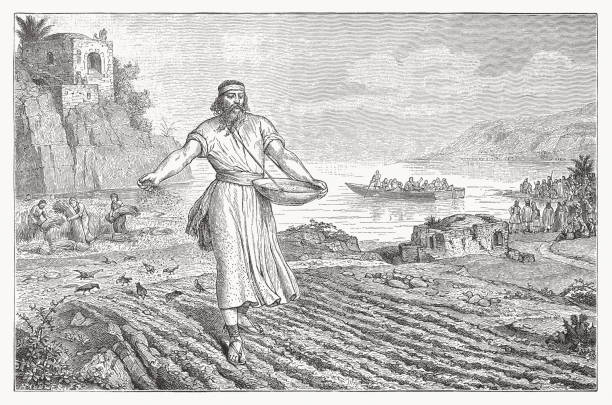
And how shall we proceed to develop virtue? I have said several things about the life of prayer recently, I have suggested ordering our lives, avoiding sin and impurity, imitating and communing with the Saints who have succeeded in all of this before us. Especially the Blessed Virgin. These small initiatives of ours make us the fertile soil of the parable in our gospel reading this weekend. And then we are prepared for the shower of God’s grace that the prophet Isaiah speaks of, and for the seed of the Gospel to fall upon us, and we shall make a good return, a hundredfold, sixtyfold or thirtyfold, as the Lord says.
For as the prophet says in the first reading (above), the grace of God falling upon the earth does not return without bringing yield from that earth. We must be as clean and pure as possible, without the weeds of sinful attachments, without weaknesses created by the evil one, the enemy of our souls. We must not permit other attachments to the things or the people of this world to make the soil of our hearts too thin or too laid up with thorns or weeds to permit the Gospel to take root.
Again, none of this is meant to be easy, this building of virtue, this maintaining of virtue… so the Saints of God speak of spiritual warfare, and we know from the stories of war how soldiers in such situations as trench warfare were to keep vigil for weeks and months, for attacks that were always imminent, for means of making advancements. So, we keep vigil according to the counsels of Christ, we place our focus upon Him, and we shall persevere until the end.
“The same day Jesus going out of the house, sat by the sea side. And great multitudes were gathered unto Him, so that He went up into a boat and sat: and all the multitude stood on the shore. And He spoke to them many things in parables, saying, ‘Behold the sower went forth to sow. And whilst he soweth some fell by the way side, and the birds of the air came and ate them up. And other some fell upon stony ground, where they had not much earth: and they sprung up immediately, because they had no deepness of earth. And when the sun was up they were scorched: and because they had not root, they withered away. And others fell among thorns: and the thorns grew up and choked them. And others fell upon good ground: and they brought forth fruit, some an hundredfold, some sixtyfold, and some thirtyfold. He that hath ears to hear, let him hear.'”
Gospel of S. Matthew, 13: 1-9 [link]

