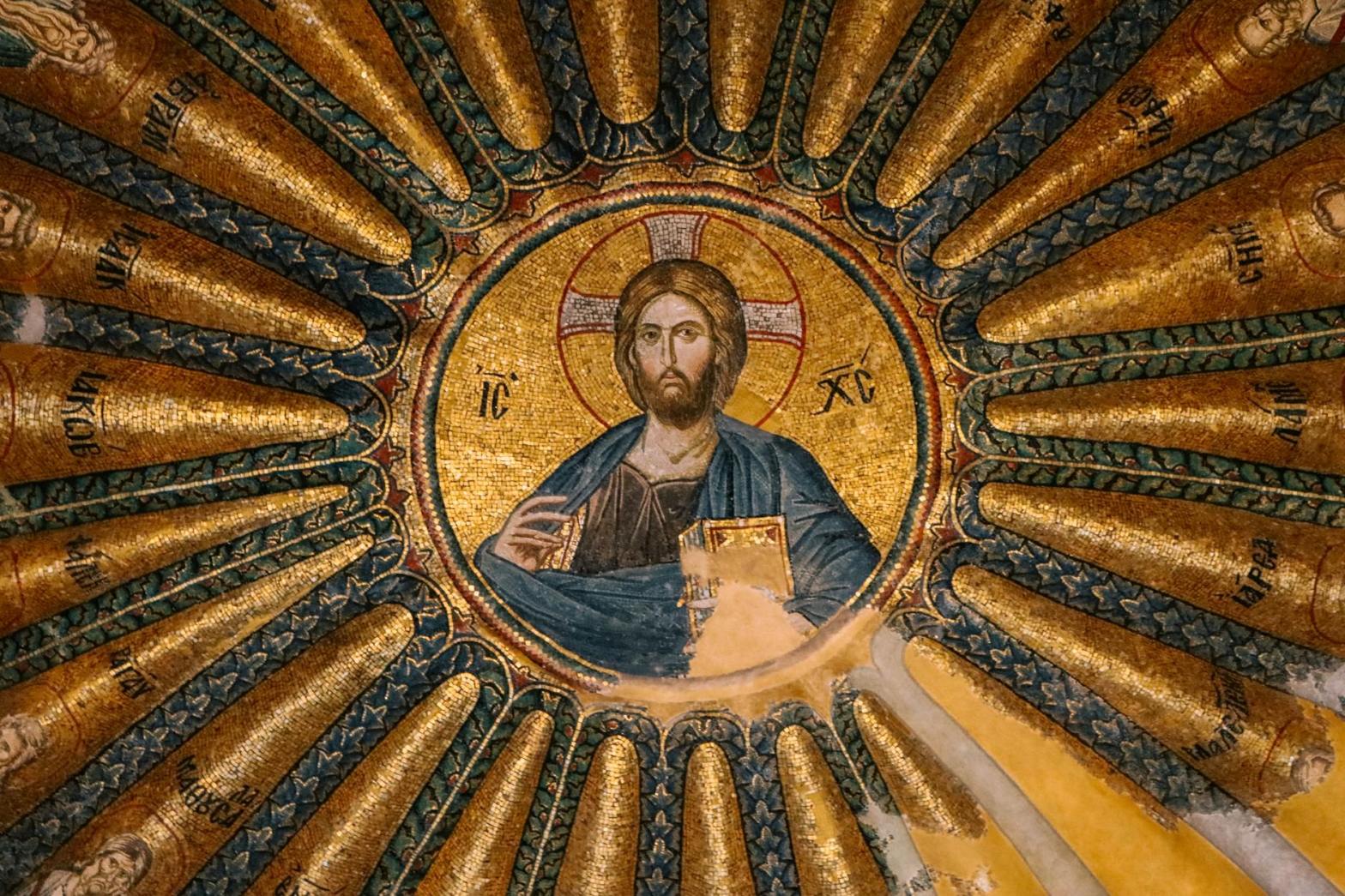
“Then having sent away the multitudes, He came into the house, and His disciples came to Him, saying, ‘Expound to us the parable of the cockle of the field.’ Who made answer and said to them, ‘He that soweth the good seed, is the Son of man. And the field, is the world. And the good seed are the children of the kingdom. And the cockle, are the children of the wicked one. And the enemy that sowed them, is the devil. But the harvest is the end of the world. And the reapers are the angels. Even as cockle therefore is gathered up, and burnt with fire: so shall it be at the end of the world. The Son of man shall send His angels, and they shall gather out of His kingdom all scandals, and them that work iniquity. And shall cast them into the furnace of fire: there shall be weeping and gnashing of teeth. Then shall the just shine as the sun, in the kingdom of their Father. He that hath ears to hear, let him hear.'”
Gospel of S. Matthew, 13: 43 [link]
The just – or the virtuous – shall shine as the sun in the kingdom of their Father. The kingdom is the Church, the community of those whose hearts are ruled by the divine King. One of the rallying cries of Catholic martyrs in the twentieth century has been Long live Christ the King. And this line gives us an opening for my ongoing theme of virtue. I have said something about virtue in recent weeks, and now let’s have a look at some of the virtues of the Christian life. Let’s begin with what the Catechism calls the ‘cardinal virtues.’ These are prudence, justice, fortitude and temperance.
Prudence, first. This is quite the master virtue, and guides moral behaviour for the top. Prudence is the practical pursuit of the true good, discovering the pathway to it, and keeping to it. S. Thomas called prudence ‘right reason in action,’ There is a theological element to prudence, because Christ called Himself the Way, the Truth and the Life. He demonstrates prudence by example, and if we are to point towards Him as the true good, His gospel demonstrates the way to eternal life – a way that we should embrace.
Justice is giving both to God what is due to Him and to neighbour what is due to him – to God worship and adoration (which leads to the virtue of religion), to neighbour the means of material and spiritual flourishing. Justice also has a theological content, because Scripture and Tradition call God the divine Judge, the ultimate judicial authority, and the Gospels say very much of Christ coming at some point to judge the living and the dead (as in the Gospel reading this weekend, above); we even put these words into our creeds. We are to exercise justice and enforce fairness in our own behaviour towards God and other people.
Fortitude is a moral virtue that builds firmness in the face of suffering and perseverance in the path that prudence chooses. When we speak of resisting temptation, and standing up to those who attempt to destroy what is important to us, we are reaching for fortitude. Fortitude is a significant virtue in our countries, because whenever we pass a war memorial or when we come up to Remembrance events in November, we remember the fortitude of the men and women in the services who made great sacrifices to preserve what they loved.
Temperance or sobriety we may perhaps connect with historical temperance movements in the protestant world of the nineteenth century, which have often led to the extreme of abstinence. It must be why when I pick up a bottle of wine at the shops, people sometimes raise an eyebrow. But the Christian moral virtue of temperance is less abstinence from a good thing, and more a rational moderation of the will and its appetite for pleasure. God has given to us many good things, and we should not be afraid of using them. But all things in moderation, we may hear people say.
All of these human virtues have a very strong link to Christ. Although fortitude is a human virtue, the God-man lived it to the highest degree in his prophetic ministry and took it to the Cross with Him – one doesn’t endure the torment of the Cross without fortitude. And the same with temperance… one of the accusations of His opponents was that He ate and drank with sinners, and elsewhere that He came eating and drinking (a glutton and a drunkard) while S. John the Baptist was an ascetic. But we also know that Christ had no attachment to these goods – food and drink – He rather used those opportunities to draw souls to Himself.
The wondrous thing about the Incarnation of Christ, in the context of human virtue, is that God took up human virtue and lived it perfectly. That’s what makes Him the model for imitation for a Christian soul. The Catechism says that virtue is developed through learning and by deliberate and persistent virtuous acts, and He would have done this throughout His life on earth. This is why I like that Christ is the appointed Judge at the end of all things, for as the first reading keeps saying the divine Judge is gracious, merciful and lenient with repentant souls. The divine Judgement is directed to the repentance of souls.
“For there is no other God but Thou, Who hast care of all, that Thou shouldst shew that Thou dost not give judgment unjustly. Neither shall king, nor tyrant in Thy sight inquire about them whom Thou hast destroyed. For so much then as Thou art just, Thou orderest all things justly: thinking it not agreeable to Thy power, to condemn him who deserveth not to be punished. For Thy power is the beginning of justice: and because Thou art Lord of all, Thou makest Thyself gracious to all. For Thou shewest Thy power, when men will not believe Thee to be absolute in power, and Thou convincest the boldness of them that know Thee not. But Thou being master of power, judgest with tranquillity; and with great favour disposest of us: for Thy power is at hand when Thou wilt. But Thou hast taught Thy people by such works, that they must be just and humane, and hast made Thy children to be of a good hope: because in judging Thou givest place for repentance for sins.”
Book of the Wisdom of Solomon 12: 13-19 [link]
When we confess our sins and look for forgiveness, we stare into the furnace of love that is the Sacred Heart – a human heart that has felt many of the same temptations that we have felt. When we are looking to build prudence, fortitude, temperance, etc. in our hearts, we look to the Sacred Heart, Which is a treasury of graces to aid us in our weakness. Our weakness is the result of sin, and our attachment to the things of this world. We may not have the words to pray for these graces maybe, but as S. Paul says in our second reading, the Holy Ghost Himself then prays within us.
“Likewise the Spirit also helpeth our infirmity. For we know not what we should pray for as we ought; but the Spirit Himself asketh for us with unspeakable groanings. And He That searcheth the hearts, knoweth what the Spirit desireth; because He asketh for the saints according to God.”
Letter of S. Paul to the Romans, 8: 26-27 [link]
The gospel message (above) presents a tragedy. Last weekend, we were the fertile ground for the gospel. This weekend, we are the seed and sapling, but there may be weeds planted by the enemy! The voice of the serpent in the Garden has bent the will of many even within the Church. Because the kingdom of heaven is the Church. But, at the same time, the heavenly Voice bids the attendants of the field to not uproot the weeds, lest the wheat come up with it. We cannot easily judge between the wheat and the cockle – we know not the hearts of the men and women around us – and we could make terrible mistakes of judgement. And so, we tend the crop and wait for the great Judgement to come.
And we work to draw hearts to the King of Hearts, even though virtue is planted with vice, until a set of angelic reapers will one day separate the wheat from the darnel/cockle, the virtuous from the corrupt. My friends, let us preach virtue, let us build virtue.

