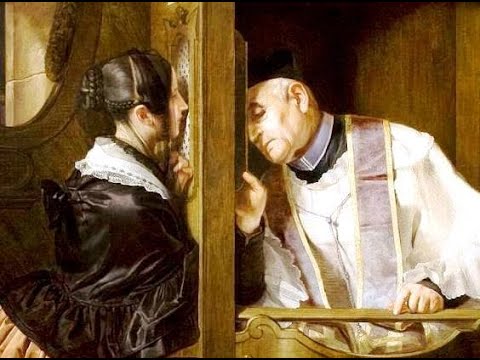
Aside from the morning of Holy Saturday at Louth (the day before Easter Sunday), confessions will be heard for at least half an hour before every parish Mass, from Monday of Holy Week down to the Easter vigil. Please come as early as possible, in case there is difficulty with queueing.
This will be attempted even on the Sundays, but logistics may make that more difficult than on weekdays.
The programme of planned Masses and other services is on the front page of the parish website.
To be read at all Masses on the Fifth Sunday of Lent (Passion Sunday) the 5th and 6th of April, 2025
“My dear brothers and sisters in Christ,
I wish to speak with you today about the process in which our Parliament is currently considering legalising assisted suicide through the Terminally Ill Adults (End of Life) Bill. As I have made clear earlier in this debate, as Catholics we have maintained a principled objection to this change in law recognising that every human life is sacred, coming as a gift of God and bearing a God-given dignity. We are, therefore, clearly opposed to this Bill in principle, elevating, as it does, the autonomy of the individual above all other considerations.
“The passage of the Bill through Parliament will lead to a vote in late April on whether it progresses further. This will be a crucial moment and I, together with all the Bishops of England and Wales, am writing to ask your support in urging your MP to vote against this Bill at that time.
“There are serious reasons for doing so. At this point we wish not simply to restate our objections in principle, but to emphasise the deeply flawed process undergone in Parliament thus far. We wish to remind you that it is a fundamental duty of every MP to ensure that legislation is not imposed on our society which has not been properly scrutinised and which will bring about damaging consequences.
“The Terminally Ill Adults (End of Life) Bill will fundamentally change many of the key relationships in our way of life: within the family, between doctor and patient, within the health service. Yet there has been no Royal Commission or independent inquiry ahead of its presentation. It is a Private Member’s Bill. The Bill itself is long and complex and was published just days before MPs voted on it, giving them inadequate time to consult or reflect upon it. The time for debate was minimal. The Committee examining the Bill took only three days of evidence: not all voices were heard, and it comprises an undue number of supporters of the Bill. In short, this is no way to legislate on such an important and morally complex issue.
“One consequence of this flawed process is that many vital questions remain unanswered. Can MPs guarantee that the scope of the Bill will not be extended? In almost every country where assisted suicide has been introduced the current scope is wider than was originally intended. What role, if any, will the judiciary have in theprocess? We were told that judicial oversight was a necessary and vital part of the process; now we are told it isn’t needed at all. What will protect the vulnerable from coercion, or from feeling a burden on family? Can the National Health Service cope with assisted suicide or will it, as the Health Secretary has warned, cause cuts elsewhere in the NHS? Can MPs guarantee that no medical practitioner or care worker would be compelled to take part in assisted suicide? Would this mean the establishment of a ‘national death service’?
“In contrast to the provisions of this Bill, what is needed is first-class, compassionate palliative care at the end of our lives. This is already provided to many in our society but, tragically, is in short supply and underfunded. No-one should be dispatched as a burden to others. Instead, a good society would prioritise care for the elderly, the vulnerable, and the weak. The lives of our families are richer for cherishing their presence.
“It is sad reflection on Parliament’s priorities that the House of Commons spent far more time debating the ban on fox hunting than it is spending debating bringing in assisted suicide.
“I am sure that you will share these concerns. It is now clear that this measure is being rushed without proper scrutiny and without fundamental questions surrounding safeguards being answered. This is a deeply flawed Bill with untold unintended consequences.
“Every MP, and Government, has a solemn duty to prevent such legislation reaching the statute book. This, tragically, is what may happen. So I appeal to you: even if you have written before, please make contact now with your MP and ask them to vote against this Bill not only on grounds of principle but because of the failure of Parliament to approach this issue in an adequate and responsible manner.
“In his Letter to the Philippians, from which we heard in the Second Reading, St Paul reflects on the difficulties and responsibilities of life. He speaks of ‘pressing on’ and ‘striving’ for the fulness of life promised in Christ Jesus. Yet he is totally confident in his struggles because, as he says, ‘Christ Jesus has made me His own.’
“We too have many struggles. We too know that Christ Jesus has made us His own. So we too press on with this struggle, so important in our times. May God bless you all.”
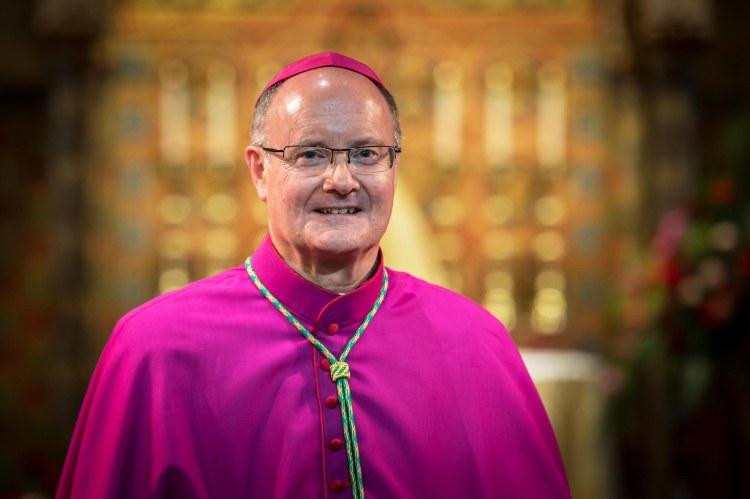
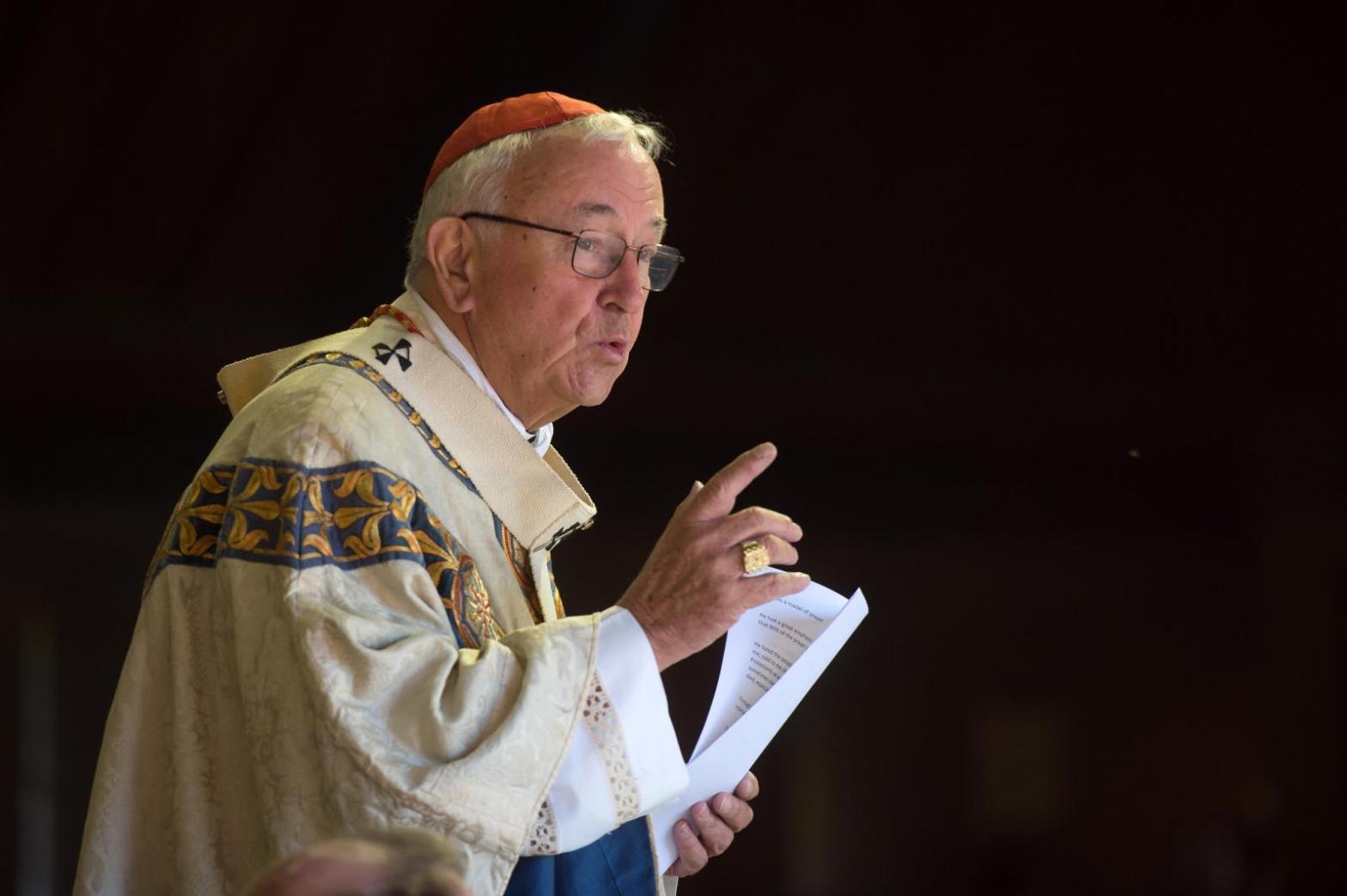
Cardinal Vincent Nichols President of the Bishops’ Conference of England and Wales
This letter is published with the full support of Bishop Patrick McKinney, Bishop of Nottingham.
I shall end today with my descriptions of the Mass, and next weekend, I shall begin with the Rosary. The Mass, as the second Vatican Council said, is the source and summit of our lives. It is our nearest encounter with the Holy One, the moment when heaven touches earth, and we stand among angels and Saints around the throne of God as a worshipping community. In the past, I have portrayed the various parts of the Mass as an ascent on a holy mountain and as an entry into a sacred space – a sanctuary. I have tried to say how everything prepares us for the Consecration at Mass – when we first adore Christ-made-Present – and for Holy Communion immediately afterwards – when we physically receive Christ-made-Present.
The parallel to this Holy Communion made from the very pages of the New Testament is the exit of the Hebrews from Egypt – their Passover – before they began their long trek towards their Promised Land. As I have said repeatedly, our Egypt is this world and our Promised Land is eternal happiness with God in heaven. That’s why we call Christ our Passover Lamb, and we say Lamb of God, Lamb of God, just before we receive Holy Communion. In the story of the Hebrew Passover and the trek through the desert, the people grew hungry and thirsty, and ached to go back to the comforts of Egypt, and they were fed by God with a ‘bread from heaven.’ Our first reading this weekend is about this coming to an end, when the Promised Land had been acquired. Similarly, in our trek through the desert of this life, we grow spiritually hungry and thirsty and ache far too often to return to the pleasures of this world, and we are fed by God with the true ‘bread from heaven,’ the Blessed Sacrament.
And so we descend from our holy mountain of the Mass, and we leave the blessed sanctuary behind, fed through Holy Communion by God with God. And to what end? What is the point of Mass? Simply, and in a word – holiness. We are to become holy, shorn of sin and evil, we are to be as Adam and Eve were before their Fall. Having become holy, we are also supposed to make the world holy, by drawing other men and women to Christ, thus becoming ministers of God, ambassadors of Christ. And so, when the priest comes to the end of Mass, he says, Go in peace, glorifying God with your lives, to love and serve the Lord, etc.
And our readings this weekend are providentially about Passover, Holy Communion, and participating in Christ’s new Creation. Taste and see that the Lord is good. In our second reading, S. Paul says that the new Creation is in the hearts of men and women.
“…when a man becomes a new creature in Christ, his old life has disappeared, everything has become new about him. This, as always, is God’s doing; it is He Who, through Christ, has reconciled us to Himself, and allowed us to minister this reconciliation of His to others. Yes, God was in Christ, reconciling the world to Himself, establishing in our hearts His message of reconciliation, instead of holding men to account for their sins. We are Christ’s ambassadors, then, and God appeals to you through us; we entreat you in Christ’s name, make your peace with God. Christ never knew sin, and God made him into sin for us, so that in him we might be turned into the holiness of God.”
Second letter of S. Paul to the Corinthians, 5: 17-21 [link]
Remember that Christ said to His adversaries that the Kingdom of God was already among the crowds of people listening to Him. He, the King of Hearts, was already receiving the allegiance of thousands before the Crucifixion – we know, because He was feeding them miraculously in the desert. In so far as we go away after Mass in peace, glorifying the Lord by our lives, we should endeavour constantly to spread the knowledge of Christ and of the commandments of Christ to others, bringing them to Him and so enlarging His Kingdom.
“This day, the Lord said to Josue, ‘I have reversed the lot that made you slaves in Egypt;’ and so the place came to be called Galgal, Turning Round, the name it still bears.”
What is the ‘shame of Egypt’ or the ‘slavery of Egypt’ that is mentioned here, at the top of the first reading this weekend? It is idolatry, and the worship of false gods, that is, evil spirits. We know how contagious idolatry is. The moment the Hebrews thought they had lost Moses, because he was too long up the mountain, they tried to establish an Egyptian fertility religion with the golden calf. And we know that the moment the people we know and love forsake Christ, they find some other object of devotion to replace Him. Turning around from idolatry and back to God is so significant that when the people have made the pledge in the newly-attained Promised Land, their very camp is named Galgal – literally, turning around.
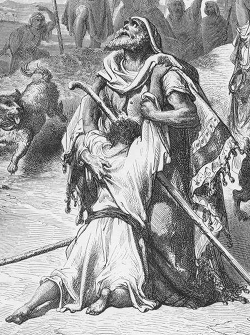
“‘And when the son said, Father, I have sinned against heaven and before thee; I am not worthy, now, to be called thy son, the father gave orders to his servants, Bring out the best robe, and clothe him in it; put a ring on his hand, and shoes on his feet. Then bring out the calf that has been fattened, and kill it; let us eat, and make merry; for my son here was dead, and has come to life again, was lost, and is found. And so they began their merry-making. The elder son, meanwhile, was away on the farm; and on his way home, as he drew near the house, he heard music and dancing; whereupon he called one of the servants and asked what all this meant. He told him, Thy brother has come back, and thy father has killed the fattened calf, glad to have him restored safe and sound. At this he fell into a rage, and would not go in. When his father came out and tried to win him over, he answered his father thus, Think how many years I have lived as thy servant, never transgressing thy commands, and thou hast never made me a present of a kid, to make merry with my friends; and now, when this son of thine has come home, one that has swallowed up his patrimony in the company of harlots, thou hast killed the fattened calf in his honour. He said to him, My son, thou art always at my side, and everything that I have is already thine; but for this merry-making and rejoicing there was good reason; thy brother here was dead, and has come to life again; was lost, and is found.'”
Those of us who are still attached to Christ are like the older brother in this gospel story, for we have not left the Father’s house. But we know others who have. We have to work to bring them back. The Holy Father John Paul II called this the ‘new evangelisation’ – bringing back former Christians to the practice of religion. These may have squandered the graces they had in Baptism, Confirmation and Holy Communion, and we could understand perhaps the indignation of the older brother in the story. It is not unlike the indignation of the Pharisees and scribes, who were struggling to perfect their observance of the Law of Moses, and were seeing public sinners entering into the promises of Christ right before them.
Remember the parable of the shepherd who would leave ninety-nine sheep in safety to rescue the one truant. W should always marvel at the heart of God – the Sacred Heart – Who looks at all repentant hearts with great joy, calls His angels and Saints and all His Church to Him and says, Rejoice with me, for they were dead, and are now alive.
I thought we could make an end of my descriptions of the Eucharistic prayer this weekend. I had mentioned from the very beginning of my short theology of the Mass (from January) that entering into the Mass means remaking a very intimate covenant with God that we entered into on the day of our baptism. A covenant that requires making peace with God constantly, and therefore entering His presence in holiness. The readings assist this, the homily assists this, and so we make our offerings before God. The Eucharistic Prayer then ushers us into the presence of God, surrounded by His angels and Saints.
After the consecration, by which the bread and the wine become the Body and Blood of Christ, we find further and repeated references to the offering of the Church, which is nothing more than the self-offering of Christ made together with the offerings of all the rest of us. Then we find ourselves making a memorial of the dead, whom we call the Church Suffering, the Holy Souls in purgatory. We add these very important souls to the worshipping community of the Saints in heaven and the Church living in this world to complete the overall picture of the Church.
Then we have a second long list of Saints on this other side of the Eucharistic prayer, and it’s worth looking through it: there are
the important New Testament martyrs John the Baptist and Stephen (the first deacon),
there are the Apostles Matthias (who replaced Judas the traitor) and Barnabas (the associate of Paul),
there is the martyr bishop Ignatius of Antioch, and there are several martyrs of the early Roman Church…
men like Alexander, the priest Marcellinus and the exorcist Peter, and
women like the mothers Felicity and Perpetua,
and the virgins Agatha, Lucy, Agnes, Cecilia and Anastasia.
We end with the great doxology at the end: for all glory and praise is due to God the Father through, with and in Our Lord Jesus Christ in the unity of the Holy Spirit.
It’s difficult to hear the story of Moses and the Burning Bush (the subject of the first reading) and not think of our experience at Mass. For if we accept the Church’s teaching of Mass as a divine encounter and communion with God then we are obviously standing before a quite different type of burning bush, but a Burning Bush nevertheless, and it would be surprising if we were not given a mission, as Moses was.
“Let me remind you, brethren, of this. Our fathers were hidden, all of them, under the cloud, and found a path, all of them, through the sea; all alike, in the cloud and in the sea, were baptized into Moses’ fellowship. They all ate the same prophetic food, and all drank the same prophetic drink, watered by the same prophetic rock which bore them company, the rock that was Christ. And for all that, God was ill pleased with most of them; see how they were laid low in the wilderness. It is we that were foreshadowed in these events. We were not to set our hearts, as some of them set their hearts, on forbidden things. You were not to turn idolatrous, as some of them did; so we read, The people sat down to eat and drink, and rose up to take their pleasure. We were not to commit fornication, as some of them committed fornication, when twenty-three thousand of them were killed in one day. We were not to try the patience of Christ, as some of them tried it, the men who were slain by the serpents; nor were you to complain, as some of them complained, till the destroying angel slew them. When all this happened to them, it was a symbol; the record of it was written as a warning to us, in whom history has reached its fulfilment; and it means that he who thinks he stands firmly should beware of a fall.”
First letter of S. Paul to the Corinthians, 10: 1-12 [link]
In this second reading, S. Paul talks about the sequel to the burning-bush episode – about the baptism of the people into Moses when they were guided by God through the sea and the desert, eating the spiritual food and drinking the spiritual drink during that great pilgrimage from Egypt towards the Holy Land. Paul wants us to be extremely careful during our own great pilgrimage from this world (our Egypt) towards Heaven (our Holy Land), he wants us to learn from the mistakes of those Hebrews, and not fall into sin as so many of them did. When he talks about the baptism of the people into Moses, Paul surely means their baptism into the way of God as given to them by Moses, just as we are baptised into the way of God as given us by OLJC. In each case commandments are issued and a spiritual government of priests is established, by which we should be able to live lives acceptable to God.
The same warning that Paul issues is given by our Lord in our gospel reading as well this weekend – the warning of care in our dealing with temptation and sin, and care in our observance of the commandments. At first Christ treats of some Galileans who were massacred by the Roman procurator Pilate at the Temple (‘mingled their blood with their sacrifice’) and still others who died when the tower of Siloam fell upon them. Whether killed by human hands or killed by accident, Christ declares that they did not necessarily so die because they were greater sinners like everybody else. More important than the way we die is how we live our lives, in repentance and building virtue.
So, our Lord speaks in parable of God planting us as fig trees in his vineyard (the Church) and then perhaps being dismayed when we do not produce the fruit He is expecting; God may then wish to cut down the fruitless trees, for their being useless. The merciful heart of Christ here steps forth as the keeper of the trees and speaks for us, saying, Leave it another year and let’s see if things improve. This is the season of grace, the time of mercy, and we must make avail of this extra time given us by Christ to build virtue and produce fruit – fruit that will last.
“At this very time there were some present that told Him the story of those Galileans, whose blood Pilate had shed in the midst of their sacrifices. And Jesus said in answer, ‘Do you suppose, because this befell them, that these men were worse sinners than all else in Galilee? I tell you it is not so; you will all perish as they did, if you do not repent. What of those eighteen men on whom the tower fell in Siloe, and killed them; do you suppose that there was a heavier account against them, than against any others who then dwelt at Jerusalem? I tell you it was not so; you will all perish as they did, if you do not repent.’ And this was a parable He told them; ‘There was a man that had a fig-tree planted in his vineyard, but when he came and looked for fruit on it, he could find none; whereupon he said to his vine-dresser, See now, I have been coming to look for fruit on this fig-tree for three years, and cannot find any. Cut it down; why should it be a useless charge upon the land? But he answered thus, Sir, let it stand this year too, so that I may have time to dig and put dung round it; perhaps it will bear fruit; if not, it will be time to cut it down then.”
I’m not in a hurry to finish talking about the Mass, and we’re at the summit of it, where time and clocks don’t matter. Because at Mass we kneel among angels, in an eternity of time.
There is a beautiful church that was built for us in Derby city in the nineteenth century called S. Mary’s, and one of its most memorable features is its windows; in one of them, in the Lady chapel, there are angels dressed as Roman clerics: priests and deacons.
When Moses established the tabernacle religion at Mount Sinai, he was following a plan he saw of the heavenly temple, which is staffed by angel-priests. Before Solomon built the Temple in Jerusalem, King David his father established a liturgy, complete with musicians and various orders of deacons, again with a mind to replicating a heavenly model. And shortly after our Lord established the divine liturgy of the Mass, the Apostle S. John saw the visions of the book of Apocalypse (aka. Revelation), the last book of the Bible.
The book of Revelation is a complex picture of the Church at worship in the first century, in the midst of the turmoil of on-and-off persecution. S. John was a bit of a Padre Pio at least with these visions – he saw angels everywhere. He saw what we cannot ourselves – that as the Church lives her life on this earth, and especially when she is at worship, she walks with the angels. The church in Derby tries to make that visible. We know that we all have guardian angels (somebody at some point taught us that) and we get used to the priest saying in the preface to the Eucharistic prayer, ‘…with angels and archangels, thrones, and dominations, etc…,’ but we still usually think that these kindly spirits, shining with the Eternal light, are somewhere up there, and not down here.
So… if we think the Eucharistic prayer too boring – same old words, every Sunday of every week of every month of every year – I suggest that we listen for keywords. Some of these keywords I’ve been calling out for several Sundays now are ‘offering,’ and ‘we offer.’ For it is in offering constantly throughout our lives as Christians that we are a priestly people. So, let’s keep our ears out now for every mention of ‘offering,’ and also for every mention of the angels, as archangels, thrones, dominations, powers of heaven, etc. We shall find that when the angels are not filling the heavenly Temple with the smoke of incense, they are carrying our prayers and offerings (signified by that smoke of incense) up to the altar in that Temple.
Now, what would a crowd of angels be doing in our little parish churches in the countryside? They are here for us, yes, but far more than us, they are here for Him. If we take His presence in our churches for granted, they never do. In our gospel story today, the three cardinal Apostles catch a glimpse of Christ as the angels behold Him.
“It was about a week after all this was said, that He took Peter and John and James with Him, and went up on to the mountain-side to pray. And even as He prayed, the fashion of His face was altered, and His garments became white and dazzling; and two men appeared conversing with Him, Moses and Elias, seen now in glory; and they spoke of the death which He was to achieve at Jerusalem. Meanwhile, Peter and His companions were sunk in sleep; and they awoke to see Him in His glory, and the two men standing with Him. And, just as these were parting from Him, Peter said to Jesus, ‘Master, it is well that we should be here; let us make three arbours in this place, one for Thee, and one for Moses, and one for Elias.’ But he spoke at random: and even as he said it, a cloud formed, overshadowing them; they saw those others disappear into the cloud, and were terrified. And a Voice came from the cloud, ‘This is My beloved Son; to Him, then, listen.’ And as the Voice sounded, Jesus was discovered alone. They kept silence, and at the time said nothing of what they had seen to anybody.”
As the glory of the Holy One flashes forth on the mountain, the law-giver and judge Moses appears and the prophet and moralist Elijah appear alongside. They were talking about the point where Law and prophecy come together, where justice and righteousness are fulfilled, where heaven touches earth and angels walk among men. They are talking about the Passion of Christ, His death and His resurrection. They are therefore talking about the Mass.
The terrified Apostle S. Peter says an odd thing – he wants to erect three tabernacles (arbours, or tents), one for each heavenly figure. This was about the time of the Jewish feast of Tabernacles, the time of year when Jews remember how their forefathers wandered through the desert with Moses as judge, when they lived in tabernacles (tents) and grew in their knowledge of God and their intimacy with Him, and received His promises. For He journeyed with them, and dwelt in a tabernacle just outside their camp.
And here’s where we can link the story of the Transfiguration to the season of Lent, for as we give up our usual sources of comfort in food and drink and other things we enjoy, we walk away from the flesh-pots of Egypt and through the wilderness, giving up the stability of stone and brick homes (worldly security) for the transitory nature of tents (greater dependence on God), putting ourselves at the mercy of nature, and at the mercy of God. Taking risks for Him. Abandoning to an extent our reliance on ourselves and trusting to a ministry of angels.
This will always be a challenge, for we are accustomed to relying for the most part upon ourselves and the systems of our society and culture. On the security of Egypt, let’s say. But S. Peter seems to have been hoping to keep heaven open a little longer, by keeping the presence of God (as presented by the heavenly figures) tabernacled with the people of Israel, as in the time of Moses perhaps. And so should we wish to preserve the desert experience constantly, with our lives of continued prayer, fasting and almsgiving.
Last week, I mentioned the reality of the Blessed Sacrament, and how we are to behave when the very Body and Blood of Christ – Christ Himself – lies upon the altar. But why is it that this should be? Why have Christ upon an altar at all? As we continue with the frame of the Mass, we find that after a quick memorial of the suffering, death, resurrection and ascension into heaven of Christ, the Eucharistic Prayer gives us the answer, for it calls the now-consecrated bread and wine a pure victim, a holy victim, a spotless victim.
This throws us all the way back into the Old Testament, when the victims of the Temple sacrifices of the Hebrew nation were animals. And those sacrifices were intended to purify the people so that they could approach the holiness of God. The Church, looking upon that situation, would tell us that those animal sacrifices had no power of their own; rather, what God has looked for always is a humble and contrite heart, a repentant sinner, one who goes far enough in seeking God’s forgiveness as to seek the priesthood of the Jerusalem Temple. The Church also tells us that it is the great Sacrifice of Christ that truly redeems, and that the animal sacrifices looked forward to Calvary and Good Friday. They had no power of themselves then.
To return to our question, why should the Body and Blood of Christ be lying upon an altar in a Catholic Church…? Because the Mass is a Temple liturgy which echoes the worship of the heavenly Temple, and this presence of Christ upon our altars forms the greatest part of the offertory of the Church – our joint offering to God the Father of ourselves is made together with Christ’s offering of Himself. So, the next time we make a big sacrifice (or a little one) – and Lent is a season of personal sacrifices made – we mustn’t forget to offer it up, and bring it to Mass, where it can lie upon the altar with Christ.
Finally, to hammer in the unity of the Sacrifice of the Mass with the sacrifices of the Hebrews, the Eucharistic prayer also mentions three ancient priests – Abel the son of Adam, the patriarch Abraham and the mysterious priest-king Melchizedek – asking God to accept our offering, as He once accepted theirs.
Let’s continue with this theme of priesthood and offering as we look at our readings this weekend. In the first reading from Deuteronomy, we find what we could call the Creed of the Hebrew nation.
“Thereupon the priest will take the basket from thy hand, and set it down before the altar of the Lord thy God. In that divine presence, thou wilt continue thy protestation: My fathers were wanderers, hunted to and fro in Syria, when they made their way into Egypt and began to dwell there, only a handful of them; but they grew to be a great people, hardy and numerous. Whereupon the Egyptians treated us ill and persecuted us, and the burden we must bear was insupportable; so we cried out to the Lord God of our fathers, and he listened to our plea, and took pity on our affliction, the toil and oppression we suffered; rescued us from Egypt by force, with his arm high uplifted to strike great terror, and perform great wonders and portents, and brought us here, where he has given us a land that is all milk and honey. That is why I am offering first-fruits, now, out of the land which the Lord has given me. So leave them there, in the presence of the Lord thy God, and when thou hast paid worship to this Lord and God of thine…”
Remember our own Creed – I believe in the Father, I believe in the Son, I believe in the Holy Spirit, etc. which we have as part of the Mass on Sundays and holy days. The setting of the Hebrew Creed in the reading is also a divine liturgy, with a priest offering a sacrifice of first-fruits on behalf of the people. We could take the frame of this Hebrew Creed: Abraham our father, enslavement in Egypt, rescue by God with great miracles, the promise of the Holy Land, and behold we make these offerings… and we could give it a Christian aspect: God our Creator, Adam our father, enslavement to sin and death, rescue by Christ with His life-death-resurrection-ascension, the promise of Heaven, and behold we make these offerings at Mass…
Our gospel story carries us out into the wilderness with Christ, as He endures His forty days and forty nights of preparation for ministry. Let us approach our Lenten observances in the spirit of offertory. Giving up even small things is difficult. There are Eastern Catholics who give up not only sweets and alcohol but all animal products – including dairy products – for the duration of Lent. Now, that is very difficult, and even scary. And just as with every other privation we may suffer during the rest of the year, we had best offer up the Lenten sacrifices we make. And there’s no better time to make that offering in prayer than at Mass, on Sunday or during the week.
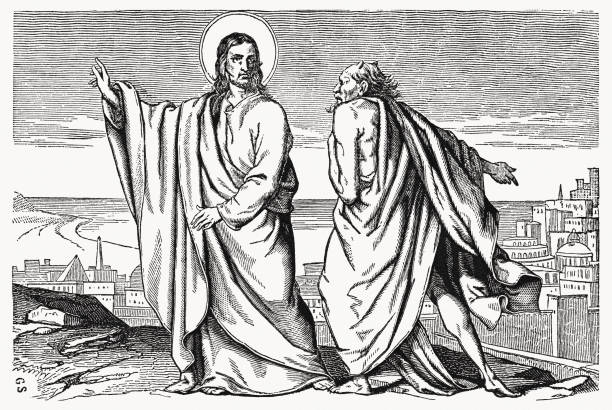
We can be sure that the enemy of our souls will not only come to ruin our Lent at the end of it, just as he probably tempted Christ through all of His forty days, and not just with this parting salvo in our gospel story today. If we maintain our discipline and are hungry, we will be tempted to take liberties; if we give up our devotion to things other than God during Lent, we will be tempted to return to them.
But, we shall be strong and persevere, eyes fixed upon Christ, and the serpent will have to leave in frustration, to perhaps return at a later time.
“Jesus returned from the Jordan full of the Holy Spirit, and by the Spirit He was led on into the wilderness, where He remained forty days, tempted by the devil. During those days He ate nothing, and when they were over, He was hungry. Then the devil said to Him, ‘If Thou art the Son of God, bid this stone turn into a loaf of bread.’ Jesus answered him, ‘It is written, Man cannot live by bread only; there is life for him in all the words that come from God.’ And the devil led Him up on to a high mountain, and shewed Him all the kingdoms of the world in a moment of time; ‘I will give Thee command,’ the devil said to Him, ‘over all these, and the glory that belongs to them; they have been made over to me, and I may give them to whomsoever I please; come then, all shall be Thine, if Thou wilt fall down before me and worship.’ Jesus answered him, ‘It is written, Thou shalt worship the Lord thy God; to Him only shalt thou do service.’ And he led Him to Jerusalem, and there set Him down on the pinnacle of the temple; ‘If Thou art the Son of God,’ he said to Him, ‘cast thyself down from this to the earth; for it is written, He shall give his angels charge concerning thee, to keep thee safe, and they will hold thee up with their hands, lest thou shouldst chance to trip on a stone.’ And Jesus answered him, ‘We are told, Thou shalt not put the Lord thy God to the proof.’ So the devil, when he had finished tempting Him every way, left Him in peace until the time should come.”
I shall continue with my description of the Mass next Sunday. But while still on the subject of the Consecration during the Eucharistic prayer of the Mass, I thought I’d talk this weekend about reverence for the Blessed Sacrament.
Let’s look at our foundations. I have been talking about building a relationship of marital give-and-take with Christ to the extent that Christ gives Himself entirely for us as the Church and each one of us individually… and then we make an equally personal donation of ourselves to Him. And then, with the institution of the Mass, Christ literally and practically puts Himself into our hands. And this is how…
Christ tells us in the Gospel that the only way that we can break the bonds of mortality and live forever is by eating Him. This confused His Jewish hearers, who asked themselves (as per the Apostle S. John’s account) what this apparent madness could mean. They are probably concerned about cannibalism, which Judaism along with almost every other human tradition abhors. And during that episode of the gospel, and at that very point, many of Christ’s followers left Him. He looked at His Apostles and asked if they would leave also. S. Peter stood up and declared that there was nowhere else for them to go. And the Catholic Church has always stood behind the Apostle.
How do we eat Christ? A Catholic will answer that without missing a beat: in the Eucharist. And if receiving Holy Communion means eating Christ, the consecrated bread upon the altar is Christ Himself. And the consecrated bread that goes into the tabernacle at the end of Mass is Christ Himself. If Christ is king of all things, and Lord of lords, that makes our churches into throne-rooms.
If we were to peek into His Majesty King Charles’ throne room in one of his palaces when the king was present, what should we find? Respectful courtiers perhaps, and detailed and quasi-ritual ceremonial, and undoubtedly a general hush? This wouldn’t surprise us. And if somebody were for some reason to draw a curtain before the throne of the king, everybody in the room would still know that he was there, although they couldn’t see him, and not cease from the customary honours. They wouldn’t at once begin to talk loudly or turn on some music, or look at their phones instead.
And yet, we have forgotten to treat our churches similarly. There are some quite simple means of demonstrating respect for the Holy One in His churches, especially when He is exposed for veneration during the Adoration of the Blessed Sacrament: (i) we could take care to not turn our backs upon the tabernacle in the sanctuaries, if we can help it, (ii) we could attempt to maintain silence for as much as possible in His presence, and (iii) we could pay some respect to others in church who are struggling to pray in that presence of Christ. If we could manage at least these, we could perhaps show a greater courtesy to the presence of the Him Who loves us, and has given Himself thus into our hands in our churches.
Our readings at Mass this weekend have to do with moral instruction, and the first reading just makes me laugh, because it’s so blunt. We know that some people can and will change their ways under the influence of grace, but we all know that other people are more ingrained in their bad habits and careless manner. And some of us can be quite obtuse and annoying to be around. The Wisdom books, such as this Sirach/Ecclesiasticus, say wonderful things like, A fool reveals himself when he talks. And today’s reading is like that: we demonstrate our personal faults when we speak, we demonstrate our mind by what we say and do.
“The sieve shaken, nothing is left but refuse; so thou wilt find a man’s poverty in his thought. Pottery is tested in the furnace, man in the crucible of suffering. Good fruit comes from a tree well dressed, and a man will be in word what he is in thought; do not give thy opinion of a man till he has spoken; there lies the proof.”
And so, according to that last line of the reading – even if famous people, politicians and celebrities do not agree – we should be very careful about writing autobiographies and giving interviews. Similarly, we could say that the cleverest (or most pious) of men and women have concealed themselves in monasteries and hermitages. And that this is the reason why several church communities still have the good sense to appoint their bishops not from the chattering classes of clergy but from the monasteries.
For wisdom is gained in silence and listening, rather than in speech, and as the Lord says in our gospel reading today, a foolish man will lead everybody who follows him into the pit he’s digging for himself. Once more, blindness here refers to spiritual blindness, so that the ungodly and impious man will make all who look up to him godly and impious, for the student becomes his teacher (as Christ here says). And that’s how we shall be able to tell who a good teacher is – from his students, and from his students’ students. For rot spreads easily, and produces rotten fruit.
To end on a pleasant note: for centuries, the Church has identified saintly men and women who have produced good fruit in abundance, often with miracles added on, often in the silence of the monasteries and convents, whose wisdom has come down to us either in their writing or in the stories written about them by their confreres. They are models for us, good teachers who show us the good way to Christ, and how to trace the narrow road with all its joys and sorrows that will eventually place us in the eternal embrace of Christ.
“And He told them this parable, ‘Can one blind man lead another? Will not both fall into the ditch together? A disciple is no better than his master; he will be fully perfect if he is as his master is. How is it that thou canst see the speck of dust which is in thy brother’s eye, and art not aware of the beam which is in thy own? By what right wilt thou say to thy brother, Brother, let me rid thy eye of that speck, when thou canst not see the beam that is in thy own? Thou hypocrite, take the beam out of thy own eye first, and so thou shalt have clear sight to rid thy brother’s of the speck. There is no sound tree that will yield withered fruit, no withered tree that will yield sound fruit. Each tree is known by its proper fruit; figs are not plucked from thorns, nor grapes gathered from brier bushes. A good man utters what is good from his heart’s store of goodness; the wicked man, from his heart’s store of wickedness, can utter nothing but what is evil; it is from the heart’s overflow that the mouth speaks.'”
I’m getting to the very centre now of my my short descriptions of the Catholic Mass. I have called it a festival of divine love, specifically the love that dies in order that the Beloved may live. The Mass requires a relationship of intimate love with the Holy One, which is likened to marital love, so that God in Christ is the Bridegroom and the Church is the Bride. Any marital relationship, as most of us know, requires an active spirit of reconciliation between spouses, and unsurprisingly the Mass has a penitential rite at the beginning.
Then having divined a little of the mind of the Bridegroom in the readings from Scripture, and in the homily, we declare our faith in Him in the lengthy formula we call the Creed. And then we offer our heart to Him, for He has given us His own. And then we arrive at the foot of the Cross, where the Sacred Heart is indeed bared in His great love for mankind, whom He raised up from the dust of the earth. We sing the Holy-Holy-Holy of the angels at the beginning of the Eucharistic Prayer and gather together around the names of the Holy Father and the Bishop and a number of Saints.
Something I sometimes say is that the Last Supper, the Crucifixion and indeed the Resurrection, although they took place across a series of consecutive days, are really one great event. So, as we kneel before the altar and hear the words of Christ – ‘…this is My Body, this is My Blood…’ – from the Last Supper, we are simultaneously watching that Body heaving upon the Cross as the Holy One struggled to sustain His torturous breathing, we are simultaneously watching that blood pour down and stain the blessed wood. And then, beyond the horror of the Crucifixion, we see (also simultaneously) that Body now gloriously risen and walking out of the tomb on Easter Sunday.
Our next move will be to take up this glorious Body and Blood of Christ and offer it back to God the Father – His gift to us, so cruelly treated by sinful mankind, we offer back to Him. It is our best possible offering, the most pure, most holy, most spotless.
What makes the Sacrifice of our Lord upon the Cross so perfect? In a single word, His humility, which perfectly reverses the pride of mankind and negates the punishment due to that pride. Humility creates the locus for that self-sacrificing love we always talk about. Without pride, the command of the gospel story this weekend is not just possible but becomes probable. It is a message of perfect love, even for enemies, and of endless generosity.
“‘And now I say to you who are listening to Me, Love your enemies, do good to those who hate you; bless those who curse you, and pray for those who treat you insultingly. If a man strikes thee on the cheek, offer him the other cheek too; if a man would take away thy cloak, do not grudge him thy coat along with it. Give to every man who asks, and if a man takes what is thine, do not ask him to restore it. As you would have men treat you, you are to treat them; no otherwise. Why, what credit is it to you, if you love those who love you? Even sinners love those who love them. What credit is it to you, if you do good to those who do good to you? Even sinners do as much. What credit is it to you, if you lend to those from whom you expect repayment? Even sinners lend to sinners, to receive as much in exchange. No, it is your enemies you must love, and do them good, and lend to them, without any hope of return; then your reward will be a rich one, and you will be true sons of the most High, generous like Him towards the thankless and unjust. Be merciful, then, as your Father is merciful. Judge nobody, and you will not be judged; condemn nobody, and you will not be condemned; forgive, and you will be forgiven. Give, and gifts will be yours; good measure, pressed down and shaken up and running over, will be poured into your lap; the measure you award to others is the measure that will be awarded to you.'”
The corresponding illustration from the old testament, given by our first reading, is the story of King David, not yet a king, and fleeing from persecution by the legitimate king who had grown to hate David and envy David’s relationship with God, a relationship Saul himself had briefly enjoyed but had lost. David’s companion Abishai suggests to him that he dispatch the king his enemy, who has fallen so marvellously into his hands.
“So, at dead of night, David and Abisai passed through into the Israelite lines, and found Saul asleep in his tent, with his spear driven into the ground by his pillow; all around him, Abner and the rest of his army lay sleeping too. ‘Now,’ said Abisai, ‘the Lord has left thy enemy at thy mercy! Let me pin him to the ground as he lies with one thrust of yonder spear; there will be no need for a second.’ ‘Nay,’ answered David, ‘kill him thou must not; none can lay hands on the king whom the Lord has anointed but he incurs guilt.'”
First book of the Kings (aka. I Samuel), 26: 7-9 [link]
David, although a seasoned warrior, would not sink as low as to kill the anointed king, his enemy, and centuries later his Successor, hanging upon the cross with all the power of God Himself, would only bow His head and ask His Father to forgive His enemies, for they did not know what they were doing. Give, He says to us in the gospel reading, until you can give no more, and do not hope for a return. Give your very life for even your enemy, and you will show the world the heart of God, because you are compassionate/merciful as your Father in heaven is compassionate/merciful. Unusually, the second reading has a common message, asking us who share the humanity of Adam to take upon ourselves the Humanity of Christ…
“Mankind begins with the Adam who became, as Scripture tells us, a living soul; it is fulfilled in the Adam who has become a life-giving spirit. It was not the principle of spiritual life that came first; natural life came first, then spiritual life; the man who came first came from earth, fashioned of dust, the Man who came afterwards came from heaven, and His fashion is heavenly. The nature of that earth-born man is shared by his earthly sons, the nature of the heaven-born Man, by His heavenly sons; and it remains for us, who once bore the stamp of earth, to bear the stamp of heaven.”
First letter of S. Paul to the Corinthians, 15: 45-49 [link]
Now, that is the humility of Christ. In humility, as per the gospel reading, neither shall we judge, for humility does not take upon itself the mantle of a judge. If we didn’t have two thousand years of church history, we would think all of this impossible for the human heart. Most people today will still have an eye for every eye taken from them, a tooth for every tooth knocked out of their mouths. Vengeance lives wonderfully in the human heart.
But through long centuries, saintly Christian men and women have given and given beyond human ability, have knelt before cruel torturers in superhuman endurance and, hanging from their own crosses, they have spoken the message of their Lord, a message of undying love for fallen men, whom He would like to raise despite everything to eternal life.
I shall continue this weekend with my short trip through the Mass. I have so far described our Sunday experience as a walk from the gateway of a Temple in the penitential rites at the beginning, to the several atriums of memory in the readings from the Old Testament and the New Testament of the Bible, to the doorway of the confession of belief in the Creed (where we are invited also to make an offering of ourselves, in the Offertory). The door to the inner sanctum is opened and we are greeted with the song of the angels, the Holy-Holy-Holy, as we arrive at the foot of the Cross and the holiest part of the Mass – the Eucharistic prayer.
At the beginning of the Eucharistic prayer, the priest takes up the narrative of the offerings made a little earlier (principally, the offering of ourselves) and requests that these be received and blessed, and he prays for the Church and her centre of unity – the Holy Father in Rome – and our local leader, the Bishop in Nottingham. There comes a moment then at the beginning of the first Eucharistic Prayer when we pray for the living, just as nearer its end when we pray for the dead. As you may have heard me do, it is at one or both of these two points that I bring in the intention of the Mass, or any prayers people ask of me, and we pray for these in particular and for ‘all those gathered in the church, whose faith and devotion are known’ to God already.
It is for all these that the priests offer the ‘sacrifice of praise,’ and indeed this sacrifice of praise is offered by all the people present, for themselves and those they love. Now, we come to a moment when we reflect again on the nature of the Church, which is not only a community of us here on earth, but a community of all the living, even those Saints in heaven. We cannot name every one of those thousands of Saints, but we name the few who are primary to the Roman Church, namely, the Holy Mother, her spouse S. Joseph, the eleven Apostles and S. Paul, several of the early Successors of Peter (Linus, Cletus, Clement, Sixtus, Cornelius), the great bishop Cyprian, and several martyrs (Lawrence, Chrysogonus, John and Paul, Cosmas and Damian).
In effect, what we do as Christians in walking thus into the heart of the Mass is we put our hearts and minds in trust into the hands of God. We trust then in Him alone, and (as above, in the Eucharistic prayer) we have just made a first listing of the one Lady and the several men who did the same thing – they gave their lives, especially the martyr Saints, for Christ and for His Church. In the witness of their lives, today’s first reading comes alive, for we are called as Christians to set aside any reliance on the fickle people of this world, and indeed the more untrustworthy among them, who have themselves turned away from God. With no knowledge of Him, these who have turned from God would be the blind leading the blind, having no eyes for what is good (as the prophet says), if we were to be foolish enough to put ourselves into their hands.
“Cursed shall he be, the Lord says, that puts his trust in man, and will have flesh and blood to aid him, his thoughts far from God. Never shall the sight of better times greet him; forlorn as some bush of tamarisk out in the desert, he dwells in a parched waste, the salt plains for all his company. Blessed shall he be that puts his trust in the Lord, makes the Lord his refuge. Not more favoured is tree planted by the water’s edge, that pushes out its roots to catch the moisture, and defies the summer heat; its green leaves careless of the drought, its fruit unfailing.”
Rather, as the prophet suggests, and as our Lord Himself once said when He was talking about building upon solid rock rather than on sand, if we were to rely on the Holy One, God our Lord, being sure of His protection, we would have fewer worries, even when suffering and distress comes upon us. And so therefore, we have had the first psalm of the Book of Psalms this weekend: Blessed is he (or indeed, she) who places trust in God alone.
“Blessed is the man who does not guide his steps by ill counsel, or turn aside where sinners walk, or, where scornful souls gather, sit down to rest; the man whose heart is set on the Law of the Lord, on that Law, day and night, his thoughts still dwell. He stands firm as a tree planted by running water, ready to yield its fruit when the season comes, not a leaf faded; all that he does will prosper. Not such, not such the wicked; the wicked are like chaff the wind sweeps away. Not for the wicked, when judgement comes, to rise up and plead their cause; sinners will have no part in the reunion of the just. They walk, the just, under the Lord’s protection; the path of the wicked, how soon is it lost to sight!”
For our gospel reading, we for the first time in a while have an accurate translation of what we call the Beatitudes. Some of us may remember that for a few decades, we have heard that they are happy who are poor, who mourn, who weep, etc. Rather, now, blessed are they who are poor of spirit, who are hungry for God and His justice, who weep at primarily the state of mankind in this ‘vale of tears,’ as we sometimes call our short lives of strife in this world of sin and death. For we shall one day find riches in God, rejoice in His reign and witness His renewal of the world. If we truly walk in faithful trust in God, we shall find ourselves occupied somehow with the things that are His: simplicity of heart (poverty of spirit), justice, union of all men and women with Him, etc. And significantly – for Christ makes loud mention of this – we shall find merit in our attachment to Him in spite of everything while we still suffer the indignities of this world, for then we should be like the Saints of God who suffered for Christ, and our reward (He says) will be great in heaven.
“With them He went down and stood on a level place; a multitude of His disciples was there, and a great gathering of the people from all Judaea, and Jerusalem, and the sea-coast of Tyre and Sidon. These had come there to listen to Him, and to be healed of their diseases; and those who were troubled by unclean spirits were also cured; so that all the multitude was eager to touch Him, because power went out from Him, and healed them all. Then He lifted up His eyes towards His disciples, and said; ‘Blessed are you who are poor; the kingdom of God is yours. Blessed are you who are hungry now; you will have your fill. Blessed are you who weep now; you will laugh for joy. Blessed are you, when men hate you and cast you off and revile you, when they reject your name as something evil, for the Son of Man’s sake. When that day comes, rejoice and exult over it; for behold, a rich reward awaits you in heaven; their fathers treated the prophets no better. But woe upon you who are rich; you have your comfort already. Woe upon you who are filled full; you shall be hungry. Woe upon you who laugh now; you shall mourn and weep. Woe upon you, when all men speak well of you; their fathers treated the false prophets no worse.'”
In the last several weeks, I have been describing the Mass we attend weekly (or some of us more often) as a celebration of our union with the Holy One, God our Lord, our divine Spouse. We often hear of the Church called the Bride of Christ in the New Testament of the Bible, but every human soul is also a bride of Christ. One of the reasons the Church takes marriage so seriously is because of the comparison of Christian marriage to this marriage of Christ to the Church, and of God to each human soul.
Last week, I drew a picture of us being invited to a type of dinner party and being drawn into a dining room which is also the sacred space within a large Temple. But, when we get to that sacred space, we find ourselves at the foot of a cross, twenty centuries ago, outside Jerusalem. Standing near us is the Blessed Virgin, leaning in distress upon the support of her nephew S. John the Evangelist, surrounded by her sisters, her cousins and friends. For her Son is dying upon the Cross.
As we kneel before the vision of the Holy One in His agony, other Christians of all ages, all assisting at Mass also appear around us, until countless men and women of all places and all times are gathered before the Cross. The Holy One says to His Christians, Behold, I have given My life for you, now give yourselves to Me. Then comes the ninth hour, 3.00 in the afternoon, and He has completed His work for the destruction of sin and death, and He says, It is accomplished. And within this sacred space in the Temple into which we at Mass have been drawn, the ministerial priest begins the words of the Eucharistic Prayer.
Remember our gift of bread and wine at the offertory, as well the gift of ourselves. So the priest says, To you, therefore, dear Father, we humbly ask through Jesus Christ, your Son, our Lord, that you accept and bless these gifts, these offerings, praying at the first for your holy Catholic Church, in her chief governor Francis our Pope and in our local governor Patrick our Bishop, and all the others who cooperate with them in handing on the Catholic faith.
All this is recited soon after the song of the angels, the Holy, Holy, Holy. And perhaps those of us who read the first reading this weekend will be putting things together. The prophet Isaiah was probably a priest of the Temple in Jerusalem, and had entered to offer incense there – one of the primary duties of the Hebrew priests – for the narrative talks for the Temple being filled with smoke. All of a sudden Isaiah who had entered a stone Temple on the mountain in Jerusalem finds himself in the heavenly Temple, with the angels singing the Holy-Holy-Holy.
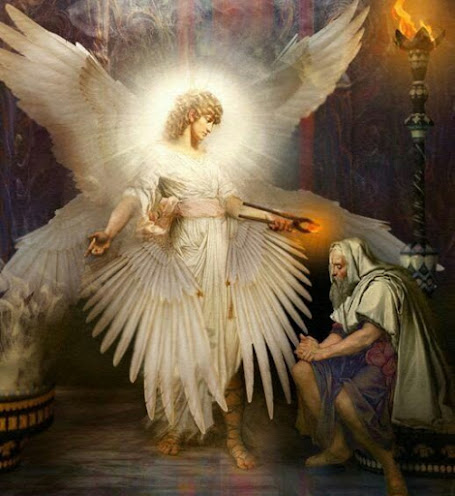
“In the year of king Ozias’ death, I had a vision. I saw the Lord sitting on a throne that towered high above me, the skirts of His robe filling the temple. Above it rose the figures of the seraphim, each of them six-winged; with two wings they veiled God’s face, with two His feet, and the other two kept them poised in flight. And ever the same cry passed between them, ‘Holy, holy, holy is the Lord God of hosts; all the earth is full of His glory.’ The lintels over the doors rang with the sound of that cry, and smoke went up, filling the temple courts. ‘Alas,’ said I, ‘that I must needs keep silence; my lips, and the lips of all my countrymen, are polluted with sin; and yet these eyes have looked upon their King, the Lord of hosts.’ Whereupon one of the seraphim flew up to me, bearing a coal which he had taken with a pair of tongs from the altar; he touched my mouth with it, and said, ‘Now that this has touched thy lips, thy guilt is swept away, thy sin pardoned.’ And now I heard the Lord say, ‘Who shall be My messenger? Who is to go on this errand of Ours?’ And I said, ‘I am here at Thy command; make me Thy messenger.'”
Again, remember where we are when at Mass. Isaiah may as well have been kneeling before the Cross at this moment, and his words could be ours at Mass, Wretched am I, a sinner, for here I am in the presence of the Holy One. Again, as in the gospel story, when S. Peter falls before the Holy One now clothed in human flesh, Who tells him that grace brings great things from humble souls. The same glory that shone upon Isaiah, that shone upon S. Peter, now shines upon us as well, at Mass.
“…He said to Simon, ‘Stand out into the deep water, and let down your nets for a catch.’ Simon answered Him, ‘Master, we have toiled all the night, and caught nothing; but at Thy word I will let down the net.’ And when they had done this, they took a great quantity of fish, so that the net was near breaking, and they must needs beckon to their partners who were in the other boat to come and help them. When these came, they filled both boats, so that they were ready to sink. At seeing this, Simon Peter fell down and caught Jesus by the knees; ‘Leave me to myself, Lord,’ he said; ‘I am a sinner.’ Such amazement had overcome both him and all his crew, at the catch of fish they had made; so it was, too, with James and John, the sons of Zebedee, who were Simon’s partners. But Jesus said to Simon, ‘Do not be afraid; henceforth thou shalt be a fisher of men.’“
And we begin the Eucharistic Prayer to thank God for His generosity to us, baffled in a way that the Ancient of Days should trouble Himself with little old us, overcome like the Fisherman was by the extraordinary miracle of the fish. So we huddle around the Bishop, and around the Successor of that Fisherman, the Holy Father in Rome, whose names we mention, and we ask God to accept the poor offerings we have just made. And (as we shall see when we talk about the end of the Mass) He has a mission for us, poor sinners though we are.
We might as well use S. Paul’s words in the second reading this weekend: I am the least of the people to be sent out by You, Lord, for I have been a great sinner, and I hardly deserve the name Apostle, but by your grace I shall be fruitful, by your grace I shall be an apostle. Then, as per the first reading, we continue: You have cleansed me of my sins, as the angel touches the coal to my lips.
And the Sacred Heart looks upon us and says, Be not afraid, you are to be apostles of My love, and through your love, you will catch and bring souls to Me.
“Of all the apostles, I am the least; nay, I am not fit to be called an apostle, since there was a time when I persecuted the Church of God; only, by God’s grace, I am what I am, and the grace He has shewn me has not been without fruit; I have worked harder than all of them, or rather, it was not I, but the grace of God working with me. That is our preaching, mine or theirs as you will; that is the faith which has come to you.”
First letter of the Apostle S. Paul to the Corinthians, 15: 9-11 [link]
In the last few weeks, I presented the Liturgy of the Word, together with the Penitential Rite and the recitation of the Creed as a sort of introductory session in the ‘marriage feast of the Lamb,’ which is an early description of the Mass. It’s like when you’re invited to a dinner party, but in a larger home you are led from the front door through hallways and ante-rooms before you arrive at the set table. In like fashion, the Mass is ordered in time as a dinner party is ordered in space.
So, here we are, having been led through the doorway of penitence and so being of readiness for union with God, and having been walked progressively through the ante-rooms of the Old Testament reading and the writings of S. Paul and others, and then the parlour of the gospel reading, a deacon (which is Greek for ‘servant’) stands before you and bids you prepare for your meeting with the Host of the event, the great King. He has offered you His heart, now you are to offer Him yours. So you recite the Creed, I believe in God the Father, I believe in God the Son, I believe in God the Holy Spirit, and you place your heart upon the altar, so-to-speak.
And then you hear the ministerial priest declare, Pray brothers and sisters, that my sacrifice and yours may be acceptable to God the Almighty Father… and the veil is lifted before the door into the dining room, and before you is the High King, Who stands to greet His guests. In our ears are the words of the priest as he calls out, Lift up your hearts, and we reply, We lift them up to the Lord. Soon afterwards, we are singing the song of the angels, Holy, Holy, Holy is the Ancient One, Hosanna in the Highest, and our gaze settles upon the familiar face of Christ as we say, Blessed is He Who comes in the name of the Lord. Thus have we fully entered into the heavenly Temple, and are prepared for the heart of the Mass: the Eucharistic prayer.
And this idea of entry into a temple may be an interesting way to introduce today’s festival, insofar as the Holy One enters His own Temple in Jerusalem, which was a facsimile of the heavenly Temple; and He enters to establish forever the locus of divine worship. The Holy Family honours their ancient religion with its Temple ritual on the eve of its transformation, which would happen on the hill of the Crucifixion. The Apostle S. John says in his gospel that the true Temple – the true Shrine – is the body of Our Lord. When that new Shrine hung dead upon the cross, a dreadful earthquake shook the old shrine and its veil was torn asunder. When that Body rose gloriously on Easter Sunday, true worship could only again take place through it. One of the principal points of the old Sacred Heart devotion was and is entering into the heart of Christ. As we say at the end of the Eucharistic prayer, Through Him, with Him, and in Him…
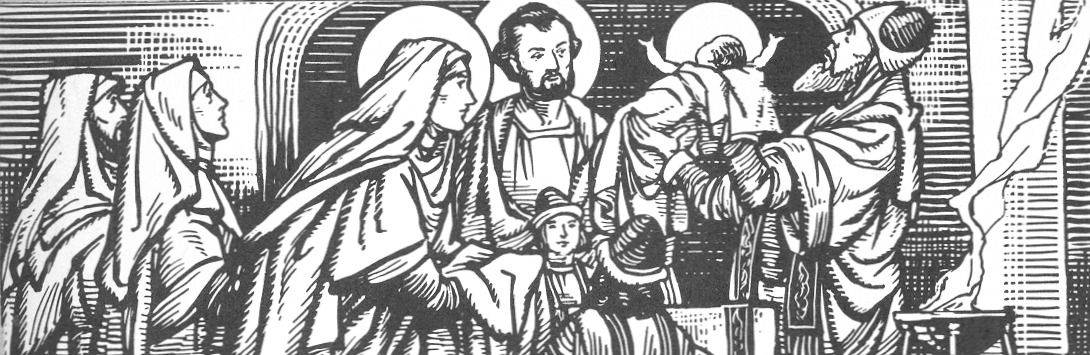
The Presentation of the Lord in the Temple comes precisely forty days after Christmas and is also connected with the Hebrew tradition of the purification of the mother after the birth of her son, which gives us some of our old Christian traditions of the ‘churching of women.’ This is very much a festival of both Our Lord and of His holy Mother. The prophet Malachi in our first reading looks forwards centuries before the event to the entry of the Holy One into His Temple in Jerusalem.
“See where I am sending an angel of Mine, to make the way ready for My coming! All at once the Lord will visit His temple; that Lord, so longed for, welcome herald of a divine covenant. Ay, says the Lord of hosts, He is coming; but who can bear the thought of that advent? Who will stand with head erect at His appearing? He will put men to a test fierce as the crucible, searching as the lye that fullers use.”
Those of you who listen to or read my ramblings about the Old Testament know that Solomon’s great Temple was destroyed in 587BC and a second Temple was built, which still stood in the first century. Malachi lived in the time of the second Temple, which was notably without the supernatural effects of Solomon’s Temple, which had had mysterious clouds and smoke, flashings of light, etc. The prophet looked into the future and saw when these supernatural effects would return, when the God of Israel would enter once more into His sanctuary in Jerusalem. The second reading this weekend tells us how the God of Israel took His descent as a human being from those very Hebrews whom Malachi was prophesying to, from the stock of Father Abraham. And the gospel story tells us of the circumstances of this extraordinary figure of the God-man being carried into the second Temple by His Mother Mary, closely followed by their guardian S. Joseph, who made the requisite sacrifice of four birds for the ‘churching’ of his wife.
The old priest Simeon was waiting for them. He was a prophet, not unlike Malachi, and he knew that he before he died would see the Holy One enter His Temple, as Malachi had foretold. With a joy that has echoed down to us in his famous words, Now, Master, you can let your servant depart in peace, S. Simeon returns the Child to Our Lady, saying to her that she would have to suffer much on the Child’s behalf, but through it all would Judgement come upon mankind, and Salvation to all who believe.
“At this time there was a man named Simeon living in Jerusalem, an upright man of careful observance, who waited patiently for comfort to be brought to Israel. The Holy Spirit was upon him; and by the Holy Spirit it had been revealed to him that he was not to meet death, until he had seen that Christ Whom the Lord had anointed. He now came, led by the Spirit, into the Temple; and when the Child Jesus was brought in by His parents, to perform the custom which the law enjoined concerning Him, Simeon too was able to take Him in his arms. And he said, blessing God, ‘Ruler of all, now dost Thou let Thy servant go in peace, according to Thy word; for my own eyes have seen that saving power of Thine which Thou hast prepared in the sight of all nations. This is the light which shall give revelation to the Gentiles, this is the glory of Thy people Israel.‘ The father and Mother of the child were still wondering over all that was said of Him, when Simeon blessed them, and said to his Mother Mary, ‘Behold, this Child is destined to bring about the fall of many and the rise of many in Israel; to be a sign which men will refuse to acknowledge; and so the thoughts of many hearts shall be made manifest; as for thy own soul, it shall have a sword to pierce it.”
To recap my little descriptions of the Mass on the last three Sundays, I called the Mass a celebration of the self-sacrificing love of God, as given by the Man on the cross. I might as well also call it a celebration of the human community that that Love has established – the Church, in all its hierarchical splendour. I don’t mean only the hierarchy of bishops and priests; every one of us is a member of the hierarchical constitution of the Church. As a human community, we have a history, and as a human community we have a code of conduct and rule of life, and a government also. S. Paul compared this communal aspect of the Church to the way parts of the animal body (we all have) work together to form a whole. We actually have this as our second reading this weekend. It is rather long for a second reading, but we priests like to hammer in a point, don’t we? Here’s a short extract…
“A man’s body is all one, though it has a number of different organs; and all this multitude of organs goes to make up one body; so it is with Christ. We too, all of us, have been baptised into a single body by the power of a single Spirit, Jews and Greeks, slaves and free men alike; we have all been given drink at a single source, the one Spirit.”
First letter of S. Paul to the Corinthians, 12: 12-13 [link]
The readings and the homily at Mass serve the upkeep of our social fabric, by preserving the stories of the founding of our community or family and the consequent social rule of Christ that is exercised in our midst. And then, this family of ours (around the world) approaches the heart of the Mass, the ‘source and summit of our lives’ (as the second Vatican council called it), when the community approaches physical union with Christ her Lord. But before this feast of faith, there are the Offertory rites, when we make our offering of ourselves to our divine Spouse. Remember my frequent mention of our individual relationship with God (as well as the communal relationship of the Church with Christ) as spousal.
In the Offertory, we may as well be making our vows to Him (He having made His own already) – in sickness and in health, for better or for worse, etc. – and the Eucharistic Prayer that follows is a great vote of thanksgiving and praise to the Holy One, of remembering His favours to us and asking for more. In the next few weeks, I shall be running slowly through the first Eucharistic Prayer – the Roman canon – which I have chosen because it is our most ancient Eucharistic Prayer, already in evidence over 1,500 years ago and traditionally much older. In looking at it, I hope to draw us into the Jewish Temple of ancient times, where our holy religion began in its essentials, and where (as per the book of Revelation) it will end.
And speaking of the Jewish Temple where our religion began, we have a narrative in our first reading this weekend of a religious service that was conducted after the second Jewish Temple was built, several decades after King Solomon’s Temple was destroyed by the Babylonian empire (586 BC).
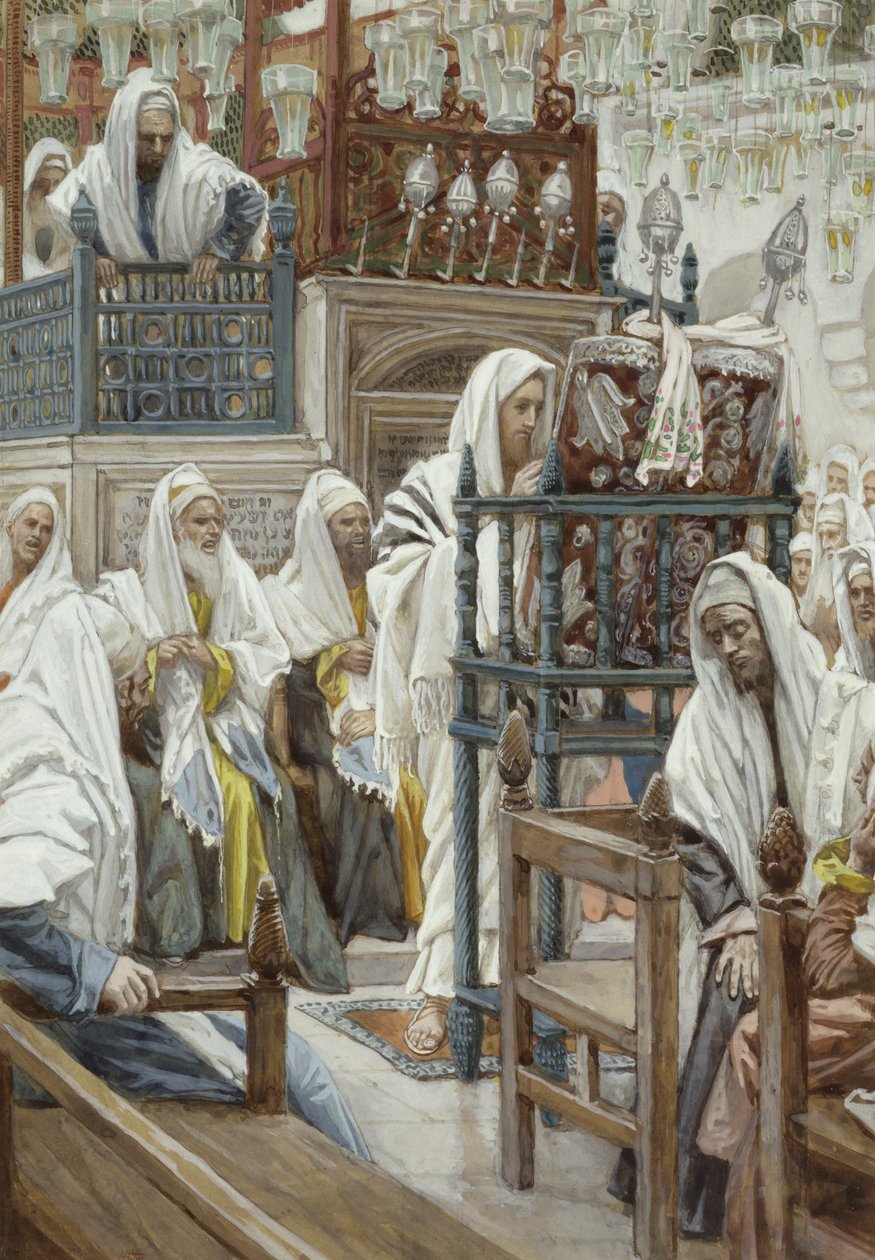
“…on the first day of the seventh month, the priest Esdras fetched out the book, in the presence of a great throng of men and women, with such children as were old enough to understand it. And there in the open space before the Water-gate he proclaimed the Law, before men and women and such younger folk as could take it in, from daybreak to noon, and all listened attentively while the reading went on. A wooden pulpit had been erected to carry the sound better, and at this the scribe Esdras stood; with him were Mathathias, Semeia, Ania, Uria, Helcia and Maasia on his right, Phadaia, Misael, Melchia, Hasum, Hasbadana, Zacharia and Mosollam on his left. Esdras was plainly seen, as he opened the book, by all the people underneath. When he had opened it, all rose; and when he blessed the Name of the Lord, the great God, all lifted their hands and answered, ‘Amen, amen’; and with that they bowed down and worshipped with their faces close to the ground. Then the Levites came forward, Josue, Bani, Serebia, Jamin, Accub, Sebthai, Odia, Maasia, Celita, Azarias, Jozabed, Hanan and Phalaia; these enjoined silence on the people, as they stood there in their places for the reading of the Law. And they read out the book of the law, clear and plain to give the sense of it, so that all could understand the reading.”
Nehemiah, the author of this book, was the Jewish governor of his time and it had been his task to restore the security of Jerusalem by rebuilding its encircling wall. But in our story here, let’s find a liturgical structure that we might find familiar. The priest Ezra brings together a congregation of men, women and children – so do we. He reads to them from the book from morn ’til noon – we thankfully don’t have readings that long at Mass. When he reads from his wooden dais or pulpit, probably from a lectern, everybody stands up – we still do that for the gospel. Ezra blesses the Holy One and everybody answers Amen, Amen – we do this at the end of the Eucharistic Prayer. And Ezra translates the Hebrew of the book and explains it – that sounds suspiciously like a homily to me, except much longer.
And it all ends with a bit of a feast – I needn’t mention Holy Communion. Historically, in the time of Ezra and from the time before the destruction of King Solomon’s Temple, the Jewish people had been scattered throughout the known world. Wherever they went, they already began to establish what we would recognise as synagogues to serve their national culture and identity, even as they do today. It was at one of these synagogues in the Greek area of Galilee in the north of the Holy Land that our Lord stood up, according to the gospel story, to tell His Jewish brothers and sisters that their long wait for a Messiah and the Successor of King David was over. That what Moses and the prophets, what Ezra and Nehemiah had established was being fulfilled. That Love had finally arrived and was standing before them.
“And Jesus came back to Galilee with the power of the Spirit upon Him; word of Him went round through all the neighbouring country, and He began to preach in their synagogues, so that His praise was on all men’s lips. Then He came to Nazareth, where He had been brought up; and He went into the synagogue there, as His custom was, on the sabbath day, and stood up to read. The book given to Him was the book of the prophet Isaias; so He opened it, and found the place where the words ran: ‘The Spirit of the Lord is upon me; He has anointed me, and sent me out to preach the gospel to the poor, to restore the broken-hearted; to bid the prisoners go free, and the blind have sight; to set the oppressed at liberty, to proclaim a year when men may find acceptance with the Lord, a day of retribution.’ Then He shut the book, and gave it back to the attendant, and sat down. All those who were in the synagogue fixed their eyes on Him, and thus He began speaking to them, ‘This scripture which I have read in your hearing is to-day fulfilled.'”
As if we needed a particular Sunday for this… every Sunday is a Sunday of the Word of God.
But Rome is making a point, and the Dicastery for Evangelisation is serious about this, as we can see from their website. If you click the button below, you can download a short PDF file about this weekend’s feast day and celebration.
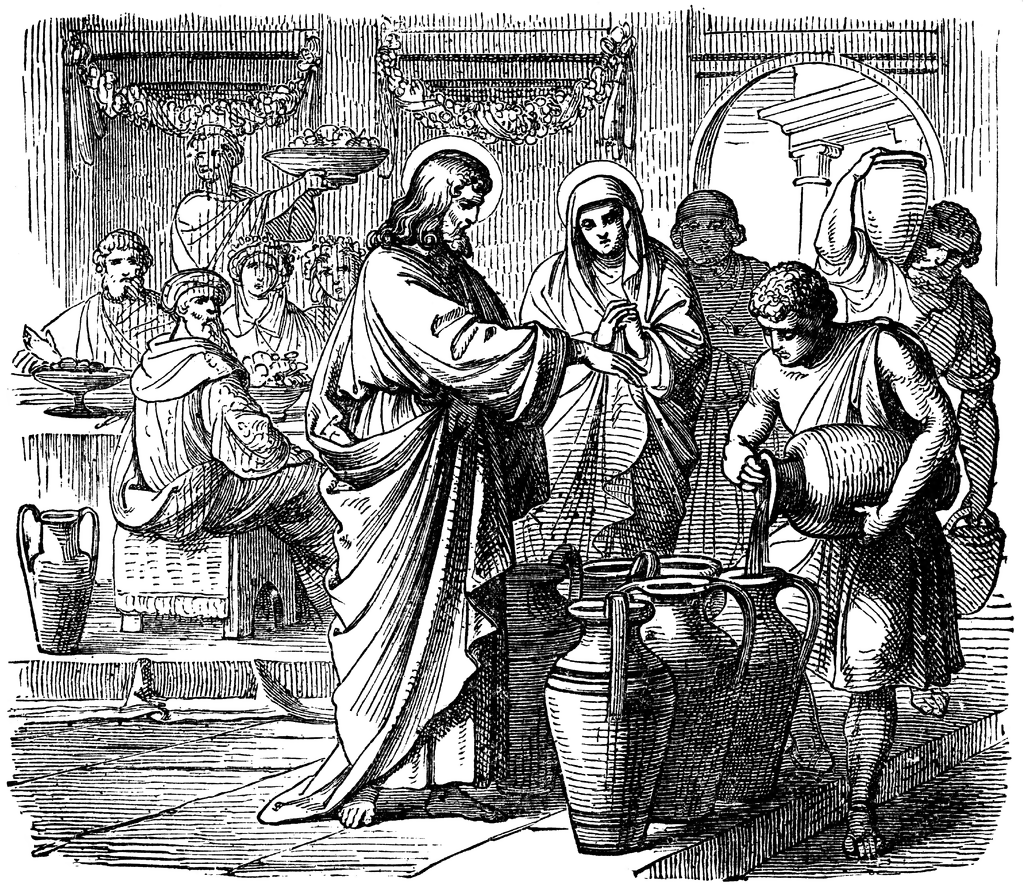
“Two days afterwards, there was a wedding-feast at Cana, in Galilee; and Jesus’ mother was there. Jesus Himself, and His disciples, had also been invited to the wedding. Here the supply of wine failed; whereupon Jesus’ mother said to Him, ‘They have no wine left.’ Jesus answered her, ‘Nay, Woman, why dost thou trouble Me with that? My time has not come yet.’ And His mother said to the servants, ‘Do whatever He tells you.’“
In the last two weeks, I called the Mass a festival or celebration of love, and specifically of the type of love which sacrifices itself for the sake of the person or persons loved, and a love that is demonstrated by the man on the Cross, which is why the crucifix has come to become a common feature of our churches and altars. The Mass is then a participation in the wedding feast of the Lamb, as is mentioned in the book of Revelation and in the gospels as the feast given by the high king to which many are invited. I also spoke of the purification of our own reciprocal love for God through penitence and confession, and I then described the readings as a memorial of the work of God throughout the history of the Hebrew and Jewish nation and the Church – what we call ‘salvation history.’ A sort of family history.
But I shall say today that the readings are also moral lessons. In fact, before the liturgical changes of the 70s, we used to call at least the first reading at Mass ‘the Lesson.’ So, we had the lesson and the Gospel. The Holy Father Paul VI decided that we should have a greater dose of S. Paul every Sunday and on holy days, and we received a second reading. Another lesson. So, we have two lessons and the gospel, and all of these give us moral and spiritual guidance. How we are to live our lives. The Hebrews/Jews have another word for that – ‘Torah,’ which we translate in English as Law. The Law of Moses.
And the Church declares that this Law of God became flesh and dwelt among us, and that the Word of God – the Guidance of God for our lives – took on a human face. And now we’re going to come back around to the subject of self-sacrificial love. Because that is the undergirding and the foundation of the Law of Moses of the Old Testament and the Law of Christ in the New Testament – the love for God and the consequent love for neighbour. That is what we are taught in the readings, and hopefully in the homily that follows them: how it is that we are to bring to bear practically this self-sacrificial love in our lives today. The Church uses Scripture – the Bible – and the wisdom she receives constantly through the inspiration of the Holy Spirit to produce for us such guidances – in the catechisms – which enable us to fulfil the Law of God in our own time.
And it is this type of self-sacrificial love that turns water into wine.
The beauty of this story of the wedding at Cana that we’ve had in our gospel reading this weekend is in Christ’s devotion to His holy Mother. When she said, Do something about that wine situation, He responded and said, But, Mother, my hour has not yet come. What hour is that? I’ve heard it said often that Christ’s hour was His crucifixion. Now, if the crucifixion was the extraordinary self-emptying and sacrifice of Christ, by which the divine love of God was finally made manifest in all its glory, then this excruciating torment of Christ’s is here connected with the wedding at Cana.
Christ says to His Mother, If I do this thing for you – if I bring them the wine they need – you know what comes next, you know that I shall next walk up to Jerusalem and be tortured and killed. So, this is not necessarily a smiling and cheerful Mary asking for this miracle at the wedding, but a sorrowful mother preparing with her request to offer her Son for the salvation of the world. When the master steward declared that the water drawn out was the best wine he had ever tasted, the Immaculate Heart looked forward to the Cross of her Son. And it is apparent to me that this is where the Catholic tradition of intercession to the Holy Mother begins. She can obtain the impossible from her Son, because of His extraordinary devotion to her.
And now, why this Sacrifice on the Cross? Could not humanity have been saved by God without this horrible blood-letting? We do not quite understand why blood sacrifice is required by God, but we know from Scripture that it is, and that this requirement is so serious that God Himself will undergo the pain of it, in order that the men and women He loves will not suffer eternal death. So, He says through Isaiah in our first reading, For Jerusalem’s sake, I will not be silent, I shall not weary, until her integrity shines forth in Christ My beloved Son, until her salvation – her Jesus – flames forth like a torch. And that torch has never burned brighter than from the Cross, not only for the benefit of the Jews but all the nations. And the new community – the new family – that is born out of that burning love of the Sacred Heart, the heart of God bared upon the Cross, would have a new name. This the prophet says. The new congregation would be named after her Lord, she would be called Christian.
“For love of Sion I will no more be silent, for love of Jerusalem I will never rest, until He, the Just One, is revealed to her like the dawn, until He, her deliverer, shines out like a flame. All the nations, all the kings of the nations, shall see Him, the Just, the glorious, and a new name shall be given thee by the Lord’s own lips. The Lord upholds thee, His crown, His pride; thy God upholds thee, His royal diadem.”
I had begun to speak about the Mass last week, and I called it the festival (or feast) of love. I described this marital type of love as a total mutual self-giving between the Church and God her Lord, and said that such a love requires frequent purification, so that it can be perfected. Hence the penitential ritual at the beginning of every Mass.
Now we can talk about the readings that we have at Mass, something that the Church has inherited from the synagogues of the first-century Jews. As with any other people, the Jews are a people of memory and tradition. They remember in particular the promises made by God to their patriarchs Abraham, Isaac in Jacob. When they wrote that down, it became the book of Genesis. They remember their extraordinary rescue from Egypt under Moses. When they wrote that down it became the book of Exodus. Moses gave them an elaborate religious ritual and an equally elaborate legal code, or (we might say) a guidance for right living in the presence of God. When they wrote all that down, it became the books of Leviticus, Numbers and Deuteronomy.
Much of the rest of the Old Testament is a narrative history of this nation of Jews, how they repeatedly fell out of their relationship with God, and how they recovered by the guiding hands of priests, prophets, and kings. And they waited (and many of them still wait) for the arrival of a Messiah, Who would tie up all the loose ends and draw them and with them all the rest of mankind into a right relationship with God.
In the New Testament, a remnant of this Jewish nation describes how that was accomplished in the person of the God-man Jesus Christ. Just as the synagogue remembered Moses and the prophets, the Church remembers Moses and the prophets, Christ and His Apostles. Think of this part of the Mass as a family get-together, where stories may be told of the origins of the family, the traditions of the family, how the family honoured God in the past and still honours Him today. Of the very essence of Holy Mass, and one of the most significant properties of the Catholic Church, is tradition, by which we perform the rituals that were given to the Apostles at the beginning and have been hallowed by the centuries.
And, on this feast day of the baptism of OLJC, we must bring to our minds that long history of the Jewish nation, for God Himself in becoming a Jew honoured that history and tradition. The rituals of purification and washing away of sins were given to the people by Moses as a symbol of the setting-aside of the filth of sin, so that the people could make a suitable offering of themselves to God. They belonged to Him by His own election – He had declared them to be His – and for that offering to be perfect they had to set aside every other item that dominated their lives and distracted them from Him.
Baptism is like the penitential rite at the beginning of Mass, which recognises sin and wipes the slate clean, allowing the offering of the rest of our lives to God to be more beautiful, more pure, more single-minded. Baptism is the preliminary to a daily consecration of our lives to God. And Christ Himself goes through the motion of purification at the hands of his cousin John. Did He need to do so – He Who remained without sin? Of course not. But when John protested, He replied and said that it was necessary to do all that Righteousness demands.
Righteousness according to Scripture is the fulfilment of the commandments of God. Christ wished in His sacred humanity to be a righteous Jew, to carry out perfectly the very same Law that He had given to Moses after He spoke to him from the burning bush. For the same reason, the Immaculate one, His mother, also obeyed every command of the Jewish Law, undergoing the rites of purity, when she was always without sin. It is in humility that Christ thus bows His head and takes up the yoke that is laid upon the shoulders of sinful and mortal humanity, living every aspect of human life perfectly, and raising human life thereby to the heights of sanctity and immortality. So the sinless One must needs undergo a ritual purification, and suffer and die for sin, for He takes upon Himself our sins, and is then sealed in the tomb of death designed for mortal men and women. But then, unexpectedly He walks out of it, walks out of the clutches of death, and in so doing carries mankind with Him.
“It was while all the people were being baptised that Jesus was baptised too, and stood there praying. Suddenly heaven was opened, and the Holy Spirit came down upon Him in bodily form, like a dove, and a voice came from heaven, which said, ‘Thou art My beloved Son, in Thee I am well pleased.'”
Just over a year ago, the Bishop had suggested that I should include a little bit more of catechesis in homilies, in addition to anything on the Scripture readings at Mass. So, for Sundays this year I shall include a short discourse on the common Catholic experience before I get to the readings. You may have heard this countless times before, but let’s begin with the Mass.
The Mass is the festival of love – and I am clearly not talking about erotic or sexual love. This love of ours is the agape of the Greeks that becomes the caritas (charity) of the Latins. The love that gives of itself for the sake of the beloved, that when taken to its extreme dies upon a cross for the sake of the beloved. If you’re a spouse and certainly if you’re a parent, you have an idea of what agape is, of what supreme charity is. And yes, this is what the Mass is all about. That’s why the Holy One hangs crucified above our heads. He would have us learn how to love as He does.
Over the next few weeks, I shall go through the Mass in sections. Today we begin with the penitential rite: the first bit, where we call to mind our sins and make an act of contrition (the Confiteor, or I Confess) and ask for mercy with the Greek words Kyrie Eleison – Lord, have mercy. Charity is a love which is complete, given entirely. It is a love that needs to be purified constantly, so that it can be given entirely. Just as those of us who are married choose to periodically make acts of charity/love to our spouses, and many Catholic spouses arrange to remake or renew their marriage vows now and again in a semi-ritualistic manner… similarly, we call to mind even our smallest sins during the penitential rite, sins by which we have betrayed God’s love, and prepare to remake/renew our promises to Him. Remember when Christ said in the gospel that the angels in heaven greatly rejoice over a single repentant sinner. This is therefore a fitting moment for us to add the great Gloria, using the words of the angels to the shepherds on Christmas Day: Glory to God in the highest, and peace to all of good will.
“‘If any of you owns a hundred sheep, and has lost one of them, does he not leave the other ninety-nine in the wilderness, and go after the one which is lost until he finds it? And when he does find it, he sets it on his shoulders, rejoicing, and so goes home, and calls his friends and his neighbours together; Rejoice with me, he says to them, I have found my sheep that was lost. So it is, I tell you, in heaven; there will be more rejoicing over one sinner who repents, than over ninety-nine souls that are justified, and have no need of repentance. Or if some woman has ten silver pieces by her, and has lost one of them, does she not light a lamp, and sweep the house, and search carefully until she finds it? And when she does find it, she calls her friends and her neighbours together; Rejoice with me, she says, I have found the silver piece which I lost. So it is, I tell you, with the angels of God; there is joy among them over one sinner that repents.'”
And speaking of Christmas, we cannot end our celebrations before the great festival of the kings from the east. The word we may read out as ‘mayjai’ is a plural of the Latin magus. So, magi. These were a species of learned men and even sorcerors, whether or not they were kings, and certainly knowledgeable enough about astronomy to know when a new light had appeared in the heavens. And when they had appeared in Jerusalem to find the Child, Jewish heads would have looked up at the mention of a new light shining out in the heavens, because of such prophecies as we have from Isaiah in our first reading today.
“Rise up, Jerusalem, and shine forth; thy dawn has come, breaks the glory of the Lord upon thee! What though darkness envelop the earth, though all the nations lie in gloom? Upon thee the Lord shall dawn, over thee His splendour shall be revealed. Those rays of thine shall light the Gentiles on their path; kings shall walk in the splendour of thy sunrise. Lift up thy eyes and look about thee; who are these that come flocking to thee? Sons of thine, daughters of thine, come from far away, or rising up close at hand. Heart of thee shall overflow with wonder and gratitude, to see all the riches of ocean, all the treasure of the Gentiles pouring into thee! A stream of camels thronging about thee, dromedaries from Madian and Epha, bringing all the men of Saba with their gifts of gold and incense, their cry of praise to the Lord!”
Why else would Herod go with his sword for the innocent young boys of Bethlehem, seeking to destroy Christ? He, Herod, in his pride may have thought that he and his dynasty and nobody else was the light of Jerusalem, and the glory of the Israel. Herod was an Idumaean, not a Jew, but had contrived with the Romans to be called the king of the Jews. And the people disliked him for it. And suddenly, here are foreigners from the East, asking where the new King of the Jews is. Foreigners! What else does Isaiah say in our reading? Foreign nations (Gentiles) will come to Jerusalem, foreign kings to her growing light.
This was always the promise of the prophets: that the coming of the Messiah would bring non-Jews and people from other nations into covenant with the God of Israel. Hence the response to our psalm today: All nations on earth shall fall prostrate before you, O Lord. And S. Paul would obviously have taken this message to the Church in Ephesus with its growing number of Gentile Christians, for we have in our second reading his assertion that the pagans (non-Jews, Gentiles) now share the inheritance of the Jews, being welcomed into a Jewish covenant by the Apostles and their associates.
And so when we look upon a nativity scene with the Child and His mother and S. Joseph and the shepherds – all Jews – and then we see with them the three kings – all Gentiles – bent in adoration, we should see the Child look upon us as if to say, You are not Jews, but even so, you are Mine.
“You will have been told how God planned to give me a special grace for preaching to you; how a revelation taught me the secret I have been setting out briefly here; briefly, yet so as to let you see how well I have mastered this secret of Christ’s. It was never made known to any human being in past ages, as it has now been revealed by the Spirit to his holy apostles and prophets, and it is this: that through the gospel preaching the Gentiles are to win the same inheritance, to be made part of the same body, to share the same divine promise, in Christ Jesus.”
“Bethlehem-Ephrata! Least do they reckon thee among all the clans of Juda? Nay, it is from thee I look to find a Prince that shall rule over Israel. Whence comes He? From the first beginning, from ages untold! Marvel not, then, if the Lord abandons His people for a time, until she who is in travail has brought forth her Child; others there are, brethren of His, that must be restored to the citizenship of Israel. Enabled by the Lord His God, confident in that mighty protection, stands He, our Shepherd, and safely folds His flock; fame of Him now reaches to the world’s end…”
We can tell that we are near Christmas at last, because we have very unusually a bit of the prophecy of Micah (Greek, Michaeas), which is very significant to the Christmas story. If you remember, when those wise men of the East arrived in Jerusalem, expecting to find the newborn King of the Jews in Herod’s palace, a very confused Herod asked his scribes where the Child was to be born. They, just as confused, reached for this prophecy of Micah.
The reading is quite clear. Ephratha was the old name of Bethlehem – the ancestral home of King David. Writing long after the time of David, Micah is talking about God’s promise of a new David, Who would be born at the original David’s home town. And yet, shockingly, the new David has a more ancient origin, a very ancient origin. This new David is the moment when God enters history powerfully after a long period of abandonment – centuries of a prophet-less Israel. But then God arrives as a shepherd to reunite the separated clans of the nation – for Micah says that the remnant of the Jews will gather around him – and the Shepherd-King would even draw non-Jews into his union – for Micah says that he will extend his power to the ends of the earth and bring peace. It is no wonder Herod panicked and killed every young boy his soldiers could get their hands on – a worldly king with a limited rule under Rome like him could not tolerate being removed and replaced by a high-king of all Israel and of all mankind, born only a few miles down the road in Bethlehem.
“Give audience, Thou that art the Guide of Israel, that leadest Joseph with a shepherd’s care. Thou Who art enthroned above the Cherubim, reveal thyself to Ephraim, Benjamin, and Manasses; exert Thy sovereign strength, and come to our aid. O God, restore us to our own; smile upon us, and we shall find deliverance… Long ago, Thou didst bring a vine out of Egypt, rooting out the heathen to plant it here; Thou didst prepare the way for its spreading, and it took root where Thou hadst planted it, filled the whole land. How it overshadowed the hills, how the cedars, divinely tall, were overtopped by its branches! It spread out its tendrils to the sea, its shoots as far as the great river. Why is it that in these days Thou hast levelled its wall, for every passer-by to rob it of its fruit? See how the wild boar ravages it, how it gives pasture to every beast that roams! God of hosts, relent, look down from heaven, look to this vine, that needs thy care.”
The psalm this weekend is an ancient song of Israel, for the nation was the vine planted by the God the Shepherd and requiring His protection. Centuries later, He would stand among the people in the person of Christ and say, I AM the vine and My heavenly Father is the vinedresser, so stay attached to Me. The Gospel reading is extraordinary because the pre-born S. John the Baptist dances at the sound of the voice of the Holy Mother, just as we Catholics tend to dance with joy at news from the Blessed Virgin. Yes, of course, she was visiting S. Elisabeth pregnant and we have always spoken of S. John leaping at the presence of his pre-born Lord. But it is striking, that Luke speaks of Mary’s greeting, which at once furnishes us with some words for our Hail Marys, as Elisabeth exclaims aloud, Blessed art thou, and blessed the fruit of thine womb.
“In the days that followed, Mary rose up and went with all haste to a town of Juda, in the hill country where Zachary dwelt; and there entering in she gave Elizabeth greeting. No sooner had Elizabeth heard Mary’s greeting, than the child leaped in her womb; and Elizabeth herself was filled with the Holy Ghost; so that she cried out with a loud voice, ‘Blessed art thou among women, and blessed is the Fruit of thy womb. How have I deserved to be thus visited by the mother of my Lord? Why, as soon as ever the voice of thy greeting sounded in my ears, the child in my womb leaped for joy. Blessed art thou for thy believing; the message that was brought to thee from the Lord shall have fulfilment.'”
That’s all I have for this weekend. I wish you the very best for holy festival of the Nativity of our Lord. I pray that you will deepen your prayer, join your heart to His Sacred Heart, and let Him be born anew in the depths of your heart, making His home within you, and establishing peace with you forever.
The following letter will be read at all Sunday Masses across the weekend of the 28th and the 29th of December for the feast day of the Holy Family.
“Hope does not disappoint, because God’s love has been poured into our hearts through the Holy Spirit that has been given to us.” (St Paul, Romans 5:5)
“Hope is the central message of the Jubilee Year 2025 which today, the Feast of the Holy Family, now formally begins in our diocese and every Catholic diocese throughout the world. Our schools, presently on holiday, will have their special start to the Jubilee Year on 24th January. Pope Francis’ prayer for us all, young and not so young, is that this Jubilee Year might be a time of renewed personal encounter with Christ Jesus and an opportunity to be renewed in our Christian hope. Our Holy Father is very aware that, in these uncertain times across our world, hope feels under attack and many people feel very anxious. He encourages us to find in God’s Word reasons why our Christian hope will never deceive or disappoint us. That hope is, of course, grounded in the certainty that nothing and no-one can ever separate us from God’s love. Saint Paul can certainly testify to a life of faith that suffered many trials but in which hope endured: ‘We rejoice in our sufferings, knowing that suffering produces endurance, and endurance produces character, and character produces hope.’ (Romans 5: 3-4)
“Ordinary Jubilees now take place across the Catholic Church every twenty-five years; the previous one, in the year 2000, was to celebrate two thousand years since the birth of Jesus Christ. More recently, in 2015, Pope Francis proclaimed an extra-ordinary Jubilee of Mercy to encourage each of us to encounter the merciful face of God, and then to share that mercy with others. Throughout this Ordinary Jubilee Year 2025, Pope Francis is inviting us to open ourselves to what he calls ‘an intense experience of the love of God that awakens in hearts the hope of our salvation in Christ.’ We are to set out on this Jubilee Year, ‘firm in our faith, active in charity and steadfast in hope.’ He encourages us to be Pilgrims of Hope, putting our Christian faith into action in our relationships with those around us who are experiencing hardships: the sick, the elderly, people with disabilities, the poor, the homeless, those in prison, and migrants and refugees. He invites us to give special encouragement to the young because as he says, ‘they are the joy and hope of the Church and of the world.’ As a practical example of hope, he asks that the more affluent countries cancel the debts of countries that will never be able to repay them.
“In Rome, all the Holy Doors of the Basilicas of Saint Peter, Saint John Lateran, Saint Mary Major, and Saint Paul Outside the Walls, will be opened to pilgrims as particular places of pilgrimage during the Jubilee Year; here a special indulgence may be received under the usual conditions of sacramental confession, reciting the creed and receiving Holy Communion. Many people will be unable to visit these Basilicas in Rome, so here in our diocese I have designated nine churches as Jubilee Churches, one in each deanery: the Cathedral Church of Saint Barnabas; Good Shepherd, Woodthorpe; Saint Philip Neri, Mansfield; Our Lady of Lincoln, Lincoln; Our Lady and Saint Norbert, Spalding; Saint Mary, Derby; Saint Joseph, Matlock; Holy Cross, Leicester; and Saint Mary of the Annunciation, Loughborough. The Jubilee indulgence can be received in these churches under the same conditions when people visit them on pilgrimage. My hope is that parishes across each deanery will make a special effort to journey as Pilgrims of Hope to the local Jubilee Church; deaneries might also like to make a collective Jubilee Pilgrimage to our diocesan Cathedral.
“There is a special Jubilee Prayer which I would encourage you to pick up from church this weekend; please take two, one for yourself and one for someone you know who may not be a regular church-goer but who might appreciate receiving it. Why not agree to pray it for each other! A Jubilee hymn has been composed which, in our diocese, has been set to a well-known tune so as to encourage it to be sung throughout the year. Rather than try to do too many extra things in the course of the Jubilee Year, I suggest that what we already do be badged up as Jubilee events. For example we can speak of people ‘baptised in the Jubilee Year’ or ‘getting married in the Jubilee Year’. Parishes might decide to have a Jubilee Summer Fete with the Jubilee logo on a special cake. Each parish, school and chaplaincy is encouraged to be as creative as it wishes in integrating the Jubilee Year into existing activities.
“During Lent I will celebrate a Jubilee Deanery Station Mass in each of our Jubilee Churches. The Deans will advertise the details of these Masses where there will also be an opportunity for Confessions, Eucharistic Adoration, and to receive the Jubilee indulgence. I very much look forward to meeting many of you on these occasions. Throughout the year special days have been set aside to celebrate particular Jubilees. An impressive list of these has been put up on the diocesan website, included in the Ordo, the diocesan Liturgical Calendar, and has been distributed to parishes, schools and chaplaincies. During the Jubilee Year we will also be celebrating, on 29th September, the 175th anniversary of the creation of our diocese.
“In the midst of the troubles in life that besiege us, may this Jubilee Year help us all to deepen still more our relationship with Our Lord and Saviour, Jesus Christ, whose birth we are celebrating this Christmastide. May we recognise Him more and more as our steadfast hope and firm anchor in life, and may He send us out into our wider communities to be the living signs of hope He desires us to be. So, as we set out to be Pilgrims of Hope this Jubilee Year, may I encourage you with these words of the Psalmist, ‘Hope in the Lord! Hold firm, take heart and hope in the Lord.’ (Psalm 27:4)
“With prayer for the New Year, and good wishes on this special Feast of the Holy Family,
I have determined to not prepare any homilies for the Christmas Masses, for it would be far too tedious considering the long list of readings the Church has prepared for us. So, I thought for a Christmas post, I would simply drift through some of these readings.
Many families will turn up for the first Mass of Christmas this evening, which is the vigil Mass, which anticipates the great festival. If you attend this Mass, you will suffer through the long genealogy of our Lord given at the top of S. Matthew’s gospel. For priests, this is mostly a stumbling through mostly unfamiliar Hebrew names. Matthew, writing for a Jewish audience, begins with the first Jewish patriarch, Abraham, and omits several levels to flatten the whole into three sets of fourteen: from Abraham to David (I), from David to the deportation of the people to Babylon (II), and from the deportation to Christ (III). I: Abraham – Isaac – Jacob – Juda – Phares – Esron – Aram – Aminadab – Naasson – Salmon – Booz – Obed – Jesse – king David – II: Solomon – Roboam – Abias – Asa – Josaphat – Joram – Ozias – Joatham – Achaz – Ezechias – Manasses – Amon – Josias – Jechonias – III: Salathiel – Zorobabel – Abiud – Eliacim – Azor – Sadoc – Achim – Eliud – Eleazar – Mathan – Jacob – Saint Joseph, spouse of the BVM – Christ.
I’ve highlighted some of these great ancestors of Christ in His humanity. Abraham, of course, is the father of the nation. His son Isaac and his grandson Jacob are normally named with him as the great patriarchs, so that when the Holy One appears to the law-giver Moses in the Exodus story, He identifies himself as the God of Abraham, Isaac and Jacob. Jacob’s son Juda is significant for the Jews and Christians because his is the tribe from which came the great shepherd-king David, and the prophets of old Israel promised repeatedly that a new king David, the Successor of David, would one day return to bless the nation. Booz, or Boaz, is significant in joining the bloodline of Juda with that of the Moabites from the East of the Jordan, for he married the widowed wife of a cousin of his, the Moabitess Ruth. Decades later, King David would find this link useful, when he was fleeing for his life and sent his family for protection to the king of Moab. David received the promise that the Salvation (Hebrew, Yehoshuah, Greek, Jesus) of God would emerge from his own descendants, which is why such people as the blind beggar of the gospel stories called Christ Jesus, Son of David. Solomon, the son of David, would upgrade the religion of the people by building a stone Temple in Jerusalem and activating his father’s detailed liturgical preparations for it. Centuries later, Achaz received the promise of the virgin birth of Christ, as given by chapter seven of the prophecy of Isaiah. Ezechias and Josias are the most highly regarded of the kings of Judah, who restored and preserved the ancient religion before the kingdom was destroyed and the Temple levelled in 587 BC. Seventy years later, Zorobabel built a second Temple and restored the old religion, and his family carefully preserved for the remaining centuries the promise once made to King David, that his Successor would arrive as the anointed (Greek, Christ) king of the Jews. For as God says through the prophet Isaiah in the first reading at the vigil Mass,
“For love of Sion I will no more be silent, for love of Jerusalem I will never rest, until He, the Just One, is revealed to her like the dawn, until He, her Deliverer, shines out like a flame. All the nations, all the kings of the nations, shall see Him, the Just, the Glorious, and a new name shall be given thee by the Lord’s own lips.”
The Just One we know as Christ and the people receives a new name in Him. They are called after Him. Once the children of Adam and (as Jews by blood) of Abraham, once reborn in Christ they are His children. And that brings us to the night Mass, which many of us will celebrate as a midnight Mass. Our readings day begin with Isaiah’s several names for the Successor of David.
“For our sakes a Child is born, to our race a son is given, whose shoulder will bear the sceptre of princely power. What name shall be given Him? Peerless among counsellors, the mighty God, Father of the world to come, the Prince of peace. Ever wider shall His dominion spread, endlessly at peace; He will sit on David’s kingly throne, to give it lasting foundations of justice and right; so tenderly He loves us, the Lord of hosts.”
So, the Child bears a sceptre of princely power, great counsellor, unsurprisingly He is mighty God and Father of the future world, and Prince of Peace. Having received this wonderful prophecy, the midnight Mass now presents us with the circumstances of Christ’s birth in the gospel narrative. Joseph is given to be a son of David himself, and tradition tells us that Mary his wife was as well. The very reason they went to Bethlehem was to honour the census command of the Roman governor Quirinius in Antioch, and every man had to return to his home country for it, so Joseph headed for the traditional home town of shepherd-king David – Bethlehem – where he must have had family property. But why did angels send a message only to the shepherds on the hills about the birth of Christ? Perhaps they were the only ones awake at that hour. And perhaps it was because they were shepherds, and were being summoned to receive their own Shepherd, Who is God in the flesh.
The sequel to the call of the shepherds is their arrival at the crib, and that takes us to the dawn Mass, which gives us the reaction of the shepherds. Neither Mary nor Joseph were expecting visitors so very early, but the shepherds described the astonishing angel choirs on the hills, and Mary promptly stored the information away so she could later tell S. Matthew about it. The shepherds had more to rejoice about than simply proving the words of the angels on the hills. As religious Jews, they may have remembered the lines of Isaiah, given us by the first reading at the dawn Mass, which were coming to fruition before their eyes. Here the Deliverer is God Almighty Who brings His labour or task of redemption to completion in His birth as a human child. By innocent humanity is fallen and sinful humanity restored. Such is His plan. So, the sinful are no longer forsaken.
“Out, out through the city gates! Give My people free passage; a road, there, a smooth road, away with the boulders on it! Raise a signal for all the nations to see. To the furthest corners of the earth the Lord proclaims it, A message to queen Sion: Look, where thy Deliverer comes, look, how they come with Him, the reward of His labour, the achievement of His task! A holy people they shall be called, of the Lord’s ransoming, and thou the city of His choice, no more forsaken.”
And, with the day Mass, we set aside the history of the Nativity of Christ and rejoice and marvel in the reality of it. So, Isaiah sings for joy in the first reading that first Jerusalem – the Jewish nation, that is – is renewed and then she becomes a beacon to the rest of the world. For Salvation comes from God through the Jewish nation, through the little Jewish boy lying in the manger in the Bethlehem stable. And the Church has no better song for this than the great hymn at the top of the Gospel of S. John, with which I shall end this post.
“At the beginning of time the Word already was; and God had the Word abiding with Him, and the Word was God. He abode, at the beginning of time, with God. It was through Him that all things came into being, and without Him came nothing that has come to be. In Him there was life, and that life was the light of men. And the Light shines in darkness, a darkness which was not able to master it. A man appeared, sent from God, whose name was John. He came for a witness, to bear witness of the light, so that through him all men might learn to believe. He was not the Light; he was sent to bear witness to the Light. There is One Who enlightens every soul born into the world; He was the true Light. He, through Whom the world was made, was in the world, and the world treated Him as a stranger. He came to what was His own, and they who were His own gave Him no welcome. But all those who did welcome Him, He empowered to become the children of God, all those who believe in His Name; their birth came, not from human stock, not from nature’s will or man’s, but from God. And the Word was made flesh, and came to dwell among us; and we had sight of His glory, glory such as belongs to the Father’s only-begotten Son, full of grace and truth.“
Let’s talk about John the Baptist. We don’t tend to see him as much more than the herald of Christ, and some of us may remember that he baptised our Lord in the Jordan river. We know that he had a particular ministry to the people, and his own baptismal rite for a spiritual washing to accompany their repentance and desire to return to God. But we know from S. Luke’s narratives that his father Zecharyah and his mother Elisabeth were both of the priestly family of Aaron the brother of Moses, and so John would have been destined from his birth for the priestly work of the Temple in Jerusalem. And he was dedicated from his birth to the Holy One in a special way.
And yet, he did not train for the Temple, and seems to have avoided the Temple to the point of fleeing into the wilderness of Judah, where he conducted his ministry. And it was a truly priestly ministry, even if it was ordered away from the Temple. What was a Hebrew priest? First, of course, there was the priest’s Temple ministry of offering divine worship, and conducting the sacrificial rites. But the priest was also a teacher and a ruler of the people. We call John ‘the baptist,’ the Jews who knew him would have called him John the son of Zecharyah the priest. He would have had a considerable following as a Jewish rabbi, and we see glimmers of that in the gospel, when for example we hear that many of his disciples became followers of Christ.
“And the multitudes asked him, ‘What is it, then, we are to do?’ He answered them, ‘The man who has two coats must share with the man who has none; and the man who has food to eat, must do the like.’ The publicans, too, came to be baptized; ‘Master,’ they said to him, ‘what are we to do?’ He told them, ‘Do not go beyond the scale appointed you.’ Even the soldiers on guard asked him, ‘What of us? What are we to do?’ He said to them, ‘Do not use men roughly, do not lay false information against them; be content with your pay.’ And now the people was full of expectation; all had the same surmise in their hearts, whether John might not be the Christ. But John gave them their answer by saying publicly, ‘As for me, I am baptizing you with water; but One is yet to come Who is mightier than I, so that I am not worthy to untie the strap of His shoes. He will baptize you with the Holy Ghost and with fire. He holds His winnowing-fan ready, to purge His threshing-floor clean; He will gather the wheat into His barn, but the chaff He will consume with fire that can never be quenched.'”
It is obvious from our reading above that John had a moral authority, and his message came from the Law of Moses, a law that was designed above all to teach charity; hence the command to share, for tax-collectors and soldiers to not extort or exploit. But this was still not an ordinary teacher of the Law; there was something different about this consecrated soul, and I am certain it was his thorough dedication to God that was made at the time of his conception, when the angel appeared to his father Zecharyah. People don’t seize upon just any teacher and wonder if he may be the promised Messiah.
But they saw in John a teacher unlike other teachers; they heard prophecy once more, after hundreds of prophet-less years. And the holy man, with fire in his eyes, declared that his baptism was inferior, that he had only come to bring about repentance, and that the Holy One Himself was imminent, for only God Himself could bring judgement as John describes: gathering the wheat and burning the chaff. John practically uses the words of our first reading today, from the royal prophet Zephanyah: the Lord is in your midst as a victorious warrior, He will exult over you and renew you with His love.
“Break into song, fair Sion, all Israel cry aloud; here is joy and triumph, Jerusalem, for thy royal heart. Thy doom the Lord has revoked, thy enemy repulsed; the Lord, there in the midst of thee, Israel’s King! Peril for thee henceforth is none. Such is the message yonder day shall bring to Jerusalem: Courage, Sion! What means it, the unnerved hand? Thou hast one in the midst of thee, the Lord thy God, Whose strength shall deliver thee. Joy and pride of His thou shalt be henceforward; silent till now in His love for thee, He will greet thee with cries of gladness. Truants that were lost to the covenant I will reclaim; of thy company they are, thou shalt be taunted with them no longer…”
We do not know how long John’s ministry was; the gospel narrative can make us think it was for only a few weeks or months before the arrival of Christ. But consider that it might have been a work of years, so that when Christ did arrive John’s handing over of the baton was a great act of humility of the servant for his Master. Or rather, in John’s own words from the gospel, as the best-man making way for the Bridegroom to take up His Bride, which is the Church of God.
What does a prophet do, when the glory of God manifests to the people? He steps aside. What is the prophet’s ultimate desire, aside from that the will of God be done? He wants the best for the people. That’s why he serves. That’s why our priests serve us today, not for themselves or their own glory, but for the glory of God and the salvation of souls. Whose souls? Ours. The second reading gives us another window into the soul of the priest of Christ’s church. The priest here is S. Paul, a man who suffered very much for the many small churches he had erected everywhere. And he says here to his Philippians that he wants their ultimate happiness, which they will only find in God. He wants to see the love, the charity of God manifest in them. He wants them to trust God entirely and not worry. And he wants them to pray, especially for peace of heart in every circumstance, good or bad.
“Joy to you in the Lord at all times; once again I wish you joy. Give proof to all of your courtesy. The Lord is near. Nothing must make you anxious; in every need make your requests known to God, praying and beseeching him, and giving him thanks as well. So may the peace of God, which surpasses all our thinking, watch over your hearts and minds in Christ Jesus.”
The letter of S. Paul to the Philippians, 4: 4-7 [link]
I had said last weekend that Advent is both remembering the preparations for the First Coming of Christ in Bethlehem and the preparations for the Second Coming of Christ in glory, on the clouds of heaven, with angelic assistants, etc. I had suggested that our vigil for the Second Coming could take example from the vigil of the Jewish people for their Messiah, more than two thousand years ago and more. The first reading this weekend is about the glorification of Jerusalem, which takes place in Christ and His Church.
“Enough, Jerusalem; lay aside now the sad garb of thy humiliation, and put on bright robes, befitting the eternal glory God means for thee; cloak of divine protection thrown about thee, thy temples bearing a diadem of renown. In thee God will manifest the splendour of His presence, for the whole world to see; and the name by which He will call thee for ever is, Loyalty rewarded, Piety crowned. Up, Jerusalem, to the heights! Look to the sun’s rising, and see if thy sons be not coming to thee, gathered from east to west, joyfully acknowledging God’s holy will! Afoot they were led off by the enemy; it is the Lord that shall lead them home, borne aloft like royal princes. He will have the ground made level; high mountain must stoop, and immemorial hill, and the valleys be filled up, for Israel’s safe passage and God’s glory; spinneys of every scented tree shall grow, by His divine command, to give Israel shade. So merciful He is, and so faithful! In great content, their journey lit by the majesty of His presence, Israel shall come home.”
The prophet Baruch was a scribe working alongside the prophet Jeremiah, the both more often than not thinking with one mind, and Baruch acting as Jeremiah’s spokesman when Jeremiah was imprisoned or otherwise unable to function as prophet. The prophets usually saw Jerusalem the Holy City as dressed by God in glorious vestment, prepared as a bride for her Husband, Who is God. The vestment assumes an integrity and a purity, especially from idolatry, and God honours that purity and dresses the pure one – here Jerusalem – with glory. When the people fell into sin and idolatry, they lost their purity. When they pretended to serve God in holiness while they were fallen deep into vice and the degradation of sin, they lost their integrity.
Jerusalem in this reading represents the people of God. God had made the Hebrew people glorious and a sign to every other nation of the earth, and they had failed to be faithful as a nation, and been humiliated in their pride by the great powers of the time, the Assyrians and the Babylonians. The prophet is here calling the people to repentance and atonement with God. Arise, he says, stand upon the heights, take up your mantle of purity once more and the splendour that God once gave you and which is yours.
Baruch and Jeremiah lived through two successive exiles of the Jewish people from Jerusalem and Judah to Mesopotamia and other countries. Writing now, in the period between the first exile and the destruction of Jerusalem and the second exile, Baruch is calling upon the people to return to God, and if they do, the captives of the first exile would be returned. A beautiful hope, especially when we know that the people did not repent, and there was a second exile after the City was destroyed. Bondage came, the Jewish kingdom was destroyed.
But Jerusalem would be glorified as the dazzling bride of the Holy One, in mercy and integrity, centuries later. And the beginning of that glorification is what we honour particularly this weekend. For the eighth day of December is the day Catholics remember the Immaculate Conception, when the Blessed Virgin Mary appeared in the womb of her mother S. Anna. The bishops have delayed the liturgical observance to Monday, to preserve the second Sunday of Advent, but Sunday is still the calendar day. The significance of this conception of Our Lady should be obvious to us, in so far as we human beings in a very real way are our parents, in that we take our humanity and our human traits materially from them.
And when God decided that He would be a man, and that He would be born of a Virgin, He proposed to take His humanity materially from this beautiful woman, the purest of all created things, conceived without sin – as we Latins say, conceived immaculate – sine macula, without stain of sin. In the Blessed Virgin Mary at the moment of her conception in the womb of S. Anna mercy and integrity begin to return to the human race in this daughter of Adam, and we are left to marvel at the miracle. In the words of the psalm, When God finally delivered Sion or Jerusalem – the Hebrew nation – from bondage to sin – in Mary – He had finally prepared all things for the glorification of Jerusalem that was to follow, in the life, death and resurrection of Christ. What a marvel the Lord worked for the Hebrew nation!
“It was in the fifteenth year of the emperor Tiberius’ reign, when Pontius Pilate was governor of Judaea, when Herod was prince in Galilee, his brother Philip in the Ituraean and Trachonitid region, and Lysanias in Abilina, in the high priesthood of Annas and Caiphas, that the word of God came upon John, the son of Zachary, in the desert. And he went all over the country round Jordan, announcing a baptism whereby men repented, to have their sins forgiven, as it is written in the book of the sayings of the prophet Isaias, ‘There is a voice of one crying in the wilderness, Prepare the way of the Lord, straighten out his paths. Every valley is to be bridged, and every mountain and hill levelled, and the windings are to be cut straight, and the rough paths made into smooth roads, and all mankind is to see the saving power of God.'”
The link of our gospel story to Baruch’s prophecy is clearly in the levelling of mountains and filling in of valleys, in order to allow Jerusalem and Judah to be more quickly restored, as per Baruch. But S. John the Baptist has a greater vision: it isn’t only the Hebrew nation returning to God in the Messiah, but all nations of the earth – all mankind. But this reading also begins the ministry of S. John (and so of Christ), with as historical a circumstance as was possible to a writer from the first century (S. Luke, that is), naming the Roman emperor, the Roman governor of the Levant, the Jewish rulers in place, and the chief priests of the Temple in Jerusalem.
For God called His people historically in Moses, and built the Temple in Solomon, and now prepares to fulfil all the promises He had made long ago to Adam to finally remake/sanctify humanity, in the birth, life, death and resurrection of Our Lord Jesus Christ, to Whom be glory and praise for all ages.
Having last Sunday celebrated the triumph of the Son of David, the Sovereign King of all things, we cycle around again this Sunday to the centuries of expectation of the Messiah. This is what Advent is – a means of stepping into the shoes of those Jewish men and women of the late Jewish period in the last few decades before Christ.
Following the destruction of the Jewish kingdom in the sixth century BC, and the several attempts of great kings and rulers to break the spirit of the Jewish nation, prophets predicted the restoration of the Davidic monarchy in the son of David, and the prophet Daniel, a Jewish captive of the Babylonian empire, predicted with some precision when this would happen. As that moment appeared, the people looked here and looked there for the promised King of the Jews. We know how anxiously they looked from the gospel account of the anxiety of the Idumaean king Herod when the magi from the east appeared and suggested that the child had already been born and Herod was afraid that the new Jewish king (however young) could supplant him, for he – Herod – was a foreigner.
But let’s come back to the heightened expectation as the prophet Daniel’s predicted moment approached. Our first reading gives us the prophet Jeremiah’s mention of the promise made to the nation of Israel concerning the house of Judah, and the prophet speaks of the Branch (here ‘scion’).
“‘Behold,’ [the Lord] says, ‘a time is coming when I will make good My promise to Israel and Juda; the day will dawn, the time be ripe at last for that faithful scion to bud from David’s stock; the land shall have a king to reign over it, giving just sentence and due award. When that time comes, Juda shall find deliverance, none shall disturb Jerusalem’s rest; and the name given to this king shall be, The Lord vindicates us.'”
Now, we might think that this is a branch of a great tree, perhaps the tree of Israel. But remember that Jeremiah was prophesying the destruction of the Jewish kingdom, and the destruction of Jerusalem, and that he lived through the same in the sixth century before Christ. He knew that the tree of David – the Davidic monarchy – was about to be felled or had been felled. Jeremiah was speaking of a branch sprouting from the stump of the felled dynasty of David. The Hebrew root for the word ‘branch’ is nzr, nazara. If that sounds familiar, it’s because it is the root of the name Nazareth.
It is a Christian tradition that both the families of the Blessed Virgin and of S. Joseph came from the area of Nazareth in the Galilee, at some distance from Jerusalem. In the first century, it would have been common knowledge that descendants of the House of Judah and the family of David were living in that place; it may be the reason it got its name – it was the place of the Branch. Those who studied their Scriptures in the first century, and knew of the promises, would have had their eyes on Nazareth.
How would they have prepared themselves for the imminent arrival of the Branch, of the Son of David, of the Messiah? In the Roman tradition of the Catholic Church, before a great festival, such as Christmas or Easter, there has always been a period of vigil, characterised by the colour purple. Those of us who remember the liturgical dispensation before the changes in the late 1960s will know that some lesser feast days also had a vigil day before, such as the feast of S. Lawrence in August. A vigil is a period of prayerful waiting. It is a time of penitence, which is indicated by the purple. It is a time of purification, and greater commitment to the setting aside of sin. Our gospel story is of Christ telling us that our whole lives should be a vigil in preparation for His return in glory.
“‘Only look well to yourselves; do not let your hearts grow dull with revelry and drunkenness and the affairs of this life, so that that day overtakes you unawares; it will come like the springing of a trap on all those who dwell upon the face of the earth. Keep watch, then, praying at all times, so that you may be found worthy to come safe through all that lies before you, and stand erect to meet the presence of the Son of Man.'”
Let’s pick out some ideas for a vigil from His words, so that we can characterise our Advent vigil… we are to watch ourselves, take up self-control to avoid possible drunkenness and debauchery, we are to stay awake, praying for the strength to survive every threat to our perseverance and faithfulness to God, and to stand confidently in all purity before the Son of Man. And what can S. Paul say to help us in the second reading from Thessalonians this weekend?
“…may the Lord give you a rich and an ever richer love for one another and for all men, like ours for you. So, when our Lord Jesus Christ comes with all His Saints, may you stand boldly before the presence of God, our Father, in holiness unreproved. Amen. And now, brethren, this is what we ask, this is our appeal to you in the Name of the Lord Jesus. We gave you a pattern of how you ought to live so as to please God; live by that pattern, and make more of it than ever. You have not forgotten the warnings we have handed on to you by the command of the Lord Jesus.”
First letter of S. Paul to the Thessalonians, 3: 12 – 4: 2 [link]
So… our vigil this Advent should confirm us in love for each other and for the whole human race. Paul also talks about purity, and blamelessness before Christ and he ends with a call to make progress in the life of holiness, according to the traditions handed on by Apostles like himself. Here are our instructions for Advent; let us commit to them, and do well.
On the last Sunday of the liturgical year we honour the High King and track His progress from Old Testament prophecy, through the witness of the Gospel and unto the apocalyptic fulfilment in the book of Revelation. First, consider that at the beginning God was named sovereign over His Creation, but the sins of humanity attempted to acquire freedom from the reign of God over the hearts of men and women. Thus the sin of our first parents, and every successive evil in the Bible. When God chose the Hebrew people for Himself, He elected prophets like Abraham, Moses and Samuel to act as His regents, He still being King. But the Israelites wanted to be like the other nations and have human kings, so Samuel gave them first King Saul, then King David. When the dynasty of King David failed to be faithful to God, the prophets foretold that God would be King once more, and that a Successor of David would return.
“Then I saw in my dream, how one came riding on the clouds of heaven, that was yet a son of man; came to where the Judge sat, crowned with age, and was ushered into his presence. With that, power was given him, and glory, and sovereignty; obey him all must, men of every race and tribe and tongue; such a reign as his lasts for ever, such power as his the ages cannot diminish.”
This Successor of David is described by the prophet Daniel in the first reading as a Son of Man, and also as a divine figure, given kingship over all things. In the fullness of time, God would bring this to fruition. The people wanted a human king, and they should have Him. God however would be king once over His people and over His Creation. Thus in a stable in Bethlehem there appeared the wondrous spectacle of a human Child before Whom not just one nation (Israel) but all nations and the Creation itself bowed the knee. A human Child Who would call Himself the Son of Man, the Son of God, and (in our gospel reading) a King.
“So Pilate went back into the palace, and summoned Jesus; ‘Art thou the king of the Jews?’ he asked. ‘Dost thou say this of thy own accord,’ Jesus answered, ‘or is it what others have told thee of Me?’ And Pilate answered, ‘Am I a Jew? It is Thy own nation, and its chief priests, who have given Thee up to me. What offence hast Thou committed?’ ‘My kingdom,’ said Jesus, ‘does not belong to this world. If My kingdom were one which belonged to this world, My servants would be fighting, to prevent My falling into the hands of the Jews; but no, My kingdom does not take its origin here.’ ‘Thou art a king, then?’ Pilate asked. And Jesus answered, ‘It is thy own lips that have called Me a king. What I was born for, what I came into the world for, is to bear witness of the truth. Whoever belongs to the truth, listens to My voice.'”
The readings now speak for themselves: the Hebrew King – the King of the Jews – reigns supreme over all the kings of men, as given by the second reading, from the book Revelation. His rule is over the hearts of men and women, and may many more answer His call.
“Jesus Christ, the faithful witness, first-born of the risen dead, Who rules over all earthly kings. He has proved His love for us, by washing us clean from our sins in His own blood, and made us a royal race of priests, to serve God, His Father; glory and power be His through endless ages, Amen. Behold, He comes with clouds about Him, seen by every eye, seen by those who wounded Him, and He shall bring lamentation to all the tribes of earth. So it must be, Amen. I am Alpha, I am Omega, the beginning of all things and their end, says the Lord God, He Who is, and ever was, and is still to come, the Almighty.”
Book of Apocalypse (aka. Revelation), 1: 5-8 [link]
Here above is an image of the west window of our Cathedral in Nottingham, where two English kings lay their crowns at their feet, being as they are in the presence of the High King – to Whom be glory and praise both now and forever.
Once more, as we come to the end of the liturgical year, in these last Sundays before Advent, our readings become apocalyptic and speak of the end of all things. This sort of thing can be frightening to the people of this world – those who have set their hearts upon the things of this world. When we have invested very much upon material things, we don’t like to hear that the material world is doomed to pass away. So, the prophet Daniel speaks in our first reading of a great distress.
“Time, then, that Michael should be up and doing; Michael, that high lord who is guardian of thy race. Distress shall then be, such as never was since the world began; and in that hour of distress thy fellow-countrymen shall win deliverance, all whose names are found written when the record lies open. Many shall wake, that now lie sleeping in the dust of earth, some to enjoy life everlasting, some to be confronted for ever with their disgrace. Bright shall be the glory of wise counsellors, as the radiance of the sky above; starry-bright for ever their glory, who have taught many the right way.”
But Daniel says of the Jews that a remnant of that people will be spared distress, that is, whose names are written down in the book of life (‘the record,’ above). The prophet speaks of a general resurrection of some to eternal life, and others to eternal disgrace – virtue will live forever, vice will not survive. Note that these last things: death, judgement, heaven and earth are all in the first reading. These are not Christian items per se, but Jewish ones.
Now, when we look upon the gospel reading for this weekend, our Lord uses the same words as Daniel, but He is more graphic in His description of the end. All the things we take for granted, sun and moon, stars in the firmament… everything will be shaken when the great Judge arrives to gather up His Elect (those whose names are written in the Book, or Record) – His Chosen – separating them out for eternal life from everybody else. So, again, death, judgement, heaven, hell. And we cannot know when this will happen, so we should always be prepared, as if it were to happen within the day, or perhaps within the hour.
“‘In those days, after this distress, the sun will be darkened, and the moon will refuse her light; and the stars will be falling from heaven, and the powers that are in heaven will rock; and then they will see the Son of Man coming upon the clouds, with great power and glory. And then He will send out His angels, to gather His Elect from the four winds, from earth’s end to heaven’s. The fig-tree will teach you a parable; when its branch grows supple, and begins to put out leaves, you know that summer is near; so you, when you see all this come about, are to know that it is near, at your very doors. Believe Me, this generation will not have passed, before all this is accomplished. Though heaven and earth should pass away, My words will stand. But as for that day and that hour you speak of, they are known to nobody, not even to the angels in heaven, not even to the Son; only the Father knows them.'”
There are two dimensions to this theme of the end of all things: there is (i) the living of a life of virtue in the present, and (ii) the living in expectation of the second coming of Christ. And Christ’s continual warning to be prepared is meant for both: we are to live in the today, doing good, avoiding evil; and if we manage, then we shall be well-prepared for when He returns. And that bit about the fig tree in the gospel story is therefore about discernment, about discovering both good and evil, and maintaining self-control in the present, and perseverance in the Christian religion in the darkest hour. And it does also indicate the discernment of good and evil in the state of the world we live in, that we may safely attach ourselves to Christ in the midst of great turmoil.
The second reading, from the letter to the Hebrews, speaks of the same period of distress as the other readings, but describing it as a moment during which all the enemies of Christ are put under His feet, the last enemies being sin and death. In His great sacrifice on the cross, He has ended sin and death in His elect, those within whose hearts He has engraved His laws, and who therefore naturally follow His rule and are attached to His Sacred Heart.
“…He sits for ever at the right hand of God, offering for our sins a Sacrifice that is never repeated. He only waits, until all His enemies are made a footstool under His feet; by a single offering He has completed His work, for all time, in those whom He sanctifies. And here the Holy Spirit adds His testimony. He has been saying, ‘This is the covenant I will grant them,’ the Lord says, ‘when that time comes; I will implant My laws in their hearts, engrave them in their innermost thoughts.’ And what follows? I will not remember their sins and their transgressions any more. Where they are so remitted, there is no longer any room for a sin-offering.”
And, thus attached to Him, He has put away forever our past sin and transgression, and we need fear no long. When sun fails and moon dies, and all about us is quaking in terror, we shall stand up and look towards the heavens, for our Salvation – our long-awaited Jesus – will finally have arrived
One of my favourite Christmas carols is In the bleak mid-winter, and I can’t easily sing the last bit without choking up. If you know it, it is the song of the Christian soul before the Christmas crib, saying, ‘What can I give to You, poor though I am? if I were a shepherd, I would bring a lamb; if I were a wise man, I would do my part; but what I can I give to You, I give to You my heart.’
What does the Holy One ask of us, really? We hear Him sometimes in the gospels say things like, He who is not prepared to hate his parents, his children and his friends for My sake is not worthy of Me. Doesn’t that sound awful, coming from the King of kings? But, of course, what He means is that we should be prepared (if we are asked) to lay aside everything, even the people most dear to us, for His sake. On this weekend, when in memorial services, we remember the ultimate sacrifice paid by so many soldiers for the sake of their countrymen and for the peace of their families and communities, it is providential that the readings at Mass have to deal with two poor women, who gave everything they had for the service of God and for love of Him. Literally for that.
“As He was sitting opposite the treasury of the temple, Jesus watched the multitude throwing coins into the treasury, the many rich with their many offerings; and there was one poor widow, who came and put in two mites, which make a farthing. Thereupon He called His disciples to Him, and said to them, ‘Believe Me, this poor widow has put in more than all those others who have put offerings into the treasury. The others all gave out of what they had to spare; she, with so little to give, put in all that she had, her whole livelihood.'”
What was the function of the Jerusalem Temple, supported by its treasury, as mentioned in the gospel story? The function was the sacrifice of animals, in reparation for sin and worship of God. The worship of God requires purity and freedom from grave sin. This is true of both Jewish and Christian worship. By putting her last two pennies into the Temple coffers, the woman was giving her life to provide for the daily offerings at the Temple, for the forgiveness of her sins and the sins of her nation, so that divine worship could continue.
In the first reading, we have the story of an Old Testament Saint, the miracle-working Elijah. This man was like John the Baptist, living in the desert, and he evidently had not in this story found his diet of locusts and wild honey, and was desperately hungry. Everybody knew Elijah, that he was a man of God, and carrying out the crucial ministry of prophet in Israel, at a time when it was prohibited for prophets of God to work. The cruel Phoenician queen of the Israelite king Achab – the well-known Jezebel – had put prophets of the Hebrew religion to death about this time. In giving everything she had to provide a meal for the hungry prophet, the woman did something similar to what the woman of the gospel story did, to preserve what remained of the Hebrew religion in Israel. And she receives an extraordinary miracle for her efforts, and probably never again went hungry.
“So he rose up and went to Sarephtha, and he had but reached the city gate when he met a woman gathering fire-wood; whereupon he called out to her, asking her to give him a cup of water to drink. And as she went to fetch it, he cried after her, ‘And when thou dost bring it, bring me, too, a mouthful of bread.’ ‘Why,’ she told him, ‘as surely as the Lord thou servest is a living God, I have no food except a handful of flour at the bottom of a jar, and a drop of oil left in a cruet. Even now I am gathering a stick or two, to serve my son and me for our last meal.’ ‘Have no fear,’ Elias said; ‘go home on this errand of thine; only use the flour to make me a little girdle-cake first, and bring it me here; cook what is left for thyself and thy son. This message the Lord God of Israel has for thee: There shall be no lack of flour in the jar, nor shall the oil waste in the cruet, till the Lord sends rain on this parched earth.’ At that, she went and did Elias’ bidding, and there was a meal for him and for her and for all her household; and from that day onwards there was still flour in the jar, still oil left in the cruet, as the Lord’s message through Elias had promised her.”
What shall we say for the woman of the gospel? Can we doubt that, once she was indicated to the Apostles by Christ as in this story, that she was taken under the wing of the early Church and never again went hungry? These two women remind of the great English women of the reign of Queen Elisabeth I, who at great risk to their lives harboured and cared for the priests of the Church, who travelled the country at a time when it was illegal to be a Catholic priest in England. Three of them we know well, for they payed for it with their lives: S. Margaret Clitheroe, S. Anne Line, S. Margaret Ward. They gave everything to preserve the Old Catholic religion of England, and to preserve the Holy Mass, in the face of the Protestant opposition.
They preserved however briefly the vision of our second reading this weekend, which is the vision of Holy Mass as the Church has always taught it: Christ entering the sanctuary on high, to appear before God the Father to plead on our behalf. There He is still now behind the veil of the heavenly Temple, and the Mass in part is a memorial of when Christ prepared to enter behind that veil in the Passion and Death and Resurrection, and when He did vanish behind it in His Ascension. One day the veil will part once more and He will return with shining face, as Moses did when he came down mount Sinai, forgiveness found, reparation completed, mankind joined once more to God, peace abounding, joy eternal.
“The sanctuary into which Jesus has entered is not one made by human hands, is not some adumbration of the truth; He has entered heaven itself, where He now appears in God’s sight on our behalf. Nor does He make a repeated offering of Himself, as the high priest, when he enters the sanctuary, makes a yearly offering of the blood that is not his own. If that were so, He must have suffered again and again, ever since the world was created; as it is, He has been revealed once for all, at the moment when history reached its fulfilment, annulling our sin by His sacrifice. Man’s destiny is to die once for all; nothing remains after that but judgement; and Christ was offered once for all, to drain the cup of a world’s sins; when we see Him again, sin will play its part no longer, He will be bringing salvation to those who await His coming.”
We have something of an identity statement of the Hebrew religion in our first reading today, which you can still hear Jewish people using today, several times weekly, if not daily. They call it the Sh’ma (pictured above in the Hebrew Bible), which is the Hebrew word for ‘hear,’ the first word of the statement which addresses God in the third person. Hear, o Israel, the Lord your God is one God, and you shall love Him with all your heart, with all your soul, with all your strength.
“‘Go in fear of the Lord thy God; here is a lifelong task for thee, and thy sons and thy grandsons after thee, to observe all the laws and decrees I here make known to thee; so thou wilt keep what thou hast won. The Lord thy God, Israel, has promised thee a land that is all milk and honey; but if thou art to prosper and multiply there, thou must needs listen to His commands, and mark them well, and live by them. Listen then, Israel; there is no Lord but the Lord our God, and thou shalt love the Lord thy God with the love of thy whole heart, and thy whole soul, and thy whole strength. The commands I give thee this day must be written on thy heart…”
A close enough statement for the Christian is the minor Gloria, which reveals that the one God of the Hebrews is a Trinity of persons. Glory be to the Father, and to the Son, and to the Holy Spirit; as it was in the beginning is now and ever shall be. Both statements define their respective religious community. Both are associated with a covenantal requirement: obedience of the commandments of God. The one in Deuteronomy immediately precedes the Sh’ma. But this theological basis for the commandments is revealed also by our Lord in the gospel story when He attaches to the Sh’ma the requirement that we should love our neighbours as ourselves. This is the point of the commandments, it is their inner logic – the love of God and the love of neighbour. At another point in the gospel, the smart-aleck lawyer who posed the question to Christ dared to ask who the neighbour was, and received as a reply the marvellous story of the Good Samaritan, where love/charity once more triumphs over legalities.
“One of the scribes heard their dispute, and, finding that He answered to the purpose, came up and asked Him, ‘Which is the first commandment of all?’ Jesus answered him, ‘The first commandment of all is, Listen, Israel; there is no God but the Lord thy God; and thou shalt love the Lord thy God with the love of thy whole heart, and thy whole soul, and thy whole mind, and thy whole strength. This is the first commandment, and the second, its like, is this, Thou shalt love thy neighbour as thyself. There is no other commandment greater than these.’ And the scribe said to Him, ‘Truly, Master, Thou hast answered well; there is but one God, and no other beside Him; and if a man loves God with all his heart and all his soul and all his understanding and all his strength, and his neighbour as himself, that is a greater thing than all burnt-offerings and sacrifices.’ Then Jesus, seeing how wisely he had answered, said to him, ‘Thou art not far from the kingdom of God.’ And after this, no one dared to try Him with further questions.”
The command to love neighbour as self is not an innovation of our Lord; it already existed in the Old Testament; the innovation of Christ is that we must love not only our friends and those who love us, but our enemies as well. Perfect love, perfect charity is given to absolutely everyone who needs it. As the second reading from the letter to the Hebrews declares, perfect love (as demonstrated by Christ our High-priest) pours itself out entirely for the sake of sinners, that is, those people who have lived in enmity towards God. And, to return to the story of the Good Samaritan, Jews and Samaritans were traditional enemies and so the impossible became possible in that parable.
There is a great mystery in this, because it does not come naturally to the human heart to sacrifice itself for its enemies. Throughout the history of the Church, the great martyrs were treated by their persecutors with surprise and a derision born of incomprehension. What is this strange love that sacrifices itself for strangers, persecutors and enemies? But the wise scribe of the gospel story correctly notes that this great love is more important than holocausts or sacrifice, which is a significant admission by a Jewish teacher who lived constantly in the shelter of the Jerusalem Temple and its conveyor belt system of animal sacrifices.
What was the purpose of the holocausts and sacrifices of the Temple? It was the forgiveness or putting away of sin, in order that the person offering the Sacrifice could draw nearer in purity to God. If love/charity is greater than the sacrifices, then love/charity has the ability to itself effect the putting away of sin. And indeed, Christ said of the woman who washed His feet with her tears that her great charity had led Him to forgive her sins. Again, as S. Peter says in the first of the two letters of his that we have towards the end of the Bible, love covers over a multitude of sins. The Apostle then continues to speak of hospitality given ungrudgingly, and of dealing mercifully in the way that God is merciful with us.
So then, the true sacrifice is not an animal sacrifice, but a sacrifice of self – a sacrifice of our personal prejudices and dislikes, in order to offer charity even to those we may dislike or who may dislike us. And again, this is not easy, it is not in our nature. But if we are to be perfect, we shall build our natures up with the grace of Christ, thus becoming more like Him, and more able to offer a sacrifice like unto His own. And in this love of ours for our neighbour and our observance of the commandments of Moses is revealed our love for the God Who gave us those commandments – the one God Who is three, Who is our strength in all things, our refuge and our stronghold (in the words of our psalm), and to Whom be glory and praise both now and always.
“Shall I not love thee, Lord, my only Defender? The Lord is my rock-fastness, my stronghold, my rescuer; to God, my hiding-place, I flee for safety; He is my shield, my weapon of deliverance, my refuge. Praised be the Lord! When I invoke His name, I am secure from my enemies. All about me surged the waves of death, deep flowed the perilous tide, to daunt me; the grave had caught me in its toils, deadly snares had trapped my feet. One cry to the Lord in my affliction, one word of summons to my God, and He, from His sanctuary, listened to my voice; the complaint I made before Him found a hearing…”
Let’s attempt to establish a timeframe for our readings this weekend. Jerusalem and the Jerusalem Temple was destroyed calamitously twice, once in 587 BC by the Chaldeans and the second time in AD 70 by the Romans. So, the first time was a little less than 600 years before our Lord, and the second time about 40 years after the Resurrection and the Ascension of our Lord.
“Rejoice, the Lord says, at Jacob’s triumph, the proudest of nations greet with a glad cry; loud echo your songs of praise, Deliverance, Lord, for Thy people, for the remnant of Israel! From the north country, from the very ends of earth, I mean to gather them and bring them home; blind men and lame, pregnant women and women brought to bed, so great the muster at their home-coming. Weeping they shall come, and I, moved to pity, will bring them to their journey’s end; from mountain stream to mountain stream I will lead them, by a straight road where there is no stumbling; I, Israel, thy Father again, and thou, Ephraim, My first-born son.”
Jeremiah, the prophet of our first reading this weekend, witnessed the first destruction, but as everything was falling into ruin, the dynasty of David was effectively destroyed and the people of Juda dispersed, the prophet saw a bright light in the future. This is the substance of the reading above, and the people of the city would have thought Jeremiah mad. But hear him cry out here, Shout for joy (in the midst of ruin), hail the Chief of heaven (although He seems to have abandoned His city and His Temple), proclaim that God has saved the people (although they are being dispersed throughout the known world).
But, the prophet is talking of a remnant of the people. The Hebrew nation had been chosen by God out of all humanity, but had failed to fulfil their destiny as a people of God, and from within that Elect nation, a smaller subset of people would be chosen and elect, drawn together from every part of the known world that they had once been dispersed to. For God did not wish to abandon the children of Abraham, among whom within a few short centuries His Son would appear in the flesh. Ephraim, the prophet proclaims, is God’s first-born. The Hebrew nation – called her Ephraim, after the patriarch Joseph’s son – was birthed by God at Mount Sinai, under the regency of Moses.
The restoration of the nation, as foretold by Jeremiah and other prophets, centred around the successor of King David. And although successors of David appeared soon after to lead the Jews out of the desolation caused by the Chaldeans, there was the great expectation of a particular Son of David, the Messiah, who would restore the relationship of the people with God, the relationship that had been destroyed by national sins, such as idolatry. And that introduces our gospel reading.
“And now they reached Jericho. As He was leaving Jericho, with His disciples and with a great multitude, Bartimaeus, the blind man, Timaeus’ son, was sitting there by the way-side, begging. And, hearing that this was Jesus of Nazareth, he fell to crying out, ‘Jesus, son of David, have pity on me.’ Many of them rebuked him and told him to be silent, but he cried out all the more, ‘Son of David, have pity on me.’ Jesus stopped, and bade them summon him; so they summoned the blind man; ‘Take heart,’ they said, ‘and rise up; He is summoning thee.’ Whereupon he threw away his cloak and leapt to his feet, and so came to Jesus. Then Jesus answered him, ‘What wouldst thou have Me do for thee?’ And the blind man said to Him, ‘Lord, give me back my sight.’ Jesus said to him, ‘Away home with thee; thy faith has brought thee recovery.’ And all at once he recovered his sight, and followed Jesus on His way.”
The Messiah was expected to come with the power of God in his right hand, as Moses had done. And when people like this blind beggar of our story heard of the profusion of miracles that surrounded our Lord and His apostles, Bar-Timaeus was convinced that here was the expected Son of David, and so that the restoration of the people was at hand. So he calls out what every one of us should call out regularly, especially in great need, ‘Son of David, have mercy, have pity.’ See this, for example. The world that we live in frowns at us and scolds us and may tell us to be quiet, but we must shout out even louder, ‘Son of David, most Holy One, have mercy, have pity.’ And He stops, having heard our voices, and He calls for us and asks us what He can do for us.
He’s really asking us, Do you believe that I can do this thing that you wish, that I can do it for you? Do you understand Who and What I am? And, if we make the correct reply, we may hear Him say, ‘Your faith has saved you.’ Bar-Timaeus recovered his physical sight, but when we hear of sight healings in the gospels, the evangelists are always trying to tell us that unfaith and irreligion is itself a blindness – a spiritual blindness to the being of God, and if there is an understanding of God a despair of His ability to help us. Faith is the antidote, and faith is a gift from God. Faith we should constantly pray for, always more faith. Even if we cannot have our physical or mental ailments relieved, our faith and our vision of God our loving Father will have saved us out of this world by making us believers, and by drawing us into a relationship with God that survives suffering and death. The relationship God had called the Hebrews to centuries before Christ, is the one He calls us to today. Trust Me, He says to us, beyond the evils of this current world, beyond the death that all men and women are heir to. For I am the Resurrection and the Life; I live, and you shall live because of me.
“But the souls of the just are in God’s hands, and no torment, in death itself, has power to reach them. Dead? Fools think so; think their end loss, their leaving us, annihilation; but all is well with them. The world sees nothing but the pains they endure; they themselves have eyes only for what is immortal; so light their suffering, so great the gain they win! God, all the while, did but test them, and testing them found them worthy of Him. His gold, tried in the crucible, His burnt-sacrifice, graciously accepted, they do but wait for the time of their deliverance; then they will shine out, these just souls, unconquerable as the sparks that break out, now here, now there, among the stubble. Theirs to sit in judgement on nations, to subdue whole peoples, under a Lord Whose reign shall last for ever.”
This is part of one of the most memorable parts of the Old Testament for me, and one we almost routinely have for our funeral services; it could be subtitled the Reward of the Righteous. It tells us that those men and women who have loved God and have struggled hard to do His will, and have suffered grievously in this life, are yet at peace. And then it says, they will judge the nations of the earth and subdue them, under the reign of the universal King, Who is God.
And so, we may ask, of those of us who (as S. Paul says) win the race and receive the crown at the end of these lives on earth, how would we rule? Would we sit upon thrones, wear crowns, hold an orb and a sceptre, have a government? Surely, the worldly man or woman imagines this, for it is our picture here in the west of kings and queens, reigning in splendour. And, as our gospel story demonstrates, there was something similar in the minds of the Apostles of Christ. Remember that Christ had told these Twelve men that they would sit on Twelve thrones, judging the twelve tribes of Israel. But then, in that memorable episode at Caesarea Philippi, He had singled out one of them for primacy, saying to S. Peter that he would receive the keys of the Kingdom of Heaven. Surely it is very human for these Twelve men to vie with one another for favour with Christ. We hear sometimes of how they tried to decide among themselves who was the greatest among them – whence Christ had said that the leaders of the Church would not domineer over the community, rather that they should be like little children. And now, two of the three principal Apostles have a special request.
“Thereupon James and John, the sons of Zebedee, came to Him and said, ‘Master, we would have thee grant the request we are to make.’ And He asked them, ‘What would you have me do for you?’ They said to Him, ‘Grant that one of us may take his place on Thy right and the other on Thy left, when Thou art glorified.’ But Jesus said to them, ‘You do not know what it is you ask. Have you strength to drink of the cup I am to drink of, to be baptised with the baptism I am to be baptised with?’ They said to Him, ‘We have.’ And Jesus told them, ‘You shall indeed drink of the cup I am to drink of, and be baptised with the baptism I am to be baptised with; but a place on My right hand or My left is not mine to give you; it is for those for whom it has been destined. The ten others grew indignant with James and John when they heard of it. But Jesus called them to Him, and said to them, ‘You know that, among the Gentiles, those who claim to bear rule lord it over them, and those who are great among them make the most of the power they have. With you it must be otherwise; whoever has a mind to be great among you, must be your servant, and whoever has a mind to be first among you, must be your slave. So it is that the Son of Man did not come to have service done Him; He came to serve others, and to give His life as a ransom for the lives of many.”
James and John we know from tradition were related to Christ on His mother’s side. S. Mark tells us that they came directly to Christ with their request, S. Matthew and S. Luke tell us that they got their mother Salome to ask Him on their behalf. I call her the Holy Aunty. But the response is the same. They do not know what they are asking for. What is it for the Christian soul to reign, or to judge? We jump over to the first reading, and we have a tiny portion of this excellent chapter of the prophecy of Isaiah, which is all about the Passion of our Lord.
“Ay, the Lord’s will it was, overwhelmed he should be with trouble. His life laid down for guilt’s atoning, he shall yet be rewarded; father of a long posterity, instrument of the divine purpose; for all his heart’s anguish, rewarded in full. The Just One, My servant; many shall he claim for his own, win their acquittal, on his shoulders bearing their guilt.”
This is the Passion of Christ the King. How does He acquire dominion over all things? Isaiah says that He was crushed/overwhelmed with suffering, that He offered His life humbly to join mankind to God, and Isaiah suggests that a long life still awaits Him beyond the crucible of suffering. It is because of His suffering for the life of others that He was glorified by God the Father. So He says to James and John, You don’t know what you are asking for by requesting thrones at my side. And they also don’t know what they mean when they say in reply, Yes, we can drink of Your cup and be baptised with you baptism.
A baptism of blood… S. James at least would drink it quickly; he was the first of the Apostles to be martyred, as we know from the book of the Acts of the Apostles. And S. John, the only one of the Apostles to not be martyred, nevertheless suffered much persecution especially in old age from Roman governors and heretical opponents.
And we are called to suffer also, and to suffer for others. If we recall the story of Fátima, the Lady of the Rosary asked those little shepherd children to suffer for the sake of sinners, and gave them that little prayer we have in the Rosary: O my Jesus, forgive us our sins, and save from the fires of hell especially those most in need. How old were the children? Seven to ten years old? And they accepted the task of expiatory sacrifice from our Lady. Christ will have said to these small children, The cup that I have drunk you shall drink, and even little Jacinta accepted. Are we up to doing something similar? Can we make small sacrifices and large ones, offer up our sufferings for the sake of poor sinners, to rescue their souls from the fires of hell. Yes, it’s difficult to make sacrifices – even small ones. But as S. Paul tells us in the second reading, we are not without a high-priest Who understands well the weakness of our humanity, has been tempted as we are and yet without sin. He will help us drink the bitter chalice of suffering, and drink it with joy in our hearts.
“Let us hold fast, then, by the faith we profess. We can claim a great High-priest, and One Who has passed right up through the heavens, Jesus, the Son of God. It is not as if our High-priest was incapable of feeling for us in our humiliations; He has been through every trial, fashioned as we are, only sinless. Let us come boldly, then, before the throne of grace, to meet with mercy, and win that grace which will help us in our needs.”
There’s something I mention reasonably often: integrity and sincerity. Let us define religion as rite and ritual: the ceremonies that walk us from soon after we are born, through the period of adolescence and early adulthood, that sanctify our ordinary life throughout and that then finally carry us into the tomb. Why do people who believe in God seek after religion? It perhaps is because they are seeking to please Him and enter into holiness. But many of us walk into the sacramental life of the church almost as automatons, going through the motions because that’s what’s done in a society that still has some sentiment of its Catholic routes.
But for the few now who still take religion seriously, holiness is crucial. ‘Holiness’ is a set-apartness, and it is not something we acquire for ourselves, but which is given us by the Holy One as we strive to approach Him. But how do we so strive? As heirs of the ancient covenants God made with the Hebrews, and the great new covenant He made upon the cross, we know that we are to keep His commandments to demonstrate our love for Him. He made us and knows how we should ideally live to fulfil His plan for us, and He desires to guide us towards that end. With His commandments. We see this striving after holiness through the keeping of the commandments in the heart of the young man of the gospel story.
“Then He went out to continue his journey; and a man ran up and knelt down before Him, asking Him, ‘Master, Who art so good, what must I do to achieve eternal life?’ Jesus said to him, ‘Why dost thou call Me good? None is good, except God only. Thou knowest the commandments, Thou shalt not commit adultery, Thou shalt do no murder, Thou shalt not steal, Thou shalt not bear false witness, Thou shalt not wrong any man, Honour thy father and thy mother.’ ‘Master,’ he answered, ‘I have kept all these ever since I grew up.’ Then Jesus fastened His eyes on him, and conceived a love for him; ‘In one thing,’ He said, ‘thou art still wanting. Go home and sell all that belongs to thee; give it to the poor, and so the treasure thou hast shall be in heaven; then come back and follow Me.’ At this, his face fell, and he went away sorrowing, for he had great possessions. And Jesus looked round, and said to His disciples, ‘With what difficulty will those who have riches enter God’s kingdom!’ The disciples were amazed at His words; but Jesus gave them a second answer, ‘My children, how hard it is for those who trust in riches to enter God’s kingdom! It is easier for a camel to pass through a needle’s eye, than for a man to enter the kingdom of God when he is rich.’ They were still more astonished; ‘Why then,’ they said to themselves, ‘who can be saved?’ Jesus fastened His eyes on them, and said, ‘Such things are impossible to man’s powers, but not to God’s; to God, all things are possible.'”
I’ve done it all, says the rich young man to Christ, I have obeyed the Law of God, is there anything else I should do? The Law of Moses doesn’t answer that question. Even today, a typical rabbi will tell his disciples that they are to keep as many as possible of the 613 or so commandments of the ancient Law to be a good Jew. The radical demand Christ makes – to give everything up for His sake – is new to the common Jewish understanding, and it raises the bar ever higher. We could say that holiness – true and perfect holiness – is always beyond our reach. We are to strive after it, and seek to complete the sacrifice of who we are to God, and pray for Him to grant us His good graces, to make us holy.
We know from the history of the Church that some of the greatest Saints whose names we can remember – Lawrence, Agatha, Benedict, Dominic, Teresa, Francis, Rita, etc. – were men and women who did just what Christ asked of this young man of the gospel: they sought the desert experience, giving away family and wealth, giving away everything for the sake of Christ and the gospel. They tend in general to be martyrs for the faith, or confessing monks and nuns, or otherwise clergymen who lived common lives in colleges and convents. I do not mean that we who live in the world cannot acquire holiness, but you will perhaps admit that it is much harder for us, surrounded as we are by worldliness and temptations, and distractions of every sort.
Would that we could be carried away from this world of comfort and diversion into a wilderness, if only for a time, as Moses carried the people away from Egypt into the barrenness of Sinai. How hard it is, our Lord says, for the man rich in pocket and so anchored to this world to look beyond this world – how hard it is for him to acquire holiness – to draw near to God. But, then He goes on, it is not impossible, by the grace of God. Difficult, but not impossible. It needs a little effort on our part, and God will carry us the rest of the way. S. Peter takes up the plaintive note of the martyrs of every century, and the monks, the nuns, the hermits, as he asks, What about us, who have left all for Your sake and the sake of the Gospel?
“Jesus fastened His eyes on them, and said, ‘Such things are impossible to man’s powers, but not to God’s; to God, all things are possible.’ Hereupon Peter took occasion to say, ‘What of us, who have forsaken all, and followed thee?’ Jesus answered, ‘I promise you, everyone who has forsaken home, or brothers, or sisters, or mother, or children, or lands for My sake and for the sake of the gospel, will receive, now in this world, a hundred times their worth, houses, sisters, brothers, mothers, children and lands, but with persecution; and in the world to come he will receive everlasting life.'”
And so Peter receives for all of these holy men and women the promise of Christ of due compensation in a world beyond this one. But meanwhile, living this life of consecration to God – a life we Christians are all called to – is to be accompanied by persecution from a world that doesn’t understand it and often sees it as a threat. How could men and women treasure divine Wisdom and understanding more than winning a lottery or driving expensive cars and living in large houses? But King Solomon would say (in our first reading)…
“Whence, then, did the prudence spring that endowed me? Prayer brought it; to God I prayed, and the spirit of wisdom came upon me. This I valued more than kingdom or throne; I thought nothing of my riches in comparison. There was no jewel I could match with it; all my treasures of gold were a handful of dust beside it, my silver seemed but base clay in presence of it. I treasured wisdom more than health or beauty, preferred her to the light of day; hers is a flame which never dies down. Together with her all blessings came to me; boundless prosperity was her gift.”
As given by this reading from Wisdom, this necessary abandonment of or detachment from the world by Christians living in the world, and the seeking after God alone, is the pursuit of divine Wisdom that is sung about in the Old Testament. Obviously the ‘radical’ call of the Gospel is not entirely new at all, for it is buried within the Old Testament and needs to be drawn out and brought to our attention, as here. The sage says (in this reading), I held riches as nothing, nay, I valued divine Wisdom to be greater than such wealth.
We may end this post with the second reading from the letter to the Hebrews, which now calls the Wisdom of God His word. This word of God is alive and active, and it sifts men and women, dividing them between those who would reach after God and those who would not bother, and between those who have a lukewarm approach to religion and holiness and those who strive after it in all sincerity. That is how divine Wisdom knifes through so finely, judging between our most private thoughts and emotions. As God once said to Moses, and He does to us, we are to choose good and avoid evil, follow His commandments, and then He will be with us always, yes, until the very end.
“God’s word to us is something alive, full of energy; it can penetrate deeper than any two-edged sword, reaching the very division between soul and spirit, between joints and marrow, quick to distinguish every thought and design in our hearts. From Him, no creature can be hidden; everything lies bare, everything is brought face to face with Him, this God to Whom we must give our account.”
With our readings this weekend we drift into a new meditation on human marriage. Those of you who hear me regularly know that I talk a great deal about marriage in passing, because one of the grand themes of Holy Scripture is the marriage of God to His chosen people. The Jews dwelt a great deal upon this, for it made them a very special possession of God, in the same way that a husband is the very special possession of his wife, and she a very special possession of his. It is this mutual self-giving that is the inner strength of every strong marriage.
The Church was established by a very Jewish Christ and governed at first by His very Jewish Apostles, so inevitably when they welcomed non-Jews (like ourselves) into the Church, they extended to us this belonging to God. So – and this is very clear in the New Testament – the Church considers herself the Bride of Christ, and the Church very carefully guards sacramental marriage as unbreakable, insoluble. God calls us to love each other in this respect with a love akin to His own for us. And so, with that as an introduction, let’s have a look at these readings.
“But the Lord God said, ‘It is not well that man should be without companionship; I will give him a mate of his own kind.’ And now, from the clay of the ground, all the beasts that roam the earth and all that flies through the air were ready fashioned, and the Lord God brought them to Adam, to see what he would call them; the name Adam gave to each living creature is its name still. Thus Adam gave names to all the cattle, and all that flies in the air, and all the wild beasts; and still Adam had no mate of his own kind. So the Lord God made Adam fall into a deep sleep, and, while he slept, took away one of his ribs, and filled its place with flesh. This rib, which he had taken out of Adam, the Lord God formed into a woman; and when He brought her to Adam, Adam said, ‘Here, at last, is bone that comes from mine, flesh that comes from mine; it shall be called Woman, this thing that was taken out of Man.’ That is why a man is destined to leave father and mother, and cling to his wife instead, so that the two become one flesh. Both went naked, Adam and his wife, and thought it no shame.”
This Genesis reading is quite obvious and needs no elaboration. God sees that the man He has built needs assistance in his lonely task of governing and shaping the garden of Creation and, when this gardener Adam cannot find the companionship he needs in the beasts and the fowl brought before him, the Holy One gives him the greatest blessing yet: woman. Woman who can complete him, not only assisting in the work of creation and in providing companionship, but also in uniting intimately with him in a symphony of love that finds its source in the love of God Himself. A love which then bears fruit in the birth of children and therefore the further blessing of this race of men.
But the heart of man can corrupt anything, of course, and over the course of time we know of the historical degradation of woman, that continues today despite the advances we have made over the last two hundred years in the west. Woman became and remains in many ways a possession to facilitate the lusts of man, and even among the sanctified people of God – the Jews – we hear of how easy it had become for a husband to divorce his wife, and put her away in perpetual disgrace. And these pharisees of the Gospel story dared to parade their divorce (as permitted by Moses, they said) before the Holy One, Who had given woman to man in the beginning.
“Then the Pharisees came and put Him to the test by asking Him, whether it is right for a man to put away his wife. He answered them, ‘What command did Moses give you?’ And they said, ‘Moses left a man free to put his wife away, if he gave her a writ of separation.’ Jesus answered them, ‘It was to suit your hard hearts that Moses wrote such a command as that; God, from the first days of creation, made them man and woman. A man, therefore, will leave his father and mother and will cling to his wife, and the two will become one flesh. Why then, since they are no longer two, but one flesh, what God has joined, let not man put asunder.’ And when they were in the house, His disciples asked Him further about the same question. Whereupon He told them, ‘If a man puts away his wife and marries another, he behaves adulterously towards her, and if a woman puts away her husband and marries another, she is an adulteress.’ Then they brought children to Him, asking Him to touch them; and His disciples rebuked those who brought them. But Jesus was indignant at seeing this; ‘Let the children come to Me,’ He said, ‘do not keep them back; the kingdom of God belongs to such as these. I tell you truthfully, the man who does not welcome the kingdom of God like a child, will never enter into it.’ And so He embraced them, laid His hands upon them, and blessed them.”
Our Lord is obviously not amused with the question about divorce and immediately instructs them about what marriage was when Eve had been created. The Church has continued this instruction ever since, notoriously in our own country, when the English church was divided off from the Successor of S. Peter primarily over the new controversies over marriage created by the protestant rebels. Why would it occur to King Henry that he could be divorced from his first wife, if such ideas were not placed before him by his protestant advisors?
It is interesting indeed that what remains central – the rejection of Sacraments like marriage – in the feud between the Apostolic churches and the protestant communities has to deal with unity in general. Part of what fractured the Western church (and continues to fracture the separated communities) and has divided her ever since is a Sacrament that was intended to unite husband and wife forever. Today, marriage and family life is the battleground in which we may perceive the armies of light and the armies of darkness fighting for human souls. Those of us who are old enough to have watched this train crash actually progress in our own lifetimes know best what has been lost – how stability and strength in our families declined within a hundred years as a result of persistent attacks on marriage and family life.
So, these readings are perennial, and the Holy One continues to invite spouses to commitments to each other and blesses their little children. Our second reading from the letter to the Hebrews demonstrates to us that He Himself made His commitment to His bride the Church, bowing His eternal head before her in humility, making perfect His devotion to her in sacrifice and suffering. She has always replied with tears, blessing Him to Whom she owes everything, her holy Spouse, her Lord and God.
“But we can see this; we can see one who was made a little lower than the angels, I mean Jesus, crowned, now, with glory and honour because of the death He underwent; in God’s gracious design He was to taste death, and taste it on behalf of all. God is the last end of all things, the first beginning of all things; and it befitted His majesty that, in summoning all those sons of His to glory, He should crown with suffering the life of that Prince who was to lead them into salvation. The Son Who sanctifies and the sons who are sanctified have a common origin, all of them; He is not ashamed, then, to own them as His brethren.”
Our readings this weekend begin with the delegation of apostolic authority for ministry within the Church. Remember that the Greek word ‘apostle’ simply refers to somebody who is sent, but in the Christian context that refers to a very particular missionary with extraordinary delegated power and responsibility to govern and sanctify. We’re talking here about sacramental power, and associated powers to heal and to chase away demonic forces. If we look closely in the New Testament, the word ‘apostle’ seems almost synonymous with the early Christian priests, who were to bring the Holy Eucharist – the Mass – to the new communities formed or being formed around the Roman Empire, and beyond. Among these many early apostles, there was the closed group of the Twelve, whose we know so well, and whose number had to be restored after the betrayal of Judas, which was one by election.
So, what are these delegated powers and responsibility of the Christian apostle? Let’s have a look at the original story of the appointment by Moses of seventy elders to share his responsibility for the government of the people, in the first reading today.
“And when the Lord came down, hidden in the cloud, to converse with him, He took some of the spirit which rested upon Moses and gave it to the seventy elders instead; whereupon they received a gift of prophecy which never left them. This same spirit rested even upon two men, Eldad and Medad, who were still in the camp; their names were enrolled among the rest; but they had never gone out to the tabernacle. There in the camp they fell a-prophesying, and a messenger ran to bring Moses tidings of it. At this, Josue the son of Nun, that was Moses’ favourite servant, cried out, ‘My lord Moses, bid them keep silence.’ ‘What,’ said he, ‘so jealous for my honour? For myself, I would have the whole people prophesy, with the spirit of the Lord resting on them too.'”
The theme of government in this reading (the Seventy were meant to act as judges assisting Moses as supreme judge) is a sure indication that one of the powers and responsibilities of the seventy was indeed to govern the sacred community: to administer justice according to the Law of God, to maintain peace within that community, and to bring the Law to the people. Such an act – of bringing the word of God to the people – is precisely what prophecy means. A prophet is primarily a go-between, who draws the minds of men and women nearer to the mind of the Holy One. So, we see the Seventy of Moses prophesying almost immediately. Even when two of the appointed elders of the people had not attended the solemn commissioning, they received on account of their appointment the gift of interpreting the Law in the camp, and Moses declared, How I wish that everybody could so be inspired as to become an oracle of divine Wisdom.
This is a wish we should all have. We all yearn to know the will of God, we know that great men and women whom we call Saints became oracles of God in their own lifetimes, and we pray for the inspiration of the Holy Spirit that we too could be like them: Saints in a world of sin and darkness. For this is all about understanding the will of God as given by his commandments and testimonies, and communicating it to every last person in this world. Why? Because, as we dutifully responded to the psalm, The precepts of the Lord gladden the heart. Not just my heart, or your heart, or a generic Christian heart. No, they are meant to gladden every human heart, to draw all men and women eventually to their source, in the bosom of the God Who created them and loves them beyond all telling.
This is our true wealth, as King Solomon once realised: the divine Wisdom, by which we live well and live for others. So the Apostle S. James lands a bit of a diatribe in the second reading against those who treasure the passing goods of this world – gold and silver, etc. – all gathered at the expense of the happiness and well-being of others.
“Come, you men of riches, bemoan yourselves and cry aloud over the miseries that are to overtake you. Corruption has fallen on your riches; all the fine clothes are left moth-eaten, and the gold and silver have long lain rusting. That rust will bear witness against you, will bite into your flesh like flame. These are the last days given you, and you have spent them in heaping up a store of retribution. You have kept back the pay of the workmen who reaped your lands, and it is there to cry out against you; the Lord of hosts has listened to their complaint. You have feasted here on earth, you have comforted your hearts with luxuries on this day that dooms you to slaughter. You have condemned and murdered the innocent man, while he offered no resistance.”
Let us then treasure not wealth and status, but divine Wisdom, let us seek to learn it from our Christian sources: from Scripture and tradition, and from the Lives of the Saints. For are we not all in some way apostles? If sacramental power is delegated to a handful of select men, the rest of us are a type of missionary disciple, bringing the precepts and judgements of God to the rest of mankind, bringing the word of God to a world that doesn’t have it and sorely needs it. We, having acquired a measure of Christian charity, must teach others of our families and friends and those within our social circles how to do the same. If we see Christian charity at work near us, we should cheer it on even when it exists beyond the bounds of the Apostolic Church, as the Lord says in the Gospel, for nobody who works great miracles of faith in His Name can in any way curse Him. And anybody who gives a Christian man or woman at least a glass of refreshment for the good that they have done is marked down for reward by the Holy One.
“And John answered Him, ‘Master, we saw a man who does not follow in our company casting out devils in Thy Name, and we forbade him to do it.’ But Jesus said, ‘Forbid him no more; no one who does a miracle in My Name will lightly speak evil of Me. The man who is not against you is on your side. Why, if anyone gives you a cup of water to drink in My Name, because you are Christ’s, I promise you, he shall not miss his reward. And if anyone hurts the conscience of one of these little ones, that believe in Me, he had better have been cast into the sea, with a millstone about his neck. If thy hand is an occasion of falling to thee, cut it off; better for thee to enter into life maimed, than to have two hands when thou goest into hell, into unquenchable fire; the worm which eats them there never dies, the fire is never quenched. And if thy foot is an occasion of falling to thee, cut it off; better for thee to enter into eternal life lame, than to have both feet when thou art cast into the unquenchable fire of hell; the worm which eats them there never dies, the fire is never quenched. And if thy eye is an occasion of falling, pluck it out; better for thee to enter blind into the kingdom of God, than to have two eyes when thou art cast into the fire of hell; the worm which eats them there never dies, the fire is never quenched.'”
So, just as the young men in the first reading apparently did not receive sanction for prophesying but were still given power by the Holy Spirit, so here a figure not linked to the Apostolic Church is working miracles with the authority of Christ’s Name. And the Holy Spirit works where He will. The reading ends with a warning about sin, to avoid which we must be prepared to end all relationships with other people that we know can destroy our souls spiritually. This can be very painful and a true martyrdom, for deep friendships we have cherished may have to be ended, because to continue them would be to risk committing sin and the consequent damnation. For we have a responsibility to acquire virtue and demonstrate it to all around us, for if we instead bring scandal to the Church with sin and vice – having become thereby bad or ineffective apostles – well, according to that gospel reading, there is a fire that is never quenched and a rotting that never ends.
As with last weekend, we meditate upon the suffering of our Lord in the course of His great Sacrifice, so let’s again try to unite all three of our Mass readings together to establish a common message. Remember that September is traditionally the month of our Lady of Sorrows, when we stand with our blessed Mother at the foot of the Cross and attempt to participate in her great distress as she watched her Son be humiliated and brutalised, and then die upon that cross. Whenever I say the sorrowful mysteries of the Rosary, it always strikes me that the most painful both for Him and for her was the third sorrowful mystery – the Crowning with thorns. Why that one? Because that is where the mocking was at its high point.
The Old Testament rings with the promise of the coming of the Messiah, the Son of David, the heir of that great King. This was central to the Jewish hopes of the first century. And our Lord took great pride in this human lineage, as we can perceive in His attention to detail, for example, with the arrangement of the entrance into Jerusalem on Palm Sunday. He knew, of course, that the humiliation was coming, but it would have been painful nonetheless to see and feel the people whom He had cared for for centuries and centuries reject Him, mock Him and hand Him over to non-Jews, who crowned Him with thorns in mockery.
And His poor mother, herself of the house and family of David… knowing better than anybody else that the tortured Body on the Cross belonged to both that much looked-for Messianic king and to God Himself. But, looking at it from the perspective of the corrupt priesthood of the Temple… weren’t they somehow justified (in their minds) in their hatred? We see their point of view in our first reading today, written in prophecy long before the Passion of our Lord.
“Where is he, the just man? We must plot to be rid of him; he will not lend himself to our purposes. Ever he must be thwarting our plans; transgress we the law, he is all reproof, depart we from the traditions of our race, he denounces us. What, would he claim knowledge of divine secrets, give himself out as the son of God? The touchstone, he, of our inmost thoughts; we cannot bear the very sight of him, his life so different from other men’s, the path he takes, so far removed from theirs! No better than false coin he counts us, holds aloof from our doings as though they would defile him; envies the just their future happiness, boasts of a divine parentage. Put we his claims, then, to the proof; let experience shew what his lot shall be, and what end awaits him. If to be just is to be God’s son indeed, then God will take up his cause, will save him from the power of his enemies. Outrage and torment, let these be the tests we use; let us see that gentleness of his in its true colours, find out what his patience is worth. Sentenced let him be to a shameful death; by his own way of it, he shall find deliverance.”
The sage here calls the enemies of our Lord godless in their absolute lack of charity for the virtuous man, the Just Man who pricks their consciences simply by Himself being without sin. Without a word, the sinless Man condemns the lives of the wicked; without a word, He calls out their corruption. So, they reason, let us torture the Man and if God really loves Him, God will look after Him. Didn’t they actually say that at the foot of the cross, again in mockery? ‘If you are the Son of God, come down, come down and we shall believe in you…’ Mockery, mockery, all He receives is mockery. But, as we all replied to the psalm, God does uphold the life of the Just Man. And so, He says to us His Christians, acquire Righteousness before the throne of God through lives of virtue, and they will hate you and scorn you and mock you, as they did Me, but I will uphold your life.
“Then they left those parts, and passed straight through Galilee, and He would not let anyone know of His passage; He spent the time teaching His disciples. ‘The Son of Man,’ He said, ‘is to be given up into the hands of men. They will put Him to death, and He will rise again on the third day.’ But they could not understand His meaning, and were afraid to ask Him.
So they came to Capharnaum; and there, when they were in the house, He asked them, ‘What was the dispute you were holding on the way?’ They said nothing, for they had been disputing among themselves which should be the greatest of them. Then He sat down, and called the Twelve to Him, and said, ‘If anyone has a mind to be the greatest, he must be the last of all, and the servant of all.’ And He took a little child, and gave it a place in the midst of them; and He took it in His arms, and said to them: ‘Whoever welcomes such a child as this in My Name, welcomes Me; and whoever welcomes Me, welcomes, not Me, but Him that sent Me.'”
As this Gospel story tells us, the Apostles did not understand and they were afraid to ask Him. How would they survive His torture and death? How would they survive their own persecution and martyrdoms? There are two points to be made in answer: the gospel tells us about true charity and Christian leadership, and the second reading tells us about compassion and peace-making. Christian leadership, particularly in the hierarchical governors – priests and bishops – but generally in all aspects of the Christian life, such as in the home and within social circles… Christian leadership is based on humility, and although it may involve a type of domination, it can never be domineering. This level of charity and humility is modelled for us by Christ Himself, Who was willing to suffer mockery and humiliation in order that charity and humility may prevail. Christian leadership suffers for the truth as its Lord did. And that carries us to the second reading.
“Where there is jealousy, where there is rivalry, there you will find disorder and every kind of defect. Whereas the wisdom which does come from above is marked chiefly indeed by its purity, but also by its peacefulness; it is courteous and ready to be convinced, always taking the better part; it carries mercy with it, and a harvest of all that is good; it is uncensorious, and without affectation. Peace is the seed-ground of holiness, and those who make peace will win its harvest. What leads to war, what leads to quarrelling among you? I will tell you what leads to them; the appetites which infest your mortal bodies. Your desires go unfulfilled, so you fall to murdering; you set your heart on something, and cannot have your will, so there is quarrelling and fighting. Why cannot you have your will? Because you do not pray for it, or you pray, and what you ask for is denied you, because you ask for it with ill intent; you would squander it on your appetites.”
Christian leadership must have nothing to do with jealousy or ambition/rivalry, which (S. James says) creates disharmony, disorder and wickedness, and breeds argument and infighting. We know this from experience, don’t we? We see it often, at home perhaps, but certainly at work, and in political and business governance. James is very down-to-earth here: if we don’t get what we selfishly want, we fight for it, and cause war and dissension. We may pray for peace, but if we don’t pray for it sincerely with a mind to leave off own desires and make self-sacrifices, we may not find peace.
If only we could learn to see the world and live in simplicity, as a child does, helping and being helped, we shall be able to make ourselves last, and servants of all.
In our Gospel reading today we have the great confession of the Apostle S. Peter, at Caesarea Philippi, far, far north of Judah and Jerusalem, near what they call today the Golan Heights. Far beyond Galilee even, and the tranquility of the fishing villages. And so, far away from all things, Christ asks His men what they think of Him, and their captain replies with those eternal words: You are the Christ, the Son of the living God. And Peter receives, as the Gospel of Matthew tells us, the keys of the kingdom. But to what end? The Lord goes on to tell them.
“…He said to them, ‘And what of you? Who do you say that I am?’ Peter answered Him, ‘Thou art the Christ.’ And He strictly charged them not to tell anyone about Him. And now He began to make it known to them that the Son of Man must be much ill-used, and be rejected by the elders and chief priests and scribes, and be put to death, and rise again after three days. This He told them openly; whereupon Peter, drawing Him to his side, fell to reproaching Him. But He turned about, and, seeing His disciples there, rebuked Peter; ‘Back, Satan,’ He said, ‘these thoughts of thine are man’s, not God’s.’ And He called His disciples to Him, and the multitude with them, and said to them, ‘If any man has a mind to come My way, let him renounce self, and take up his cross, and follow Me. The man who tries to save his life will lose it; it is the man who loses his life for My sake and for the gospel’s sake, that will save it.'”
So, things are coming to a head, and He is preparing for His last pilgrimage to Jerusalem. And that will end with the leadership of the community passing from Him to Peter and the Apostles, but Peter would still be the first of the Apostles and given a primacy over them. The story of the episcopal leadership of the Church in the Twelve begins here. Hence, Christ describes the inevitability of His departure through suffering and torment, and eventual death. In the first reading, we see the prophet Isaiah’s poetic vision of the suffering of the Just Man, Whom every Christian recognises as Christ: the insults, mockery, beatings, and the His almighty patience through it all.
“An attentive ear the Lord has given me; not mine to withstand him; not mine to shrink from the task. I offered my body defenceless to the men who would smite me, my cheeks to all who plucked at my beard; I did not turn away my face when they reviled me and spat upon me. The Lord God is my helper; and that help cannot play me false; meet them I will, and with a face unmoved as flint; not mine to suffer the shame of defeat; here is One stands by to see right done me. Come, who pleads? Meet me, and try the issue; let him come forward who will, and accuse me. Here is the Lord God ready to aid me; who dares pass sentence on me now?”
Although Christ will rise in three days, the Church needs a leader to take His place. But S. Peter is not ready; no, he says, surely they cannot do this evil thing to You, You Whom I see as my Lord and God. The Gospel says that Christ then rebuked Peter, and said, Get behind me, Satan, etc… Very strong words, to forestall impetuous Peter, and to draw him back to the divine plan. No, Peter, the Lord must complete His work, He must be so sacrificed and return humanity to the bosom of God the Father, and Peter must become His regent on earth. The way men think of the reading is the glorification of the Messiah, the way God thinks is the restoration of mankind through the sacrifice of the Messiah.
And He further elaborates with a new instruction to the Church: anybody who wishes to be a Christian must follow Him down the path of martyrdom. He doesn’t mean obviously that we should all be running up to Jerusalem to be crucified, but He does mean that we should be avoiding glory in this world and preparing to give away everything for His sake and for the sake of the gospel. What does that mean on a practical level? Why, that we shouldn’t set our hearts on earthly glory, which has always meant wealth, and power, and perhaps celebrity. That, in the words of the gospel, is building treasures up in this world, in the land of sin and death. The Lord wants us to build up treasures in heaven, in the land of the living, through lives of virtue.
What are the principal virtues that allow us so to focus beyond this world, and upon the life to come? S. Paul names them for us in his letters: faith, hope and charity. Faith is paramount, but as S. James tells us in our second reading, faith and charity are intertwined. You cannot claim to have faith and not do a single good act, he says. If one of our community is in need and we say, Good day, be well, keep warm, eat well, when we know that they cannot do so for lack or want, then we have failed in our charity. No, we must help… Our faith is made visible in the way we live, and actions always speak louder than words.
“Of what use is it, my brethren, if a man claims to have faith, and has no deeds to shew for it? Can faith save him then? Here is a brother, here is a sister, going naked, left without the means to secure their daily food; if one of you says to them, Go in peace, warm yourselves and take your fill, without providing for their bodily needs, of what use is it? Thus faith, if it has no deeds to shew for itself, has lost its own principle of life. We shall be inclined to say to him, Thou hast faith, but I have deeds to shew. Shew me this faith of thine without any deeds to prove it, and I am prepared, by my deeds, to prove my own faith.”
One of the things I notice a great deal about our great once-Christian country, is the increasing disrespect for human life. I know that I have for some weeks mentioned so-called ‘assisted dying’ and abortion, in the context of the recent successful March for Life. But, aside from those, the old scourge of communism is returning, and human life becomes cheapened as it is distanced further from God. As things begin to worsen, the Church must become a shining light of the charity of Christ, as she once was, on the watch of bishops like the S. James of our second reading.
And because the Church is not just priests and bishops, but all of us together, we shall have to defend human life in its every aspect together, we shall build our heavenly treasure together, suffer together, and find eternal life together.
I often take things back to the garden of Eden. That is so very significant, that fall of mankind, and everything else that takes place throughout the rest of the Bible is related straight back to that, as is also the great ending of the book of Revelation, when the tree of life – once forbidden to the children of Adam – is now accessible once more. But let us remember the malevolence of the serpent in that garden at the beginning of the story – how the enemy of our souls the devil succeeded in dragging our race into the mire of his own sin – pride and disobedience. Here is a crime that humanity in general still perpetrates against its Creator; this weakness in our nature almost makes us victims of our base instincts, and without the assistance of the Holy One we shall not be able to rise very far. It is in this respect that the prophet Isaiah in our first reading today speaks of the vengeance of God – He created humanity to be good and has had to watch sin and death wreak havoc upon His greatest creature.
“Thrills the barren desert with rejoicing; the wilderness takes heart, and blossoms, fair as the lily. Blossom on blossom, it will rejoice and sing for joy; all the majesty of Lebanon is bestowed on it, all the grace of Carmel and of Saron. All alike shall see the glory of the Lord, the majesty of our God. Stiffen, then, the sinews of drooping hand and flagging knee; give word to the faint-hearted, Take courage, and have no fear; see where your Lord is bringing redress for your wrongs, God Himself, coming to deliver you! Then the eyes of the blind shall be opened, and deaf ears unsealed; the lame man, then, shall leap as the deer leap, the speechless tongue cry aloud. Springs will gush out in the wilderness, streams flow through the desert; ground that was dried up will give place to pools, barren land to wells of clear water; where the serpent had its lair once, reed and bulrush will show their green.”
God has watched love be perverted, injustice triumph over justice. And so, says the prophet, retribution is coming, sin has had its day, salvation is now at hand. Isaiah with his gift of foresight can see the day of Christ, can see the astonishing miracles in the Galilee, can see above all the miracle of men and women turning back to their Creator in humility, the eyes of their unbelief opened, their ears deafened to the call of God now able to hear again, their lameness in walking with God according to the Law and the Commandments now ended, their tongues once unable to sing the praise of the Holy One now unstoppable.
So, then, we may theologise the deafness of the man in the gospel story, and say that humanity for the most part is deaf and dumb – deaf to the call of the Holy One and unable to speak well of Him, or to praise His holy Name. And here we have Christ overcoming the disability and bringing healing. The wilderness into which Adam our father was thrown into after his great sin, which he had to work with his hands to bring forth food and sustenance, with the sweat of his brow and long labour – into this wilderness now water gushes forth, streams in a wasteland, in the words of the prophet. What is this water gushing forth but that water that the prophet Ezechiel saw in a vision as gushing from the side of the Temple? What is this water but which Christ spoke about when He said, ‘Come to me all you who are thirsty, rivers of living water shall burst forth from within you?’ What is this water but which gushes from the side of Christ, grace from the living Shrine, pouring out upon a world of dryness and unbelief?
“Then He set out again from the region of Tyre, and came by way of Sidon to the sea of Galilee, right into the region of Decapolis. And they brought to Him a man who was deaf and dumb, with the prayer that He would lay His hand upon him. And He took him aside out of the multitude; He put His fingers into his ears, and spat, and touched his tongue; then He looked up to heaven, and sighed; ‘Ephpheta,’ He said, (that is, ‘Be opened’). Whereupon his ears were opened, and the bond which tied his tongue was loosed, and he talked plainly. And He laid a strict charge on them, not to speak of it to anyone; but the more He charged them, the more widely they published it, and were more than ever astonished; ‘He has done well,’ they said, ‘in all His doings; He has made the deaf hear, and the dumb speak.'”
And so, take courage. Are you a sinner? Aren’t we all? Do you have a particular weakness and sinful habit? So many people struggle with these? We must take refuge in the One Who can irrigate the wilderness of our souls, rendering them fertile and able to take the seeding of the gospel and bring forth much crop. This is the Christian life: the constant struggle against the blindness and the deafness and the muteness that this world of sin brings upon us, weighing us down, keeping us from soaring aloft to our eternal destiny with God. All we can do is put our best feet forward and wait for the Holy One to come up to us and say Ephphatha. Be opened. And we shall be opened.
And this is the substance of our opening prayer or collect at the beginning of the Mass this weekend. The prayer calls us the adopted children of God, but prays that we may have true freedom and an everlasting inheritance. Note here that it doesn’t say that we already have true freedom and that we are guaranteed that everlasting inheritance. No, indeed, it’s all a work in progress, this undoing of blindness, of deafness, of dumbness. Some of us get there faster – we call them the Saints – the rest of us struggle all our lives. And so let us be constant in prayer, and active in charity. And let us ask for the assistance of our Lady and the Saints, that we may be eventually be made worthy of the promises of Christ.
I think that one of the reasons the Pharisees and the disciples of Christ had so many arguments, as we are told by the gospel stories, is that they were both groups of orthodox Jews. And in the best tradition of the Jewish people, the Orthodox have a good old argument every now and again about the best way to observe the Law of Moses. Naturally, Christ, since He gave the Law to Moses in the first place, gets the better of these arguments and disputes. But that is not what the party of the Pharisees would tell us, if we could speak to them today. No, they would say, we must remain with the customs of our fathers. So then, what is this Law of Moses about which everybody was arguing? Let’s look at our first reading, which comes from Deuteronomy, which is greek for second-law: the law given to the people before their conquest and possession of the Holy Land.
“And now, Israel, pay good heed to the laws and the decrees I am making known to you. It is yours to observe them, if you would have life; if you would find your way into the land promised you by the Lord God of your fathers, and take possession of it. There must be no adding to this message of mine, no retrenching it; the commands I lay upon you are the commands of the Lord your God; keep them well. Your own eyes have witnessed what sentence the Lord passed against Beelphegor, purging out from among you all that worshipped at his shrine, while you, who remain faithful to the Lord, have lived to remember it. Be well assured that the laws and decrees I have given you come from the Lord Himself, and must still be observed when you have taken possession of the land that is to be yours. Keep them in honour and live by them; these are to be the arts, this the wisdom, that you teach the world, as men come to hear of these laws, and say to themselves, Surely they must be wise, surely they must be discerning folk, that belong to so great a nation as this! And indeed no other nation is so great; no other nation has gods that draw near to it, as our God draws near to us whenever we pray to Him. What other nation can boast that it has observances and decrees so rightly ordered as we have in this Law of ours, this law which I am setting before your eyes to-day?”
Moses talks about laws and customs he has personally taught them, and says that the observance of these traditions and customs is the condition of avoiding death and possessing the Land. Add nothing, Moses says, and remove nothing from this my legacy to you. And that is the important note for us in the first reading. Over the course of time, as it is the way with human societies, the pharisees and the scribes and the rabbis had added to the law of Moses and, even if they had done so for very good reasons, these were still non-essential accretions.
Moses had prescribed ritual purification for the priests of the tabernacle in the desert, which was later applied to the priests of the Temple in Jerusalem. The pharisees and their associates had taken these ritual washings unto themselves, although they were not all priests, and were using ritual washings in the home and in common life, as we clearly see in the narrative of the gospel today. Now, we could probably see the piety in this: they were seeking after the holiness of the Temple priests. And we can see the hygienic benefits: with all this washing of the hands and forearms before meals, and the showering after returning from the marketplace, they were probably healthier than other Jews and certainly non-Jews.
“…the Pharisees, and indeed all the Jews, holding to the tradition of their ancestors, never eat without washing their hands again and again; they will not sit down to meat, coming from the market, without thorough cleansing; and there are many other customs which they hold to by tradition, purifying of cups and pitchers and pans and beds. So the Pharisees and scribes asked Him, ‘Why do Thy disciples eat with defiled hands, instead of following the tradition of our ancestors?’ But He answered, ‘You hypocrites, it was a true prophecy Isaias made of you, writing as he did, This people does me honour with its lips, but its heart is far from me; their worship of me is vain, for the doctrines they teach are the commandments of men. You leave God’s commandment on one side, and hold to the tradition of man, the purifying of pitchers and cups, and many other like observances.’ And He told them, ‘You have quite defeated God’s commandment, to establish your own tradition instead…'”
But they made the mistake of associating these pieties of theirs with obedience to God, and the God Who had thundered the Law down to Moses was standing right there among them, as they accused His disciples of impiety and ignoring traditions. And He Who could see through the superficiality of their piousness, and into their hearts, was prepared to attack their hypocrisy. Those who persevere in uncharity and viciousness in their hearts, while appearing outwardly religious, cannot stand unscathed before the fire of divine love.
And so our Lord teaches us a very good lesson at the end of the gospel story today: it is this uncharity, this cruelty of the heart, and every other sin (and He lists several sins) – it is this that makes the heart unclean, and it comes from without. And you may wash and wash and wash your hands ritually, and you will probably live a long life on earth, but you will not necessarily acquire spiritual cleanness or purity before the Holy One, unless you turn away from sin and seek the true medicine that can purify and cleanse your heart of sin and malice. What is that true medicine? Let’s have a look at our second reading, from the apostle S. James.
“Whatever gifts are worth having, whatever endowments are perfect of their kind, these come to us from above; they are sent down by the Father of all that gives light, with whom there can be no change, no swerving from his course; and it was His will to give us birth, through His true word, meaning us to be the first-fruits, as it were, of all His creation. You know this, my beloved brethren, well enough. It is for us men to be ready listeners, slow to speak our minds, slow to take offence; man’s anger does not bear the fruit that is acceptable to God. Rid yourselves, then, of all defilement, of all the ill-will that remains in you; be patient, and cherish that word implanted in you which can bring salvation to your souls. Only you must be honest with yourselves; you are to live by the word, not content merely to listen to it. One who listens to the word without living by it is like a man who sees, in a mirror, the face he was born with; he looks at himself, and away he goes, never giving another thought to the man he saw there. Whereas one who gazes into that perfect law, which is the law of freedom, and dwells on the sight of it, does not forget its message; he finds something to do, and does it, and his doing of it wins him a blessing. If anyone deludes himself by thinking he is serving God, when he has not learned to control his tongue, the service he gives is vain. If he is to offer service pure and unblemished in the sight of God, who is our Father, he must take care of orphans and widows in their need, and keep himself untainted by the world.”
Every good gift, every perfect good, even the sanctifying grace that brings the purification we are looking for, comes from above from the Holy One, Who adopts us as His own children, plants His word within us as a seeding and nurtures the crop that will inevitably result, so that we should deliver the first-fruits of our produce to Him. And we all of us (hopefully) deliver those first-fruits of our personal devotion at Mass, every time we are here, offering it to Him in the offertory, placing it in that chalice the priest holds aloft while he says his secret prayers.
Just as Moses had required the people to make a commitment to God by following the commandments, James now asks that we submit to the word of the gospel planted within us, listening and obeying it. And James is clear that the true, pure and unspoilt religion is shown not by the superficialities of dress, accessories and numerous ritual washings, but as is made evident by the spirit of charity (towards widow and orphan, he says, but we can extend it further) and purity from the filth of sin and evil that always surrounds the Church, threatening to engulf her. But by the grace of God, she perseveres and stands in all holiness before the God Who loves her.
I had said that I would start a series of posts on prayer, after finishing up the short commentaries. Here’s a nice, old morning offering, to begin the day with:
O Lord God Almighty, behold me prostrate before Thee in order to appease Thee, and to honour Thy Divine Majesty, in the name of all creatures. But how can I do this who am myself but a poor sinner? Nay, but I both can and will, knowing that Thou dost make it Thy boast to be called Father of mercies, and for love of us hast given Thy only-begotten Son, Who sacrificed Himself upon the Cross, and for our sake doth continually renew that sacrifice of Himself upon our altars. And therefore do I – sinner, but penitent – before Thee, and, with the love of angels and of all Thy Saints, and with the tender affection of the Immaculate Heart of Mary, I offer to Thee in the name of all creatures the Masses which are now being celebrated, together with all those which have been celebrated, and which shall be celebrated to the end of the world. Moreover, I intend to renew the offering of them every moment of this day and of all my life, that I may thereby render to Thy infinite Majesty an honour and a glory worthy of Thee, thus to appease Thy indignation, to satisty Thy justice for our many sins, to render Thee thanks in proportion to Thy benefits, and to implore Thy mercies for myself and for all sinners, for all the faithful, living and dead, for Thy whole Church, and principally for its visible Head, the Sovereign Pontiff, and lastly for all poor schismatics, heretics, and infidels, that they also may be converted and save their souls.
And an addendum for priests:
Eternal Father, I offer to Thee the sacrifice which Thy beloved Son Jesus made of Himself upon the Cross, and which He now renews upon this altar; I offer it to Thee in the name of all creatures, together with the Masses which have been celebrated, and which shall be celebrated in the whole world, in order to adore Thee, and to give Thee the honour which Thou dost deserve, to render to Thee due thanks for Thy innumerable benefits, to appease Thy anger, which our many sins have provoked, and to give Thee due satisfaction for them; to entreat Thee also for myself, for the Church, for the whole world, and for the blessed souls in purgatory. Amen.
A short commentary should inevitably follow. The Catholic must live in prostration (in the Latin West, this is kneeling with the head bowed) before the Holy One, and so a day appropriately starts with a spiritual abnegation before the divine majesty. The language of appeasement is priestly language, which takes for granted that sin exists and that sin offends the God Who loves us; consequently He Who is offended must be appeased. Abnegation is again a priestly act; one of the famous sayings of the priestly soul of S. John the Baptist was, ‘He must increase, I must decrease.’ A God of justice will see offence acknowledged, confessed, punished. If that sounds horrid, we are not taking sufficient account of the seriousness of disordered sin in the history of the Hebrew and Christian religions. God brings order to creation, He even asked men and women in Adam to continue to bring order to creation, but we sinned and brought disorder and disharmony. This requires a daily repentance of sin, a daily conversion to God and the appeasement that is only completely made by the death of the Sinless One upon the Cross. And then we (all of us, clergy and laity) become the priests of the created world, taking up once more the original command to Adam to consecrate creation to the Holy One.
And that brings us to the reason for this prayer. Although most Catholics of the Western Church do not go to daily Mass, they are encouraged to do so, and this prayer is a preparation for attending a daily Mass. Within the ritual of the Mass stands the old, rugged Cross and the Mass was designed from the beginning to apply the merits of the Crucified One to men and women of every successive age of the Church’s history. Our daily acts of repentance and conversion to God are gathered together in what we call the penitential rite at the beginning of Mass, and (given that we confess sin regularly to a priest) this ritual allows us to stand blameless before the Holy One, before we receive the lessons of the readings and the Gospel and are admitted to Holy Communion. So, even if we are sinners, we are penitent sinners, and seek the appeasement that is brought to us by the Sacrifice of Christ, which Sacrifice we partake of in Holy Communion.
Making an offering is a priestly act that every Christian must perform, and this short morning offering gives us the words for it. We make offering to God of ourselves, and of all creation, for the whole Church, for those who have separated themselves from the Church (heretics and schismatics) and those who have either not approached the Church or have rejected her (infidels). It is still very much the teaching of the Church that, in so far as salvation may only be had through Christ and the Church is His instrument for that salvation, salvation may only be had through the Church.
The added prayer for the priest is very similar, but it is directed towards the actual offering of the Sacrifice of Christ, which only the ordained priest may perform.
And finally, here is my last short essay on the books of the Bible, part of a marathon read through the entire Knox English version of Holy Scripture, a copy of which I acquired when I worked at the cathedral in Nottingham. Monsignor Knox was a twentieth-century Anglican clergyman who became a Catholic priest, following an intellectual pathway comparable to that of the great Saint John Henry Newman in the century before. He was an excellent author and essayist in English and is well known for his homily collections on various subjects, his satires and even his murder mysteries. At one point, by the request of the English bishops, he produced by himself this excellent if idiosyncratic translation of Scripture, which has become known as the Knox version. You can get a new and well-bound copy here.
To begin this short post on Apocalypse, let’s have a quick look at the traditional origin of this book, which is now frequently thrown in doubt by biblical scholarship. I shall take this from the bishop Eusebius’ church history. This is what he says in Book III of that history:
“It is said that in this persecution [of the Emperor Domitian] the Apostle and evangelist John, who was still alive, was condemned to dwell on the island of Patmos in consequence of his testimony to the divine word. Irenæus, in the fifth book of his work Against Heresies, where he discusses the number of the name of Antichrist which is given in the so-called Apocalypse of John, speaks as follows concerning him: ‘If it were necessary for his name to be proclaimed openly at the present time, it would have been declared by him who saw the revelation. For it was seen not long ago, but almost in our own generation, at the end of the reign of Domitian.‘ To such a degree, indeed, did the teaching of our faith flourish at that time that even those writers who were far from our religion did not hesitate to mention in their histories the persecution and the martyrdoms which took place during it.”
So, then, Saint Irenaeus of Lyon, who lived within two generations of Saint John, passed on a tradition that the Apostle received the revelation or apocalypse in the reign of Domitian, while he was exiled to the island of Patmos. He would later return to action in Asia Minor, ending up in the west at Ephesus. It would be natural for him to receive messages to carry back to the several churches in Asia Minor. Right. On to the book, and there are messages to carry back to churches in Asia:
“Thus John writes to the seven churches in Asia, Grace and peace be yours, from Him Who is, and ever was, and is still to come, and from the seven spirits that stand before His throne; and from Jesus Christ, the faithful witness, First-born of the risen dead, Who rules over all earthly kings. He has proved His love for us, by washing us clean from our sins in His own blood, and made us a royal race of priests, to serve God, His Father; glory and power be His through endless ages, Amen. Behold, He comes with clouds about Him, seen by every eye, seen by those who wounded Him, and He shall bring lamentation to all the tribes of earth. So it must be, Amen. ‘I am Alpha, I am Omega, the beginning of all things and their end,’ says the Lord God; ‘He who is, and ever was, and is still to come, the Almighty.’ I, John, your brother, who share your ill-usage, your royal dignity, and your endurance in Christ Jesus, was set down on the island called Patmos, for love of God’s word and of the truth concerning Jesus. And there, on the Lord’s day, I fell into a trance, and heard behind me a voice, loud as the call of a trumpet, which said, ‘Write down all thou seest in a book, and send it to the seven churches in Asia, to Ephesus, and Smyrna, and Pergamum, and Thyatira, and Sardis, and Philadelphia, and Laodicea.”
Apocalypse, 1: 4-11
It’s worth including this whole block of text because of its inclusion of a basic Christian creed: Christ is risen, He reigns over all forever. Behold, He comes with clouds, he comes with clouds descending… now listen to this lovely old Wesleyan hymn, which is a summary of the return of Christ as given by Apocalypse:
Following this listing of the churches is a frightful description of Christ, as seen in the great vision, and it is similar to those wonderful visions of prophets like Jeremias and Ezechiel:
“…One who seemed like a son of man, clothed in a long garment, with a golden girdle about His breast. The hair on His head was like wool snow-white, and His eyes like flaming fire, His feet like orichalc melted in the crucible, and His voice like the sound of water in deep flood. In His right hand were seven stars; from His mouth came a sword sharpened at both its edges; and His face was like the sun when it shines at its full strength. At the sight of Him, I fell down at His feet like a dead man; and He, laying His right hand on me, spoke thus: ‘Do not be afraid; I AM before all, I AM at the end of all, and I live. I, Who underwent death, am alive, as thou seest, to endless ages, and I hold the keys of death and hell.’“
Apocalypse, 1: 13-18
I do so love that Christ uses the same language here in his fearsome aspect that he used in the Gospels, when He also terrified men like John by walking over the water to them on a stormy sea. He at once explains that the seven stars in his hand represent seven angels that have the care of the seven churches, which are represented as candlesticks here. There follow the messages to the churches. To summarise, Ephesus has done well since it first received the Gospel and had even rejected the Nicolaitan heresy, but has suffered a loss of charity; Smyrna has done well and will soon suffer persecution; Pergamum has remained faithful in a pagan atmosphere but has lost some of its Christians to the Nicolaitan heresy; Thyatira has remained largely faithful but has been infected with a gnostic religion centering on a woman (named Jezabel here); Sardis has declined greatly and there remain only a few faithful Christians there; Philadelphia has remained faithful and will soon receive several Jewish converts; Laodicea is accused of being lukewarm, which I take to mean lacking in devotion to the faith and trusting in its own prosperity. Chapter four gives us a vision of the Throne:
“And all at once I was in a trance, and saw where a throne stood in heaven, and One sat there enthroned. He who sat there bore the semblance of a jewel, jasper or sardius, and there was a rainbow about the throne, like a vision of emerald. Round it were twenty-four seats, and on these sat twenty-four elders, clothed in white garments, with crowns of gold on their heads. Lightnings came out from the throne, and mutterings, and thunders, and before it burned seven lamps, which are the seven spirits of God; facing it was a whole sea of glass, like crystal. And in the midst, where the throne was, round the throne itself, were four living figures, that had eyes everywhere to see before them and behind them. The first figure was that of a lion, the second that of an ox, the third had a man’s look, and the fourth was that of an eagle in flight. Each of the four figures had six wings, with eyes everywhere looking outwards and inwards; day and night they cried unceasingly, ‘Holy, holy, holy is the Lord God, the Almighty, who ever was, and is, and is still to come.’“
Apocalypse 4: 2-8
Many of our Mass texts come from the book of Apocalypse, for this book is about the unceasing divine worship in heaven, of which our Mass is a participation. Hence, above, we see the twenty-four elders in white and the four great seraphs who present the worship of the Holy One in the immediate vicinity of the Throne. The vision continues with the discovery of a scroll/book in the hand of the Holy One, a scroll/book written inside and out and sealed with seven seals – a book of judgement and punishment, no doubt. Only one person could open this scroll and disclose its content: Christ Himself, the Bridge between God and mankind, here presented in a new vision: that of the Lamb of God.
“But there was no one in heaven, or on earth, or under the earth, who could open the scroll and have sight of it. I was all in tears, that none should be found worthy to open the scroll or have sight of it; until one of the elders said to me, ‘No need for tears; here is One who has gained the right to open the book, by breaking its seven seals, the Lion that comes from the tribe of Juda, from the stock of David.’ Then I saw, in the midst, where the throne was, amid the four figures and the elders, a Lamb standing upright, yet slain (as I thought) in sacrifice. He had seven horns, and seven eyes, which are the seven spirits of God, that go out to do His bidding everywhere on earth. He now came, and took the scroll from the right hand of Him Who sat on the throne, and when He disclosed it, the four living figures and the twenty-four elders fell down in the Lamb’s presence. Each bore a harp, and they had golden bowls full of incense, the prayers of the saints. And now it was a new hymn they sang, ‘Thou, Lord, art worthy to take up the book and break the seals that are on it. Thou wast slain in sacrifice; out of every tribe, every language, every people, every nation Thou hast ransomed us with Thy blood and given us to God.'”
Apocalypse, 5: 3-9
As in the letter to the Hebrews, Christ receives His great authority as a result of His voluntary self-sacrifice. The rest of the chapter is about divine worship, not only of the Holy One Who sits upon the throne, but of the Lamb as well. Chapter six describes the result of the opening of the scroll of judgement/vengeance, a sequence of plagues upon the world. The following notable vision results from the breaking of the fifth of the seven seals on the scroll, and describes the pending reward of the Christian martyrs, who had given their lives for the faith. I call it notable because it points directly to the Mass again, where the sacrifice of the Lamb is offered upon an altar that contains the relics of the Saints, often including martyr Saints.
“And when He broke the fifth seal, I saw there, beneath the altar, the souls of all who had been slain for love of God’s word and of the truth they held, crying out with a loud voice, ‘Sovereign Lord, the Holy, the True, how long now before Thou wilt sit in judgement, and exact vengeance for our blood from all those who dwell on earth?’ Whereupon a white robe was given to each of them, and they were bidden to take their rest a little while longer, until their number had been made up by those others, their brethren and fellow servants, who were to die as they had died.“
Apocalypse, 6: 9-11
In the next vision, in chapter seven, we find a fuller description of the martyrs of the Church who had suffered through the persecutions of Saint John’s time (‘the great afflication’), a great multitude indeed. The Church has always greatly honoured those men and women who have payed the ultimate price for their allegiance to Christ.
“And then I saw a great multitude, past all counting, taken from all nations and tribes and peoples and languages. These stood before the throne in the Lamb’s presence, clothed in white robes, with palm-branches in their hands, and cried with a loud voice, ‘To our God, who sits on the throne, and to the Lamb, all saving power belongs.’ And all the angels that were standing round the throne, round the elders and the living figures, fell prostrate before the throne and paid God worship; ‘Amen,’ they cried, ‘blessing and glory and wisdom and thanksgiving and honour and power and strength belong to our God through endless ages, Amen.’ And now one of the elders turned to me, and asked, ‘Who are they, and whence do they come, these who are robed in white?’ ‘My Lord,’ said I, ‘thou canst tell me.’ ‘These,’ he said, ‘have come here out of the great affliction; they have washed their robes white in the Blood of the Lamb. And now they stand before God’s throne, serving Him day and night in His temple; the presence of Him Who sits on the throne shall overshadow them. They will not be hungry or thirsty any more; no sun, no noonday heat, shall fall across their path. The Lamb, Who dwells where the throne is, will be their Shepherd, leading them out to the springs whose water is life; and God will wipe away every tear from their eyes.’“
Apocalypse, 7: 9-17
The seals all broken on the scroll, a dead silence falls upon the great assembly of worshippers, and then we discover the angel that is mentioned at Mass during the Eucharistic Prayer (the Roman Canon) offering a burning of incense to God which is composed of the prayers of Christians:
“There was another angel that came and took his stand at the altar, with a censer of gold; and incense was given him in plenty, so that he could make an offering on the golden altar before the throne, out of the prayers said by all the saints. So, from the angel’s hand, the smoke of the incense went up in God’s presence, kindled by the saints’ prayer. Then the angel took his censer, filled it up with fire-brands from the altar, and threw it down on to the earth; thunder followed, and mutterings, and lightning, and a great earthquake.”
Apocalypse, 8: 3-5
This same angel apparently starts off the plagues that will afflict the earth. I often say that the whole theme of the Old Testament is the ending of idolatry, but we could say that this is the theme of the whole of Scripture – ending idolatry is the gift of the Hebrews and the Jews to the world of men. The New Testament continues this theme (even drawing non-Jews out of idolatry and towards the worship of the one, true God), and here Saint John tells us that in spite of the great plagues, most of the inhabitants of the world refuse to give up their idolatrous acts and the sins that proceeded from these acts:
“The rest of mankind, that did not perish by these plagues, would not turn away from the things their own hands had fashioned; still worshipped evil spirits, false gods of gold and silver and brass and stone and wood, that can neither see, nor hear, nor move. Nor would they repent of the murders, the sorceries, the fornications, and the thefts which they committed.”
Apocalypse, 9: 20-21
Chapters ten and eleven are reminiscent of Ezechiel’s own descriptions of swallowing a word of prophecy that is to be delivered to the people and then of measuring the Temple of God. And there is mention of the two olive trees or candlesticks in the book of Zacharias, a book that was used multiple times by the Gospel writers. If I read it correctly, these two tree-witnesses to God were the twin ministries of the governor/administrator and the Temple high-priest, which had been erected with the establishment of the Second Temple under the priest Ezra (described by Zacharias), but which had now died together with the Temple in AD 70, under the Romans (who must be the great beast coming up out of the abyss). It appears that this two-tree system is to be restored before the establishment of the divine sovereignty, which is sung about at this point.
“Then the seventh angel sounded, and with that, a great cry was raised in heaven, ‘The dominion of the world has passed to the Lord of us all, and to Christ His anointed; He shall reign for ever and ever, Amen.’ And the twenty-four elders who sit enthroned in God’s presence fell prostrate, worshipping God and crying out, ‘Lord God Almighty, Who art, and ever wast, and art still to come, we give Thee thanks for assuming that high sovereignty which belongs to Thee, and beginning Thy reign. The heathen have vented their rage upon us, but now the day of Thy retribution has come; the time when Thou wilt judge the dead, rewarding Thy servants, prophets and holy men and all who fear Thy Name, little or great, and destroying the corrupters of the world.”
Apocalypse, 11: 15-18
But how will all this be? What made all this possible? In chapter twelve we receive the answer in the great vision of the Immaculate (the Blessed Virgin) and her eternal foe.
“And now, in heaven, a great portent appeared; a woman that wore the sun for her mantle, with the moon under her feet, and a crown of twelve stars about her head. She had a child in her womb, and was crying out as she travailed, in great pain of her delivery. Then a second portent appeared in heaven; a great dragon was there, fiery-red, with seven heads and ten horns, and on each of the seven heads a royal diadem; his tail dragged down a third part of the stars in heaven, and flung them to earth. And he stood fronting the woman who was in childbirth, ready to swallow up the child as soon as she bore it. She bore a Son, the Son Who is to herd the nations like sheep with a crook of iron; and this Child of hers was caught up to God, right up to His throne…”
Apocalypse, 12: 1-5
And so heaven calls out again to declare the reign of God, as before, but this is here qualified by the vision of the birth of the Child, and the defeat of the ancient serpent (by the sacrifice of Christ, which has enabled the martyrs to triumph). The serpent is the enemy of the Lady’s spiritual children:
“Then I heard a voice crying aloud in heaven, ‘The time has come; now we are saved and made strong, our God reigns, and power belongs to Christ, His anointed; the accuser of our brethren is overthrown. Day and night he stood accusing them in God’s presence; but because of the Lamb’s blood and because of the truth to which they bore witness, they triumphed over him, holding their lives cheap till death overtook them. Rejoice over it, heaven, and all you that dwell in heaven; but woe to you, earth and sea, now that the devil has come down upon you, full of malice, because he knows how brief is the time given him.'”
Apocalypse, 12: 10-12
Now the vision deals with the malice of the devil worked out upon the inhabitants of the earth. Chapter thirteen now describes the beast that received the authority and power of the defeated serpent and established a particular religion that centred on it – an anti-Christian religion of rebellion against the reign of God – the kingdom of God of the Gospels, which is the Church.
“And he was given power of speech, to boast and to blaspheme with, and freedom to work his will for a space of forty-two months. So he began to utter blasphemy against God, blasphemy against His Name, against His dwelling-place and all those who dwell in heaven. He was allowed, too, to levy war on the saints, and to triumph over them. The dominion given to him extended over all tribes and peoples and languages and races; all the dwellers on earth fell down in adoration of him, except those whose names the Lamb has written down in his book of life, the Lamb slain in sacrifice ever since the world was made.“
Apocalypse, 13: 5-8
There is here an exhortation to Christians to remain true and faithful to the Christian faith and the Christian religion, reminiscent of the warnings in the letter to the Hebrews and elsewhere in the New Testament. The great persecutions of the nascent Church resulted in a great temptation for Christians to give up the fight and return to traditional religions, or to the protected Jewish religion. The beast must always represent the cruel governments and corrupt cultures and societies that draw people away from the Christian religion. But the chapter ends with the famous reference to the number 666, which it seems clear referred to the persecuting Roman authority of Saint John’s time.
“Here is room for discernment; let the reader, if he has the skill, cast up the sum of the figures in the beast’s name, after our human fashion, and the number will be six hundred and sixty-six.”
Apocalypse, 13: 18
But the challenge to the Church is not unanswered and chapter fourteen shows a vision of Christ and his company of 144,000 martyrs, attended now by consecrated virgins. Christians are bidden by several angels to remain true to God in the midst of the reign of the beast, ‘by keeping true to God’s commandments and the faith of Jesus.’ This is followed by another great judgement of the earth by several angels with sharp sickels for reaping, and more plagues for the followers of the beast. In chapter seventeen, we find the vision of the so-called whore of Babylon – pagan Rome – that had so gutted the Church in Saint John’s time.
“And now one of the angels that bear the seven cups came and spoke to me. ‘Come with me,’ he said, ‘and I will shew thee how judgement is pronounced on the great harlot, that sits by the meeting-place of many rivers. The kings of the world have committed fornication with her; all the dwellers on earth have been drunk with the wine of her dalliance. Then, in a trance, he carried me off into the wilderness, where I saw a woman riding on a scarlet beast, scrawled over with names of blasphemy; it had seven heads, and ten horns. The woman went clad in purple and scarlet, all hung about with gold and jewels and pearls, and held a golden cup in her hand, full to the brim with those abominations of hers, with the lewdness of her harlot’s ways. There was a title written over her forehead, ‘The mystic Babylon, great mother-city of all harlots, and all that is abominable on earth.’ I saw this woman drunk with the blood of saints, the blood of those who bore witness to Jesus; and I was filled with great wonder at the sight.”
Apocalypse, 17: 1-6
This woman and her beast fortunately stand no chance against Christ and his legions of martyrs. This woman might as well represent every other anti-Christian being or institution that tortures the Church. For in the midst of that torture, Saint John continues to call for perseverance in the Faith.
“After this I saw another angel, entrusted with great power, come down from heaven; earth shone with the glory of his presence. And he cried aloud, ‘Babylon, great Babylon is fallen; she has become the abode of devils, the stronghold of all unclean spirits, the eyrie of all birds that are unclean and hateful to man. The whole world has drunk the maddening wine of her fornication; the kings of the earth have lived in dalliance with her, and its merchants have grown rich through her reckless pleasures.’ And now I heard another voice from heaven say, ‘Come out of her, my people, that you may not be involved in her guilt, nor share the plagues that fall upon her.’“
Apocalypse, 18: 1-4
I suppose there are limits to inculturation, and there comes a time when the Church must pull up the drawbridges and lock the gates against the evils of the culture surrounding her, to avoid sharing in its guilt, etc. Chapter eighteen seems to indicate a particular destruction of the fortunes of Rome, perhaps as a result of a natural disaster that briefly ruined the trade interests of the City or such things as the great fire of Rome, which many thought old 666 himself (the wretched emperor Nero) had started. In chapter nineteen, heaven declares triumph over the great harlot of Rome and Christ reappears in glorious vision to finally make war with the beast and conquer it and its many followers.
“Then, in my vision, heaven opened, and I saw a white horse appear. Its rider bore for his title, the Faithful, the True; He judges and goes to battle in the cause of right. His eyes were like flaming fire, and on his brow were many royal diadems; the name written there is one that only He knows. He went clad in a garment deep dyed with blood, and the Name by which He is called is the Word of God; the armies of heaven followed Him, mounted on white horses, and clad in linen, white and clean. From His mouth came a two-edged sword, ready to smite the nations; He will herd them like sheep with a crook of iron. He treads out for them the wine-press, whose wine is the avenging anger of almighty God. And this title is written on his cloak, over His thigh, ‘The King of kings, and the Lord of lords.’“
Apocalypse, 19: 11-16
The beast is taken captive and tossed into a lake of fire, and it comes the turn of the dragon/serpent. Chapter twenty describes its imprisonment and final defeat, its joining the beast in the fiery lake. And this is to be followed by the establishment of the throne of judgement for Christ and the salvation of all those whose names are found in the Book of Life. And finally, in chapter twenty-one, the new Jerusalem descends from on high, a Jerusalem from out of the visions of the Hebrew prophets (think Ezechiel), with the water gushing out the east of it.
“And I, John, saw in my vision that holy city which is the new Jerusalem, being sent down by God from heaven, all clothed in readiness, like a bride who has adorned herself to meet her Husband. I heard, too, a voice which cried aloud from the throne, ‘Here is God’s tabernacle pitched among men; He will dwell with them, and they will be His own people, and He will be among them, their own God. He will wipe away every tear from their eyes, and there will be no more death, or mourning, or cries of distress, no more sorrow; those old things have passed away.’ And He who sat on the throne said, ‘Behold, I make all things new.’ (These words I was bidden write down, words most sure and true.) And He said to me, ‘It is over. I AM Alpha, I AM Omega, the beginning of all things and their end; those who are thirsty shall drink—it is my free gift—out of the spring whose water is life.’“
Apocalypse, 21: 2-6
Clearly, this new Jerusalem, called the Bride of Christ, is Holy Church herself, also the Body of Christ. There follows a detailed description of the new Jerusalem, a city of pure gold, but with foundations of precious and semi-precious stone and actual pearly gates. A city with no Temple, for it is the Temple, enshrining within itself the eternal presence of God, which is a life-giving source of such potency that there is no requirement for sun or moon. The gates are ever open, all peoples flock to the city and there is no uncleanness within. The final chapter further describes the spring gushing forth from the side of the City/Temple. And, hello!, at the other end of the Bible, there now appears once more the Tree of Life, forbidden to the children of Adam in Genesis, on account of their rebellion. The rebellion of mankind against God, and every other profanation is now ended.
“He shewed me, too, a river, whose waters give life; it flows, clear as crystal, from the throne of God, from the throne of the Lamb. On either side of the river, mid-way along the city street, grows the tree that gives life, bearing its fruit twelvefold, one yield for each month. And the leaves of this tree bring health to all the nations. No longer can there be any profanation in that city; God’s throne (which is the Lamb’s throne) will be there, with His servants to worship Him, and to see His face, His name written on their foreheads. There will be no more night, no more need of light from lamp or sun; the Lord God will shed His light on them, and they will reign for ever and ever.”
Apocalypse, 22: 1-5
The Tree of Life I would say is the sacramental life of the Church; it is the Body upon the Cross. We must continue to wash your clothes in the Blood of the Lamb to have access to that fount of grace, that spring of life. Christ has the last word. Patience, He says, and persevere; avail yourself of the Sacraments, there is no room for idolatry and other sins; I AM; my bride calls for me and I am on the way; come to me and receive everything as a free gift.
“‘Patience, I am coming soon; and with Me comes the award I make, repaying each man according to the life he has lived. I AM Alpha, I AM Omega, I AM before all, I AM at the end of all, the beginning of all things and their end. Blessed are those who wash their garments in the Blood of the Lamb; so they will have access to the tree which gives life, and find their way through the gates into the city. No room there for prowling dogs, for sorcerers and wantons and murderers and idolaters, for anyone who loves falsehood and lives in it. I, Jesus, have sent My angel to give you the assurance of this in your churches; I, the root, I, the Offspring of David’s race, I, the bright Star that brings in the day. The Spirit and My bride bid Me come; let everyone who hears this read out say, ‘Come.’ Come, you who are thirsty, take, you who will, the water of life; it is My free gift.“
Our readings this weekend demonstrate invitations by God to a chosen people, who are always given the freedom to either accept or decline. But if they do accept, they do so not on their own conditions but on His. We should remember that in the relationships that God arranges with an elect people, He paints Himself as the Bridegroom and the People consequently become the Bride. It follows that the relationship involves the mutual give-and-take that characterises faithful marriage. With that in mind, let’s have a look at the gospel message, which terminates our month-long read through chapter six of the Gospel of S. John: the Holy Communion chapter.
“Jesus said to them, ‘Believe Me when I tell you this; you can have no life in yourselves, unless you eat the flesh of the Son of Man, and drink His blood. The man who eats My flesh and drinks My blood enjoys eternal life, and I will raise him up at the last day. My flesh is real food, My blood is real drink. He who eats My flesh, and drinks My blood, lives continually in Me, and I in him. As I live because of the Father, the living Father who has sent Me, so he who eats Me will live, in his turn, because of Me. Such is the bread which has come down from heaven; it is not as it was with your fathers, who ate manna and died none the less; the man who eats this Bread will live eternally.‘ He said all this while He was teaching in the synagogue, at Capharnaum. And there were many of His disciples who said, when they heard it, ‘This is strange talk, who can be expected to listen to it?’ But Jesus, inwardly aware that His disciples were complaining over it, said to them, ‘Does this try your faith? What will you make of it, if you see the Son of Man ascending to the place where He was before? Only the spirit gives life; the flesh is of no avail; and the words I have been speaking to you are spirit, and life. But there are some, even among you, who do not believe.’ Jesus knew from the first which were those who did not believe, and which of them was to betray Him. And He went on to say, ‘That is what I meant when I told you that nobody can come to Me unless he has received the gift from My Father.’ After this, many of His disciples went back to their old ways, and walked no more in His company. Whereupon Jesus said to the Twelve, ‘Would you, too, go away?’ Simon Peter answered Him, ‘Lord, to whom should we go? Thy words are the words of eternal life; we have learned to believe, and are assured that Thou art the Christ, the Son of God.’“
We know how often Christ declared in that chapter, ‘I AM the Bread of Life.’ Last week, we saw that Christ as Wisdom has designed for His Church that she become a temple of His glory, that every Christian soul should be a temple of the Holy Spirit. This level of intimacy in a relationship takes the concept of human marriage to its very extreme. First, He (the Bridegroom) gives Himself entirely to us (the Bride), body and soul, through His great Sacrifice on the Cross, and then through the Sacrament of Holy Communion. Second, He invites us who believe in Him to give ourselves entirely to Him, body and soul.
If we have heard this idea before, it’s because it is the subject of the spiritual theology of the Catholic Church and is very present in our catechisms and very evident in the life and teachings of the Saints of the Church. ‘Are you willing to enter into this relationship with Me?’ He asks in the gospel reading today. ‘You have seen my miracles? Can I not do this inconceivable thing? Does it upset you if I do? Would you take the risk and have eternal life?’ And the horrifying thing is that He permits us to say No, and watches sadly as the people He loves turn their backs on Him. And He remains unapologetic and clear about this doctrine of the Holy Eucharist.
In the first reading, He invited the Hebrews to an earlier covenant relationship through Joshua, the captain of the people after the death of Moses. Look at the response of that people, in that time; they have escaped slavery in Egypt and seen the great miracles of the Holy One and, having passed through the wilderness on the way to the Holy Land, they now expect greater things. ‘We will be His people,’ they say, ‘and He our God.’
“‘…You crossed Jordan, and made your way to Jericho. And the men of Jericho withstood you, Amorrhite and Pherezite, Chanaanite and Hethite, Gergesite and Hevite and Jebusite, but I gave you the mastery over them. I sent hornets in your path, and drove two kings of the Amorrhites out of their countries, before they could suffer from bow or sword of yours. I have given you lands that others had tilled, cities to dwell in, not of your building, vineyards and oliveyards, not of your planting. And now, will you fear the Lord, giving Him full and loyal service, will you banish the gods your fathers obeyed in Egypt, or in Mesopotamia, and serve the Lord only? If the Lord’s service mislikes you, choose some other way. Shall it be the gods your fathers worshipped in Mesopotamia, or the gods of the Amorrhites, in whose land you dwell? I and mine will worship the Lord.’ And with that, the whole people cried in answer, ‘Never will we forsake the Lord, and yield ourselves to alien gods! Never will we forsake the Lord our God, Who rescued us and our fathers from slavery in Egypt, Who did signal miracles under our very eyes, Who protected us on our long journey, so beset by enemies, Who dispossessed all these tribes, of native Amorrhite stock, to make room for us here. Serve we the Lord; he is our own God.‘”
This response, which Christ was looking for in the gospel story, comes not from the majority of the crowds of people He had fed wonderfully with a few bits of bread and a couple of fish only a little while before. It comes from the impulsive fisherman who was probably dismayed to see the people shaking their heads and going away. He makes the commitment to the theology of the Eucharist with characteristic emotion, speaking for the other Apostles as usual, ‘There is nowhere else to go but to You, for You are the Holy One of God.’ And that is what you and I should do as Catholics, in the midst of a world of unbelief, atheism and despair. We are to look at the Man on the Cross and say to Him, ‘Stay with us always, for we shall never leave You.’ This is a marriage which should last forever.
And speaking of marriage, let’s have a look at S. Paul’s instructions to husbands and wives in our second reading today. Keep in mind here that he’s addressing a first-century Greco-Roman church, where women didn’t have the same social standing as men, and where slavery was a fact of life. Nevertheless, the Apostle says that wives should give the respect to their husbands that the Church gives to Christ, and that husbands should love their wives with the love God has for the Church.
“Give thanks continually to God, Who is our Father, in the Name of our Lord Jesus Christ; and, as you stand in awe of Christ, submit to each other’s rights. Wives must obey their husbands as they would obey the Lord. The man is the head to which the woman’s body is united, just as Christ is the head of the Church, He, the Saviour on whom the safety of His body depends; and women must owe obedience at all points to their husbands, as the Church does to Christ. You who are husbands must shew love to your wives, as Christ shewed love to the Church when He gave Himself up on its behalf. He would hallow it, purify it by bathing it in the water to which His word gave life; He would summon it into His own presence, the Church in all its beauty, no stain, no wrinkle, no such disfigurement; it was to be holy, it was to be spotless. And that is how husband ought to love wife, as if she were his own body; in loving his wife, a man is but loving himself. It is unheard of, that a man should bear ill-will to his own flesh and blood; no, he keeps it fed and warmed; and so it is with Christ and his Church; we are limbs of His body; flesh and bone, we belong to Him.”
Letter of S. Paul to the Ephesians, 5: 20-30 [link]
Modern feminism doesn’t like this language of submission, but given what I’ve already said and what Paul has written you may be able to see that the submission of husband and wife is mutual. If God can die shamefully on a cross for His Church and give of Himself to her every day in Holy Communion, husbands can rub their faces into the ground for the sake of their wives. Or, in the language of the reading, they can love their wives as they love their own bodies. So, every one of us who is or has been married has or has had the opportunity to live this mystery of Holy Communion everyday. This mystery of divine love, given to men in sacrament – God given to men, in order that men may be made gods.
The Gospel of Saint Luke, third and longest of the lot, is particularly interesting for the way it is arranged, with much of the material in the Gospels of Saint Matthew and Saint Mark, but reordered to form a different narrative. At the same time, Luke added new material the other two Gospels don’t contain, such as the infancy narratives of Christ, and his source (because of the detail provided) can be none other than the Blessed Virgin herself, who was certainly well known to the early Church, and probably from the beginning honoured as the Queen Mother. Consequently, this post ends with a picture depicting the legend of Saint Luke, known to have been a Greek physician but also a painter and the creator of the first icon or image of the Blessed Virgin. On with the summary…
I’ve already mentioned the infancy narratives, and Luke gives us some of the great hymns of the early Church, the Benedictus, the Magnificat and the Nunc Dimittis. The first is the song of Zachary, and is recited every morning in the Divine Office:
“‘Blessed be the Lord, the God of Israel; He has visited His people, and wrought their redemption. He has raised up a sceptre of salvation for us among the posterity of His servant David, according to the promise which He made by the lips of holy men that have been His prophets from the beginning; salvation from our enemies, and from the hand of all those who hate us. So He would carry out His merciful design towards our fathers, by remembering His holy Covenant…“
Gospel of S. Luke, 1: 68-72
And covenant/testament is the strong idea throughout the Gospels. The new covenant in the Blood of Christ is founded on the old covenant mentioned here – the covenant made with the people through the Law-giver Moses. The second, the Magnificat, is the song of the bride of the Lord, here Mary and through twenty centuries, Holy Church, as given by the prophet Isaias (61: 10-11). It is recited every evening in the Divine Office:
“And Mary said, ‘My soul magnifies the Lord; my spirit has found joy in God, who is my Saviour, because He has looked graciously upon the lowliness of His handmaid. Behold, from this day forward all generations will count me blessed; because He who is mighty, He whose name is holy, has wrought for me His wonders… He has protected His servant Israel, keeping His merciful design in remembrance, according to the promise which He made to our forefathers, Abraham and his posterity for evermore.”
Gospel of S. Luke, 1: 46-49, 54-55
Again that covenant, that promise made by God with Abraham and solemnised with Moses at mount Horeb. As Christians, we must be very concerned with this heritage of ours from the early Christian Church, which was a Jewish community and adopted the rest of us as non-Jewish converts to Christ. The last of the great hymns in this first part of Luke’s Gospel is the Nunc dimittis, which is the cry of joy of the old man Simeon, who had been awaiting his union with God and had been told that he must first witness the arrival of the Messias:
“Simeon too was able to take him in his arms. And he said, blessing God: ‘Ruler of all, now dost thou let thy servant go in peace, according to thy word; for my own eyes have seen that saving power of thine which thou hast prepared in the sight of all nations. This is the light which shall give revelation to the Gentiles, this is the glory of thy people Israel.’ The father and mother of the child were still wondering over all that was said of him, when Simeon blessed them, and said to His mother Mary, ‘Behold, this child is destined to bring about the fall of many and the rise of many in Israel; to be a sign which men will refuse to acknowledge…'”
Gospel of S. Luke, 2: 28-34
Already, a prediction of the incoming of the Gentiles into the inheritance of the Hebrew people. The speech to Mary continues, and it is obviously something that only she could have recited to Luke. Luke is also different from Matthew and Mark in that he provides more of what we call historical information, wishing to tie his narratives to particular personalities and events. So, we get the precise moment of the commencement of the ministry of Saint John the Baptist:
“It was in the fifteenth year of the emperor Tiberius’ reign, when Pontius Pilate was governor of Judaea, when Herod was prince in Galilee, his brother Philip in the Ituraean and Trachonitid region, and Lysanias in Abilina, in the high priesthood of Annas and Caiphas, that the word of God came upon John, the son of Zachary, in the desert. And he went all over the country round Jordan, announcing a baptism whereby men repented, to have their sins forgiven…”
Gospel of S. Luke, 3: 1-3
Chapter three is then all about Saint John the Baptist, and then chapter four about the the beginning of Christ’s ministry, the multiple exorcisms and other miracles, all of this before He called the Apostles to Him. This happens in chapter five, where the challenges from the religious authorities begin, as they complain to Him that His followers do not fast and pray like the followers of John the Baptist and those of the Pharisees. No, He replied, for He was right there and they would fast and pray when he had left them. Here we find the hints of a renewal of the ancient religion, for Christ says that new structures would have to replace the old ones, or the old ones would burst apart:
“And He told them this parable; ‘Nobody uses a piece taken from a new cloak to patch an old one; if that is done, he will have torn the new cloak, and the piece taken from the new will not match the old. Nor does anybody put new wine into old wine-skins; if that is done, the new wine bursts the skins, and there is the wine spilt and the skins spoiled. If the wine is new, it must be put into fresh wine-skins, and so both are kept safe. Nobody who has been drinking old wine calls all at once for new; he will tell you, The old is better.”
Gospel of S. Luke, 5: 36-39
The old religious observance had become a stricture, and the focus had become on fulfilling it to the letter, without quite understanding the heart of it – detailed observance of the Law had come to precede acts of charity in some cases. New wine-skins were required to contain the new wine of the Gospel message and the charity that underlay that message – a new Church to replace the old church of the Hebrew nation. As these arguments, about such things as the Sabbath observance continued, Christ gained more followers and He now appointed the rest of the Apostles, in chapter six. Where Matthew had presented the Sermon on the Mount with Christ sitting on a high place (Gospel of S. Matthew, chapters five through seven), Luke now presents much of the same material in a Sermon on the Plain, with Christ standing on a level place:
“With them He went down and stood on a level place; a multitude of His disciples was there, and a great gathering of the people from all Judaea, and Jerusalem, and the sea-coast of Tyre and Sidon. These had come there to listen to Him, and to be healed of their diseases; and those who were troubled by unclean spirits were also cured; so that all the multitude was eager to touch Him, because power went out from Him, and healed them all. Then He lifted up His eyes towards His disciples, and said; ‘Blessed are you who are poor; the kingdom of God is yours. Blessed are you who are hungry now; you will have your fill. Blessed are you who weep now; you will laugh for joy. Blessed are you, when men hate you and cast you off and revile you, when they reject your name as something evil, for the Son of Man’s sake…”
Gospel of S. Luke, 6: 17-22
Chapter seven sees Christ making His headquarters at Capharnaum, His centre while in Galilee, probably at the house of Saint Peter. In chapter seven, He validates Saint John’s ministry and condemns the hard-heartedness of the religious leaders of the time. There would always be those who refused to believe, no matter who the prophet would be. They would not be pleased with John’s asceticism and they would not be pleased with His own pastoral charm:
“‘I tell you, there is no greater than John the Baptist among all the sons of women; and yet to be least in the kingdom of heaven is to be greater than he.’ It was the common folk who listened to him, and the publicans, that had given God his due, by receiving John’s baptism, whereas the Pharisees and lawyers, by refusing it, had frustrated God’s plan for them. And the Lord said, ‘To what, then, shall I compare the men of this generation? What are they like? They put me in mind of those children who call out to their companions as they sit in the market-place and say, You would not dance when we piped to you, you would not mourn when we wept to you. When John came, he would neither eat nor drink, and you say, He is possessed. When the Son of Man came, He ate and drank with you, and of Him you say, Here is a glutton; He loves wine; He is a friend of publicans and sinners. But wisdom is vindicated by all her children.”
Gospel of S. Luke, 7: 28-35
The hinge moment of Christ’s ministry in the Gospel of S. Luke, the Transfiguration, takes place very early on, compared to the Gospel of S. Matthew, here in chapter nine. Before it but especially after it, Christ is focused upon His self-sacrifice and is continuously moving toward Jerusalem. He first began to talk about His suffering and death to His Apostles here:
“There was a time when He had gone apart to pray, and His disciples were with Him; and He asked them, ‘Who do the multitude say that I am?’ They answered, ‘John the Baptist; others say Elias; others, that one of the old prophets has returned to life.’ Then He said to them, ‘But who do you say that I am?’ And Peter answered, ‘Thou art the Christ whom God has anointed.’ And He laid a strict charge upon them, bidding them tell no one of it; ‘The Son of Man,’ He said, ‘is to be much ill-used, and rejected by the elders and chief priests and scribes, and be put to death, and rise again on the third day.’ And He said to all alike, ‘If any man has a mind to come my way, let him renounce self, and take up his cross daily, and follow Me. He who tries to save his life will lose it; it is the man who loses his life for My sake, that will save it. How is a man the better for gaining the whole world, if he loses himself, if he pays the forfeit of himself? If anyone is ashamed of acknowledging me and my words, the Son of Man will be ashamed to acknowledge him, when He comes in His glory, with His Father and the holy angels to glorify Him. Believe me, there are those standing here who will not taste of death before they have seen the kingdom of God.’ It was about a week after all this was said, that He took Peter and John and James with Him, and went up on to the mountain-side to pray. And even as He prayed, the fashion of His face was altered, and His garments became white and dazzling; and two men appeared conversing with him, Moses and Elias, seen now in glory; and they spoke of the death which He was to achieve at Jerusalem.”
Gospel of S. Luke, 9: 18-31
It’s now all about the great Sacrifice to crown all the sacrifices of old. So bent is He upon Jerusalem that his Samaritan friends refuse to host him, simply because of their old enmity towards the Jews and Jerusalem. The healing and exorcising ministry of the seventy-two missionaries is introduced by Luke late, in chapter ten, and his final condemnation of Galilee for its bad reception of the Gospel is given here. In chapters eleven and twelve, the condemnations of the rigid religious observances of the Pharisees multiply, and the words of encouragement for the Christians who would face the hostility of these religionists follow:
“‘I will tell you who it is you must fear; fear Him who has power not only to kill but to cast a man into hell; Him you must fear indeed. Are not sparrows sold five for two pence? And yet not one of them is forgotten in God’s sight. As for you, He takes every hair of your head into His reckoning; do not be afraid, then; you count for more than a host of sparrows. And I tell you this; whoever acknowledges Me before men, will be acknowledged by the Son of Man in the presence of God’s angels; he who disowns Me before men, will be disowned before God’s angels. There is no one who speaks a word against the Son of Man but may find forgiveness; there will be no forgiveness for the man who blasphemes against the Holy Spirit. When they bring you to trial before synagogues, and magistrates, and officers, do not consider anxiously what you are to say, what defence to make or how to make it; the Holy Spirit will instruct you when the time comes, what words to use.‘”
Gospel of S. Luke, 12: 5-12
Christ had not, after all, come to make peace with the spirit of the world, but rather to restore all things to God; and this would require a brutal dissension or rebellion against that spirit of the world, which is opposed to the reign of God. His ardent desire for His self-sacrifice is again evident here, and he calls it a new baptism which he would be given. This is made abundantly clear when He declares that those who know what is required by God will have more expected of them by God. That I take to mean as saying that more will be expected of Christians than of anybody else, and more of the priests and bishops than of the laity. For to those to whom more has been given, much more will be required.
“‘Yet it is the servant who knew his Lord’s will, and did not make ready for him, or do his will, that will have many strokes of the lash; he who did not know of it, yet earned a beating, will have only a few. Much will be asked of the man to whom much has been given; more will be expected of him, because he was entrusted with more. It is fire that I have come to spread over the earth, and what better wish can I have than that it should be kindled? There is a baptism I must needs be baptized with, and how impatient am I for its accomplishment! Do you think that I have come to bring peace on the earth? No, believe me, I have come to bring dissension.”
Gospel of S. Luke, 12: 47-53
Chapters thirteen and fourteen are full of classical Christian teaching and fiery criticisms against the rigidity of Jewish observances such as that of the Sabbath. Then, His determination for His upcoming Passion and a terrible condemnation on the priesthood of the Jerusalem Temple:
“And He said to them, ‘Go and tell that fox [Herod], Behold, to-day and to-morrow I am to continue casting out devils, and doing works of healing; it is on the third day that I am to reach My consummation. But to-day and to-morrow and the next day I must go on my journeys; there is no room for a prophet to meet his death, except at Jerusalem. Jerusalem, Jerusalem, still murdering the prophets, and stoning the messengers that are sent to thee, how often have I been ready to gather thy children together, as a hen gathers her brood under her wings, and thou didst refuse it! Behold, your house is left to you, a house uninhabited. I tell you, you shall see nothing of me until the time comes, when you will be saying, Blessed is He that comes in the Name of the Lord.'”
Gospel of S. Luke, 13: 32-35
The goody-goody Pharisees keep getting upbraided for the superficiality of their religion in these chapters, and the resulting hypocrisy of their observance. In chapter fifteen, when they challenge Christ’s familiarity with sinners, He serves them the parable of the lost sheep and, in quick succession, the parable of the prodigal son. The Pharisees who were fond of material riches are served the parable of the rich man and Lazarus in chapter sixteen. The Pharisees who felt that they were particularly close to God for being more observant of the Law of Moses were served the parable of the Pharisee and the publican:
“‘Two men went up into the temple to pray; one was a Pharisee, the other a publican. The Pharisee stood upright, and made this prayer in his heart, I thank thee, God, that I am not like the rest of men, who steal and cheat and commit adultery, or like this publican here; for myself, I fast twice in the week, I give tithes of all that I possess. And the publican stood far off; he would not even lift up his eyes towards heaven; he only beat his breast, and said, God, be merciful to me; I am a sinner. I tell you, this man went back home higher in God’s favour than the other; everyone who exalts himself shall be humbled, and the man who humbles himself shall be exalted.'”
Gospel of S. Luke, 18: 10-14
Utter humility then, and the heart of a child, are requisites for the Saint. On the journey in earnest into Jerusalem, Christ passes through Jericho and there makes two disciples who were likely still known in the early Church, and told their stories to Luke. These were the former blind man, Bar-Timaeus, and the tax-collector Zacchaeus. Now, Christ arranges his entry into Jerusalem and thereafter is based on the mount of olives, just east of the Holy City, whose distant fate he could already see, for she would be entirely destroyed by the Romans within a few decades:
“And as He drew near, and caught sight of the city, He wept over it, and said: ‘Ah, if thou too couldst understand, above all in this day that is granted thee, the ways that can bring thee peace! As it is, they are hidden from thy sight. The days will come upon thee when thy enemies will fence thee round about, and encircle thee, and press thee hard on every side, and bring down in ruin both thee and thy children that are in thee, not leaving one stone of thee upon another; and all because thou didst not recognize the time of My visiting thee.'”
Gospel of S. Luke, 19: 41-44
Now, the antagonism between Christ and the Sadducees, who were the party of the Temple priests, and the scribes intensifies, as He first cleanses the Temple of money-lenders and animal-sellers (who provided the material for the Temple sacrifices), and then tells them the parable of the vine-dressers who would not honour the lord of the vineyard, when he sent servants after servants and finally his own son. They try to find fault with His theology and His knowledge of the Law, but are unsuccessful. Chapter twenty-one provides more information about the destruction of Jerusalem and also of the end of all things. The rest of this gospel book is about the arrangements for the so-called Last Supper, and the following Passion of Christ, His burial and Resurrection. Here is the finale, an abbreviation of the forty days between Resurrection and Ascension, to which Luke would eventually add his second great contribution, the Acts of the Apostles:
“‘So it was written,’ He told them, ‘and so it was fitting that Christ should suffer, and should rise again from the dead on the third day; and that repentance and remission of sins should be preached in His name to all nations, beginning at Jerusalem. Of this, you are the witnesses. And behold, I am sending down upon you the gift which was promised by My Father; you must wait in the city until you are clothed with power from on high.’ When He had led them out as far as Bethany, He lifted up His hands and blessed them; and even as He blessed them He parted from them, and was carried up into heaven. So they bowed down to worship Him, and went back full of joy to Jerusalem, where they spent their time continually in the temple, praising and blessing God.”
This is a difficult one. The Song of Songs is probably the hardest to understand in its place in the canon of Sacred Scripture – even more so than Ecclesiastes. It seems to be a series of love letters thrown back and forth between various couples, with no obvious point. Could it be taken as words between a human soul and the God Who pursues her and draws her continually to Himself? Could it represent the Blessed Virgin herself who, as the spouse of the Holy Ghost, is mystically the Sulamite girl who is the focus of much of this set of poems? Let’s have a look. This book is attributed generally to the Israelite king Solomon, so I’ll stick his picture to this post.
“A kiss from those lips!” Thus it begins, and already it would have youngsters giggling in secondary school. It is well known that King Solomon had a harem of thousands of women. Being one of the most glamorous of the monarchs of the Levant in his time, he would certainly have had. And the women in the harem would probably vie among themselves for the attentions of the king.
“Dark of skin, and yet I have beauty, daughters of Jerusalem. Black are the tents they have in Cedar; black are Solomon’s own curtains; then why not I? Take no note of this Ethiop colour; it was the sun tanned me, when my own brothers, that had a grudge against me, set me a-watching in the vineyards. I have a vineyard of my own that I have watched but ill.”
Song of Songs, 1: 4-5
The king doesn’t seem to have minded having liaisons with foreign women, even from African tribes, whether this is an actual woman of the harem or if some young lady is dreaming the whole thing. The chronicles of the kings demonstrate that many of these marriages were made for diplomatic reasons.
“Still bewildered, fairest of womankind? Nay, if thou wilt, wander abroad, and follow with the shepherds’ flocks; feed, if thou wilt, those goats of thine beside the shepherds’ encampment. My heart’s love, prized above all my horsemen, with Pharao’s wealth of chariots behind them! Soft as doves are thy cheeks, thy neck smooth as coral. Chains of gold that neck must have, inlaid with silver.”
Song of Songs, 1: 7-10
A little later, his affection for this one lady is given with the line:
“A lily, matched with these other maidens, a lily among the brambles, she whom I love!”
Song of Songs, 2: 2
I have seen some of these lines used of the Blessed Virgin, the Virgin most fair, in such devotions as to the Holy Rosary, in the meditations for the final mysteries of the Assumption and the Coronation of the Virgin. So, arise, arise, she must be raised to heaven. She is often called by Catholic tradition the Spouse of the Holy Spirit, or His most decorated habitation.
“I can hear my true love calling to me: ‘Rise up, rise up quickly, dear heart, so gentle, so beautiful, rise up and come with me. Winter is over now, the rain has passed by. At home, the flowers have begun to blossom; pruning-time has come; we can hear the turtle-dove cooing already, there at home. There is green fruit on the fig-trees; the vines in flower are all fragrance. Rouse thee, and come, so beautiful, so well beloved, still hiding thyself as a dove hides in cleft rock or crannied wall. Shew me but thy face, let me but hear thy voice, that voice sweet as thy face is fair.'”
Song of Songs, 2: 10-14
In some of the poetry of the Catholic mystics, such as the great Saint John of the Cross and his Dark Night of the Soul, we hear strong echoes of the pining of the human soul for the God that completes her, and often finding Him elusive, even as in these lines from chapter three.
“In the night watches, as I lay abed, I searched for my heart’s love, and searched in vain. Now to stir abroad, and traverse the city, searching every alley-way and street for him I love so tenderly! But for all my search I could not find him. I met the watchmen who go the city rounds, and asked them whether they had seen my love; then, when I had scarce left them, I found him, so tenderly loved; and now that he is mine I will never leave him, never let him go, till I have brought him into my own mother’s house, into the room that saw my birth.”
Song of Songs, 3: 1-4
Blush we past the intimacy of chapter four and some of chapter five, to find that the gentleman lover has departed once more. In Catholic spiritual theology, we find the Saints often talking about sequences of consolations (union with God) and desolations (God seemingly vanished). This is a strong theme in the teachings of Saint Ignatius Loyola of the Jesuits and also among the works of the great Carmelites of the sixteenth century. The very real sentiment of the presence of God in the soul is often followed swiftly by a strong intimation of his having departed. This departure is what we mean when we talk about the dark night of the soul: the dark night of desolation, when God has apparently left, is experienced for different amounts of time, and for such as Saint Teresa of Calcutta (aka. Mother Teresa) it has lasted decades. After the high intoxication of the presence of God, this period of apparent draught can be extremely painful:
“I rose up to let him in; but my hands dripped ever with myrrh; still with the choicest myrrh my fingers were slippery, as I caught the latch. When I opened, my true love was gone; he had passed me by. How my heart had melted at the sound of his voice! And now I searched for him in vain; there was no answer when I called out to him. As they went the city rounds, the watchmen fell in with me, that guard the walls; beat me, and left me wounded, and took away my cloak. I charge you, maidens of Jerusalem, fall you in with the man I long for, give him this news of me, that I pine away with love.”
Song of Songs, 5: 5-8
The rest of chapter five is a wistful memory of what is lost. The next chapter is the quiet appreciation of the hidden gentleman lover for this one lady, fairest of all, who is searching him out. If we consider that, especially in the several prophecies, God is always given as a husband to the nation of Israel, which is his bride, we may understand why this little book of poetry has been retained in the canon of Sacred Scripture. And this has been carried over by Apostles such as Saint Paul to the Christian Church. And there is further and more personal aspect at which I have hinted earlier: Catholic theology calls every human soul female, in that she is betrothed to her Saviour.
“Who is this, whose coming shews like the dawn of day? No moon so fair, no sun so majestic, no embattled array so awes men’s hearts. But when I betook me to the fruit garden, to find apples in the hollows, to see if vine had flowered there, and pomegranate had budded, all unawares, my heart misgave me… beside the chariots of Aminadab. Come back, maid of Sulam, come back; let us feast our eyes on thee. Maid of Sulam, come back, come back!“
Song of Songs, 6: 9-12
And I shall end with this end of the book. What is more precious than this relationship of love between husband and wife, between God and people, God and individual soul which is sung about throughout the Bible? Ask a Saint of the Church what they would want the most of all. The great Dominican sage, Saint Thomas of Aquino, had this answer: ‘Non nisi Te, Domine.’ None other than Thyself, o Lord. [link]
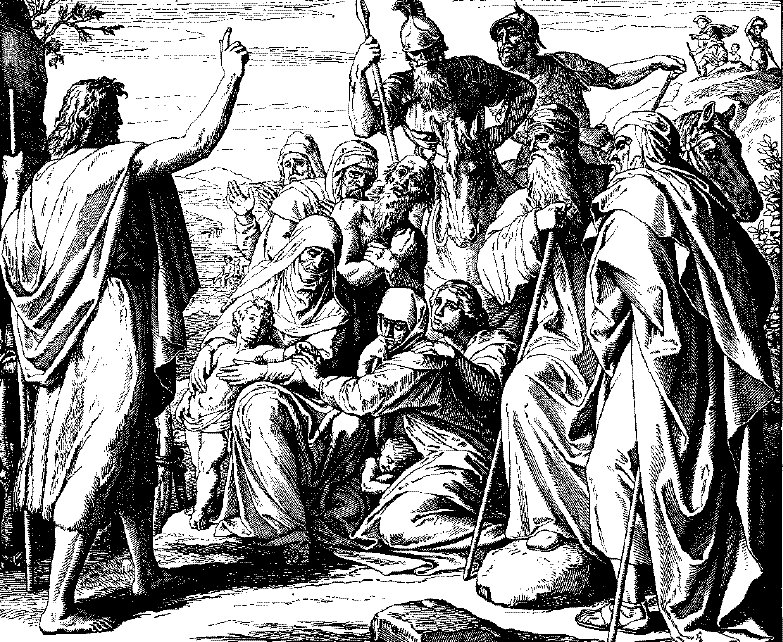
“Solomon had a vineyard at Baal-Hamon; and when he gave the care of it to vine-dressers, each of these must pay a thousand silver pieces for the revenue of it. A vineyard I have of my own, here at my side; keep thy thousand pieces, Solomon, and let each vine-dresser have his two hundred; not mine to grudge them. Where is thy love of retired garden walks? All the countryside is listening to thee. Give me but the word to come away, thy bridegroom, with thee; hasten away like gazelle or fawn that spurns the scented hill-side underfoot.”
The Greek term deutero-nomos is literally ‘the second law.’ We may be aware that God gave the prophet Moses a law on Mount Horeb/Sinai after the dramatic escape from Egypt; this is outlined at the end of the book of Exodus, and throughout the book of Numbers, and is a first Law for the observance of the people, to train them in the mind of God as they passed through the wilderness of Sinai and wandered for forty years through the wilderness of Seir. But, at the end of the book of Numbers, the people had arrived in the plains of Moab, which were directly opposite the Holy Land, across the Jordan on the East. They had already taken much of Moab by storm and the land there had been partitioned among three of the tribes of the people: Ruben, Gad and part of Manasses.
Now they have prepared an invasion force, which Moses will not lead, since he is to be punished for his bad faith (in the desert of Seir, when the people suffered great thirst, and he joined them in complaining to God) with death in the land of Moab, on mount Nebo. Before he left them, Moses appointed a new captain for them, his disciple Joshua/Iosue, the son of Nun. And he gave them the second law, the deutero-nomos, which would guide their lives while they were no longer wandering in the desert, but settled in the Holy Land that they would soon conquer and distribute to the nine and a half remaining of the twelve tribes. Thus Deuteronomy – the last book of the Torah – that has governed the lives of the Hebrews since then, and the lives of the Jews (and in a different way, the Christians) until now.
The book begins with Moses recapping the history of the people from the time they left mount Horeb in Sinai until their then current location on the plains of Moab. He describes their acclamation of the first Law and their consequent prosperity in numbers, their procession to Cadesh-Barnea and the first discouragement given by the scouts the tribes had sent into the Holy Land to take a measure of the crops, the defences of the Canaanite tribes and the chances of conquest there. This had occasioned the great revolt against Moses’ leadership that resulted in the destruction of significant portions of the tribe of Ruben, among other rebels:
“Faction raised its head in the camp against Moses, against Aaron, the Lord’s chosen priest; and now earth gaped, swallowing up Dathan, overwhelming Abiron and his conspiracy; fire broke out in their company, and the rebels perished by its flames.”
Psalm 105(106): 16-18
Another result of these factions among the people was the punishment of the forty-years wandering through the desert before they could finally make progress towards the lands of Moab (which are across the river Jordan from the Holy Land). By then, the first generation of the people had perished in the wilderness and those who had been children at the Exodus found themselves easily overcoming and exterminating powerful Syrian tribes, led by the Amorrhite kings Sehon of Hesebon and Og of Basan. This resulted in the settlement of the vast Amorrhite country to the east of the Dead Sea, and the country also of Basan to the east of Sea of Kinereth (later Galilee), all rebuilt and given over to those three tribes, Ruben, Gad and half the tribe of Manasses. This history of Moses ends with his exhortation to the people to keep the terms of the second Law, in order to avoid losing the plot and ending in their own destruction as a people. Thus begins the law book, in chapter five of Deuteronomy, lasting until chapter twenty-five. It begins with the Ten Commandments, which are thereafter expanded in content and applied directly to diverse situations. This begins with the famous Shemaa of the Hebrew and the Jewish people, beloved of Christ and the Apostles, and still recited/sung by Jewish communities today in synagogue:
“Listen then, Israel; there is no Lord but the Lord our God, and thou shalt love the Lord thy God with the love of thy whole heart, and thy whole soul, and thy whole strength. The commands I give thee this day must be written on thy heart, so that thou canst teach them to thy sons, and keep them in mind continually, at home and on thy travels, sleeping and waking; bound close to thy hand for a remembrancer, ever moving up and down before thy eyes; the legend thou dost inscribe on door and gate-post.”
Deuteronomy, 6: 4-9
The Jewish people still follow these rules literally, binding portions of the Law upon their foreheads, and upon their doors and gate-posts. The very soul of the Law is complete dedication and devotion to the Lord, the God of Israel, to the exclusion of every other deity that the people would find during the course of their stay in the Holy Land. Obedience of the Law was to be a sign of that devotion and their love for the God Who had claimed them as His own. The Hebrews had not earned the Land in any way; it was a promise made to their ancestors, Abraham, Isaac and Jacob, and the Canaanites are given to have forfeited the land themselves at the command of God, because of their own idolatry and moral perversion. The Land was and is a gift, and a pledge.
“But do not flatter thyself, when the Lord thy God destroys them thus at thy onslaught, do not flatter thyself it was for any merit of thine He gave thee possession of this land thou hast invaded, when in truth it was the wickedness of those other nations that brought them to ruin. No, if thou dost invade and conquer their lands, it is for no merit of thine, no right dispositions of thine; they are to perish at thy onslaught in punishment of their own ill-deeds, and because the Lord must needs fulfil the promise which He made on oath to thy fathers, Abraham, Isaac and Jacob. Be well assured thou hadst no claim to the possession of this fair land the Lord thy God is bestowing on thee, a stiff-necked nation as thou art.”
Deuteronomy 9, 4-6
Avoidance of idolatry (and of the related superstitious practices of soothsaying and divination, in chapter eighteen) was to be the condition of their continued possession of this gift of land, and idolatry was to be utterly condemned and exterminated from their society, to the extent that any idolater would be put to death by an act of the whole people:
“Somewhere, unworthy sons of Israel are seducing their fellow-citizens, bidding them follow the worship of alien gods untried. Careful and anxious be thy search, to find out the truth of the matter; and if it proves that the report was true, and the foul deed has been done, then, without delay, put all the inhabitants of that city to the sword, and destroy it, with all that is in it, even the cattle in its byres. Make a pile in the streets of all its household store, and burn that with the city itself, as forfeit to the Lord thy God. Let it be a ruin for all time, never to be rebuilt.”
Deuteronomy, 13: 13-16
The law book begins with a command to the people as a whole to support the tribe of the Levites (such as through the tithing system in chapter fourteen), which was to receive no inheritance of property, since God Himself was to be their inheritance – they had been appointed for sacred duty, and as a symbol of holiness among the people. Holiness of the people as a whole was to be another result of the second Law, which reiterated the purity conditions of the first Law, which included the dietary regulations. The jubilee year regulations and the great calendar festivals are reproduced in chapters fifteen and sixteen, and a government of judges and magistrates was required to settle disputes; this local government system in the various regions would still be subordinate to a higher court of the priests and Levites at the religious centre of the people (eventually Jerusalem) – a hierarchical system that was erected by Christ in the Christian Church as well. Severe rules are presented against homicide in chapter nineteen and various other offences in chapters twenty-one through twenty-five, including the stoning of unruly children!
“Is there a son so rebellious and unmanageable that he defies his parents’ bidding, and will not brook restraint? Such a son they must bring by force to the city gate, where the elders are assembled, and make complaint to them, ‘This son of ours is rebellious and unmanageable; he pays no heed to our remonstrances, but must ever be carousing, ever at his wantonness and his cups.’ Thereupon the citizens shall stone him to death, so that you may be rid of this plague, and every Israelite that hears of it may be afraid to do the like.“
Deuteronomy, 21: 18-21
Now that is an extreme result of the fourth commandment: Honour thy father and thy mother, etc. This is quickly followed by the curse which Christ accepted upon Himself on our behalf:
“When a man is guilty of a capital crime, and his sentence is to hang on a gallows, his body must not be left to hang there on the gibbet, it must be buried the same day. God’s curse lies on the man who hangs on a gibbet, and the land which the Lord thy God gives thee for thy own must not suffer pollution.”
Deuteronomy, 21: 22-23
There follows, in conclusion to the book of the Law, the command that the people are to surrender the first-fruits of their labour to God, in addition to the tithing system outlined earlier, for the support of the Levites and of foreigners, orphans and widows, with the following prayer:
“I have stripped my house, thou wilt tell Him, of all that I had vowed away, given it to Levite or to wanderer, to orphan or to widow, as Thou badest me; I have not neglected Thy will, or forgotten Thy commands. None of it has been eaten when I was in mourning, or set apart when I was defiled, or devoted to the dead; no, I have obeyed the Lord my God, and done all Thy bidding. Look down, then, from that sanctuary of Thine, that dwelling-place high in heaven, and bless Thy people Israel; bless the land Thou hast given us, that land, all milk and honey, which Thou didst promise to our fathers before us.”
Deuteronomy, 26: 13-15
Once the Holy Land had been settled, a rite of blessing and cursing was to take place in the ancient sanctuary of Shechem, north of Jerusalem. This is described in detail in chapter twenty-seven and is comparable to the anathemas proclaimed against grave sin by the Church. The following description of blessings associated with the fulfilment of the Law and accompanying curses in chapter twenty-eight illustrate well what Saint Paul called the burden of the Law in the letter to the Galatians and elsewhere:
“There is a passage in Scripture which, long beforehand, brings to Abraham the good news, ‘Through thee all the nations shall be blessed;’ and that passage looks forward to God’s justification of the Gentiles by faith. It is those, then, who take their stand on faith that share the blessing Abraham’s faithfulness won. Those who take their stand on observance of the Law are all under a curse; ‘Cursed be everyone (we read) who does not persist in carrying out all that this book of the law prescribes.’“
Galatians, 3: 8-10
That last is Saint Paul actually quoting this part of Deuteronomy. Chapter twenty-eight describes in detail the almost total destruction of the people that would follow a general apostasy from God among them. The remainder of the book deals with the solemn appointment of Joshua/Iosue as captain of the people in the Conquest, the great song of Moses predicting the eventual destruction of the people and their later restoration, and then a final blessing on the tribes by Moses and his death on mount Nebo. The scene is now set for the crossing of the Jordan and the conquest of the Holy Land.
How do you summarise the first and greatest of the books of the Torah? Let’s put it into the following portions: (i) the Creation and the early prehistory, (ii) the story of Abraham, and (iii) the son of Israel and the heads of the tribes
The most significant theme of the first three or four chapters is that God created all things in six ‘days’ as a setting and environment for a genus of creatures to whom He granted His own image: an intellect and a will by which they would govern the Creation around them as an extension of God’s own government of all things, in a joint exercise of love, intellect and will. The primordial garden is a Creation in union with the Holy One, contrasted with the darkness beyond, and the gardener creature Adam was charged with both the upkeep of the Garden (naming the creatures) and and the defence of it from the evil beyond. This is why the Garden is always there, and as Christ once said to his interlocutors: the kingdom of God (the Garden) is all around you. At a crucial point, Adam is given Eve as a helper in this task.
“So the Lord God took the man and put him in His garden of delight, to cultivate and tend it. And this was the command which the Lord God gave the man, ‘Thou mayest eat thy fill of all the trees in the garden except the tree which brings knowledge of good and evil; if ever thou eatest of this, thy doom is death.’ But the Lord God said, ‘It is not well that man should be without companionship; I will give him a mate of his own kind.’ And now, from the clay of the ground, all the beasts that roam the earth and all that flies through the air were ready fashioned, and the Lord God brought them to Adam, to see what he would call them; the name Adam gave to each living creature is its name still. Thus Adam gave names to all the cattle, and all that flies in the air, and all the wild beasts; and still Adam had no mate of his own kind. So the Lord God made Adam fall into a deep sleep, and, while he slept, took away one of his ribs, and filled its place with flesh. This rib, which he had taken out of Adam, the Lord God formed into a woman; and when he brought her to Adam, Adam said, ‘Here, at last, is bone that comes from mine, flesh that comes from mine; it shall be called Woman, this thing that was taken out of Man.'”
Genesis, 2: 15-23
But we know the sad story of their fall. At first, the defence of the garden fails and the enemy enters in the form of the serpent. For some reason, it is the woman who becomes the focus of the serpent’s plan and is convinced that the forbidden fruit will bring her and Adam not death but the knowledge that will make them gods, capable of independence from the Holy One. Following this original sin of pride, the source of eternal life is shut away from humanity, and is only opened again through Christ, in the last chapter of the book of Apocalypse/Revelation. For men cannot be permitted to live forever in a state of sin and separation from God – He will not allow us to be destroyed utterly.
“And now the Lord provided garments for Adam and his wife, made out of skins, to clothe them. He said, too, ‘Here is Adam become like one of ourselves, with knowledge of good and evil; now he has only to lift his hand and gather fruit to eat from the tree of life as well, and he will live endlessly.’ So the Lord God drove him out from that garden of delight, to cultivate the ground from which he came; banished Adam, and posted His Cherubim before the garden of delight, with a sword of fire that turned this way and that, so that he could reach the tree of life no longer.”
Genesis, 3: 21-24
We see in the following story of the fratricide, when the priest Abel’s sacrifice was accepted by God and his brother Cayin in jealousy slays him, the ongoing effect of the separation of humanity from God, and the cry of the Creation that fell with mankind into death and decay and here is forced to swallow the blood of the first wilful murder. As the story continues, we find that the depravity of mankind has grown, and even worsened by the continual involvement of demonic figures (sons of God, or fallen angels), who after that serpent in the garden took the form of monsters and brought forth children by human mothers. This intolerable situation of perversion of the original Creation became the reason first for a diminution of the lifetime of human beings and then for the Flood.
“Time passed, and the race of men began to spread over the face of earth, they and the daughters that were born to them. And now the sons of God saw how beautiful were these daughters of men, and took them as wives, choosing where they would. But God said, ‘This spirit of mine shall not endure in man for ever, he is but mortal clay; his life-time shall be a hundred and twenty years.’ Giants lived on the earth in those days, when first the sons of God mated with the daughters of men, and by them had children; these were the heroes whose fame has come down to us from long ago. And now God found that earth was full of men’s iniquities, and that the whole frame of their thought was set continually on evil; and He repented of having made men on the earth at all. So, smitten with grief to the depths of His heart, He said, ‘I will blot out mankind, my creature, from the face of the earth, and with mankind all the beasts and the creeping things and all that flies through the air; I repent of having made them.'”
Genesis, 6: 1-7
But the story of salvation continued. Long ago, God had told Adam and Eve that the son of a human mother would crush the head of the serpent and destroy his pride. And in the midst of boundless sin and destruction, Noach and his family appear as faithful and devout. They survive the flood, and Noach receives the first covenant-agreement from God.
“God said to Noe, and to Noe’s sons: ‘Here is a covenant I will observe with you and with your children after you, and with all living creatures, your companions, the birds and the beasts of burden and the cattle that came out of the Ark with you, and the wild beasts besides. Never more will the living creation be destroyed by the waters of a flood; never again a flood to devastate the world. This,’ God said, ‘shall be the pledge of the promise I am making to you, and to all living creatures, your companions, eternally; I will set My bow in the clouds, to be a pledge of My covenant with creation. When I veil the sky with clouds, in those clouds My bow shall appear, to remind me of My promise to you, and to all the life that quickens mortal things; never shall the waters rise in flood again, and destroy all living creatures. There, in the clouds, My bow shall stand, and as I look upon it, I will remember this eternal covenant; God’s covenant with all the life that beats in mortal creatures upon earth.’ Such was the pledge God gave to Noe of His promise to all living things.”
Genesis, 9: 8-17
In a long line through Noach’s son Shem, whose family gives us the name Shemites/semites, we find the patriarch of the Hebrews, Abram, a man who is able to place great faith and trust in the Holy One. This allows him to put one foot in the primordial garden of Eden, recovering the original faith of Adam and beginning the reliance upon God that would bless his family and eventually bring from it Miryam, the mother in the flesh of the Holy One, through Whom all the tribes of mankind would be permitted to re-enter into Eden and recover the original purpose for Creation. To provide for this extraordinary plan, Abram is given the Land where his people would be established in the future. Abram is a priest, and he builds an altar to the Promise:
“When Abram had parted from Lot, the Lord said to him, ‘Look about thee, turn thy eyes from where thou art to north and south, to east and west. All the land thou seest I make over to thee, and to thy posterity for ever. And to that posterity I will grant increase, till it lies like dust on the ground, past all counting. Up, then, and journey through the land at thy ease, the length and breadth of it; to thee I will give it.’ So Abram moved his tent, and went to live by the valley of Mambre, at Hebron, and there he built an altar to the Lord.”
Genesis, 13: 14-18
You may have heard it said that the Old Testament is the story of Israel’s ongoing struggle against polytheism and idolatry, and that it was mostly a struggle with self. Because polytheism was the way of men everywhere in ancient times, even as it very much is today and increasingly so. It was a tendency of the chosen People to copy the culture they found themselves surrounded by and re-assume the idolatry that their ancestors had rejected. I believe this was the reason for the several tests of Abram, before the great promises of the Land were made to him in the second great covenant.
“So Abram put his faith in God, and it was reckoned virtue in him. And now God said to him, ‘I AM the Lord, who brought thee out from Ur of the Chaldees, to give thee possession of this land instead.’ And when he asked, ‘Lord God, what assurance may I have, that it is mine?’ the Lord answered, ‘Bring me a three-year-old heifer, a three-year-old she-goat, and a three-year-old ram, and a turtle-dove, and a pigeon.’ All these he brought to him, and cut them in half, laying the two halves of each on opposite sides, except the dove and the pigeon; he did not divide these. The whole day long Abram stood there, driving away the carrion-birds as they swooped down on the carcases; but when the sun set, deep sleep fell upon him, and in the darkness a great dread assailed him. So a voice came to him, ‘This thou must know, that thy race will live as strangers in a land not their own, reduced to slavery and ill-used for four hundred years. But I am there to pass judgement on the nation which enslaves them; and when this is done, they shall come back rich in possessions. For thyself, thou shalt be buried with thy fathers, grown old in comfort; but the fourth generation will have come before these return hither; the wickedness of the Amorrhites has not reached its full term.’ So the sun went down, and when the darkness of night came on, a smoking furnace was seen, a torch of fire that passed between the pieces of flesh. And the Lord, that day, made a covenant with Abram; ‘I will grant this land, he told him, to thy posterity, with its borders reaching up to the river of Egypt, and the great river Euphrates; the land of the Cinites, and the Cenezites, and the Cedmonites, the Hethites and the Pherezites, the Raphaim, too, and the Amorrhites, and the Chanaanites, and the Gergesites, and the Jebusites.'”
Genesis, 15: 6-21
This promise of Land was followed by one of great posterity so that the Holy One made a play on Abram’s name, calling him Ab-raham, or Father-of-many (chapter 17). But the threat of polytheism and idolatry lay continually about, and in the book of Genesis itself, we find that Abraham was taught devotion to the one God gradually, in the course of all those stories about him that we know so well: the gift of Isaac, and the almost-sacrifice of Isaac. Abraham wished to preserve his son from the pollution of idolatry in the Holy Land and sent to Haran in Mesopotamia, to find a wife among his own clan, where the true God was worshipped (although, as one among others). Then, later on, Isaac is called to obedience of the God of his father Abraham, as if asked to choose this Deity over others he was probably surrounded with and attracted to. In fact, he is favoured as a result of Abraham’s devotion, rather than his own:
“From there he went to Bersabee; and here, the same night, he had a vision of the Lord, who said to him, ‘I am the God of thy father Abraham; fear nothing, I am with thee. I mean to bless thee, and give increase to thy posterity, in reward of Abraham’s true service.’ So he built an altar, and invoked the Lord’s name, and pitched his tent there, and bade his servants dig a well.”
Genesis, 26: 23-25
And when it came to Isaac’s twin sons, Jacob and Esau, we find the old problem of infidelity to the God of Abraham, for Esau (to his parents’ displeasure) married outside religion and so risked and endangered the blessing of God on the children of Abraham. Isaac’s reaction was to send Jacob off to find a wife in Mesopotamia, once more. When Jacob had the vision of the staircase going to Heaven, he was in flight from his brother Esau (who meant to kill him), and he renamed the place he was at (Luza) as Beth-El (literally, the house of God), and promised God to be faithful only to Him if He were to protect him from Esau’s rage:
“When he awoke from his dream, Jacob said to himself, ‘Why, this is the Lord’s dwelling-place, and I slept here unaware of it!’ And he shuddered; ‘What a fearsome place is this!’ said he. ‘This can be nothing other than the house of God; this is the gate of Heaven.’ So it was that, when he rose in the morning, Jacob took the stone which had been his pillow, and set it up there as a monument, and poured oil upon it; and he called the place Bethel, the House of God, that was called Luza till then. And there he took a vow; ‘If God will be with me,’ he said, ‘and watch over me on this journey of mine, and give me bread to eat and clothes to cover my back, till at last I return safe to my father’s house, then the Lord shall be my God.’“
Genesis, 28: 16-21
Through tribulation therefore, the ancient patriarchs were led towards devotion to the one God. Later, in chapter 31, we discover that Jacob’s uncle Laban, whose daughters he had married, was himself either a polytheist or a syncretist, for when Jacob travelled back to the Holy Land from Mesopotamia, his wife Rachel smuggled away some of her father’s household gods:
“Upon this, Jacob waited no longer; he mounted his children and wives on the camels, and set out on his journey; taking with him all his possessions, his cattle and all the wealth he had gained in Mesopotamia; he would return to his father Isaac, and the land of Chanaan. Meanwhile, in the absence of her father Laban, who had gone to shear his sheep, Rachel stole his household gods from him. Jacob had given his father-in-law no warning of his flight, and it was not till he and all that belonged to him had gone away, and crossed the Euphrates, and were making for the hills of Galaad, that a message came to Laban, three days too late, Jacob has fled.”
Genesis, 31: 17-22
And then we arrive at the point at which Jacob (now renamed Israel by God) decided to permanently consecrate not only himself but his entire family to the one God at Bethel. The rest of the Old Testament is the story of Jacob’s children falling away from and reconciling themselves to the one God, and that’s one reason for the importance of the story of our Hebrew ancestors in the Faith: we have the same human inclinations to turn away from God, and we must repeatedly turn back towards Him. The picture below is the foundation story for Bethel (the end of Genesis 28).
“In the meanwhile, too, God had said to Jacob, ‘Bestir thyself, go up to Bethel, and make thy dwelling there; there build an altar to the God who revealed himself to thee when thou wast in flight from thy brother Esau.’ Whereupon Jacob summoned all his household; ‘Cast away, he told them, whatever images of alien gods you have among you, purify yourselves, and put on fresh garments. We must leave this, and go up to Bethel; there we must build an altar to the God who listened to me in time of trouble, and escorted me on my journey.’ So they gave him all the images of alien gods that were in their possession, the rings, too, which they wore on their ears, and he buried them under the mastic-tree, close to the town of Sichem. Thus they set out on their journey, and God inspired terror into the hearts of all who dwelt around them, so that they durst not pursue them as they went. Jacob, then, with all his clan, made their way to Luza, which is now called Bethel, and built an altar there. It was he who called the place Bethel, the house of God, because it was there God appeared to him when he was in flight from his brother.”
Genesis, 35: 1-7
So Jacob, the grandson of the faithful Abraham, grew in prosperity as a result of the blessing he inherited from Abraham, and brought his whole family to a high degree of monotheism. From now on in the books, only the Hebrew God is referred to, by Jacob and by Joseph his son. Pious Jews and Catholics refuse to pronounce the ancient name of God, which simply means to be, or I am, and when pronounced in Hebrew sounds like the wind in the trees (the breath of God?). Jews simply replace the Holy Name as they read with Adonai, which means my Lord; a similar use is also found in good Catholic bibles.
The book of Genesis ends with the Joseph story, where we discover the wickedness of Jacob’s sons, and in particular the first three, Ruben, Simeon and Levi. Ruben had had incestuous relations with one of his father’s wives, Bala, and Simeon and Levi had led a genocide on a people called the Hevites, and brought dishonour to the family. Lastly, the whole lot of them had managed to sell their half-brother Joseph into slavery in Egypt and convinced the old man that he had been killed in the wild. Joseph, who inherited the priesthood of Abraham and was finally granted the birthright forfeited by his eldest brothers by his father, is rescued from slavery and becomes a prince of Egypt. His sons Manasseh and Ephraim become the heads of the most prosperous of the twelve tribes of Israel in later days.
“In these years before the famine came, Joseph’s wife Aseneth, daughter of Putiphare that was priest at Heliopolis, bore him two sons. He called his first-born Manasses, Oblivion; God has bidden me forget all my troubles, said he, forget my home. The second he called Ephraim, as if he would say of God, Hiphrani, he has made me fruitful, in this land where I was once so poor. So the first seven years passed, years of plenty for Egypt; and now, as Joseph had prophesied, seven years of scarcity began; famine reigned all over the world, but everywhere in Egypt there was bread to be had. When food grew scarce, there was ever a cry made to Pharao for bread, and still he would answer, ‘Betake yourselves to Joseph, do what he bids you.’“
Genesis, 41: 50-55
The book of Genesis ends with blessings for all the sons but those first three. And the blessing on the fourth son, Judah, is memorable, and this is later very important to the claim of King David to the kingship of all Israel (for David was of the tribe of Judah), and is also central to the Messiah’s claim to kingship of all nations (and all things), as David’s son. Here is the blessing on Judah:
“But thou, Juda, shalt win the praise of thy brethren; with thy hand on the necks of thy enemies, thou shalt be reverenced by thy own father’s sons. Juda is like a lion’s whelp; on the hills, my son, thou roamest after thy prey; like a lion couched in his lair, a lioness that none dares provoke. Juda shall not want a branch from his stem, a prince drawn from his stock, until the day when He comes who is to be sent to us, He, the Hope of the nations. To what tree will he tie his mount; the ass he rides on? The vine for him, the vineyard for him; when he washes his garments, it shall be in wine, all his vesture shall be dyed with the blood of grapes. Fairer than wine his eyes shall be, his teeth whiter than milk.”
Genesis, 49: 8-12
Similar language was later used by King David, when he composed the famous Messianic psalm, Psalm 109 (110), which the priests and Religious recite every Sunday evening at Evening Prayer:
To the Master I serve the Lord’s promise was given, Sit here at my right hand while I make thy enemies a footstool under thy feet. The Lord will make thy empire spring up like a branch out of Sion; thou art to bear rule in the midst of thy enemies. From birth, princely state shall be thine, holy and glorious; thou art my son, born like dew before the day-star rises. The Lord has sworn an oath there is no retracting, Thou art a priest for ever in the line of Melchisedech.”
Psalm 109 (110): 1-4
And Christ Himself quotes this psalm in his famous defence to the Pharisees:
“Then, while the Pharisees were still gathered about Him, Jesus asked them: ‘What is your opinion concerning Christ? Whose son is he to be?’ They told Him, ‘David’s.’ ‘How is it then,’ said He, ‘that David is moved by the Spirit to call him Master, when he says: The Lord said to my Master, Sit on my right hand while I make thy enemies a footstool under thy feet?David calls Christ his Master; how can he be also his son?‘ None could find a word to say in answer to Him, nor did anyone dare, after that day, to try Him with further questions.”
Gospel of S. Matthew, 22: 41-46
Reading the book of Genesis is always easy, because the language used is so simple, and the narrative style is story-telling. The book of Exodus is very similar. I would start to worry when I get to Leviticus, the priestly book; the liturgical detail there is extremely detailed. The picture below is of the patriarch Jacob blessing his grandsons by Joseph, shown on the right. Joseph tried to present them by putting the older boy Manasses on Jacob’s right, so he would get the blessing of the first-born. But Jacob crossed his arms over and gave his right-hand blessing to the younger boy, Ephraim, from whom would come the greatest of the tribes of Israel in her heyday.
Here’s an old prayer-card image of the Apostle Saint Jude, aka. Thaddaeus, better known to us today as the patron Saint of hopeless causes. One of Jude’s letters – a rather short one – sits in our collection in the New Testament. This letter has a common theme that it shares with other early letters, that of the spirit of anti-Christ, which ever threatens belief in Christ, and seeks to draw believers back to the world. In this case though, anti-Christ may have infiltrated the Christian community itself:
“Godless men, long since destined thus to incur condemnation, have found their way secretly into your company, and are perverting the life of grace our God has bestowed on us into a life of wantonness; they even deny Jesus Christ, our one Lord and Master… they pollute nature, they defy authority, they insult august names…. Such men sneer at the things they cannot understand; like the brute beasts they derive knowledge only from their senses, and it serves to corrupt them…Godless and sinners, with how many ungodly acts they have defied God, with how many rebellious words have they blasphemed him! Such men go about whispering and complaining, and live by the rule of their own appetites; meanwhile, their mouths are ready with fine phrases, to flatter the great when it serves their ends. But as for you, beloved, keep in mind the warnings given you long since by the apostles of our Lord Jesus Christ; how they told you, that mocking spirits must needs appear in the last age, who would make their own ungodly appetites into a rule of life.”
Epistle of S. Jude, 4, 8, 10, 15-18
It sounds a little like our present anti-Christian culture, doesn’t it? I think this has always been so. It has been at rare moments in history that the Church has had any sort of moral claim on society in general without the heavy arm of the secular law on her side. But, even then, there will always be those who mock the moral life of the Christians and our beliefs, and do so openly. The solution to living in such a situation is first to build up the spiritual life of the Christian community…
“It is for you, beloved, to make your most holy faith the foundation of your lives, and to go on praying in the power of the Holy Spirit; to maintain yourselves in the love of God, and wait for the mercy of our Lord Jesus Christ, with eternal life for your goal.”
Epistle of S. Jude, 20-21
…and then challenge the rival philosophies and even go so far as to avoid the company of those who refuse to be corrected.
“To some you must give a hearing, and confute them; others you must pluck out of the fire, and rescue them; others again you can only pity, while you shun them; even the outward fringe of what the flesh has defiled must be hateful to you.”
Epistle of S. Jude, 22-23
Right, then, it’s time to see if we remember all the Apostles by name. Let’s set them all out with a memory assist:
B – Bartholomew A – Andrew P – Philip T – Thomas I – Iochanna (John), Iacob (James the Greater), Iacob (James the Lesser), Iuda (Jude Thaddaeus), Iuda the traitor (Judas Ish-kariot) S – Simon (called Peter), Simon the Zealot M – Matthew
The Wisdom of Solomon is traditionally attributed to the king of that name, although Scripture scholars have attempted to throw doubt on that (as Scripture scholars are wont to do). But let’s use the traditional attribution to keep things simple. There are three great themes of the book: (i) the triumph of the Just (often used in Masses of the Dead, when we assume that the Deceased is numbered among the Just); (ii) the glory of personified Wisdom, usually given the aspect of a desirable woman, to be courted and embraced; and (iii) the action of Divine Wisdom in the history of the Israelite nation. Let’s go through the whole thing, in summary fashion.
First, there’s an introduction to Wisdom in chapter one, and then there is the introduction to the Just Man, who is hated by schemers and villains, who wish to destroy him and humiliate him. This terrifying chapter two is brought to life by the treatment of Christ by his tormentors: the Temple priests (and their party of the Sadducees):
“Where is he, the just man? We must plot to be rid of him; he will not lend himself to our purposes. Ever he must be thwarting our plans; transgress we the law, he is all reproof, depart we from the traditions of our race, he denounces us. What, would he claim knowledge of divine secrets, give himself out as the son of God? The touchstone, he, of our inmost thoughts; we cannot bear the very sight of him, his life so different from other men’s, the path he takes, so far removed from theirs! No better than false coin he counts us, holds aloof from our doings as though they would defile him; envies the just their future happiness, boasts of a divine parentage. Put we his claims, then, to the proof; let experience shew what his lot shall be, and what end awaits him. If to be just is to be God’s son indeed, then God will take up his cause, will save him from the power of his enemies. Outrage and torment, let these be the tests we use; let us see that gentleness of his in its true colours, find out what his patience is worth. Sentenced let him be to a shameful death; by his own way of it, he shall find deliverance.“
Wisdom, 2: 12-20
But such Just people, who suffer patiently and treasure Wisdom in their hearts, have a great reward coming their way, because although they seem to have succumbed to weakness, suffering and death, their life is hidden with God in heaven. For about the first time in the Old Testament, we find hints of resurrection, a life beyond the grave and eternal beatitude. This is one of the readings at funeral Masses:
“But the souls of the just are in God’s hands, and no torment, in death itself, has power to reach them. Dead? Fools think so; think their end loss, their leaving us, annihilation; but all is well with them. The world sees nothing but the pains they endure; they themselves have eyes only for what is immortal; so light their suffering, so great the gain they win! God, all the while, did but test them, and testing them found them worthy of Him. His gold, tried in the crucible, His burnt-sacrifice, graciously accepted, they do but wait for the time of their deliverance; then they will shine out, these just souls, unconquerable as the sparks that break out, now here, now there, among the stubble. Theirs to sit in judgement on nations, to subdue whole peoples, under a Lord whose reign shall last for ever. Trust Him if thou wilt, true thou shalt find Him; faith waits for Him calmly and lovingly; who claims His gift, who shall attain peace, if not they, His chosen servants?“
Wisdom, 3: 1-9
Of course, the men of this world do not understand all of this. For them, the death of the Just Man (or Woman), deprived as he is of worldly honours and worldly fortunes, is shameful and an object of contempt and derision. This was the curse that fell upon the Jewish priests after the Resurrection of Christ. Within forty years of the Ascension and the first Christian Pentecost (in AD 70), the Jerusalem Temple was no more and has never been rebuilt.
“Did they know it, the death of the just man, with its promise early achieved, is a reproach to the wicked that live yet in late old age. But what see they? Here is a man dead, and all his wisdom could not save him. That the Lord planned all this, and for the saving of him, does not enter their minds. What wonder if the sight fills them with contempt? And they themselves, all the while, are earning the Lord’s contempt; they themselves, doomed to lie there dishonoured among the dead, eternally a laughing-stock! How they will stand aghast, when he pricks the bubble of their pride! Ruins they shall be, overthrown from the foundation, land for ever parched dry; bitter torment shall be theirs, and their name shall perish irrecoverably.”
Wisdom, 4: 16-19
Chapter five goes further into the rewards of the Just, and we can see in this some of the rewards Christ Himself promises to his disciples and primarily to the Apostles. Wearing crowns and judging the tribes of Israel, receiving very much in return for the sacrifice of family and property, etc.
“It is the just that will live for ever; the Lord has their recompense waiting for them, the most high God takes care of them. How glorious is that kingdom, how beautiful that crown, which the Lord will bestow on them! His right hand is there to protect them, His holy arm to be their shield.“
Wisdom, 5: 16-17
Chapter six begins the picture of Wisdom personified as a desirable woman, to be embraced at all cost, particularly by kings and governors, those who have the care of the people, as King Solomon did.
“The bright beacon of wisdom, that never burns dim, how readily seen by eyes that long for it, how open to their search! Nay, she is beforehand with these her suitors, ready to make herself known to them; no toilsome quest is his, that is up betimes to greet her; she is there, waiting at his doors. Why, to entertain the very thought of her is maturity of the mind; one night’s vigil, and all thy cares are over. She goes her rounds, to find men worthy of her favours; in the open street unveils that smiling face of hers, comes deliberately to meet them.“
Wisdom, 6: 13-17
It is in chapter seven that the author seems to identify himself as Solomon, hence the book’s attribution of authorship. This chapter points back to the beginning of the reign of King Solomon, when legendarily he had requested Wisdom from God as more desirable to him than anything worldly. The next two chapters and this one continues the glorification of Wisdom in the chapter six. Chapter ten begins the final phase of the book, which is an account of the history of the Israelite nation, from Abraham to Moses and the passage through the Red Sea and the period of wandering in the wilderness and being fed with manna, as being facilitated by divine Wisdom. I shall only put three quotes from this section down, but a complete reading would allow for a devotional meditation on the care of God for His people. First, we have Abraham and his nephew Lot:
“And when the nations went their several ways, banded in a single conspiracy of wickedness, of one man’s innocence she still took note; Abraham must be kept irreproachable in God’s service, and steeled against pity for his own child. Here was another innocent man, Lot, that owed his preservation to Wisdom, when godless folk were perishing all around him. Escape he should, when fire came down upon the Cities of the Plain; those five cities whose shame is yet unforgotten, while smoke issues from the barren soil, and never tree bears seasonable fruit, and the pillar of salt stands monument to an unbelieving soul. Fatal neglect of Wisdom’s guidance, that could blind their eyes to the claims of honour, and leave the world such a memorial of their folly, as should make the record of their sins unmistakable! But those who cherish her, Wisdom brings safely out of all their striving.”
Wisdom, 10: 5-9
The rest of the book is about the plagues that were inflicted upon the Egyptians before the flight of the Israelites into the wilderness. The Egyptians are excoriated for their idolatry, and this is not infrequently given to be the cause of their treatment, quite apart from their abuse of the Israelites – worship animals and animals will be used by divine Wisdom to inflict injury upon you. Idolatry is the great foe, the great villain, of the people of the Old Testament, as it is even for us today. It is all too easy to find other things to worship and trust in, than the God Who stands above all.
“For Israel, only a test of their faith; only a father’s correction; for Egypt, as from a king, stern scrutiny and stern doom. Tidings from far away, that racked the Egyptians no less than their own former sufferings; anguish redoubled, as they groaned over the memory of things past! That the same plague of thirst which had tortured themselves should be the source of Israel’s rejoicing! Then indeed they felt the Lord’s power, then indeed they wondered at the revenge time had brought; wondered at Moses, whom their insolence had long ago disinherited, when they exposed him with the other children. Thirst, that had been Egypt’s enemy, had no terrors for the just. So lost to piety were these Egyptians, such foolish reasonings led them astray, that they worshipped brute reptiles, and despicable vermin. And swarms of brute beasts thou didst send to execute thy vengeance, for the more proof that a man’s own sins are the instrument of his punishment. Thy power knows no restraint, the power that created an ordered world out of dark chaos. It had been easy to send a plague of bears upon them, or noble lions; or to form new creatures, of a ferocity hitherto unknown, breathing fiery breath, churning out foul fumes, terrible sparks darting from their eyes, so that men would die of fear at their very aspect, without waiting for proof of their power to do harm.”
Wisdom, 11: 11-20
Chapter sixteen has a beautiful and wonder-filled description of the gift of manna, the material which fell from the sky and was baked into cakes for the people for forty long years. But in chapter seventeen, the gaze of the author returns to the Egyptians, and the whole chapter is about the superstitious and fear-filled darkness that engulfed that idolatrous nation, even as (chapter eighteen now) light shone on the Israelites, being cared for by divine Wisdom:
“Brightest of all, that light shone on Thy chosen people. These neighbours of theirs, heard but not seen, the Egyptians must congratulate on their escape from the common doom, thank them for letting vengeance be, and ask forgiveness for past ill-will. To these Thou gavest, not darkness, but a pillar of burning fire, to be the guide of their unfamiliar journey, a sun, all gracious welcome, that brought no harm. A fitting punishment it was for the Egyptians, this loss of light; fitting that they should be imprisoned in darkness, who had kept Thy own sons in prison; Thy own sons, through whom that Law, which is light unfailing, was to be given to the world.”
Wisdom, 18: 1-4
And on that recommendation of the Torah – the Law of Moses – I shall end this post. What’s the lesson of this book? Treasure Wisdom, embrace Wisdom, and Wisdom will embrace you, protect you, grant you virtues, such as prudence and right judgement. These virtues will colour your life upon earth, and will bring you the reward of the Just – a light-filled future life beyond this world.
“See, where Wisdom has built herself a house, carved out for herself those seven pillars of hers! And now, her sacrificial victims slain, her wine mingled, her banquet spread, this way and that her maidens are dispatched, to city keep and city wall, bidding her guests make haste. ‘Simple hearts,’ she says, ‘draw near me;’ and to all that lack learning this is her cry, ‘Come and eat at my table, come and drink of the wine I have brewed for you; say farewell to your childishness, and learn to live; follow all of you in the path that leads to discernment.'”
We’re still working our way through the Holy Communion chapter of the Gospel of S. John in our gospel readings. You have heard for yourselves how many times the Holy One said in the course of this gospel story, I AM the bread of life, eat Me, I AM the bread of life, eat Me, I AM the bread of life, you must eat me if you want to live eternally… if He must repeat Himself to make His point, so shall we.
So, then, the Church has taught us that we are Temples of the Holy Spirit. Many of us were taught that as seven-year-olds, preparing for Confession and FHC. Now, what’s the first line of the first reading today? ‘Wisdom has prepared herself a house, erected her seven pillars, laid her table for the feast, invited visitors, saying, Come to the feast, leave folly (childishness) and sin, acquire true understanding.’ Seven pillars? Another thing Holy Church has taught us is that there are seven gifts of the Holy Spirit. Let’s list them from the Catechism: (i) Wisdom!, (ii) Understanding!, (iii) and this follows from the first two, Counsel, for we can give counsel to others and receive it from them only according to the wisdom and understanding we have acquired. (iv) Fortitude. If we have acquired wisdom, it is because we have judged it valuable to do so; and something that precious we shall have the fortitude to secure and defend. (v) Knowledge, for true knowledge is acquired at the feet of divine Wisdom, whence we learn about the world from the point of view of its Creator. (vi) Piety, which is an adherence to the traditions of the people and, in our case, the teaching of Holy Church concerning faith, morals and divine worship; we acquire this while seated continually at the feet of the Holy One, in prayer and devotion. And the seventh gift of the Holy Spirit is (vii) the Fear of the Lord – not a fear, that is, that we have of those who can and will destroy us, but the pious fear of a child for their parent, a fear of falling away from the parent and losing their protection, a fear full of trust, a loving fear, a fear that is rewarded with a glimpse at the Sacred Heart, Who declares that He has loved us from all eternity.
So, we are walking Temples of God, and we must carefully support our walls with these seven strong pillars, and the Holy One living within our hearts will find in us His especial delight. Let us clean out the Temple frequently with the devotion of our lives; S. Paul suggests again the second reading… live your lives in an intelligent manner, a rational manner.
“See then, brethren, how carefully you have to tread, not as fools, but as wise men do, hoarding the opportunity that is given you, in evil times like these. No, you cannot afford to be reckless; you must grasp what the Lord’s will is for you. Do not besot yourselves with wine; that leads to ruin. Let your contentment be in the Holy Spirit; your tongues unloosed in psalms and hymns and spiritual music, as you sing and give praise to the Lord in your hearts. Give thanks continually to God, Who is our Father, in the Name of our Lord Jesus Christ;”
Letter of S. Paul to the Ephesians, 5: 15-20 [link]
The Apostle is speaking of the Church living through evil times in the middle of the first century (his own experience), but a quick look at our 2000-year history will show us that the Church always lives through evil times, and despite even the wickedness and profligacy of her very shepherds she survives. Paul says that in wicked days, we should discern carefully what the will of God is. We should know not to fall into hopeless addictions, and seek to improve ourselves daily; and we should be a strong community of prayer – he says that we should be singing psalms and hymns together (even without the organ, he would probably add), and afterwards continue the singing in our hearts. He wants us to be a liturgical people, so that the hymns we sing together on a Sunday, or whenever else we come together for Mass, continue to resound in our hearts for the rest of the week.
But let’s come back to Divine Wisdom and her many living Temples, and her feast which she holds within them…
“‘I Myself am the living bread that has come down from heaven. If anyone eats of this bread, he shall live for ever. And now, what is this Bread which I am to give? It is My flesh, given for the life of the world.’ Then the Jews fell to disputing with one another, ‘How can this man give us His flesh to eat?’ Whereupon Jesus said to them, ‘Believe Me when I tell you this; you can have no life in yourselves, unless you eat the flesh of the Son of Man, and drink His blood. The man who eats My flesh and drinks My blood enjoys eternal life, and I will raise him up at the last day. My flesh is real food, My blood is real drink. He who eats My flesh, and drinks My blood, lives continually in Me, and I in him. As I live because of the Father, the living Father Who has sent Me, so he who eats Me will live, in his turn, because of Me.'”
Here’s the Holy One in the gospel reading saying that Holy Communion is the condition of gaining eternal life with God. And those good Jews about Him sneered at Him and said, How is He going to give us Himself to eat? They have a natural horror of cannibalism, and they don’t yet have the theology of the Eucharist. And yet, even today, there are Christians who look pityingly at us and at our Blessed Sacrament and sneer similarly: Is that what you Catholics think?
And He stands there and says, ‘the eternal life of My Father flows through Me, and you will eat Me if you wish to have it. For I AM the Way and the Life, and nobody comes to the Father except through Me.’
The first letter we have of S. John’s is not a very long letter at all, and has many features from the Gospel of Saint John, such as the theology of light and dark, good and evil and attachment to Christ. It is marvellously black and white, the constant theme being that if you love God, you keep His commandments (also a feature of his Gospel), and that if you don’t keep those commandments and still claim to love God, you’re a bit of a liar.
The whole letter is a warning against idolatry and apostasy, big problems at the time of its writing, because of the increasing vehemence of the persecuting Roman authorities as they attacked the early Christians in various places for ‘impiety’ – that is, the abandonment of the state religion and particularly the worship of Caesar. Simultaneously, the Apostles and early bishops already had to deal with heretics like Simon Magus and the ebionites, and continue the battle against the judaisers who wished all Christians to be circumcised Jews first. Appropriately, John ends his letter with the stern warning:
“Beware, little children, of false gods.”
I John 5: 7
The second preserved letter we have is a really short one. Really short. It has one message: cling to the true faith, there will be false prophets and you will know them when they deny that Christ came in human flesh, this is the spirit of anti-Christ, stay clear of it or lose your heavenly reward.
And there it is. Saint John identifies himself as an elder of a church that is not specified, and he is addressing another church, possibly as the last surviving Apostle. All the others had been by then martyred. He addresses this second church as a lady:
“I, the presbyter, send greeting to that sovereign lady whom God has chosen; and to those children of hers who are my friends in the truth, loved, not by me only, but by all those who have recognized the truth.”
II John 1
The warning about the anti-Christ is as simple as my summary above. Many Christians think that there is a single figure called anti-Christ who will arrive at a particular moment and cause significant damage to the Church. But it seems to me that John is speaking of a spirit of anti-Christ, a rival religious or political movement that specifically denies that the second person of the most blessed Trinity was made incarnate as a human being (as defined by the Creed), in order to bring about our salvation:
“Many false teachers have appeared in the world, who will not acknowledge that Jesus Christ has come in human flesh; here is the deceiver you were warned against, here is Antichrist. Be on your guard, or you will lose all you have earned, instead of receiving your wages in full. The man who goes back, who is not true to Christ’s teaching, loses hold of God; the man who is true to that teaching, keeps hold both of the Father and of the Son.
II John 7-9
Whereas John repeats the teaching that has made his Gospel famous – that we must love Christ by keeping His commandments – his last solemn warning is that we not even entertain the preachers and teachers who bring with them the above anti-Christian idea (that Our Lord has not come in human flesh). We know of historical persons who have presented this idea, and we may know people today who do so. John would call them anti-Christ, and that is terrible. We could compare his warning to those made by Saint Paul to his churches to remain in the traditions he had given them and not attempt to go beyond them, such as this one:
“Stand firm, then, brethren, and hold by the traditions you have learned, in word or in writing, from us.”
II Thessalonians 2: 14
The third preserved letter of S. John is another tiny one, this time from Saint John to a new Christian called Gaius, and it’s interesting to discover that, like Saint Paul, John calls his converts his children. It would seem to have been an early tradition for the Apostles and their successors, the bishops and the priests, to have a parent-children relationship with the young churches. This tradition has continued today, when we call our bishops and priests Father.
“I have no greater cause for thankfulness, than when I hear that my children are following the way of truth.”
III John 4
The first part of the letter is a eulogy to Gaius, who has been very charitable to the church he was at that time serving and other correspondents seem to have informed John about it. The rest of the letter seems to be parish politics: John is sending the letter privately to avoid an obnoxious member of the church called Diotrephes, who seems to have had the power to exclude both John himself and Gaius. I wonder who he was: bishop or priest?
Anyway, we get a flash of the Jewish distinction between good and evil from the first letter of Saint John before the end: choose good and God is with you, choose evil and you’re taking your character from the devil:
“Beloved, choose the right pattern, not the wrong, to imitate. He who does right is a child of God; the wrong-doer has caught no glimpse of him.”
Here’s the slightly controversial Old Testament book called Ecclesiastes, or Qoheleth. The word ecclesia in Greek means ‘assembly’ and, like the other book called Ecclesiasticus, was designed to be read to an assembly. As indeed was most of Scripture. The Hebrew word Q’hal has a similar meaning, but some scholars treat ‘Qoheleth’ as a proper name. My own Bible translation, the Knox version, translates it as Spokesman, which of course is more accurate.
This ‘spokesman’ identifies himself as son of King David and one-time king of Jerusalem and therefore the book is traditionally given to be the work of King Solomon. It is a Wisdom book – it glorifies divine Wisdom and finally the commandments of God. I called it controversial because it is unlike any other book in the Bible in that it hardly ever refers to God, and the few references are often seen by scholars as later additions to engraft this rather odd book into the canon of Scripture. The Spokesman describes himself as a student of human nature and an observer of all things under the sun, the words ‘under the sun’ repeated multiple times throughout. That makes this a book part of a general study of science, and we know that King Solomon was devoted to the study of the natural world, alongside everything else (III Kings, 4: 32-34). So, let’s jump right in with some general observations about this book.
“I was a king in my day, I, the Spokesman; Israel my realm, Jerusalem my capital. And it was my resolve to search deep and find out the meaning of all that men do, here under the sun; all that curse of busy toil which God has given to the sons of Adam for their task. All that men do beneath the sun I marked, and found it was but frustration and lost labour, all of it; there was no curing men’s cross-grained nature, no reckoning up their follies.”
Ecclesiastes, 1: 12-15
The whole book almost is an expression of frustration, and so in a way discouraging. No matter what you do, says the writer, if you practice virtue or live in sin, you still end your life in the same way, with death and the grave. The book evidently has no understanding of the life beyond, reward beyond this life and any pleasure in virtue aside from the life of virtue itself – there is no apparent gain one may have from any action performed here below that can be carried beyond the grave. Therefore, what’s the point in trying? Hence the frustration. A scientist studies systems to discover their ends – what they were intended to produce and enable – and when he cannot find this design result, after long investigation, he lapses into frustration. This is the spirit I find in this book.
“Next, I thought to give the rein to my desires, and enjoy pleasure, until I found that this, too, was labour lost. Wouldst thou know how I learned to find laughter an empty thing, and all joy a vain illusion; how I resolved at last to deny myself the comfort of wine, wisdom now all my quest, folly disowned? For I could not rest until I knew where man’s true good lay, what was his life’s true task, here under the sun.”
Ecclesiastes, 2: 1-4
So, the writer has discovered that even bodily pleasures are vain and unfulfilling, so he took up a severe asceticism and made the study of wisdom his primary activity. But even this seemed fruitless, for it profited nothing to the wise man to transcend the common end of all mortal beings. The writer makes the same observation we’ve seen in books like Job – that evil men thrive and good men suffer – and asks what’s the point of practising virtue at all. We’re all being driven towards the grave anyway, along with every other kind of mortal being.
“I marked, too, how wrong was done instead of right, injustice instead of justice, there under the sun’s eye; and I told myself that God would give judgement one day between the just and the sinners, and all things would reach their appointed end then. I told myself that God’s purpose with the sons of men was to test them …… And that they might see they were only like the beasts … After all, man comes to the same ending as the beasts; there is nothing to choose between his lot and theirs; both alike are doomed to die. They have but one principle of life; what has man that the beasts have not? Frustration everywhere; we are all making for the same goal; of earth we were made, and to earth we must return.“
Ecclesiastes, 3: 16-20
Dear me, it’s all dismal. The Spokesman decides that the best we can do with our lives is to enjoy ourselves while we still can. Does this sound familiar? It’s the song of our nihilist society today. How can this position possibly be drawn into the conventional Hebrew faith of trust in God and the quest for justice? There must be some reason the Fathers have retained this book in our canon of Sacred Scripture. At this point, we discover some good advice for social living:
” Better to be in partnership with another, than alone; partnership brings advantage to both. If one falls, the other will give support; with the lonely it goes hard; when he falls, there is none to raise him. Sleep two in one bed, each shall warm the other; for the lonely, there is no warmth. Two may withstand assault, where one is no match for it; a triple cord is not lightly broken. There is more hope for a wise servant that is in hard straits, than for a dotard king that foresight has none… Look well what thou art doing when thou goest into God’s house; present thyself there in a spirit of obedience. Obedience is far better than the sacrifice made by fools, that are guilty of unwitting sacrilege.”
Ecclesiastes, 4: 9-13, 17
Ahah – the first reference to God. Despite everything – despite the frustration of living – you must keep up the religious observances of the people. The next chapters continues the theme of honouring God, and sounds vaguely similar to Christ warning us not to use many words in prayer, for God knows what we need already. This fifth chapter notes that injustice committed is still watched over by the Eternal One, even it seems to be meaningless to the unjust. There is certainly a moral element here, for although the writer again states that man can do no more than take enjoyment from the work of his hands in this life, he speaks of the futility of hoarding one’s money away when one cannot take it beyond the grave. Could he mean that the wealth should be shared? Anyhow, the ongoing theme is the unfulfilling nature of riches and wealth, what chapter six calls ‘a full mouth and an empty belly.’ Frustration, frustration, all around. What is the point of living and working? Chapter seven begins a typical set of instructions for the wise, which we would recognise from the books of Proverbs and of the Wisdom of Solomon: keep man’s final end always in mind, search for wisdom, control your tongue, accept your station in life as given by God, avoid evil, fear God and cultivate the traditions of the past (piety), etc. It seems that all this must be honoured without looking for a reward, material or otherwise.
“Whatever lies in thy power, do while do it thou canst; there will be no doing, no scheming, no wisdom or skill left to thee in the grave, that soon shall be thy home. Then my thought took a fresh turn; man’s art does not avail, here beneath the sun, to win the race for the swift, or the battle for the strong, a livelihood for wisdom, riches for great learning, or for the craftsman thanks; chance and the moment rule all. Nor does man see his end coming; hooked fish or snared bird is not overtaken so suddenly as man is, when the day of doom falls on him unawares.”
Ecclesiastes, 9: 10-12
Do what you can, while you have the opportunity. For we cannot plan our opportunities. Above all, we do not know when we ultimately lose all opportunities, when death takes us, as it will inevitably do. Chapter ten is a long ridicule of foolishness and idleness in the face of the above advice to use every opportunity. So, the effect so far is the value of the virtue of diligence exercised without the hope of reward. This type of activity performed during youth will stand one in good stead when the illness and infirmity of old age make such things more difficult and frustration increases (as may have happened to the writer himself).
“Only be thy years never so many, never so happy, do not forget the dark days that are coming, the long days, when frustration will be the end of it all. While thou art young, take thy fill of manhood’s pride, let thy heart beat high with youth, follow where thought leads and inclination beckons, but remember that for all this God will call thee to account. Rid thy heart, then, of resentment, thy nature of ill humours; youth and pleasures, they are so quickly gone!”
Ecclesiastes, 11: 8-10
The final chapter speaks of the increasing physical and mental dissipation of old age, and the flight from this life on earth. How would I sum up this book? It is a call to duty towards God and towards society, working while there is still time to work and hoping for no reward for it. If reward does come, take enjoyment of it but do not hoard away, for nobody can take wealth beyond the grave. And all will finally fall before the judgement of God. This is the summary of the book, given by the book itself:
“Fear God, and keep his commandments; this is the whole meaning of man. No act of thine but God will bring it under His scrutiny, deep beyond all thy knowing, and pronounce it good or evil.“
This fourth book of the Torah is mixed material. It begins with a detailed census of the people who found themselves at the foot of Mount Sinai, being entered into a serious covenant with the God of their forefathers. This was done in the second year after the escape from Egypt, and counts a surprising 603,550 fighting men (not counting women and children). The registry also notes the names of tribal and clan chieftains in that early period and the marching order of the tribes, for the community was still mobile, travelling from place to place in the desert. When they ended that march and set up camp, there was a detailed prescription based on compass points for the building of the tribal camps (all this in the first two chapters of the book). Speaking of marches, though – and Numbers is the book of marching through the desert – let’s have a look at the marching psalm:
“Let God bestir Himself, needs must His foes be scattered, their malice take flight before His coming. Vanish the wicked at God’s presence as the smoke vanishes, as wax melts at the fire, while the just keep holiday and rejoice at the sight of Him, glad and content. Sing, then, in God’s honour, praise His Name with a psalm; a royal progress through the wilderness for the God Whose Name tells of omnipotence! Triumph in His presence; he is a father to the orphan, and gives the widow redress, this God who dwells apart in holiness. This is the God who makes a home for the outcast, restores the captives to a land of plenty, leaves none but the rebels to find their abode in the wilderness. O God, when Thou didst go forth at the head of Thy people, on that royal progress of Thine through the desert, how the earth trembled, how the sky broke at God’s coming, how even Sinai shook, when the God of Israel came…! See where God comes, with chariots innumerable for His escort; thousands upon thousands; comes from Sinai to this His sanctuary… Blessed be the Lord now and ever, the God who bears our burdens, and wins us the victory. Give praise to the Lord God in this solemn assembly, sons of Israel! Here is Benjamin, youngest of the tribes, that marches in the van; here are the chieftains of Juda with their companies, chieftains, too, from Zabulon, chieftains from Nephtali. Shew Thy power, O God, shew Thy Divine power, perfect Thy own achievement for us; to honour Thy temple at Jerusalem, kings shall bring gifts before Thee. Tame the wild beasts of the marshes, fierce bulls that lord it over the peaceful herd of nations; down fall they, bringing silver pieces for their ransom. Scatter the nations that delight in war, till Egypt sends hither her princes, till Ethiopia makes her peace with God. Kingdoms of the earth, raise your voices in God’s honour, sing a psalm to the Lord; a psalm to God, who mounts on the heavens, the immemorial heavens, and utters His word in a voice of thunder. Pay honour to God, the God Whose splendour rests over Israel, who holds dominion high among the clouds. Awe dwells about Him in His holy place! The God of Israel gives His people strength and courage; blessed be God!”
Psalm 67(68)
Aaron, the brother of Moses, now appears as the appointed high-priest. The members of their tribe, the Levites, were to be the servants or assistants of Aaron’s family, which alone provided priests for the new rites. The major Levitical clans included those of Gerson, Caath and Merari. The Levites were consecrated in a special way, with all their possessions, as God’s very own, set apart as the first-borns of the entire community. Moreover, they were not to be fighting men, but entirely given over to the care of the sacred: the bearing of the tabernacle and all its associated equipment. The book sets out the details of the dedication gifts given to the tabernacle, for the hallowing of the altar, etc. Let’s put that down here, to provide an idea of what this ancient accounting system looked like. This is only for the tribe of Judah, but chapter seven sees it fit to repeat the lines for every tribe (although the offering was the same in every case):
“The first day, Nahasson son of Aminadab, of Juda, made his offering; a silver dish of a hundred and thirty, and a silver bowl of seventy sicles’ weight, by sanctuary reckoning, both full of flour kneaded with oil for sacrifice; a gold saucer weighing ten sicles, full of incense; a bullock, a ram, and a yearling he-lamb for burnt-sacrifice; a goat to make amends for fault; and for a welcome-offering, two oxen, five rams, five goats, and five yearling he-lambs. Such was the gift of Nahasson son of Aminadab…”
Numbers, 7: 12-17
There is significant ritual material in Numbers. For example, chapter five is a detailed rite for the humiliation of a woman suspected of adultery, and chapter six details the solemn Nazirite vow of consecration that characterised the lives of famous men like Samson, Samuel and John the Baptist, and probably Christ Himself. Chapter fifteen produces general ritual detail for sacrifices, and chapter twenty-eight and twenty-nine provide particular ritual detail for daily, monthly and regular sacrifices. Chapter nineteen details the preparation of lustral water, which was intended to purify people and property that had somehow been defiled, such as by contact with dead bodies.
Moses’ trouble with government of the people becomes evident, as there were far too many of them seeking interpretations of the Law from him continuously and grumbling endlessly about the monotonous nature of the food in the desert and the discomfort of constant travelling. Each group sedition was accompanied by horrible plagues that caused much death among the community, and finally resulted in their wandering through the wilderness until a whole generation of people had passed away. Moses own brother and sister, Aaron and Myriam, at one point challenged his leadership of the people (chapter twelve). With regard to guiding them through the wilderness, Moses had sought the assistance of his brother-in-law, Hobab son of Raguel (Jethro), a professional desert wanderer. Later, seventy-two elders were chosen to share the government of the people with Moses (chapter eleven). The troubles continued to grow. After Moses sent scouts into the Holy Land to provide an account of what could be expected before the Israelite invasion began; almost every returning scout (apart from Caleb and Iosue/Joshua) discouraged the people, who were once more aching to return to the comforts of Egypt. The result was calamitous:
“Then the Lord said, ‘At thy request, I forgive. But as I am the living Lord, whose glory must spread wide as earth, these men who have been witnesses of My greatness, of all the marvellous deeds I did, in Egypt and in the desert, yet must needs challenge My power half a score of times, and disobey My will, these shall never see the land I promised to their fathers; it shall never be enjoyed by those who slighted Me. My servant Caleb was of another mind; he took My part, and I will allow him to enter the land which he surveyed, and leave his race an inheritance there. The sons of Amalec and Chanaan may rest secure in their mountain glens; tomorrow you must move camp, and go back to the desert by the Red Sea.”
Numbers, 14: 20-25
This was not enough for a small band of Levites, who also resented Moses’ leadership of the people. Core/Korah, together with Dathan and Abiron. The whole episode is presented in chapter sixteen, and the dreadful sequel – the seditionists found themselves falling into the depths as the ground opened up beneath their camp – designed to imprint the challenge they had made to the authority of the high-priest in the people’s minds for generations. Other Levites, who wished to usurp the priesthood of Aaron’s family, were incinerated. An unspecified plague followed and the chapter ends with the claim that 14,700 had died in just this altercation. Another rebellion took place when the people had arrived at Cades (Kadesh-Barnea), and were in great thirst – at this point Moses and Aaron themselves lost faith and were cursed to not enter the Promised Land themselves (chapter twenty) – nevertheless, water famously burst forth from a rock when they found a new spring. The final rebellion mentioned here is in chapter twenty-one, where the people tire of the march and call to return to Egypt again; poisonous serpents and (in a story referenced by Christ in the Gospels) Moses fashions the famous bronze serpent to cure them.
The remainder of the book consists of the attempts to arrive at the Holy Land from the south, attempts that were frustrated by native tribes like the Edomites. Other tribes, like the Aradites and the Amorrhites and the people of Basan, were destroyed. Chapters twenty-two through twenty-four tell the tale of the prophet Balaam, representing the fear of the Moabite king, Balac, in whose lands the Israelites were now arriving in copious numbers, swollen with their conquests. By the end of the book of Numbers, the Madianites had been destroyed and Moabite land had been entirely taken by Israel, to the point where the Israelite tribes of Ruben, Gad and Manasses claimed these territories as their own (chapter thirty-two). Moses began a new census (chapter twenty-six) of the people as they camp in the plains of Moab, across the Jordan from Jericho and the Holy Land. Surprisingly, after all the plagues, and the forty-year wandering through the desert, etc. the number of survivors compares favourably with that from the beginning of the book: 601,730 fighting men (excluding women and children).
The final notes cover the people’s itinerary through the wilderness, from Egypt to the plains of Moab (chapter thirty-three), the divinely-provided boundaries of the land of Israel, once the invasions have taken place and a list of men who would one day divide up this conquered land among the tribes (chapter thirty-four). The last chapters of the book deal with the care of the Levites, who alone among all the tribes would not inherit land, their existence being entirely tied up with the care of the sacred, (chapter thirty-five) and marriage being confined to persons within the same tribe, to preserved tribal inheritance of property (chapter thirty-six).
And this is where I’ll stop. It has been a long post, but it’s an eventful book and central to the identity of the Hebrews and the later Jews.
The first letter of the Apostle Saint Peter that is preserved in our New Testament was addressed to Christians of Asia Minor, what is now called ‘Turkey.’ As we can see from the map just below, in Greek times, Pontus and Bithynia were on the north, sitting on the Black Sea, Galatia was the great central area, Cappadocia was on the south-east and Pisidia was west central and south-west. The west of the land-mass was simply called Asia, to distinguish it from Europa, which began across the Bosphorus, the strait connecting the Black Sea with the Mediterranean. Great churches dotted this land, many of them claiming their origin in the missionary work of early Saints like Saint Paul. Some people today seem to doubt that the Peter who wrote this letter was the Apostle himself, who is called the first bishop of both Antioch (which can be seen on the lower right of the map, in upper Syria) and of the mother city of Rome itself and, through his commission from Christ, the prince of the Apostles and the point of unity of the Church. But far greater men than I have accepted this to be the work of the Apostle and I have no problems with the idea. So, onwards!
This letter is absolutely full of gold, and much of it is familiar to those of us who pay attention to the liturgy of the Church, both Holy Mass and the Divine Office of prayer, which are peppered with references to the two letters of Peter that we have. First, there’s the idea of impending tribulations and sufferings to be borne, but to those who persevere the reward and inheritance will be worth it:
“We are to share an inheritance that is incorruptible, inviolable, unfading. It is stored up for you in heaven; and meanwhile, through your faith, the power of God affords you safe conduct till you reach it, this salvation which is waiting to be disclosed at the end of time. Then you will be triumphant. What if you have trials of many sorts to sadden your hearts in this brief interval? That must needs happen, so that you may give proof of your faith, a much more precious thing than the gold we test by fire; proof which will bring you praise, and glory, and honour when Jesus Christ is revealed.”
I Peter, 1: 4-7
The Christian theology of suffering takes shape in this early period of the Church, because of the immense persecution coming not only from the Jewish authorities in the Holy Land, but in waves high and low from the Roman authorities. All this Christ had predicted, and the promise of a reward beyond this world is His, but the Apostles and bishops were strong in their preaching and in their ongoing support of the people, going themselves with the people to trial, torture and execution. They were tested by fire, all together and shine down like gold through the smoke of history. This salvation, this glory beyond the present world, was what the prophets were tirelessly preaching; they were not talking about the endless and tiresome prattling and warfare for possession of the Holy Land that continues today. Oh, no! This world will pass away. What will remain?
“Salvation was the aim and quest of the prophets, and the grace of which they prophesied has been reserved for you. The Spirit of Christ was in them, making known to them the sufferings which Christ’s cause brings with it, and the glory that crowns them; when was it to be, and how was the time of it to be recognized? It was revealed to them that their errand was not to their own age, it was to you. And now the angels can satisfy their eager gaze; the Holy Spirit has been sent from heaven, and your evangelists have made the whole mystery plain, to you instead. Rid your minds, then, of every encumbrance, keep full mastery of your senses, and set your hopes on the gracious gift that is offered you when Jesus Christ appears. Obedience should be native to you now; you must not retain the mould of your former untutored appetites. No, it is a holy God Who has called you, and you too must be holy in all the ordering of your lives; You must be holy, the scripture says, because I am holy.“
I Peter, 1: 10-16
That last bit is from the eleventh chapter of Leviticus, but remember that Christ also said that we should be perfect, as God the Father is perfect (end of the Gospel of S. Matthew, chapter five). All things are indeed passing away, all flesh is as grass: here today, gone tomorrow. What remains is charity. Another name for which is love.
“Purify your souls with the discipline of charity, and give constant proof of your good will for each other, loving unaffectedly as brethren should, since you have all been born anew with an immortal, imperishable birth, through the word of God who lives and abides for ever. Yes, all mortal things are like grass, and all their glory like the bloom of grass; the grass withers, and its bloom falls, but the word of the Lord lasts for ever. And this word is nothing other than the gospel which has been preached to you.”
I Peter, 1: 22-25
And then, there’s a little ecclesiology (church science), where the Apostle says that we are a priestly nation, a holy nation, living stones, built upon a foundation stone once rejected, but from whom we inherit through baptism our being a royal priesthood, a people of God, desired by him, called out of the darkness of the world that surrounds us!
“Draw near to Him; He is the living antitype of that stone which men rejected, which God has chosen and prized; you too must be built up on Him, stones that live and breathe, into a spiritual fabric; you must be a holy priesthood, to offer up that spiritual sacrifice which God accepts through Jesus Christ. So you will find in scripture the words, ‘Behold, I am setting down in Sion a corner-stone, chosen out and precious; those who believe in him will not be disappointed.‘ Prized, then, by you, the believers, he is something other to those who refuse belief; the stone which the builders rejected has become the chief stone at the corner, a stone to trip men’s feet, a boulder they stumble against. They stumble over God’s word, and refuse it belief; it is their destiny. Not so you; you are a chosen race, a royal priesthood, a consecrated nation, a people God means to have for himself; it is yours to proclaim the exploits of the God who has called you out of darkness into his marvellous light.“
I Peter, 2: 4-9
Now that is part of one of the prefaces of Holy Mass that we hear frequently just before the Eucharistic prayer. We see here what it means for Christians to each have a priestly role: it is in offering that spiritual sacrifice, a personal offering of praise and thanksgiving, which is acceptable to God through Christ. This is what makes every Christian a priest. Christ alone makes the offering acceptable, which gives the Church something rather exclusive in this world – she is a chosen race, a consecrated nation, etc. The Apostle accepts the social situation in his time, which included the subjection of some people to others, as something that is yet beyond the Church’s ability to oppose and change, but speaks of the benefits of suffering in subjection, for all suffering is redemptive when offered up to God in prayer.
“Give all men their due; to the brethren, your love; to God, your reverence; to the king, due honour. You who are slaves must be submissive to your masters, and shew all respect, not only to those who are kind and considerate, but to those who are hard to please. It does a man credit when he bears undeserved ill treatment with the thought of God in his heart. If you do wrong and are punished for it, your patience is nothing to boast of; it is the patience of the innocent sufferer that wins credit in God’s sight.“
I Peter, 2: 17-20
And the suffering of Christ is itself a model for that patient suffering Peter expects of the Church. Part of this message includes wives, especially of non-Christian husbands, who must bring about a change in the hearts of their husbands through lives of virtue. I’m sure we can turn that around and speak of Christian husbands who must work for the salvation of their wives.
“You, too, who are wives must be submissive to your husbands. Some of these still refuse credence to the word; it is for their wives to win them over, not by word but by example; by the modesty and reverence they observe in your demeanour. Your beauty must lie, not in braided hair, not in gold trinkets, not in the dress you wear, but in the hidden features of your hearts, in a possession you can never lose, that of a calm and tranquil spirit; to God’s eyes, beyond price.”
I Peter, 3: 1-4
The rest of chapter three is a counsel for virtuous living and encouragement towards suffering on account of virtue, being prepared always to give account of our hope in eternal life, the reason why we are prepared to suffer loss in this world, unlike everybody else. Christ is again the model for this.
“On the upright, the Lord’s eye ever looks favourably; His ears are open to their pleading. Perilous is His frown for the wrong-doers. And who is to do you wrong, if only what is good inspires your ambitions? If, after all, you should have to suffer in the cause of right, yours is a blessed lot. Do not be afraid or disturbed at their threats; enthrone Christ as Lord in your hearts. If anyone asks you to give an account of the hope which you cherish, be ready at all times to answer for it, but courteously and with due reverence. What matters is that you should have a clear conscience; so the defamers of your holy life in Christ will be disappointed in their calumny. It may be God’s will that we should suffer for doing right; better that, than for doing wrong.”
I Peter, 3:12-17
There’s some nice advice about charity in chapter four, such as the wonderful Charity draws the veil (or covers over) over a multitude of sins, and the ungrudging sharing of possessions, where possible. All the acts of mercy and charity of the Church are given opportunity by God Himself, and the performance of these works gives glory to God.
“The end of all things is close at hand; live wisely, and keep your senses awake to greet the hours of prayer. Above all things, preserve constant charity among yourselves; charity draws the veil over a multitude of sins. Make one another free of what is yours ungrudgingly, sharing with all whatever gift each of you has received, as befits the stewards of a God so rich in graces. One of you preaches, let him remember that it is God’s message he is uttering; another distributes relief, let him remember that it is God who supplies him the opportunity; that so, in all you do, God may be glorified through Jesus Christ; to him be the glory and the power through endless ages, Amen.”
I Peter, 4: 7-11
The final chapter of this fine letter is first a charge to the priests of the pronvinces of Asia Minor, that they should be shepherds worthy of the Prince of shepherds. The younger priests to respect the older:
“Be shepherds to the flock God has given you. Carry out your charge as God would have it done, cordially, not like drudges, generously, not in the hope of sordid gain; not tyrannizing, each in his own sphere, but setting an example, as best you may, to the flock. So, when the Prince of shepherds makes Himself known, your prize will be that crown of glory which cannot fade. And you, who are young, must defer to these, your seniors. Deference to one another is the livery you must all wear; God thwarts the proud, and keeps his grace for the humble.”
I Peter, 5: 2-5
That humility and deference to one another is a lesson hard learnt, as we know from the Gospel, when Christ had to repeatedly counsel humility to the Apostles, and at one point said that those in the Christian community who would be masters must commit to being the servants of the others. And now there is that famous counsel about temptation that we hear often in the Sacred Liturgy:
“Be sober, and watch well; the devil, who is your enemy, goes about roaring like a lion, to find his prey, but you, grounded in the faith, must face him boldly…“
I Peter, 5: 8-9
The letter was probably dictated at Rome, which was referred to by early Christians as Babylon in its pagan turmoil. Peter speaks of Saint Mark, the evangelist, who was his assistant for a long time in Rome, before travelling to Alexandria to erect the Coptic Church there.
And I shall end with the end of this letter:
“The Church here in Babylon, united with you by God’s election, sends you her greeting; so does my son, Mark. Greet one another with the kiss of fellowship. Grace be to all of you, friends in Christ Jesus. Amen.“