Reading through the prophecy of Joel

It’s Pentecost Sunday, and the prophet of Pentecost is Joel; so let’s have a run through this short book of prophecy…

Joel begins with a great calamity upon the nation of Israel: either some terrible invading army that is figured as swarms of locusts has destroyed the countryside, or else some terrible natural calamity (like several swarms of locusts) has devastated the fields and destroyed the crop and is likened to an terrible invading army. Either way, the prophet call for a general lamentation, a religious fast and a general penitential effort. Naturally, this call is familiar to us as the reading for Ash Wednesday, that brings on the fast of Lent.

“Mourn, priests, and lament; in mourners’ garb go about your work at the altar; ministers of God, to His presence betake you, and there, in sackcloth, keep vigil; your God’s house, that offering of bread and wine has none! Then proclaim a fast, assemble the folk together, ruler and commoner alike summon to the temple, and there for the Lord’s help cry lustily. Woe betide us this day! The day of the Lord is coming; His the dominion, His the doom.”

Joel, 1: 13-15

The Day of the Lord, that awful day, that haunts the minds of Jew and Christian alike. In the midst of distress and turmoil, we await that day of judgement, when all injustice will be removed and mankind will be weighed in the scales of divine Justice. The second chapter goes on poetically to announce the Day of the Lord, again colourfully describing the attack of locust swarms. But in the midst of this, comes a call from God to contrition, for He alone is the Salvation of the people. This is again a Lent-type discourse for Ash Wednesday.

“Time now, the Lord says, to turn the whole bent of your hearts back to Me, with fasting and with mourners’ tears. It is your hearts, not the garments you wear, that must be torn asunder. Come back to the Lord your God; He is ever gracious and merciful, ever patient and rich in pardon; threatens He calamity, even now He is ready to forgive. Who knows but He will relent, and be appeased; cast one glance behind Him, and, enough for His own due of bread and wine-offering, spare us largesse yet?”

Joel, 2: 12-14

And after a new promise of restoration after the devastation that the prophet has been lamenting comes a wonderful prediction of the first Christian Pentecost and the spirit of prophecy falling upon the people. There are words of apocalypse in this, with the sun being darkened, the earth being bloodied, etc. which are used by Christ in the Gospels, when He speaks of the end of all things.

Afterwards I will pour out My Spirit upon all mankind, and your sons and daughters will be prophets. Your old men shall dream dreams, and your young men see visions; everywhere servants of Mine, handmaids of Mine, inspired to prophesy! I will shew wonders in heaven, and on earth blood, and fire, and whirling smoke. The sun will be turned into darkness and the moon into blood before the day of the Lord comes, the great, the terrible day. And never a soul shall call on the Lord’s Name but shall find deliverance; here on mount Sion, here in Jerusalem there shall be refuge; for a remnant, a remnant of the Lord’s own summoning, there shall be deliverance at last.”

Joel, 2: 28-32

But where is this Jerusalem, that will give refuge to a remnant? It seems to be a messianic Jerusalem, far beyond history. The last chapter of Joel speaks of retribution for the loss of the Israelite families that were hauled away into distant slavery through the agency of their neighbours, who struck when they had the chance. These Gentile nations would now suffer in like manner. 

“Into the valley of Josaphat I will herd the heathen folk, one and all, and there hold assize over them for the wrong they did to My people, to Israel, My own domain. People of Mine they scattered through the world, land of Mine they parcelled out between them. Must they be awarded by lot, such captives, and then sold cheap, boy-slave for a harlot’s hire, girl-slave for the draining of a wine-stoup? What, would you chaffer with Me, men of Tyre and Sidon, men from the pale of Philistia? Must there be barter and exchange between us? Nay, if you will have exchanges with Me, look to it that the reward does not fall on your own heads, swift and sudden! Would you carry off silver of mine and gold, lay up the choicest of My treasures in yonder temples? Citizens of Jerusalem, men of Juda’s breed, would you sell them to Grecian masters, far away from their home?

Joel, 3: 2-6

There is a final vision of the graces that flow forth from the Temple in Jerusalem, turning the wilderness into greenery, as in the vision of Ezechiel. And that is a good point to end this post.

“Loud as roaring of lion speaks the Lord in thunder from His citadel at Jerusalem, till heaven and earth quake at the sound. To His own people, the sons of Israel, refuge He is and stronghold; doubt you shall have none thenceforward that I, the Lord your God, have My dwelling-place at Jerusalem; a holy city Jerusalem shall be, never again shall alien foe breach the walls of her. Drip now with sweet wine the mountain-slopes, bathed in milk the upland pastures; never a stream in all Juda but flows full and strong. What fountain is this that comes out from the Lord’s temple, and waters the dry valley of Setim?

Joel, 3: 16-18

That fountain of living water is the Holy Spirit of God, and the Lord’s Temple is the Body of Christ, broken upon the Cross and restored marvellously in the Resurrection.

Engraved upon our hearts (Pentecost Sunday)

We suitably terminate our seven weeks of Easter with today’s festival of Pentecost. This is not necessarily a Christian system; it is a Jewish one. Long before our Lord walked this earth as a man, the Hebrew nation celebrated their liberation from slavery in Egypt with the festivals of Passover and of unleavened bread. Immediately following this was the harvest festival of first fruits. Now, Christians have celebrated Good Friday as our own Passover (with Christ as Passover Lamb), not of liberation from slavery of the Hebrews in Egypt, but indeed as liberation from sin and death of mankind from this world of darkness. And on Easter Sunday, we celebrate our own festival of first fruits; as S. Paul states clearly in his letters to the Corinthians, Christ Risen from the dead is the first-fruits of all those who have died.

“If the dead, I say, do not rise, then Christ has not risen either; and if Christ has not risen, all your faith is a delusion; you are back in your sins. It follows, too, that those who have gone to their rest in Christ have been lost. If the hope we have learned to repose in Christ belongs to this world only, then we are unhappy beyond all other men. But no, Christ has risen from the dead, the first-fruits of all those who have fallen asleep; a man had brought us death, and a man should bring us resurrection from the dead; just as all have died with Adam, so with Christ all will be brought to life.”

First letter of S. Paul to the Corinthians, 15: 16-22 [link]

Now, seven weeks after the festival of first fruits, the Hebrews marked another harvest festival, which they called Weeks: seven weeks of seven days. Hebrews in Greek countries used the Greek word Pentecost for this. Seven is a meaningful number in Hebrew writings, and Weeks celebrated also the giving of the Law of Moses (the Ten Commandments) to Moses on the mountain. For centuries after that immortalised moment on Mount Sinai, prophets like Ezekiel spoke of the Law of God one day being written upon the hearts of the men and women who loved Him, in such a way that we should know almost automatically what it is we should say and do, without having to consult Scriptures and catechisms, etc. We should know it because the Holy One lives within us.

“I mean to set you free from the power of the Gentiles, bring you home again from every part of the earth. And then I will pour cleansing streams over you, to purge you from every stain you bear, purge you from the taint of your idolatry. I will give you a new heart, and breathe a new spirit into you; I will take away from your breasts those hearts that are hard as stone, and give you human hearts instead. I will make My Spirit penetrate you, so that you will follow in the path of My Law, remember and carry out My decrees. So shall you make your home in the land I promised to your fathers; you shall be My people, and I will be your God.”

Prophecy of Ezechiel, 36: 24-28 [link]

How would this happen? How would God effect this engraving of His upon our hearts. Isn’t it natural that it was on the feast of Weeks or Pentecost that the rush of wind we hear about in our readings today came down upon the Apostles of Christ and imprinted within their hearts far more than the prophet Ezekiel could ever have imagined? In the last hours of the Jewish festival of Pentecost then, the heavens burst forth and the fire of Love, seen burning upon the cross of Christ on Good Friday, descended upon the men He had appointed as His priests and evangelists.

“When the day of Pentecost came round, while they were all gathered together in unity of purpose, all at once a sound came from heaven like that of a strong wind blowing, and filled the whole house where they were sitting. Then appeared to them what seemed to be tongues of fire, which parted and came to rest on each of them; and they were all filled with the Holy Spirit, and began to speak in strange languages, as the Spirit gave utterance to each.”

Acts of the Apostles, 2: 1-4 [link]

The outstanding effect was thus the reversal of the ancient curse imposed upon mankind when we had begun to build a tower at Babel in Mesopotamia, in a direct challenge to the Holy One – we would have climbed up to heaven uninvited and seized upon the Tree of Life that had been forbidden us after the sin of Adam and Eve, if we could manage it. And He divided us in speech until such a time should come as mankind should learn humility and submission to His will for us. And mankind demonstrated that very humility and submission upon a Cross outside Jerusalem, on Good Friday. Learn from me, our Lord had once said, for I am meek and humble of heart, and (if you too are meek and humble of heart) you will find rest for your souls. Humanity is thus redeemed in Christ from its ancient rebellion against the Holy One, and those united to Christ thus receive the grace of holy abandon to His will, and the ability to be united not only in mind and heart, but in understanding and language.

“Let me say this; learn to live and move in the spirit; then there is no danger of your giving way to the impulses of corrupt nature. The impulses of nature and the impulses of the spirit are at war with one another; either is clean contrary to the other, and that is why you cannot do all that your will approves. It is by letting the spirit lead you that you free yourselves from the yoke of the law. It is easy to see what effects proceed from corrupt nature; they are such things as adultery, impurity, incontinence, luxury, idolatry, witchcraft, feuds, quarrels, jealousies, outbursts of anger, rivalries, dissensions, factions, spite, murder, drunkenness, and debauchery. I warn you, as I have warned you before, that those who live in such a way will not inherit God’s kingdom.”

Letter of S. Paul to the Galatians, 5: 16-21 [link]

Yes, we have all received the Holy Spirit in the manner of the rush of wind upon the Apostles and our Lady at our Confirmations, but are we truly guided by this Spirit of God, or do we still try to have our own way? S. Paul says in our second reading (above, to the Galatians) that if we are truly guided by the Holy Spirit, we should avoid self-indulgence, especially with regard to serious sins, of which he provides quite the catalogue. Looking about us at the world we live in, we can see a humanity lost to self-indulgence, and in growing enmity towards Christ and His Church. Even Catholics quarrel with the eternal Law, as expressed principally in our time by both Scripture and the Catechism of the Catholic Church.

But if we are honest, we will all of us note that spirit of rebellion in our hearts. We shall therefore never cease to call ourselves sinners and, as Paul concludes, seek to be directed by the Holy Spirit rather than by our own wills. For, in the words of the gospel reading, it is through this submission of our wills to the Holy One that we shall receive thereby the things that are of Christ, we shall commune with the Truth Who is Christ, and we shall be witnesses to glorify the Name of Jesus before all men.

“‘I have still much to say to you, but it is beyond your reach as yet. It will be for Him, the truth-giving Spirit, when He comes, to guide you into all truth. He will not utter a message of His own; He will utter the message that has been given to Him; and He will make plain to you what is still to come. And He will bring honour to Me, because it is from Me that He will derive what He makes plain to you. I say that He will derive from Me what He makes plain to you, because all that belongs to the Father belongs to Me.'”

Gospel of S. John, 16: 12-15

Elected out of this world (Sunday after the Ascension)

Following Thursday’s feast of the Ascension (forty days after Easter Sunday), we are now on the approach towards Pentecost Sunday (fifty days after Passover/Easter). That’s what Pentecost means : fifty days in weeks. And our readings now relate to the promise of the guidance of the Holy Spirit, Who will animate the Church while Christ remains in the beyond, representing humanity to His heavenly Father. Here’s an image of Christ is His Ascension, from the letter of S. Paul to the Hebrews:

“Christ has taken His place as our high priest, to win us blessings that still lie in the future. He makes use of a greater, a more complete tabernacle, which human hands never fashioned; it does not belong to this order of creation at all. It is His own blood, not the blood of goats and calves, that has enabled Him to enter, once for all, into the sanctuary; the ransom He has won lasts for ever. The blood of bulls and goats, the ashes of a heifer sprinkled over men defiled, have power to hallow them for every purpose of outward purification; and shall not the blood of Christ, who offered Himself, through the Holy Spirit, as a victim unblemished in God’s sight, purify our consciences, and set them free from lifeless observances, to serve the living God?”

The letter to the Hebrews, 9: 11-14 [link]

What does this guidance of the Holy Spirit imply? Let’s have a look through the readings. First, the gospel reading. Here we have a fragment of what scripture scholars call the ‘high-priestly prayer’ which Christ the High-priest makes on behalf of primarily the Apostles, but then on behalf of us all. The theme is unity. He wants us to be united, to be one in our profession of faith, but also one in our love for one another.

“‘Holy Father, keep them true to Thy Name, Thy gift to Me, that they may be one, as We are one. As long as I was with them, it was for Me to keep them true to Thy Name, Thy gift to Me; and I have watched over them, so that only one has been lost, he whom perdition claims for its own, in fulfilment of the scripture. But now I am coming to Thee; and while I am still in the world I am telling them this, so that My joy may be theirs, and reach its full measure in them. I have given them Thy message, and the world has nothing but hatred for them, because they do not belong to the world, as I, too, do not belong to the world.'”

Gospel of S. John, 17: 11-14 [link]

Remember that, in the gospel fragment last weekend, He had said that we should love each other as He loves us, with an intimate self-sacrificial love of the type of married friendship. This unites us, just as married love unites husband and wife. And if we can love each other like this, we are true to His Name. Let’s go on through the gospel reading: the Christian carries in his or her heart this word of God the Father – this seed of the Gospel – which makes them hated by ‘the world’ – that is to say, the spirit of disunity and hatred. And, very significantly, it separates us out of the world, so that in the words of Christ, we are living in the world, but do not belong to it. We belong rather to Him.

The whole idea about ‘staying true’ to Christ, if I haven’t yet mentioned the Holy Spirit yet, concerns this third Person of the Godhead, the power that enables this indwelling of the word of God within Christians, thus uniting us to Christ and separating us out of the world, ‘consecrated in the truth,’ as the Lord says. The Holy Spirit is love, that very sacrificial love of God living within us. And so, we must live in love, and S. John continues to tell us about love in our second reading this weekend.

“Beloved, if God has shewn such love to us, we too must love one another. No man has ever seen God; but if we love one another, then we have God dwelling in us, and the love of God has reached its full growth in our lives. This is our proof that we are dwelling in Him, and He in us; He has given us a share of His own Spirit. We Apostles have seen for ourselves, and can testify, that the Father sent out His Son to be the Redeemer of the world, and where a man acknowledges that Jesus is the Son of God, God dwells in Him, and He in God; we have learned to recognise the love God has in our regard, to recognise it, and to make it our belief. God is love; he who dwells in love dwells in God, and God in him.”

First letter of S. John, 4: 11-16 [link]

Consider how the mercy we ask for ourselves from God is joined to the mercy we show to others at the end of the Lord’s Prayer? Forgive us our trespasses as we forgive those who trespass against us… That show of mercy is a result of the love/charity that we have for others. So John says, if we love one another, then God will complete His love in us. Pray for the fullness of charity in your hearts, and see if He doesn’t honour His promise to us, sending us the Holy Spirit in all His fullness, that we may thus have God dwelling within us.

Does any of this sound rather abstract? It should be very practical. We should be able to look about us and see in the faces of the men and women around us a humanity in need – people we can in some way help or assist, if not in physical need, then in spiritual and psychological need. This is not the easiest demand of Christ, but it is essential: reaching out to others is not very easy and full of risk, for all types of love involve taking risks. The Lord Himself takes risks with us, knowing that not all of us will accept Him in love, and the great majority of men and women will reject Him, deeply wounding the Sacred Heart.


The last note I want to make about the weekend’s readings concerns the work of the Holy Spirit in the Church with respect to governance. We should constantly pray for good and holy priests, and good and holy bishops, to carry on the sacramental work of the Church through the ages, here in our localities and everywhere else. In the first reading, we hear of how the Apostles after the Ascension of OL moved to reestablish the full number of the Twelve Apostles, after the suicide of Judas the traitor. In the absence of the Lord Himself, the college of Apostles appoints this man S. Matthias to fill the gap, and to stand with them around the BVM as, a few days later, at the end of the Pentecost festival, the heavens burst forth and the Spirit of God confirmed the election of Matthias and sent the Twelve out to convert the world. Now consider that the gospel reading has the prayer of Christ for primarily the Twelve Apostles before He mentions the rest of us as those given the gospel by the Twelve:

“‘Thou hast sent Me into the world on Thy errand, and I have sent them into the world on My errand; and I dedicate Myself for their sakes, that they too may be dedicated through the truth. It is not only for them that I pray; I pray for those who are to find faith in Me through their word; that they may all be one; that they too may be one in Us, as Thou, Father, art in Me, and I in Thee; so that the world may come to believe that it is Thou who hast sent Me.'”

Gospel of S. John, 17: 18-21 [link]

The unifying love that is friendship (Sunday VI of Easter)

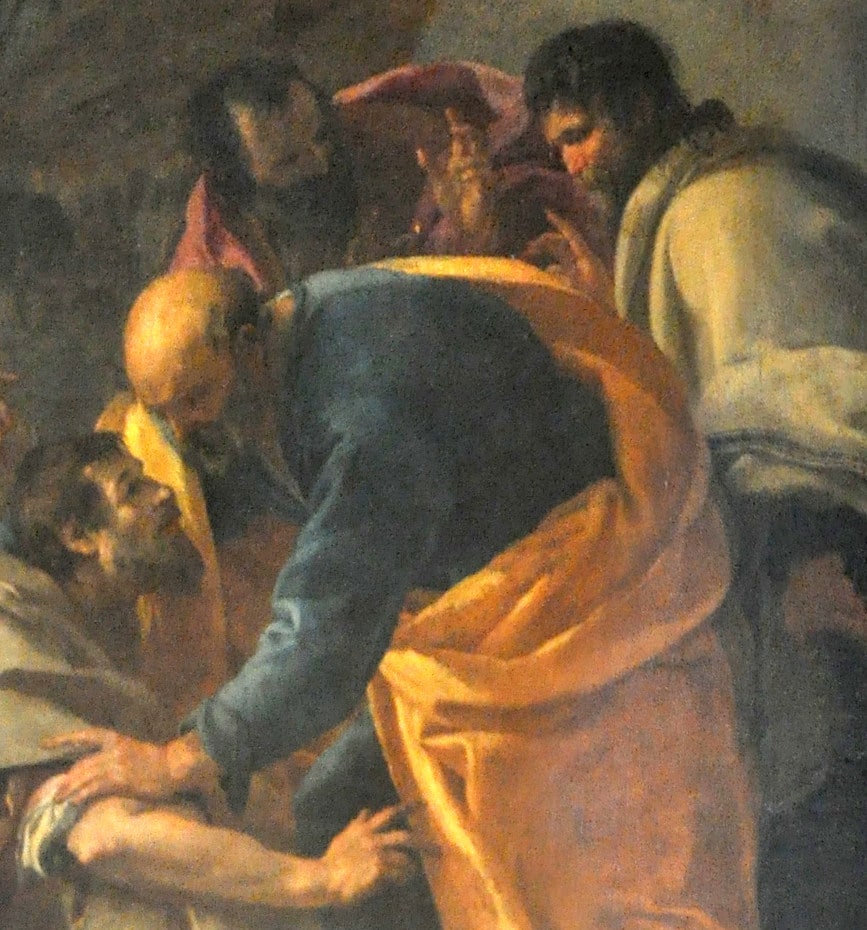
Cornelius, a leading character of our first reading this weekend, was a Roman, and so not Jewish, although not necessarily a pagan, for he was sufficiently devoted to the God of Israel to received the angelic vision that led him to call for the Apostle S. Peter. The Romans looked down upon the Jews as little more than slaves, so this Roman soldier falling before the Apostle S. Peter (pictured above) is beyond extraordinary. Our Lord had said in the Gospel that His mission was to the Jewish community (He is primarily their Messiah), but He had begun to receive non-Jewish believers, such as the Syro-Phoenician woman, the Samaritan woman and a handful of unnamed Greeks. The prophets had long spoken of non-Jewish believers entering the Church of God, or the Assembly of God’s people, in the days of the Messiah. It was inevitable that the Apostolic Church would take up this mission, and Cornelius and his family (as given by our reading today) were the first non-Jews to be formally be admitted to Catholic communion.

“And as soon as Peter had entered, he was met by Cornelius, who fell at his feet and did reverence to him; but Peter raised him; ‘Stand up,’ he said, ‘I am a man like thyself.’ So he went in, still conversing with him, and found a great company assembled. ‘You know well enough,’ he told them, ‘that a Jew is contaminated if he consorts with one of another race, or visits him; but God has been shewing me that we ought not to speak of any man as profane or unclean; and so, when I was sent for, I came without demur. Tell me then, why you have sent for me.’ And Cornelius said, ‘Three days ago, at this very time, I was making my afternoon prayer in my house, when suddenly I saw a man standing before me, in white clothes, who said to me, “Cornelius, thy prayer has been heard, thy alms-deeds have won remembrance in God’s sight. Thou art to send to Joppa, and summon thence that Simon who is also called Peter; he is lodging with a tanner called Simon, close to the sea.” I lost no time, therefore, in sending for thee, and thou hast done me a favour in coming. Now thou seest us assembled in thy presence, ready to listen to whatever charge the Lord has given thee.’ Thereupon Peter began speaking; ‘I see clearly enough,’ he said, ‘that God makes no distinction between man and man; He welcomes anybody, whatever his race, who fears Him and does what piety demands….'”

Acts of the Apostles, 10: 25-35 [link]

This is a great story for us today, for most of us do not have Jewish roots and it is in this story that the promises made by the Holy One to the nation of the Hebrews (and later Jews) were first formally extended to us non-Jews. Let’s go to the Last Supper for an understanding of what I have just called ‘Catholic communion.’ Christ says to His Apostles in this gospel reading that if we love Him and demonstrate our love for him by obeying His commandments and thereby building fraternal charity, then we are His friends. The word ‘servant’ best describes the adherents of ancient religions: they were usually servants of their gods. The very Jews would have called themselves servants of the Most High, for, although the nation of Israel was called God’s first-born, the sons of God in the times of the Old Testament were divine figures, angelic beings. But the Christian message was about the adoption of servants as children of God, Children of Light. This extraordinary relationship of belonging that Christ extends to His own is described again in our gospel reading this weekend. Here is what the Lord says:

“‘I have bestowed My love upon you, just as My Father has bestowed His love upon Me; live on, then, in My love. You will live on in My love, if you keep My commandments, just as it is by keeping My Father’s commandments that I live on in His love. All this I have told you, so that My joy may be yours, and the measure of your joy may be filled up. This is My commandment, that you should love one another, as I have loved you. This is the greatest love a man can shew, that he should lay down his life for his friends; and you, if you do all that I command you, are My friends. I do not speak of you any more as My servants; a servant is one who does not understand what his master is about, whereas I have made known to you all that My Father has told Me; and so I have called you My friends.'”

Gospel of S. John, 15: 9-15 [link]

The last few Sundays, we have heard Him call us the sheep of His sheepfold who know Him intimately, and the branches of Him as the Vine, by which we are part of Him. Now, he says clearly that we are not His servants, for He is on the point of adopting us as the sons and daughters of His heavenly Father. As you can see very clearly, our Lord’s concept of friendship is far more intimate than the common idea of acquaintance that we have today, thanks to the Americanisation of our society. We should certainly not find many we call friends, for example, prepared to lay down their lives for us. Rather, Christ’s idea of friendship is more akin to the friendship in married life of husband and wife in its level of intimacy, and it calls to my mind at once the promises that are made in marriage: unity in sickness and in health, in good times and bad, until death doth separate. If we can achieve this intimacy with Christ, Who has called us to it, then His desires and intentions will coincide with ours, and our Thy-will-be-done prayers will be powerful.

“Beloved, let us love one another; love springs from God; no one can love without being born of God, and knowing God. How can the man who has no love have any knowledge of God, since God is love? What has revealed the love of God, where we are concerned, is that He has sent His only-begotten Son into the world, so that we might have life through Him. That love resides, not in our shewing any love for God, but in His shewing love for us first, when He sent out His Son to be an atonement for our sins.”

First letter of S. John, 4: 7-10 [link]

In this second reading this weekend, the Apostle S. John sets forth about love, and that love is associated with sacrifice, for the atonement for sin comes from a blood sacrifice. Let us make no mistake: this ‘love’ the Apostles kept talking about is not the vacuous or ambiguous type that is constantly before us in our culture, because that often ends in separation and divorce, and the corresponding dissolution and fracturing of families. The ‘love’ the Apostles taught us about is the undying love of the Holy One, that is willing (as He said in the gospel reading) to die for the sake of the beloved. This entirely self-giving and marital love, as S. John says, comes from God, and makes the lover powerfully related to the Holy One.

Anyone who cannot love like this cannot have known God, John says. That may sound like an exaggeration, but its establishes a Christian anthropology: mankind has been built like God to love like this, to die for love – it’s part of what it means to be human and to be made in the ‘image’ of God. Christ teaches us to do it perfectly, and in so far as we open our hearts to Him and become His friends we should not find this type of love a great challenge.

In fact, we should find it easy.

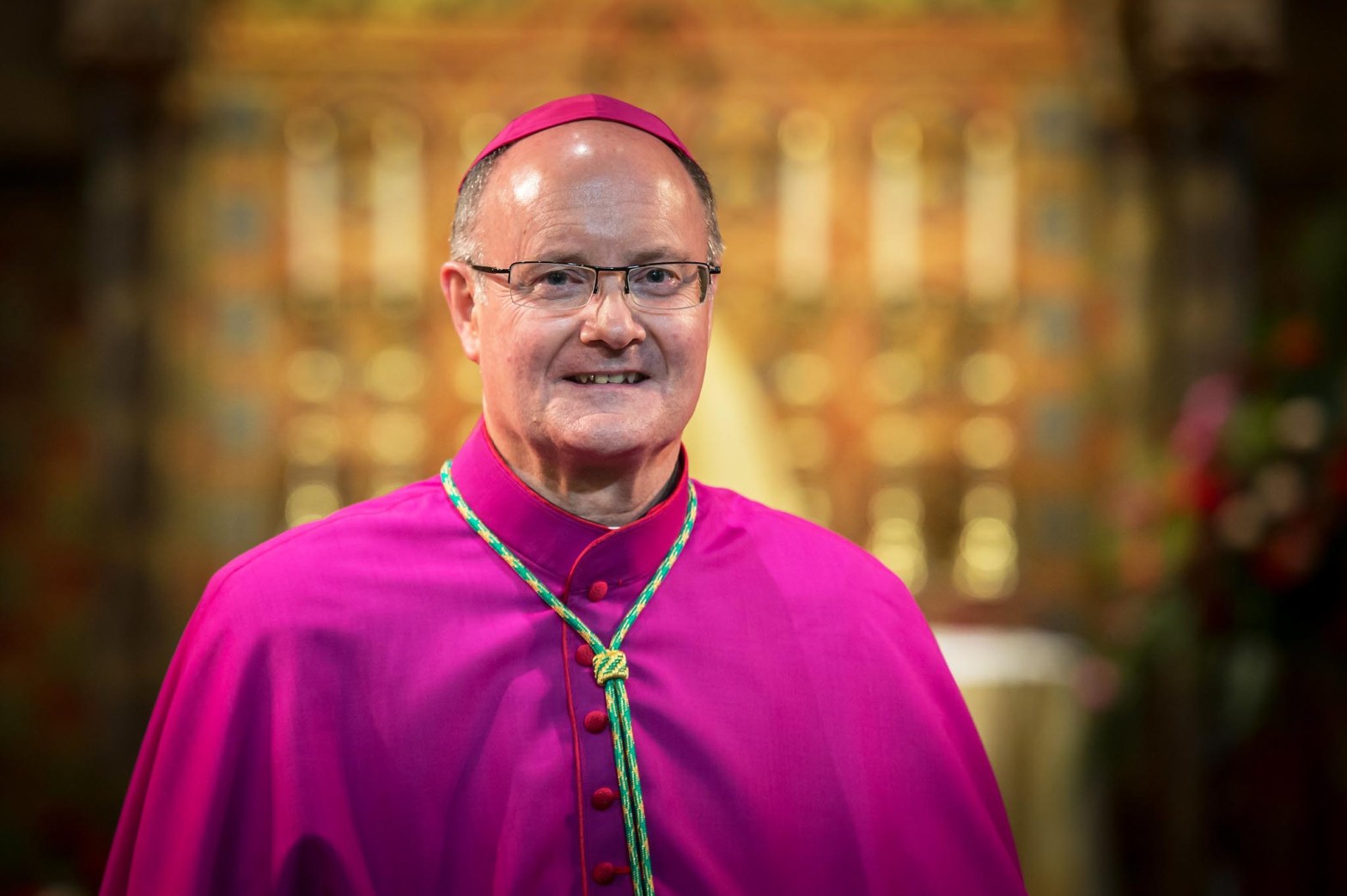
The Bishop’s letter for Safeguarding Sunday

for parish newsletters and / or parish noticeboards
Sixth Sunday of Easter
Saturday 4th and Sunday 5th May 2024

“This is my commandment, love one another as I have loved you.”
(John 15:12)

“Today is Safeguarding Sunday. It’s an opportunity to reflect a little on our ongoing journey as a diocese to build a safer environment for every person. You will recall that the Elliott review in 2020 recommended that the Catholic Church in England and Wales put in place a national safeguarding body. In July 2021 the Catholic Safeguarding Standards Agency was formed. Its task is to ensure that all dioceses are regulated to meet the national standards recommended in the Elliott Report.

“As a diocese, our priority is to ensure that we are providing a safe environment for all those who come in contact with our parishes, chaplaincies, and the Catholic organisations at work throughout the diocese. So I do want to assure you that the diocese is very much committed to embedding robust safeguarding standards. The professional support of our Diocesan Safeguarding Department now enables the safer recruitment and training of all clergy, employees and volunteers. It also ensures that we are transparent and accountable in the way that all allegations and concerns are managed.

“I wish to thank the Diocesan Safeguarding Department of Rachael Campion, Alan Booth and Jane Black for all their good work. I would also like to express my gratitude to the priests and parish safeguarding representatives for their generous commitment to improving safeguarding practices in their parishes. Additional training for clergy and parish safeguarding representatives is now in place. There is also safeguarding information available on the diocesan website, and an easy to read and comprehensive guide to safeguarding has been produced in the form of a very helpful Parish Safeguarding Handbook. Please do take a look at this material because it is the responsibility of each of us to help ensure that our churches and chaplaincies are both safe and welcoming. This is something that cannot just be left to the Diocesan Safeguarding Department, the clergy and the parish safeguarding representatives.

“From meeting with and listening to victims and survivors of child sexual abuse I have come to understand, ever more deeply, that sexual abuse not only heinously violates a child at the time of their abuse, but it all too often cruelly robs a child of their future. Victims and survivors of sexual abuse continue to carry throughout their lives the painful and debilitating consequences of the grave crime of sexual abuse. I do not underestimate the traumatic and life-long consequences of sexual abuse upon their lives and how it also affects their families and parish communities. Please know that my door, and that of our Diocesan Safeguarding Department, is always open to anyone affected by abuse.

“Like you, I continue to love Christ’s Church, but I acknowledge that sexual abuse has stained the face of the Church and it has undermined her mission. I feel a deep sense of shame for this abuse. So, as Bishop, I am committed to ensuring that we do everything that we each can to learn from the past and to protect and keep safe the most vulnerable in our communities. There can be no room in our diocese for complacency or for not taking seriously the need for vigilance on the part of all of us. Thank you for doing all you can to support your parish priest and parish safeguarding representative* in fostering a deeper and more evident culture of safeguarding, care and protection for everyone in your parish or chaplaincy.

“With my prayers and gratitude,
The Right Reverend Patrick McKinney,
Bishop of Nottingham.”

Reading through the letter of S. James

The first bishop of Jerusalem, Saint James the Just, was greatly honoured during his lifetime, by Christian and Jew alike. The tradition of the Church speaks through S. Jerome who quotes an older description of him thus:

“After the apostles, James the brother of the Lord surnamed the Just was made head of the Church at Jerusalem. Many indeed are called James. This one was holy from his mother’s womb. He drank neither wine nor strong drink, ate no flesh, never shaved or anointed himself with ointment or bathed. He alone had the privilege of entering the Holy of Holies, since indeed he did not use woolen vestments but linen and went alone into the temple and prayed in behalf of the people, insomuch that his knees were reputed to have acquired the hardness of camels’ knees.

[text source]

It certainly seems as if James was a life-long Nazirite, like Saint John the Baptist, and so was greatly respected in Jewish society. From this figure comes this excellent letter in our New Testament, addressed to ‘the twelve tribes scattered throughout the world,’ and to my mind that indicates a general message to Christian Jews and non-Christian Jews alike from someone who may have been a figure of authority for both, although the letter is manifestly Christian. Or perhaps the Church did understand herself in those early years as being the spiritual heir of the twelve tribes of old Israel. His understanding of suffering as valuable in itself (enabling spiritual growth and maturation) is both Jewish and Christian. Suffering and martyrdom as providing a crown is an idea we may know from the letters of Saint Paul. 

“Blessed is he who endures under trials. When he has proved his worth, he will win that crown of life, which God has promised to those who love Him. Nobody, when he finds himself tempted, should say, I am being tempted by God. God may threaten us with evil, but He does not Himself tempt anyone. No, when a man is tempted, it is always because he is being drawn away by the lure of his own passions. When that has come about, passion conceives and gives birth to sin; and when sin has reached its full growth, it breeds death.”

James, 1: 12-15

God may lead us to the place of temptation (as in the Lord’s prayer), but he doesn’t himself draw us into evil; we are often our own worst enemies, when it comes to temptation and sin. In line with the old Hebrew prophets, James recommends honesty and faithful living, and prudence in speech, and in works of charity.

“Only you must be honest with yourselves; you are to live by the word, not content merely to listen to it. One who listens to the word without living by it is like a man who sees, in a mirror, the face he was born with; he looks at himself, and away he goes, never giving another thought to the man he saw there. Whereas one who gazes into that perfect law, which is the law of freedom, and dwells on the sight of it, does not forget its message; he finds something to do, and does it, and his doing of it wins him a blessing. If anyone deludes himself by thinking he is serving God, when he has not learned to control his tongue, the service he gives is vain. If he is to offer service pure and unblemished in the sight of God, who is our Father, he must take care of orphans and widows in their need, and keep himself untainted by the world.”

James, 1: 22-27

James witnesses the absolute equality of the members of the Church at the time in their synagogue or place of meeting:

Suppose that a man comes into your place of meeting in fine clothes, wearing a gold ring; suppose that a poor man comes in at the same time, ill clad. Will you pay attention to the well-dressed man, and bid him take some place of honour; will you tell the poor man, ‘Stand where thou art,’ or ‘Sit on the ground at my footstool?’ If so, are you not introducing divisions into your company? Have you not shewn partiality in your judgement? Listen to me, my dear brethren; has not God chosen the men who are poor in the world’s eyes to be rich in faith, to be heirs of that kingdom which he has promised to those who love him?

James, 2: 2-5

This is followed by a fine discourse on the integrity of the Law of God, so that even the smallest transgression or sin is still an offence against the Law worthy of judgement and sentence. And our faith is demonstrated not by fine words, but by our actions. This is thoroughly worthy of Christ Himself, who scolded the Pharisees of His time for observing the letter of the Law while neglecting charity:

Of what use is it, my brethren, if a man claims to have faith, and has no deeds to shew for it? Can faith save him then? Here is a brother, here is a sister, going naked, left without the means to secure their daily food; if one of you says to them, ‘Go in peace, warm yourselves and take your fill,’ without providing for their bodily needs, of what use is it? Thus faith, if it has no deeds to shew for itself, has lost its own principle of life.

James, 2: 14-17

The third chapter of the letter is a colourful description of the damage that can be done by bad speech, the cause of strife, the enemy of peace, the instrument of pride. It think he means to say that self-control and prudence, especially with respect to things spoken, helps establish and maintain peace, within which holiness may grow.

“Among the organs of our nature, the tongue has its place as the proper element in which all that is harmful lives. It infects the whole body, and sets fire to this mortal sphere of ours, catching fire itself from hell. Mankind can tame, and has long since learned to tame, every kind of beast and bird, of creeping things and all else; but no human being has ever found out how to tame the tongue; a pest that is never allayed, all deadly poison… Where there is jealousy, where there is rivalry, there you will find disorder and every kind of defect. Whereas the wisdom which does come from above is marked chiefly indeed by its purity, but also by its peacefulness; it is courteous and ready to be convinced, always taking the better part; it carries mercy with it, and a harvest of all that is good; it is uncensorious, and without affectation. Peace is the seed-ground of holiness, and those who make peace will win its harvest.”

James, 3: 6-8, 16-18

James says that it is desire and concupiscence – wishing to possess what is not one’s to possess – that leads eventually to quarrelling and murder. And the basis of those desires is an unhealthy intention, not of appreciation for the object of desire, but merely the satisfying of those desires. The work of the believer is then to draw nearer to God in humility and to purify the intentions of his or her heart. 

“Be God’s true subjects, then; stand firm against the devil, and he will run away from you, come close to God, and He will come close to you. You that are sinners must wash your hands clean, you that are in two minds must purify the intention of your hearts. Bring yourselves low with mourning and weeping, turn your laughter into sadness, your joy into downcast looks; humble yourselves before the Lord, and he will exalt you.

James, 4: 7-10

The last chapter begins with a condemnation of those who set their hearts on riches and abuse the poor, such as by neglecting the wages of their servants and workmen. This is an echo of the voice of the Hebrew prophets, and James’ follow-up is not very different from Isaiah’s, or Hosea’s, or Habacuc’s: wait patiently for the Lord, as farmers wait for the right seasons for returns on their work. And James does refer directly to the patience of the old prophets and of such men as Job. There are some nice bits of advice, such as to prayer, hymning, sacramental confession and that bit that sounds like it came out of a Gospel:

“But above all, my brethren, do not bind yourselves by any oath, by heaven, by earth, or by any oath at all. Let your word be Yes for Yes, and No for No; if not, you will be judged for it.

James, 5: 12

That is the advice we remember from Christ’s sermon on the mount (Gospel of S. Matthew, 5: 37), which is the basis for James’ commitment to prudence in speech, mentioned earlier. And there are those lines that everybody who has attended the service of the Anointing of the Sick will remember well (and there this post could end): 

Is one of you sick? Let him send for the presbyters of the church, and let them pray over him, anointing him with oil in the Lord’s name. Prayer offered in faith will restore the sick man, and the Lord will give him relief; if he is guilty of sins, they will be pardoned.

James 5: 14-15

One in Christ, Jew and Gentile (Sunday V of Easter)

One of the books I have been reading this week was written by a Jewish rabbi  from Rochester in the US, who a few decades ago came to a understanding of Our Lord Jesus Christ that his fellowmen mostly abhor. He realised that Christ was the Hebrew Messiah long awaited by the Jews. This man’s name is Bernis, and his journey into the Christian faith began with friendship with evangelical Christians, although he spearheaded the creation worldwide of a type of Jewish synagogue called ‘messianic’ – that is Jews who believe in Christ and are somehow baptised, but not obviously attached to any of the various branches of protestantism, much less the Catholic Church.

Rabbi Yonathan Bernis and his testimony

The language Bernis uses in his books is the born-again type of protestant language, but there have been other Jews like him who have taken the further step and joined one of the Apostolic Churches, of which ours is one.  I have read several of their stories, because I love to hear of Jews who break through the walls the rabbis have built for centuries and see with wonder the glory of the Holy One manifested in the God-man. The usual theme I find is this: a Jew who accepts Christ and somehow becomes a Christian doesn’t feel that he or she has ceased to be a Jew; rather, they find that their Jewishness is deepened and that they stand at the end of a long story that began with the election of the patriarch Abraham. The reason I mention all this is that it forms a good introduction to the two principal readings today. In the first reading, we find that S. Paul, called here by his Hebrew name Sa’ul (Luke calls him by his Greek name Paulos when he is in the Greek countries), some time after having his extraordinary conversion of heart on the road to Damascus, is now looking for the Apostles of the Lord. He has seen Christ in vision on the road, and now he is looking for those who saw Christ with their own eyes, heard them with their own ears.

“So [Paul] reached Jerusalem, where he tried to attach himself to the disciples; but they could not believe he was a true disciple, and all avoided his company. Whereupon Barnabas took him by the hand and brought him in to the Apostles, telling them how, on his journey, he had seen the Lord and had speech with Him, and how at Damascus he had spoken boldly in the Name of Jesus. So he came and went in their company at Jerusalem, and spoke boldly in the Name of the Lord. He preached, besides, to the Jews who talked Greek, and disputed with them, till they set about trying to take his life. As soon as they heard of this, the brethren took him down to Caesarea, and put him on his way to Tarsus.”

Acts of the Apostles, 9: 26-30 [link]

He, Paul, had also been given a task by Christ – he was to be the missionary to carry the Christian religion beyond the bounds of Judaea, to the Greek countries and beyond. Throughout the history of the Church, men who have had similar missions have sought first the apostolic authority of the bishops in communion with the successor of Peter. So, Paul goes with the support of S. Barnabas to Jerusalem. He needs that support also for, not very long before, he had been persecuting the Christians wherever he could find them. Now this proud Pharisee kneels before Christ’s regents in humility and, with their authority, creates such a stir in the Holy City that the Church is forced to send him off to Roman Caesarea for safety. Let us consider the plight of all converts, with that fire within their hearts, like S. Paul and also like the rabbi I mentioned earlier, and also converts to Catholicism from other Christian communities. They don’t necessarily suffer violence anymore, but they quickly become pariahs among their former communities, cut off and abandoned. They should not be abandoned by us. Let us pray first of all for the conversion of the hearts of our Jewish brothers and sisters, through the intercession of OL and the Apostles, and the Saints of the early Church – Jews all of them.

Our gospel message establishes the picture of the vine of the Church – a Jewish vine – as Christ explains to His Jewish audience that they are branches on that vine.

“I AM the true Vine, and it is My Father Who tends it. The branch that yields no fruit in Me, He cuts away; the branch that does yield fruit, He trims clean, so that it may yield more fruit. You, through the message I have preached to you, are clean already; you have only to live on in Me, and I will live on in you. The branch that does not live on in the vine can yield no fruit of itself; no more can you, if you do not live on in Me. I AM the Vine, you are its branches; if a man lives on in Me, and I in him, then he will yield abundant fruit; separated from Me, you have no power to do anything. If a man does not live on in Me, he can only be like the branch that is cast off and withers away; such a branch is picked up and thrown into the fire, to burn there. As long as you live on in Me, and my words live on in you, you will be able to make what request you will, and have it granted. My Father’s Name has been glorified, if you yield abundant fruit, and prove yourselves My disciples.”

The Gospel of S. John, 15: 1-8 [link]

Paul would later explain in his letters that non-Jewish people such as ourselves are grafted onto that Jewish vine through baptism. And the life that flows through us – the sap of the vine – is the grace of God, through which we are meant to bear fruit, or else we are pruned off and destroyed. This is a strong theme in the Gospel of S. John: that if any of the sons and daughters of men are to have life, they must have it through Christ, and that they must have His life within them. And it should be demonstrable, not just some vague and abstract faith, but a life of charity and devotion – by real and active lives of faith, as S. John also says in the second reading. Misunderstanding and ridicule we will undoubtedly have, but so did He Who went to the Cross for us. But we are bound to evangelise, anyhow, in word and act, and draw as many people as we can to the promises of Christ.

 “My little children, let us shew our love by the true test of action, not by taking phrases on our lips. That proves to us that we take our character from the truth, and we shall be able to satisfy our consciences before God; if our consciences condemn us, it is because God is above conscience, and nothing is hidden from Him. Beloved, if conscience does not condemn us, we can appear boldly before God, and He will grant all our requests, since we are keeping His commandments, and living as He would see us live. What He commands is, that we should have faith in the Name of His Son Jesus Christ, and at His command should love one another. When a man keeps his commandments, it means that he is dwelling in God, and God in him. This is our proof that he is really dwelling in us, through the gift of his Spirit.”

First letter of the Apostle S. John, 3: 18-24 [link]

The Shepherd-king as Father (Sunday IV of Easter)

We must always marvel at the benevolent love of the Holy One for the men and women that He calls His own. And we know that He calls the Church His own, because He actually calls it the sheepfold of which He is the Good Shepherd. And this is the theme of the readings today, which we have dubbed Good Shepherd Sunday: the love of God. What is the easiest way of describing the love of God? Paternity. We do, after all, call Him Father in our most well-known prayer. What is the love of a father? If we are not human fathers, we may have the experience of a human father. My own experience is of the man who picked me up when I fell over (and still does, even if he now has to drive halfway across the country for it), who corrected me (and still does), who is constantly concerned for my physical and spiritual welfare and for my ability to reach a happy end. Now, multiply this love infinitely, and you will find the Sacred Heart, a fire that burns for the sons and the daughters of men. And the Sacred Heart says to us in our reading today, ‘I AM the Good Shepherd.’

“I AM the Good Shepherd. The good shepherd lays down his life for his sheep, whereas the hireling, who is no shepherd, and does not claim the sheep as his own, abandons the sheep and takes to flight as soon as he sees the wolf coming, and so the wolf harries the sheep and scatters them. The hireling, then, takes to flight because he is only a hireling, because he has no concern over the sheep. I AM the Good Shepherd; My sheep are known to Me and know Me; just as I am known to My Father, and know Him. And for these sheep I am laying down My life.”

Gospel of S. John, 10: 11-15 [link]

Some 600 years before OLJC walked this earth in human form, the prophet Ezechiel memorably spoke of God as the Good Shepherd. It’s not in our readings this weekend (sadly), but it is the Good Shepherd chapter of the Old Testament of our bibles:

“A word, shepherds, for your hearing, a message from the Lord God: ‘Out upon yonder shepherds! I will hold them answerable for the flock entrusted to them, and they shall have charge of it no more, feed themselves out of its revenues no more. From their greedy power I will rescue it; no longer shall it be their prey.’ This is what the Lord God says: ‘I mean to go looking for this flock of Mine, search it out for Myself. As a shepherd, when he finds his flock scattered all about him, goes looking for his sheep, so will I go looking for these sheep of Mine, rescue them from all the nooks into which they have strayed when the dark mist fell upon them. Rescued from every kingdom, recovered from every land, I will bring them back to their own country; they shall have pasture on the hill-sides of Israel, by its watercourses, in the resting-places of their home.'”

Prophecy of Ezechiel, 34: 9-13 [link]

The summary of this chapter of Ezechiel is this: God had appointed men to work as the shepherds of his people, priests (especially the High Priest of the Temple) and the Jewish king and his council, but these men had instead led the people into serious error – God declared through Ezekiel that He had had enough of this destruction of souls and that He would arrive Himself as their Shepherd, working together with a descendant of King David, a true king – so, the divine Shepherd colluding with a human shepherd-king. Does that sounds marvellously familiar? In the fullness of time, a strange being appeared in Bethlehem of Judaea, a Child Who (an angel had told His mother) would rule for His ancestor David and at the same time would be called God. The Holy One Who loved His people had arrived to shepherd them as their Father, but in the human form of the Davidic king that would make Him also their Brother. And He would rule their hearts, their wills voluntarily united to His. Listen to Him speak in our gospel reading above: hirelings flee their responsibility, human shepherds are not always reliable, but the Good Shepherd never leaves the sheep, and gives His life for them. And they love Him with a love that will draw them to the cross and to death for Him.

This is the true love of a father, inspiring a similar love in his children; even if some of us have had no experience of human fatherhood, or perhaps abusive or otherwise deficient fathers, we can yet understand an ideal if not from humanity then in the animal world, of parents that do everything to protect their young from danger and death. And you and I, all of us, are forever young before the Ancient of Days, and we shall always require His fatherly love, His assurance in the midst of our suffering and at the moment of our death that we are accompanied and loved, by a fire of fatherly devotion that burns forever. ‘Think of the love lavished upon us,’ S. John tells us in our second reading, that we can call the Creator of all things by the most familiar names given to earthly fathers; which other community but the Christian ones can do this?

“See how the Father has shewn His love towards us; that we should be counted as God’s sons, should be His sons. If the world does not recognize us, that is because it never recognized Him. Beloved, we are sons of God even now, and what we shall be hereafter, has not been made known as yet. But we know that when He comes we shall be like Him; we shall see Him, then, as He is. Now, a man who rests these hopes in Him lives a life of holiness; he, too, is holy. The man who commits sin, violates order; sin of its nature is disorder. You know well enough that when He was revealed to us, it was to take away our sins; there is no sinfulness in Him, and no one can dwell in Him and be a sinner. The sinner must be one who has failed to see Him, failed to recognise Him.”

First letter of the Apostle S. John, 3: 1-6 [link]

S. John like the other Apostles is insistent that our lives reflect our election as the Children of God; the Children of Light cannot associate with the darkness of sin. But why is it even possible that the children of men can be adopted by God. Because of the Sacred Heart, which is both human and divine, and through which we are therefore adopted by the Holy One. This is the substance of the first reading, where S. Peter declares that the most important stone in the edifice of the People of God (of both old and new testaments) – the God-man, both human and divine, Who brings communion between God and mankind, Who makes them His children – this most important stone was cast aside by the men who should have received Him with joy. These priests and their associates of the first century were not unlike those unworthy shepherds of the prophet Ezechiel, who were to be replaced by the Good Shepherd – he would replace them, too. For their attempt at opposing the Will of God was foiled by the Resurrection of Christ, by which the most important cornerstone of Israel was replaced, upon which the Church was built and will ever stand.

“Peter was filled with the Holy Spirit, and said to them, ‘Rulers of the people, elders of Israel, listen to me. If it is over kindness done to a cripple, and the means by which he has been restored, that we are called in question, here is news for you and for the whole people of Israel. You crucified Jesus Christ, the Nazarene, and God raised Him from the dead; it is through His Name that this man stands before you restored. He is that stone, rejected by you, the builders, that has become the chief stone at the corner. Salvation is not to be found elsewhere; this alone of all the names under heaven has been appointed to men as the one by which we must needs be saved.”

The Acts of the Apostles, 4: 8-12 [link]

The Old Testament and the New (Sunday III of Easter)

Let’s try to find a common thread for all of our readings at Mass this weekend. There is first of all the sermon of Saint Peter on the occasion of a miracle of healing performed upon a cripple in Christ’s Name.

“Peter, when he saw it, addressed himself to the people; ‘Men of Israel,’ he said, ‘why does this astonish you? Why do you fasten your eyes on us, as if we had enabled him to walk through some power or virtue of our own? It is the God of Abraham and Isaac and Jacob, the God of our forefathers, who has thus brought honour to His Son Jesus. You gave Him up, and disowned Him in the presence of Pilate, when Pilate’s voice was for setting Him free. You disowned the Holy, the Just, and asked for the pardon of a murderer, while you killed the Author of life. But God has raised Him up again from the dead, and we are here to bear witness of it. Here is a man you all know by sight, who has put his faith in that Name, and that Name has brought him strength; it is the faith which comes through Jesus that has restored him to full health in the sight of you all. Come then, brethren, I know that you, like your rulers, acted in ignorance; but God has fulfilled in this way what was foretold by all the prophets about the sufferings of His Christ. Repent, then, and turn back to Him, to have your sins effaced, against the day when the Lord sees fit to refresh our hearts. Then He will send out Jesus Christ, Who has now been made known to you, but must have His dwelling-place in heaven until the time when all is restored anew, the time which God has spoken of by His holy prophets from the beginning.”

The Acts of the Apostles, 3: 12-21

Peter declares that those same people gathered to celebrate the Passover in Jerusalem – that is, the liberation of the Hebrew people from Egypt – had unthinkingly handed over the God (Who had liberated their ancestors) over to the Romans for execution, collaborating with the Temple priests and their party of the Sadducees to do so. They were guilty of this great sin, said Peter, but they had also unwittingly fallen in with God’s plan, by which the dead Christ had been raised to life and had thereby drawn not only the Hebrews but all humanity united with Him out of the darkness and death of this world and into the light of God’s presence. Repent, cried Peter, and join yourselves to Christ, through Whom alone true freedom is to be had.

Then, in our second reading, another Apostle, this time S. John, is keeping on about repenting and avoiding sin. But, he says, if we should sin, Christ the Just One advocates for us before God the Father, taking our sins upon Himself. But not without conditions: we are to unite ourselves to Christ in love, through our observance of His commandments, by which we can claim to know Him. If we ignore the commandments and claim to know Christ and God, we are either extremely foolish or liars. Hopefully, only foolish…

“Little children, the purpose of this letter is to keep you clear of sin. Meanwhile, if any of us does fall into sin, we have an Advocate to plead our cause before the Father in the Just One, Jesus Christ. He, in His own person, is the atonement made for our sins, and not only for ours, but for the sins of the whole world. Have we attained the knowledge of Him? The test is, whether we keep His commandments; the man who claims knowledge of Him without keeping His commandments is a liar; truth does not dwell in such a man as that. No, if a man keeps true to His word, then it is certain that the love of God has reached its full stature in Him; that is what tells us that we are dwelling in Him.”

First letter of the Apostle S. John, 2: 1-5

So, here’s our thread so far: the necessity of allegiance to Christ, Who comes not as a judge but as an advocate for those who love Him. For those who do not love Him, who even reject Him, judgement is already made by their own words and deeds, and condemnation follows. I am convinced this means that our words and deeds should be deliberately intended to derail the work of Christ and His Church to condemn us, and this implies a real malevolence, even if this is sometimes hidden behind a façade of humanism and equity.

And that takes us down to the gospel reading. The two men on the road to Emmaus had returned in a hurry to Jerusalem to tell the disciples there that they had seen the risen Christ, and that He had been revealed to them in the breaking of the bread. In Luke’s narratives, the ‘breaking of the bread’ is a direct reference to the holy Eucharist, which we of the Latin West call ‘the Mass.’ While the community was excitedly discussing this implication of the presence of Christ in the Eucharist, suddenly the Holy One is standing right there among them. How they must have jumped! Alarm and fright, says Luke. The two men from Emmaus had said that He had vanished from their sight when they had recognised Him. He must be a ghost! So, He holds out His arms so they can feel muscle and sinew, bones and joints, and know that He is standing before them, body and soul, and even ready afterwards for a bit of grilled fish. In what follows, we may draw a connection to the other readings this weekend.

“‘This is what I told you,’ He said, ‘while I still walked in your company; how all that was written of Me in the Law of Moses, and in the Prophets, and in the Psalms, must be fulfilled.’ Then He enlightened their minds, to make them understand the scriptures; ‘So it was written,’ He told them, ‘and so it was fitting that Christ should suffer, and should rise again from the dead on the third day; and that repentance and remission of sins should be preached in His Name to all nations, beginning at Jerusalem. Of this, you are the witnesses.'”

Gospel of S. Luke, 24: 44-48

What does Christ say? The Law of Moses spoke of Him, the Prophets spoke of Him, the Psalms spoke of Him. What is the Law of Moses? The guidance of God, embodied by the Ten Commandments and the associated rituals of the people, the observance of which S. John in the second reading connected with the love of God and knowledge of Him. What were the prophecies? The condemnation of sin and the recalling of the people to the observance of the Commandments of the Law. Repent, S. Peter had cried out in our first reading, and turn back to God and His guidance – His commandments. What are the psalms of the Hebrew liturgy? A joyful singing of the glory of God and His guidance and protection for the people He loved.

All of these spoke of Christ, of His Passion and death, and how this would bring repentance and the forgiveness of sins. ‘I gave Moses the Old Testament,’ Christ says, ‘and behold I have written the New Testament in My blood. And you, My Apostles and My Church, are witnesses to this.’

The Church in effect (Sunday II of Easter)

This Sunday is the octave day of Easter Sunday, and just as a musical octave at its end pitches the same note higher, the Resurrection of our Lord raises in pitch on the eighth day in a way, to the flourishing of the Church. For the grand theme of all our readings this weekend is the rapid growth and progress of the Church in the wake of the Passion and the Resurrection of the Lord – that one event that rocked Jerusalem and opened the floodgates of God’s blessings upon all the men and women who flocked to the Holy City in spirit, to the threshold and gates of the Successor of David, Son of Man and Son of God, now gloriously risen from the dead. Let’s have the prophet Isaiah introduce this nicely…

“In later days, the mountain where the Lord dwells will be lifted high above the mountain-tops, looking down over the hills, and all nations will flock there together. A multitude of peoples will make their way to it, crying, ‘Come, let us climb up to the Lord’s mountain-peak, to the house where the God of Jacob dwells; He shall teach us the right way, we will walk in the paths He has chosen.’ The Lord’s commands shall go out from Sion, His word from Jerusalem, and He will sit in judgement on the nations, giving His award to a multitude of peoples. They will melt down their swords into plough-shares, their spears into pruning-hooks, nation levying war against nation and training itself for battle no longer.”

Prophecy of Isaias, 2: 2-4 [link]

In our gospel reading from S. John, we find the Christ crossing boundaries in an extraordinary manner, walking carefree into sealed rooms. Already at the foot of the Cross, S. John had noted with horror the opening of Christ’s side with a spear, and the bursting forth of the Sacraments of Baptism and the Holy Eucharist in the water and blood. Now, he notes on the evening of Easter Sunday with astonishment the birth of the Sacrament of Confession and Reconciliation, as the risen Christ gives authority to His Apostles to forgive sins in His name, a gift they would hand down to their successors, the priests of the Church.

“And now it was evening on the same day, the first day of the week; for fear of the Jews, the disciples had locked the doors of the room in which they had assembled; and Jesus came, and stood there in their midst; ‘Peace be upon you,’ He said. And with that, He shewed them His hands and His side. Thus the disciples saw the Lord, and were glad. Once more Jesus said to them, ‘Peace be upon you; I came upon an errand from My Father, and now I am sending you out in My turn.’ With that, He breathed on them, and said to them, ‘Receive the Holy Spirit; when you forgive men’s sins, they are forgiven, when you hold them bound, they are held bound.'”

Gospel of S. John, 20: 19-23 [link]

The blessing of the Sacraments of the Church is given to those who believe in Christ and trust in His promises. As He Himself says at the end of the reading, visiting on the octave day, the gift of faith extends down the generations, and we have dear S. Thomas to thank for that. You believe because you can see and hear, says the Holy One to Thomas, but blessed are they who cannot see and hear and yet believe. It is the very scientistic doubting of the Apostles that confirms us in our faith in the reality of the Resurrection.

“So, eight days afterwards, once more the disciples were within, and Thomas was with them; and the doors were locked. Jesus came and stood there in their midst; ‘Peace be upon you,’ He said. Then He said to Thomas, ‘Let Me have thy finger; see, here are My hands. Let me have thy hand; put it into My side. Cease thy doubting, and believe.’ Thomas answered, ‘Thou art my Lord and my God.’ And Jesus said to him, ‘Thou hast learned to believe, Thomas, because thou hast seen Me. Blessed are those who have not seen, and yet have learned to believe.'”

Gospel of S. John, 20: 26-29 [link]

He is talking about you and me, and it is our faith and the faith of our parents and godparents that brought us baptism, and every other Sacrament. And from these streams of grace, as S. John says in the second reading – from these Sacraments is the Church built.

“Everyone who believes that Jesus is the Christ is a child of God, and to love the parent is to love his child. If we love God, and keep His commandments, we can be sure of loving God’s children. Loving God means keeping His commandments, and these commandments of His are not a burden to us. Whatever takes its origin from God must needs triumph over the world; our faith, that is the triumphant principle which triumphs over the world. He alone triumphs over the world, who believes that Jesus is the Son of God.”

First letter of the Apostle S. John, 5: 1-5 [link]

Through baptism, we are adopted sons and daughters of the Holy One and begotten by Him. Begotten of Him, we should love Him and demonstrate that love by following His commandments, as handed down to us in every generation by the teaching authority of His Church. By this love we have for the Holy One, we shall conquer and overcome the spirit of this world – this world of domination and possession and desire and power. Christ upon His cross renounced all of these things, seeking instead humility and abnegation and the Will of God. Having thus overcome the world, His name is magnified over every other name, and He extends this reward to us also – this ability to overcome and to live the freedom of the children of God, no longer enslaved by attachment to the things of this world. And we see this freedom of the children of God described powerfully by S. Luke in his Acts of the Apostles, which provides our first reading today.

“There was one heart and soul in all the company of believers; none of them called any of his possessions his own, everything was shared in common. Great was the power with which the Apostles testified to the resurrection of our Lord Jesus Christ, and great was the grace that rested on them all. None of them was destitute; all those who owned farms or houses used to sell them, and bring the price of what they had sold to lay it at the Apostles’ feet, so that each could have what share of it he needed.”

The Acts of the Apostles, 4: 32-35 [link]

The first Christians were able to give up most things also to live united in mind and heart, holding all things in common, their priests and teachers still being the Apostles of Christ, highly respected by the Church. They supplied each others wants, the goods of the community administered by the priests (and eventually by the new order of deacons).

Is this an ideal of Christian living? It most certainly is. Granted, we don’t generally live this ideal today, for we are (in the words of Christ) living in the world, if not belonging to the world, and historically this made the communal living model impractical almost immediately in every early Christian community. But we have many Religious communities established as soon as this became possible and which still exist today in one form or another – such as the Benedictines of the West and the Basilian monks of the East – that replicate to a great extent the communal living of the earliest community in Judaea. Nevertheless, we shall emulate these early Christians in so far as we can, within our families, and within the family of the Church.

Let us establish the formula again, (i) from the first reading: humility, brotherly charity, respect for the hierarchical priesthood; (ii) from the second reading: seeking after faith and understanding; and (iii) from the gospel reading: desiring forgiveness and the holiness only Christ can bring us.

Reading through the prophecy of Baruch

Running through the liturgy of the Easter vigil, some of us must have noticed the extract from Baruch about idolatry, that great sin of mankind. Baruch was an associate of the prophet Jeremias in the last years of the kingdom of Juda, and he was a scribe. When Jeremias was asked to compose a book of his devastating prophecies for the Judaite king, he asked Baruch to write it up. A common picture (as above) of Baruch is as secretary to the greater prophet. The king promptly tore the missive up and Baruch was dictated a longer one yet. 

“In the fourth year of Josias’ son Joachim, the Lord gave Jeremias this command ment: ‘Get thyself a scroll, and write down on it all the warnings I have uttered against Israel and Juda, and against the other nations of the world, ever since I first spoke to thee under king Josias. Maybe, when the men of Juda hear of all the mischief I mean to do them, they will leave off their straying in false paths, and so I will overlook the guilt of their wrong-doing.’ So Jeremias sent for Baruch the son of Nerias; the Lord’s utterances, every one, Jeremias rehearsed and Baruch wrote down on the scroll.

Jeremias, 36: 1-4

Poor Baruch was asked even to read it out at the Temple, for the persecuted Jeremias could not. Indeed, Baruch would have received much of the same treatment as Jeremias did. For all his suffering though, he was given a blessing from God:

“When Baruch, son of Nerias, had written down the words dictated to him by Jeremias, in the fourth year of Joachim’s reign in Juda, this comfort Jeremias gave him: ‘A message from the Lord, the God of Israel, to thee, Baruch! Woe is thee, heavy is thy heart; sorrow upon sorrow the Lord gives thee, and respite thou canst find none. Yet this message the Lord has for thee: Here am I destroying what My own hands built, uprooting what My own hands planted; and for thee must it be all prizes? For prizes never look thou; enough for thee that, go thou where thou wilt, safe-conduct of thy life I am granting thee.

Jeremias, 45

And that could serve as a bit of an introduction to the book of the prophecy of Baruch, which contains material apparently from the wretched time of the two deportations of the Judaites to Babylon, the second of which was accompanied by the destruction of the City and the Temple. The first chapter contains a message that Baruch read out to King Joachin (aka. Jechonias) and the Judaites clustered around him in exile, in Babylon. When Jechonias had been thus removed from his throne into imprisonment and exile, his uncle Sedecias had been put in his place at Jerusalem (Jeremias, chapter thirty-seven). The book of Jeremias speaks of a letter sent in this way to Babylon (chapter twenty-nine), but doesn’t describe Baruch as the bearer or as one deputed to read it out. The effect of Baruch’s reading is similar to Jeremias’ letter: that the people are to expect a considerable spell of time in exile and that they should cultivate the favour of the Babylonian king and build their families there:

“You shall pray long life for king Nabuchodonosor of Babylon, and his son Baltassar, that their reign on earth may last as long as heaven itself. May the Lord grant courage to all of us, and send us a gleam of hope; long thrive we under the protection of king Nabuchodonosor and his son Baltassar, persevering loyally in their service and winning their favour! And intercede with the Lord our God for us exiles; against His divine will we have rebelled, and to this hour He has not relented.”

Baruch 1: 11-13

Moreover, there is a significant sentiment of contrition in the rest of this chapter of Baruch, as the writer acknowledges the guilt of the people in their taking up multiple religions in Juda and so earning the wrath of the God of Israel:

“With king and prince of ours, priest and prophet of ours the fault lies, and with our fathers before us. We have defied the will of the Lord our God; trust and loyalty we had none to give Him, nor ever shewed Him submission, by listening to His divine voice and following the commands He gave us.

Baruch, 1: 16-18

Once more is repeated, now perhaps too late, the wisdom of Jeremias and the other prophets who had advised king and nobility to submit to Babylon before Jerusalem was levelled, to avoid the destruction of their kingdom and nation. In this reading of Baruch, we find remorse for that missed opportunity. 

“But no; Thou hadst given them due warning, through those prophets that were servants of Thine, before letting Thy angry vengeance have its way, and the warning went unheeded. ‘Bow shoulder and bow neck,’ said the divine voice, ‘and be vassals to the king of Babylon; and the land I gave to your fathers shall still be your home. Refuse to serve the king of Babylon at My divine bidding, and Jerusalem with her daughter cities shall mourn their loss; no more the cry of joy and mirth, no more the voice of bridegroom and of bride; untrodden the whole land shall be, and uninhabited.’ But all Thy threats could not persuade them to be the king of Babylon’s vassals; Thy servants prophesied in vain. And so Thy threats were performed; kings of ours and fathers of ours might not rest quiet in their graves;”

Baruch, 2: 20-24

Chapter three is a prolonged prayer for forgiveness for the sins that were committed in an older generation, the punishment for which was now being brought upon the children and grandchildren of that generation. This must be a reference to the reign of the wicked king Manasses of Juda, grandfather of King Josias, who had gone so far as to pollute the Temple mount with idolatry and with the shedding of innocent blood. The latter histories of the kingdom of Juda paint the reign of this king as the reason for all the later woes of the destruction of the kingdom and the exile of the people. Here is now a promise of a renewal and reform of the ancient religion:

“Lord Almighty, God of Israel, listen to the prayer Israel makes to Thee from the grave! Our fathers it was that defied the Lord their God, and gave no heed to Him; and to us, their sons, the punishment clings. Forget the wrong they did, those fathers of ours; remember Thy ancient power, Thy own honour, this day; only to Thee, the Lord our God, shall praise of ours be given. Why else hast Thou inspired us with such dread of Thee? Thou wouldst have us learn to invoke Thy name, to utter Thy praise, here as exiles, in proof that we disown the wrong our fathers did, when their sins defied Thee. Exiles we are this day, dispersed by Thee to suffer scorn and reviling, until we have made amends for all the wrong our fathers did when they abandoned Thee, abandoned the Lord our God.”

Baruch, 3: 4-8

After the praise of God and the futility of man’s search for Wisdom, the third chapter settles on the pride of Israel: that they alone were given the key to divine Wisdom, even if they have neglected it. Chapter four suggests that they have carried a book of the Law of Moses with them into exile, and with the help of this book, they would now reform in exile. 

Here is the book in which you may read God’s commandments, that law of His which stands for ever; holding fast by it or forsaking it, a man makes life or death his goal. Jacob, thy steps retrace, and this path follow, guiding thy steps by glow of the light that beckons thee; this is thy pride, wouldst thou yield it up to another? Thy prize, shall an alien race enjoy it? Israel, a blessed race is ours, that has knowledge of God’s will.”

Baruch, 4: 1-4

The following verses personify the Holy City as a mother who is now bereft of her children, far away in exile and chapter four ends with (and chapter five entirely consists of) a word of comfort to Jerusalem, who would be peopled once more in the future with the Jewish nation. One of the torments for the orthodox Jew living in the multicultural soup that was Babylon in that time was the rampant idolatry, and this is a subject of several books of the Bible that deal with the exiled people, such as Esther and Daniel. The book of Baruch ends with a prolonged critique and mockery of idolatry and idols, which it repeatedly says cannot protect themselves from natural wear or from destruction of any sort. Idols cannot sense anything, they are utterly dead matter, and they must be carried around for religious rites by attendants. And could such things, says Baruch, be called gods? And thus, with the eternal condemnation of idolatry by old Israel and by Holy Church, we may end this post.

“Fair, golden faces! Yet will they not shine on the worshipper, till he rub off the stains on them; cast once for all in a mould, without feeling. Cost what they will, there is never a breath of life in them; never a pace they walk, but must still be carried on men’s shoulders, putting their own worshippers to shame by the betrayal of their impotence. Fall they to earth, they cannot rise from it, and though they be set up again, it is in no power of their own that they stand. As well bring gifts to dead men as to these; the victim thou offerest yonder priest will sell, or put to his own use, nor ever a slice his wife cuts shall find its way to the sick and the needy. Those offerings every woman may touch if she will, child-birth and monthly times notwithstanding. And are these gods? Are these to be feared?

Baruch, 6: 23-28

Faithfulness rewarded (Easter Sunday)

The readings of the Easter vigil in particular take us on a run through the Old Testament, and tell us progressively of the sin of our first parents, which created the seemingly irreparable rift with the Will of the Holy One, and then of the first mending of the rift through Father Abraham’s willingness to sacrifice his beloved son for the Will of God.

The Holy One having thus tested the waters, orders that it be within the promises to Abraham and his family that the final rebuilding of the bridge between God and man would appear. That bridge would be the God-man Christ, in Whom God would sacrifice His beloved Son, this wonderful Lord of ours conforming His own human will perfectly with the Will of God His Father. So, the Holy One would draw the people of Israel out of the sinfulness of Egypt into the desert of atonement with God and into His own Presence.

But the people fell back into sin, and prophets like Isaiah, Baruch and Ezekiel called them back to obedience. In the midst of a nation of sinners, there was always a faithful remnant, carefully following the Divine Will and praying for the others. And within the fullness of time, descended of King David arose the family of the Blessed Virgin Mary, of whom we have received the perfect man, wholly God and wholly man, Who as man officiates as priest for men and in Himself finally joins mankind back to God.

On this day, that renewed Mankind walked alive from the dead, and He bids us enter into His perfection and so into His peace and His life. Salvation came from the Jews, but is now made available everywhere. For the Risen One meets the Church not in Jerusalem, but beyond, in Galilee.

“And when the sabbath was over, Mary Magdalen, and Mary the mother of James, and Salome had bought spices, to come and anoint Jesus. So they came to the tomb very early on the day after the sabbath, at sunrise. And they began to question among themselves, ‘Who is to roll the stone away for us from the door of the tomb?’ Then they looked up, and saw that the stone, great as it was, had been rolled away already. And they went into the tomb, and saw there, on the right, a young man seated, wearing a white robe; and they were dismayed. But he said to them, ‘No need to be dismayed; you have come to look for Jesus of Nazareth, Who was crucified; He has risen again, He is not here. Here is the place where they laid Him. Go and tell Peter and the rest of His disciples that He is going before you into Galilee. There you shall have sight of Him, as He promised you.‘”

Gospel of S. Mark, 16: 1-7 [link]

Humility rewarded (Palm Sunday)

The point of our palm-waving festival this weekend is to honour the King, Who entered His own capital of Jerusalem as the Successor of David, to claim not political power but His eternal priesthood. Indeed He went not to the palace of the tetrarch Herod on that day, nor even the residence of the Roman procurator Pilate, but straight to the Temple of His presence.

“The disciples went and did as Jesus told them; they brought the she-ass and its colt, and saddled them with their garments, and bade Jesus mount. Most of the multitude spread their garments along the way, while others strewed the way with branches cut down from the trees. And the multitudes that went before Him and that followed after Him cried aloud, ‘Hosanna for the son of David, blessed is He Who comes in the Name of the Lord, Hosanna in heaven above.’ When He reached Jerusalem, the whole city was in a stir; ‘Who is this?’ they asked. And the multitude answered, ‘This is Jesus, the prophet from Nazareth, in Galilee.’ Then Jesus went into the Temple of God, and drove out from it all those who sold and bought there, and overthrew the tables of the bankers, and the chairs of the pigeon-sellers; ‘It is written,’ He told them, ‘My house shall be known for a house of prayer, and you have made it into a den of thieves.'”

Gospel of S. Matthew, 21: 6-13 [link]

Thus as the prophet Zechariah once said, the Shepherd-king arrived on a makeshift throne, made from two animals: an ass and a colt. The King arrived in His capital not to be triumphantly crowned as secular prince, but to establish a new priestly ritual: He Himself would be the victim to be sacrificed, Himself the altar of sacrifice, Himself the priest offering the sacrifice upon the altar. This later theological understanding of the Church is built upon the vision of a good and honourable Heart that gave of Itself for the men and women It so loved. A very human heart. In distress and pain, It called out the lines of Psalm 22 (below): My God, My God, why have you forsaken Me? This is the matter of our first reading and psalm.

My God, my God, why hast Thou forsaken me?
Loudly I call, but my prayer cannot reach Thee.
Thou dost not answer, my God,
when I cry out to Thee day and night, Thou dost not heed.
Thou art there none the less, dwelling in the holy place;
Israel’s ancient boast.
It was in Thee that our fathers trusted,
and Thou didst reward their trust by delivering them;
they cried to Thee, and rescue came;
no need to be ashamed of such trust as theirs.
But I, poor worm, have no manhood left;
I am a by-word to all, the laughing-stock of the rabble.
All those who catch sight of me fall to mocking;
mouthing out insults, while they toss their heads in scorn,
‘He committed himself to the Lord,
why does not the Lord come to his rescue,
and set His favourite free?'”

Book of Psalms, 21(22): 2-9 [link]

In utter humiliation, this Sacred Heart then offered upon the Cross the sacrifice that Adam, Eve and every other human being before Him had failed to offer: complete subjection to the Divine will. This is described wonderfully in our second reading from S. Paul. Humility is rewarded, as S. Paul tells us, because it is when we put ourselves in the lowest place that the Holy One beckons us higher.

“Yours is to be the same mind which Christ Jesus shewed. His nature is, from the first, divine, and yet He did not see, in the rank of Godhead, a prize to be coveted; He dispossessed Himself, and took the nature of a slave, fashioned in the likeness of men, and presenting Himself to us in human form; and then He lowered His own dignity, accepted an obedience which brought Him to death, death on a cross. That is why God has raised Him to such a height, given Him that Name which is greater than any other name; so that everything in heaven and on earth and under the earth must bend the knee before the Name of Jesus, and every tongue must confess Jesus Christ as the Lord, dwelling in the glory of God the Father.”

Letter of S. Paul to the Philippians, 2: 5-11 [link]

Glorified in suffering (Sunday V of Lent)

This Sunday is called Passion Sunday. Not Palm Sunday – that comes next weekend. The reason we begin already to speak of the Passion this Sunday is because the liturgy features today the moment when our Lord set His face towards Jerusalem and to His great ordeal. As He says in the gospel reading today, the hour had finally arrived.

“And there were certain Gentiles, among those that had come up to worship at the feast, who approached Philip, the man from Bethsaida in Galilee, and made a request of him; ‘Sir,’ they said, ‘we desire to see Jesus.’ Philip came and told Andrew, and together Andrew and Philip went and told Jesus. And Jesus answered them thus, ‘The time has come now for the Son of Man to achieve His glory.'”

Gospel of S. John, 12: 20-23 [link]

What hour is that? If we read through the latter part of the Old Testament, we hear prophets repeatedly speaking, shouting, singing about the Day of the Lord, that awesome Day, when He will bring about His justice and His salvation. The God Who lives beyond time ordered that we human beings live within time. The reason for this is that time permits us to change, to mend our way, to repent and return to Him. By our dispositions at the end of our time will we be judged, and pray God we shall all die a good and holy death, in union with Him, so bringing a good state of soul with us into eternity, into timelessness. But, because we live within time, to bring about our change of heart and our conversion to Him, God entered into time Himself in the being of Christ. And God thus living within time carefully planned the moment when He would accomplish His end, and sacrifice His life for the salvation of mankind.

At the end of thirty years of dedication to this mission, Christ had arranged that He should ascend the mountain to Jerusalem and be sacrificed at the very moment that the Passover lambs were being sacrificed in the Holy City. The sacrifice of those lambs commemorated the original passover lambs of the book of Exodus that enabled the passing of death over the Hebrews in Egypt under Moses. The sacrifice of this Lamb of God would enable the passing of death over all men and women who embraced Him. This is not an easy thing – to sacrifice one’s life even for his friends – and we must always remember that this Son of God was also a Son of Man – a human being. What a terror for Him, especially knowing by His divine foresight the manner of His torture and death.

“Christ, during His earthly life, offered prayer and entreaty to the God who could save Him from death, not without a piercing cry, not without tears; yet with such piety as won Him a hearing. Son of God though He was, He learned obedience in the school of suffering, and now, His full achievement reached, He wins eternal salvation for all those who render obedience to Him.”

Letter to the Hebrews, 5: 7-9 [link]

What does this second reading say? He offered up entreaty and prayer, even with tears, that He may be saved out of death, and He was given authority by God the Father to return to life once more. But note that it says that He had to submit Himself in obedience to the command of God the Father, and perfectly unite His human will to the divine Will that also was His. And it all began as He first turned His face towards the Holy City, the God Who was honoured in the Temple there now looking forward to dying there. And the signal was given, as in the gospel reading, by the arrival of some Greeks to see Christ. Greeks who were obviously not Jewish. Here is another premonition of the coming birth of the Church – a community of both Jews and Gentiles, united together, as the prophets had long predicted. If we want a good idea of what was in the minds of Christ’s hearers as He now solemnly declared His coming death, we could pull out the prophecy of Isaiah and read through the last two chapters of it.

“Hark, a stir of tumult in the city, a stir in the temple! It is the stir the Lord makes, as He brings retribution on his enemies! Without travail, the mother has given birth; before her time a mother of men. Never till now was such a tale heard, such a sight witnessed; should a nation’s pangs come upon it in a day, a whole people be born at once? Such are the pangs of Sion, such is the birth of her children. ‘What,’ says the Lord thy God, ‘shall I, that bring children to the birth, want power to bring them forth? Shall I, that give life to the womb, want strength to open it?’ Lovers of Jerusalem, rejoice with her, be glad for her sake; make holiday with her, you that mourned for her till now. So shall you be her foster-children, suckled plentifully with her consolations, drinking in, to your hearts’ content, the abundant glory that is hers. Thus says the Lord, Peace shall flow through her like a river, the wealth of the nations shall pour into her like a torrent in flood; this shall be the milk you drain, like children carried at the breast, fondled on a mother’s lap. I will console you then, like a mother caressing her son, and all your consolation shall be in Jerusalem; your eyes feasted with it, your hearts content, vigorous as the fresh grass your whole frame. Thus to His servants the Lord makes known His power; His enemies shall have no quarter given them.”

Prophecy of Isaias, 66: 6-14 [link]

New foster-children, then, for mother Jerusalem – or rather, for Mother Church. If her children are the Hebrew people, her foster-children will be Gentiles and Greeks. The hour has come for the birth of the Church. Our first reading today speaks of the new covenant of Christ, to be established when those days arrive, when the Law of God will no longer be merely in books to be read out but written into the hearts of all who love God, through the action of the Holy Spirit. But all this glory – the Christian Pentecost and the union of all mankind, Jew and non-Jew alike – required first the evil of the Passion to fall upon Christ, by Whose devotion to His Father and perseverance through suffering the God Who saw mankind leave Him in the persons of Adam and Eve would now be glorified in mankind returning to Him through the person of Christ. When they have returned to Him, they will no longer need to have the Law taught to them by priests and scribes; they will live according to the mind of God.

“A time is coming, the Lord says, when I mean to ratify a new covenant with the people of Israel and with the people of Juda. It will not be like the covenant which I made with their fathers, on the day when I took them by the hand, to rescue them from Egypt; that they should break My covenant, and I, all the while, their master, the Lord says. No, this is the covenant I will grant the people of Israel, the Lord says, when that time comes. I will implant My law in their innermost thoughts, engrave it in their hearts; I will be their God, and they shall be My people.”

Prophecy of Jeremias, 31: 31-33 [link]

And the Voice descended from on high in the gospel reading, and some of them thought it was thunder on a cloudy day. The Voice declared, I have glorified My Name in My beloved Son, and I shall glorify it again in His Church through all ages. Sentence is thus declared upon a sinful world that rejects Christ, but from this world, when He is raised up upon the cross in great suffering, He will draw forth His Church in glory.

Surviving remnants (Sunday IV of Lent)

Our religion is one of resurrection, and if we look down the history of the people of God, first in Scripture and then in Church history, we find that with every great destruction of the people a small remnant survives in faith and devotion and becomes prosperous again. We’ve heard of the proverb that history repeats itself, and the initial devotion of the remnant survives generally for a time, before being increasingly watered down and dying. I say generally, because as the general devotion of a community dies a new small remnant remains faithful and continues to hold up the torch.

“All the chief priests, too, and the common folk did heinous wrong by following the detestable ways of the heathen; desecrated that sanctuary the Lord had set apart for Himself at Jerusalem. He, the God of their fathers, sent messengers to warn them; never a day dawned but He was already pleading with them, so well He loved His people and His dwelling-place. And they? They mocked the Lord’s own messengers, made light of His warnings, derided His prophets, until at last the Lord’s anger was roused against His people, past all assuaging. Then it was that He embroiled them with the king of Babylon, who came and put their young men to the sword in the sanctuary itself, pitying neither young man nor maid, old man nor cripple; none might escape His attack. All the furniture of the Lord’s house, great and small, all the treasures of temple and king and princes, must be carried off to Babylon. Enemy hands set fire to the Lord’s house, pulled down Jerusalem’s walls, burnt its towers to the ground, destroyed all that was of price. Those who escaped massacre were carried off to Babylon, where they must live as slaves to the king and his heirs until their empire should pass to the king of Persia…”

Second book of the Paralipomena (Chronicles), 36: 14-20 [link]

In this first reading this weekend, we hear of the calamitous destruction of Jerusalem and her Temple in 587BC. This was Solomon’s Temple; the great tragedy of its destruction is mirrored by the psalm sandwiched between the readings – that Boney M classic (psalm 136(137)). This second book of the chronicles of the kings began with the construction of this wonderful building and the establishment of its liturgical ritual according to the plan of the shepherd-king David. The priestly chronicler gives a theological justification for God’s permitting the destruction of His Temple: infidelity upon infidelity on the part of the people. Infidelity to God, because they had ignored His commandments, they had ignored the Law of charity. Failing in their charity to God, they had fallen into idolatry and syncretism, which is the worship of multiple gods, the Holy One becoming one of this pantheon. From idolatry, they had naturally fallen into moral depravity, abusing each other in various ways. God had sent them prophets to guide them, but this had had no effect. Thus came the scourge of the Babylonian king, who razed Jerusalem to the ground and carried away most of the people into exile.

After a great snip-snip, the reading tells us about a remnant of this people in Babylon who were permitted by the Persian king Cyrus to return to Jerusalem and rebuild. We should look at this story as similar to the story of the flood and Noah in the book of Genesis, who knows how long before this event in the Chronicles. In the Noah story, a sinful humanity was washed away, and a remnant of it – Noah and his family, with some animals – survived to rebuild. Within a few decades, Jerusalem would be remade, the walls built by the governor Nehemiah, the liturgical rites of a restored temple being offered by priests like Ezra. And within a few centuries, Christ would be on the streets of Jerusalem calling for the people to repent and return to Him, their ancient God, or calamity would strike again. And they crucified Him, as before they had rejected and mistreated the prophets. And within a few decades, in AD70 the Romans would raze Jerusalem to the ground. And a remnant of the people would remain in the surviving Jews and especially in the Church of Christ. O let my tongue cleave to my mouth, if I remember you not, o Jerusalem… Jerusalem stands for the earthly glory of the Chosen People. In so far as we rest upon that earthly glory and ignore the glory of the Holy One Who lives within the Temple, we have built our houses on sand and can be blown away by the turbulence of this world. The Church too has an earthly glory, but our gaze must be set upon the glory of the Holy One Who lives within our hearts as He did within His Temple of old, in Jerusalem. Our sinful behaviour attaches us to this earth and forces Him out of the temples that are our hearts.

“How rich God is in mercy, with what an excess of love He loved us! Our sins had made dead men of us, and hHe, in giving life to Christ, gave life to us too; it is His grace that has saved you; raised us up too, enthroned us too above the heavens, in Christ Jesus. He would have all future ages see, in that clemency which He shewed us in Christ Jesus, the surpassing richness of His grace. Yes, it was grace that saved you, with faith for its instrument; it did not come from yourselves, it was God’s gift, not from any action of yours, or there would be room for pride.”

Letter of S. Paul to the Ephesians, 2: 4-9 [link]

That grace S. Paul speaks of in the second reading, that divine gift which comes to us principally through the sacraments of the Church, will lift our gaze from this earth and fix them upon the God Who redeems us. It is the argument of the Church that even in the great tragedies of our history, such as the destruction of the Jerusalem Temples, there is a great mercy. For with such protracted physical and mental suffering comes a purification of the heart of the people: as they are stripped of the externals of religion and the securities of walls and armies, they rediscover the heart of their ancient faith and are drawn back to the God Who awaits them.

“And this Son of Man must be lifted up, as the serpent was lifted up by Moses in the wilderness; so that those who believe in Him may not perish, but have eternal life. God so loved the world, that He gave up His only-begotten Son, so that those who believe in Him may not perish, but have eternal life. When God sent His Son into the world, it was not to reject the world, but so that the world might find salvation through Him. For the man who believes in Him, there is no rejection; the man who does not believe is already rejected; He has not found faith in the name of God’s only-begotten Son. Rejection lies in this, that when the light came into the world men preferred darkness to light; preferred it, because their doings were evil. Anyone who acts shamefully hates the light, will not come into the light, for fear that His doings will be found out. Whereas the man whose life is true comes to the light, so that His deeds may be seen for what they are, deeds done in God.”

Gospel of S. John, 3: 14-21 [link]

Our gospel reading from the Gospel of S. John is a discourse between Christ and the pharisee S. Nicodemus on baptism – one of the seven sacraments. Baptism is tied inextricably with faith, either the faith of the adult convert or the faith of the parents of the infant catechumen. This faith and belief, the gospel reading associates with light – a theme that is distinctively one of S. John’s, seen in both his Gospel and in his first letter. So Christ declares that they who do not believe – that is, they who prefer the darkness to the light – are condemned by their very choice.

There will come a time, at the end of all things, when, just as with Noah and with the destruction of Jerusalem, everything will pass away. But there will be a remnant, as there always is, to populate a new heaven and a new earth. That remnant is associated with belief in Christ, as He has said multiple times, and so is associated with baptism, by which men and women have embraced the light of Christ, Who called Himself the Way, the Truth and the Life, the only gate of access to the union with God which is the true fulfilment of human existence. 

Commandments of love (Sunday III of Lent)

I would like to look at the readings this weekend very broadly. I shall give the usual introduction I give at our scripture-study hours. The problem mankind has had, from its very beginning, is its determination to ignore the direction or guidance of the God Who made it – the Shepherd King of hearts – and its determination to live life on its own terms. In the words of our Lord the Gospel, to be a flock of ‘sheep without a shepherd.’ Christ was referring to the Jews who were listening carefully to His words as being without a true spiritual leadership (being deserted for a large part in Galilee by the Temple authorities, specifically the learned scribes and Pharisees). But we can speak broadly of humanity as being without a true spiritual leadership, having rejected the direction of the Creator God.

Our first parents Adam and Eve tried to become gods by eating of the fruit of the tree of knowledge – this was the temptation of the serpent in the garden, that by eating of the fruit of the tree of knowledge, they would be like God. From being residents of paradise (paradise = communion with God), they were thrust out into a world of suffering, distress and confusion. The serpent had told Eve a lie – they had been nearer divinity before their trespass against God’s command concerning the tree, than they now were.

Every step that God then took, from the moment He was finished cursing the serpent, was intended to instruct wayward humanity in living a life in communion with God – and then a washing clean or purification of an elect people, so that mankind could enter little by little again into paradise (and paradise = communion with God). So, God mends the breach that our human wills creates with His will by (i) instruction and preparation, and (ii) means of purification.

“And now God spoke all these words which follow. ‘I, the Lord, AM thy God (He said); I, who rescued thee from the land of Egypt, where thou didst dwell in slavery. Thou shalt not defy Me by making other gods thy own. Thou shalt not carve images, or fashion the likeness of anything in heaven above, or on earth beneath, or in the waters under the earth, to bow down and worship it. I, thy God, the Lord Almighty, am jealous in My love; be My enemy, and thy children, to the third and fourth generation, for thy guilt shall make amends; love Me, keep My commandments, and mercy shall be thine a thousandfold. Thou shalt not take the Name of the Lord thy God lightly on thy lips; if a man uses that name lightly, the Lord will not acquit him of sin. Remember to keep the sabbath day holy. Six days for drudgery, for doing all the work thou hast to do; when the seventh day comes, it is a day of rest, consecrated to the Lord thy God. That day, all work shall be at an end, for thee and every son and daughter of thine, thy servants and serving-women, thy beasts, too, and the aliens that live within thy gates. It was six days the Lord spent in making heaven and earth and sea and all that is in them; on the seventh day He rested, and that is why the Lord has blessed the sabbath day, and hallowed it.”

Book of Exodus, 20: 1-11 [link]

In the first reading at Mass this weekend, we discover the first part, instruction, in the form of the ten commandments. Above is only the first half of the reading, featuring the three commandments that concern the love of God – it all begins there, with the caution against idolatry and the establishment of the Sabbath observance, and then continues with the love of neighbour. There soon follows in the book of Exodus the means of purification, which in those days meant the sacrifices of animals – animals who would take the place in substitution of men and women who had merited death by their sins. For, you see, all sin merits punishment. Somebody or some thing has to suffer. In the Old Testament, a catalogue of animals suffered for the sins of the people. In the New Testament, God Himself took on a human form so that He Who could not physically suffer in Himself, made Himself capable of suffering. As the Apostles taught us before and after the New Testament was written, Christ made Himself into sin, and suffered the punishment which is our due.

What is the substance of these ten commandments? Christ Himself told us: love of God first, and then love of the men and women we are obliged to call our neighbours. He obliges us, Who gave His life not only for us, but for all of them also. The ten commandments concern love. Do we claim to love God? Then we owe Him worship and praise for He is our Maker, and we are bound to His direction for our lives: His commandments. ‘If you keep My commandments,’ He has said time and again through prophets and priests and finally through Christ, ‘you show that you love Me.’ And then, do we really love our neighbour? Not just our family and friends, but those who annoy us and confuse us, who hate us and work to hurt us. We are asked to love even our enemies. Can we be like Christ, and die praying for our enemies? As S. Paul says in our second reading this weekend, this radical demand of love makes no sense in a world of men, human beings who cannot think with the mind of God – this level of charity, of love, is a grave obstacle for even the Jews who received the commandments from Moses, and certainly it is foolishness for every other race of men.

“So we read in scripture, ‘I will confound the wisdom of wise men, disappoint the calculations of the prudent.’ What has become of the wise men, the scribes, the philosophers of this age we live in? Must we not say that God has turned our worldly wisdom to folly? When God shewed us His wisdom, the world, with all its wisdom, could not find its way to God; and now God would use a foolish thing, our preaching, to save those who will believe in it. Here are the Jews asking for signs and wonders, here are the Greeks intent on their philosophy; but what we preach is Christ crucified; to the Jews, a discouragement, to the Gentiles, mere folly; but to us who have been called, Jew and Gentile alike, Christ the power of God, Christ the wisdom of God. So much wiser than men is God’s foolishness; so much stronger than men is God’s weakness.”

First letter of S. Paul to the Corinthians, 1: 19-25 [link]

But that strength of love – that weakness of God – is what the great English author and philosopher C. S. Lewis would call a ‘deeper magic,’ which appears futile and feeble, but ends up breaking the bonds of slavery and freeing souls to process through to God. The Ten Commandments teach us very much about human relations, but the whole structure of the Law of Moses was not meant to last forever, for the Messiah was meant (as the prophets had declared) to engrave the very logic of those commandments on the hearts of the men and women who loved Him. So, in our gospel story today, He sets about ending those animal sacrifices, by chasing the birds and animals intended for sacrifice out of the Temple, along with the animal sellers and merchants. Within fifty years, as He Himself later foretold, Jerusalem would be in ruins, the Temple razed to the ground by the Romans, who were exasperated with the constant tensions and rebellions fomented by militant Jews.

“So, in Cana of Galilee, Jesus began His miracles, and made known the glory that was His, so that His disciples learned to believe in Him. After this He went down to Capharnaum with His mother, His brethren, and His disciples, not staying there many days. And now the paschal feast which the Jews keep was drawing near, so Jesus went up to Jerusalem. And in the temple there He found the merchants selling oxen and sheep and pigeons, and the money-changers sitting at their trade. So He made a kind of whip out of cords, and drove them all, with their sheep and oxen, out of the temple, spilling the bankers’ coins and overthrowing their tables; and He said to the pigeon-sellers, ‘Take these away, do not turn My Father’s house into a place of barter.’ And His disciples remembered how it is written, ‘I am consumed with jealousy for the honour of Thy house.’ Then the Jews answered Him, ‘What sign canst Thou shew us as Thy warrant for doing this?’ Jesus answered them, ‘Destroy this temple, and in three days I will raise it up again.’ At which the Jews said, ‘This temple took forty-six years to build; wilt Thou raise it up in three days?’ But the Temple He was speaking of was His own body; and when He had risen from the dead His disciples remembered His saying this, and learned to believe in the scriptures, and in the words Jesus had spoken. At this paschal season, while He was in Jerusalem for the feast, there were many who came to believe in His Name, upon seeing the miracles which He did.”

Gospel of S. John, 2: 11-23 [link]

Certainly, many will have begun to believe in His Name; this was just after Cana in Galilee, and the transformation of water into wine. That extraordinary miracle would have been told everywhere, and its marital context (it took place at a wedding) would have led thoughtful minds to remember the marital relationship of God with the nation of Israel. The principal locus of that relationship of love was the Temple, so Christ proceeded there. And now comes the beginning of His revolution of the religion of the nation, which ended on Maundy Thursday, with the establishment of the priesthood of the New Testament, and on Good Friday, with the one and final Sacrifice. The sacrificial system of the people would in this way be ‘rebooted,’ because the animal sacrifice had appeared – God in the flesh. ‘I shall be the sacrifice,’ Christ means to say with this rather violent interruption to the Temple processes. ‘I shall be the Temple and I shall be the Priest. You will destroy this Temple of My Body, and in three days I shall raise it up again.’

There have been three Temples in the history of the people, after the Tabernacle that Moses had established in the desert after the Exodus from Egypt. The first King Solomon built upon the Temple Mount some three thousand years ago. The second was finished not long before the ministry of our Lord, with modifications by Herod the Great. Both were destroyed and have vanished into the mists of history. But the third Temple remains today, raised on the third day, the Body of Christ – a building of living stones – which we call the Church.

“Draw near to [Christ]; He is the living antitype of that stone which men rejected, which God has chosen and prized; you too must be built up on Him, stones that live and breathe, into a spiritual fabric; you must be a holy priesthood, to offer up that spiritual sacrifice which God accepts through Jesus Christ. So you will find in scripture the words, ‘Behold, I am setting down in Sion a corner-stone, chosen out and precious; those who believe in Him will not be disappointed.’ Prized, then, by you, the believers, He is something other to those who refuse belief; the stone which the builders rejected has become the chief stone at the corner, a stone to trip men’s feet, a boulder they stumble against. They stumble over God’s word, and refuse it belief; it is their destiny. Not so you; you are a chosen race, a royal priesthood, a consecrated nation, a people God means to have for Himself; it is yours to proclaim the exploits of the God Who has called you out of darkness into His marvellous light.”

First letter of the Apostle S. Peter, 2: 4-9 [link]

Up the mountain (Sunday II of Lent)

As we persevere in our Lenten observance, a week in now, we hope to carry through until the sixth week, and this weekend we have in our readings two episodes that take place on high mountains. Ascending towards a sanctuary was very significant in both the old and the new testaments. A sanctuary has nothing to do with the place itself, but rather with what or Who the place contains. The Temple is holy because God dwells within in some way. The tabernacle is holy because God dwells within it inexplicably. Every one of us Christians is holy because the Holy Spirit dwells within us somehow. In the first reading, Abraham ascends Mount Moriah, which is later called Mount Sion, the place where David plans and Solomon builds the Temple in Jerusalem. Already, in expectation of that later glory, the mountain is holy, but it is also at this moment holy because God is there. And what an extraordinary thing that the God of love requests of this poor man.

“After this, God would put Abraham to the test. So He called to him, ‘Abraham, Abraham;’ and when he said, ‘I am here, at Thy command,’ God told him, ‘Take thy only son, thy beloved son Isaac, with thee, to the land of Clear Vision, and there offer him to Me in burnt-sacrifice on a mountain which I will shew thee.’ Rising, therefore, at dawn, Abraham saddled his ass, bidding two of the men-servants and his son Isaac follow him; he cut the wood needed for the burnt-sacrifice, and then set out for the place of which God had spoken to him. It was two days later when he looked up and saw it, still far off; and now he said to his servants, ‘Wait here with the ass, while I and my son make our way yonder; we will come back to you, when we have offered worship there.’ Then he took the wood for the sacrifice, and gave it to his son Isaac to carry; he himself carried the brazier and the knife. As they walked along together Isaac said to him, ‘Father.’ ‘What is it, my son?’ he asked. ‘Why,’ said he, ‘we have the fire here and the wood; where is the lamb we need for a victim?’ ‘My son,’ said Abraham, ‘God will see to it that there is a lamb to be sacrificed.’ So they went on together till they reached the place God had shewn him. And here he built an altar, and set the wood in order on it; then he bound his son Isaac and laid him down there on the altar, above the pile of wood. And he reached out, and took up the knife, to slay his son. But now, from heaven, an angel of the Lord called to him, ‘Abraham, Abraham.’ And when he answered, ‘Here am I, at Thy command,’ the angel said, ‘Do the lad no hurt, let him alone. I know now that thou fearest God; for My sake thou wast ready to give up thy only son.’ And Abraham, looking about him, saw behind him a ram caught by the horns in a thicket; this he took, and offered it as a burnt-sacrifice, instead of his son. So Abraham called that spot, The Lord’s Foresight; and the saying goes to this day, ‘On the mountain top, the Lord will see to it.’ Once more the angel of the Lord called to Abraham out of heaven; and he said, ‘This message the Lord has for thee: I have taken an oath by My own Name to reward thee for this act of thine, when thou wast ready to give up thy only son for My sake. More and more will I bless thee, more and more will I give increase to thy posterity, till they are countless as the stars in heaven, or the sand by the sea shore; thy children shall storm the gates of their enemies; all the races of the world shall find a blessing through thy posterity, for this readiness of thine to do My bidding.'”

Book of Genesis, 22: 1-18 [link]

At the age of 100, and his wife being about 90, Abraham had received the joy of his son Isaac. That was certainly a miracle indeed, but the Holy One now asked for the life of the boy, and Abraham was not one who said No to God. Theologians see in this almost-sacrifice of the dearly beloved son a comparison to the later sacrifice of Christ, when the Holy One Himself gave up His dearly beloved Son to death. We can say in retrospect that God Who raised Christ from the dead could just as easily have raised Isaac up again. And I would suggest that that is just what Abraham must have expected also. When you’re hundred and your wife gives birth after a life of barrenness, you start to believe that anything is possible perhaps. So, what is this test the old man is put through? A test of faith in God? Yes! But there’s a little bit more to it. Abraham received a theology of sacrifice. Later on in the history of the people, under Moses, God would declare that the firstborn son, who opens the mother’s womb belongs to God Himself, and has to be bought back ritually by the parents by a Temple sacrifice. All of this is to teach us a lesson. Sacrifice to God must hurt us, must deprive us. We don’t give God any old thing, we give Him the best we can give, and even our own lives, our own hearts. Charity is not just giving away any money and property that we can spare, but giving of ourselves, creating to an extent a lack for ourselves. And because you have done this, He will say as He did to Abraham, now shall I bless you. This is why the Church invites us to not only fast and abstain, but to give the money we shall have saved away in alms or charity. Deprive yourself and give to others.

“Six days afterwards, Jesus took Peter and James and John with Him, and led them up to a high mountain where they were alone by themselves; and He was transfigured in their presence. His garments became bright, dazzling white like snow, white as no fuller here on earth could have made them. And they had sight of Elias, with Moses; these two were conversing with Jesus. Then Peter said aloud to Jesus, ‘Master, it is well that we should be here; let us make three arbours, one for Thee, and one for Moses, and one for Elias;’ he did not know what to say, for they were overcome with fear. And a cloud formed, overshadowing them; and from the cloud came a Voice, which said, ‘This is My beloved Son; to Him, then, listen.’ Then, on a sudden, they looked round them, and saw no one any more, but Jesus only with them. And as they were coming down from the mountain, He warned them not to tell anyone what they had seen, until after the Son of Man had risen from the dead; so they kept the matter to themselves, wondering what the words could mean, When He has risen from the dead.”

Gospel of S. Mark, 9: 1-9 [link]

The story of the Transfiguration takes place not long before the Passion and Death of Christ, and the act was surely at least in part a means of building up those three Apostles so that they (and the others) would be able to survive the tragedy of the suffering and death of their Master, and the apparent end of His mission. In the Transfiguration, God holds our Lord in His humanity up and says through the three Apostles to the Church, ‘Behold, here is My Isaac, listen to Him.’

What are we to do with that? We must take Christ up as our Way to God, we follow that way, He is the only Way. Like a lamb He was led to slaughter, and as we make a sacrifice to God of our own lives as Christians, we must be prepared to give up everything, a few small things for Lent, then greater things like our health and, finally, our property and our very lives. And we shall be fortified in all of this, as were the Apostles by the vision on the mountain. As S. Paul says in the second reading, now that God has given us His own Son in sacrifice, He cannot refuse us any gift. And so we shall ply Him with requests for His grace, that He may forgive us our many, many sins; that He may draw us ever near to Him; that He may build us up and prepare us to sacrifice even our lives for Him.

“When that is said, what follows? Who can be our adversary, if God is on our side?He did not even spare His own Son, but gave Him up for us all; and must not that gift be accompanied by the gift of all else? Who will come forward to accuse God’s elect, when God acquits us? Who will pass sentence against us, when Jesus Christ, Who died, nay, has risen again, and sits at the right hand of God, is pleading for us? Who will separate us from the love of Christ? Will affliction, or distress, or persecution, or hunger, or nakedness, or peril, or the sword? ‘For thy sake,’ says the scripture, ‘we face death at every moment, reckoned no better than sheep marked down for slaughter.’ Yet in all this we are conquerors, through Him Who has granted us His love.”

Letter of S. Paul to the Romans, 8: 31-37

Reading through the second book of the Chronicles of the kings (aka. II Paralipomena)

Here is the second book of Paralipomena, which is the Greek name used in old Catholic Bibles for the books of Chronicles. In this follow-up to 1 Chronicles, the author continues with the story of the Israelite kings, after the death of David. The books of Chronicles are very Jerusalem-centred, so are more the work of a courtier of the Judaite kings of the southern kingdom (two-three tribes: Juda, Simeon, Benjamin) than the books of the Kings, which have many more narratives about the northern kingdom of Israel (all the other tribes, especially the highly prosperous tribes of Ephraim and Manasses). In the books of Chronicles, then, we hear principally about the heirs of King David and even the fall of the northern kingdom in 721 BC is referred to only in passing. Another centre point of this second book of Chronicles is the Temple, for the book begins with the glory of its first building and the necessity for its maintenance over the centuries. The fortunes of the Judaite kings are measured according to the respect and honour that they gave to the ancient Law of Moses, and therefore to the cult of the Temple. The good Judaite kings, like Ezechias (Hezekiah) and Josias, sought to centre the national religion in Jerusalem, providing one altar only for the entire people. They had to fight against the tendency of the people to build more convenient local altars all around the Holy Land, usually on high places; such places tended to become syncretist shrines, honouring both almighty God and a variety of Chanaanite deities. We cannot forget that several Chanaanite tribes had persisted in the Holy Land, for the Israelites could never entirely expel the natives of the land; occasionally, therefore, temples were erected to the baalim of the countryside, which temples became abhorrent to religious Israelites, and in particularly the levites and the priests of the Jerusalem Temple, who were custodians of the Hebrew religious rites. And that is a rather long intro to the rather sad narrative of the gradual destruction of the Israelite nation that this book chronicles.

Much of the book of Chronicles repeats material from the third and fourth books of the Kings, so I shall simply fast-forward to some interesting moments in this latter history of the Davidic dynasty. So, we can fly over the first few chapters, that speak of the retrieval of the Ark of the Covenant from Cariathiarim (Kiriath-Iearim) by King David and its relocation to the hill-sanctuary of Gabaon, its temporary location while Solomon son of David built the Temple. We hear again of Solomon’s request of God for wisdom and the prosperity that he gained as a result, all of it being crowned by the building of the Temple and the royal palace. Solomon’s building projects extended beyond Jerusalem, and he erected civil buildings everywhere and fortified all his major towns and cities, while continuing the organisation of the liturgy and the cult of the Jerusalem Temple, as arranged by his father:

“Solomon used the altar he had built to the Lord in front of the temple porch for offering burnt-sacrifice day by day, as the law of Moses enjoined, on sabbaths, too, and at the new moon, and for the three feasts that came round yearly, the feasts of Unleavened Bread, of Weeks, and of Tabernacles. And he assigned to the priests the duties they were to perform, as his father David had prescribed them; and to the Levites their duties of singing praise, and of helping the priests with their task, as the needs of each day required; and to the door-keepers their various posts. All that God’s servant David had enjoined must be done; neither priest nor Levite might go beyond the king’s orders, in this or in the keeping of the sacred treasures.”

II Paralipomena, 8: 12-15

In its glorification of Solomon, this book fails to mention his descent into idolatry in his old age, through the favours he had granted to his many foreign wives and concubines, that enabled them to continue with their own religious rites in the region of Jerusalem. This was probably the origin of the various religious cults that took place at the shrines built on high places. Certainly, almighty God was honoured in these places also, but alongside several ‘gods of the countryside.’ Solomon’s own son Roboam (or Rehoboam) continued to allow this multicultural situation to persist. When the northern tribes seceded from the Davidic rule, Roboam fortified his cities along the border with Ephraim to the north of Jerusalem. Interestingly, and this the books of the Kings don’t mention: when the northern tribes fell into idolatry after King Jeroboam I of Israel introduced an Egyptian religion (of golden calves) at Bethel and Dan, Roboam invited large numbers of refugees, who were faithful to the Hebrew religion, into the southern kingdom. More about the new religion of King Jeroboam can be heard of in condemnation in the thirteenth chapter. 

“Juda and Benjamin were his subjects, and from their homes in every part of Israel the priests and Levites rallied to him. Precincts and lands must be left behind, to Juda and Jerusalem they must betake themselves, now that Jeroboam and his heirs would have none of their divinely appointed ministrations; Jeroboam must have his own priests, to serve the hill-shrines, and the devil-gods, and the calves he had made. Nay, in all the tribes of Israel there were dedicated hearts that had recourse still to the Lord God of Israel; these, when they had victims to offer, would present themselves at Jerusalem, before the Lord God of their fathers. These added strength to the kingdom of Juda, and lent courage to Roboam, the son of Solomon, but only for three years. Only for three years did they follow loyally in the steps of David and Solomon.”

II Paralipomena, 11: 12-17

In this second book of Chronicles, we hear more about the threats to the Holy Land not only from the Assyrians in the north and north-west, and the neo-Babylonian empire in the east, but from Egypt in the south-west. All these had become the instruments of God to chasten the pride of the Judaite kings. The next faithful king after Solomon was to be Asa, the grandson of Roboam, who took counsel from prophets such as Oded and conducted a cleansing of the popular religion of the people, destroying those hill-top shrines that had been built in Solomon’s old age, as well as all local shrines and altars throughout the kingdom, thereby centralising the religious cult at Jerusalem.

“His was a life well lived, in obedience to the Lord’s will; altar and hill-shrine of alien worship he overthrew, broke the images, cut down the forest sanctuaries, and bade Juda have recourse to the Lord, the God of their fathers, carrying out all His Law enjoined. No city in Juda but he rid it of altar and of shrine, and so he reigned in peace. And now, the Lord so blessing him with peace, his reign free from every alarm of battle, he set about fortifying the cities in his realm.”

II Paralipomena, 14: 2-6

Thus was idolatry removed from the consciousness of the people, for the prophets were united in connecting idolatry with every misfortune suffered by the kings and the people. But Asa made the mistake of allying with Syria for assistance when he was threatened with invasion by the northern kingdom. Thus began an indebtedness to Syria that must have made the Syrians more curious about the wealth of Juda. Asa’s son Josaphat was also faithful to almighty God and so experienced much prosperity. But he had created a friendship with the idolatrous King Achab of the northern kingdom of Israel, which almost led to his death. But King Josaphat of Juda is one of the heroes of this book, which in chapter twenty narrates a miraculous delivery of his kingdom from a military horde from east of the Jordan river. Unfortunately, his son Joram retained the friendship with King Achab’s Amriite dynasty in the northern kingdom and even slipped into their idolatry, corrupting the religion of the Judaites, to the point of receiving a letter from the prophet Elias/Elijah, who was ever a foe of King Achab:

“A letter, too, was brought to him, written by the prophet Elias, with a message from the Lord, the God of his father David: ‘Not for thee the example of thy father Josaphat, and of king Asa, that reigned in Juda before thee; thou wouldst play the wanton, like the house of Achab, teach the men of Juda and Jerusalem to betray their troth, after Israel’s fashion, and wouldst slay thy brethren, princes of thy own father’s line, better men than thyself. A heavy punishment the Lord will send upon thee, taking toll of thy people, of thy sons, of thy wives, and of all thou hast; and for thyself, a foul disease shall attack thy inward parts, that grows worse from day to day until thy very bowels drop out.'”

II Paralipomena, 21: 12-15

And indeed, his family was mostly carried away into slavery by Arab raiders from the desert and his son Ochozias (Joachaz), not very different from him, reigned only for a year. Ochozias’ mother Athalia was an Amriite princess of the northern kingdom and after Ochozias was killed by the reforming King Jehu of Israel, she killed every one of her grandsons and proceeded to usurp the throne of Juda and Jerusalem. When the people were finally delivered from her, it was through the intervention of the Temple priests (fed up with the reigning idolatry of the Amriites), led by the high-priest Joiada. His plot to depose the queen-mother and enthrone the last son of Ochozias, Joas, is described in chapter twenty-three and his guiding of this child king in chapter twenty-four. With the death of Joiada, strife returned and the high-priest’s son and successor was himself martyred, under this same King Joas.

“At last the divine spirit fell on the high priest Zacharias, that was son to Joiada; full in the presence of the people he stood up and gave them a message from the Lord God: ‘What means it that you so transgress the Lord’s command, to your peril, forsaking him, and by him forsaken?’ But they, at the king’s orders, gathered about him and stoned him, there in the court of the Lord’s house. Such was the gratitude of Joas; for the great services the father had done him, the son must die. And as he died, he said, May the Lord look on this, and exact the penalty.”

II Paralipomena, 24: 20-22

And I don’t believe God was very happy, for the Syrians arrived at last to have at the wealth of the Judaites, in Temple and royal palace, and the king was then treacherously murdered. His son Amasias continued in his fickleness towards the national religion, honouring almighty God among other Chanaanite deities. He was arrested in his pride by King Joas of the northern kingdom, who again looted Jerusalem and destroyed her defences (chapter twenty-five). Amasias’ son Ozias was much like his father, fickle in religion and overbearing in his pride, therefore finding alternative prosperity and ruin. He even dared to attempt priestly duties in the Temple and suffered leprosy as a result (chapter twenty-six). Ozias’ son Joatham was more faithful than his father and grandfather, and his brief reign seems to have been blessed and a short relief before the calamity of his son Achaz’ time, when Syrians came aplundering again and the Edomites from the south, followed by the Israelites of the northern kingdom, who even took captive women and children; these were only returned safely to Jericho after the intervention of the prophet Oded of Samaria (chapter twenty-eight). And in threat from every direction, Achaz made the mistake of inviting the assistance of the Assyrians in the north, who descended upon the northern kingdom of Israel to utterly destroy it; and they now themselves took note of the wealth of the Judaite kingdom. It was to this King Achaz that the great prophet Isaias had made an attempt to assist, but who prefered diplomatic links with Assyria to placing his trust in almighty God. Instead of help, he received the famous prophecy about Christ:

“Then it was that the Lord said to Isaias, ‘Take with thee thy son, Jashub the Survivor, and go out to the end of the aqueduct that feeds the upper pool in the Fuller’s Ground. There thou wilt meet Achaz, and this shall be thy message to him, Shew a calm front, do not be afraid. Must thy heart fail thee because Rasin king of Syria and the son of Romelia are thy sworn enemies? What is either of them but the smouldering stump of a fire-brand? What if Syria, what if Ephraim and the son of Romelia are plotting to do thee an injury?… Ask the Lord thy God to give thee a sign, in the depths beneath thee, or in the height above thee.’ But Achaz said, ‘Nay, I will not ask for a sign; I will not put the Lord to the test.’ ‘Why then,’ said Isaias, ‘listen to me, you that are of David’s race. Cannot you be content with trying the patience of men? Must you try my God’s patience too? Sign you ask none, but sign the Lord will give you. Maid shall be with child, and shall bear a son, that shall be called Emmanuel.’

Prophecy of Isaias, 7: 3-7, 11-14

But now, with the northern kingdom vanished and with refugees pouring into Juda from the north, Jerusalem received one of her greatest kings, Ezechias (Hezekiah), who restored the Temple finally and enforced the Law of Moses, calling Hebrews from all over, even the remains of the northern kingdom, to keep the paschal festival in Jerusalem. Many responded, and for the first time since the reign of Solomon there was a greater unity once more (chapter thirty). The liturgical systems of kings David and Solomon were restored and idolatry once more eliminated. This couldn’t stop the arrival of the Assyrians, led by the king Sennacherib, and the successful siege of the Judaite fortress-city of Lachis, but, with both Ezechias and the prophet Isaias leading the people, it did prevent the capture of Jerusalem (chapter thirty-two) and made a brief recovery possible. However, Ezechias’ son Manasses and his grandson Amon were wretched kings and undid his work, for long decades drawing the people further and further into idolatry. The last yahoo was provided by the final faithful king before Christ, Josias son of Amon. This good king restored the Temple, enthroned the Torah and worked heard to eliminate the idolatry that had accumulated from the time of King Manasses his grandfather. Chapter thirty-five tells of the last great Passover festival celebrated before the destruction of the first Temple (Solomon’s Temple). King Josias was killed when he imprudently decided to war with an Egyptian army going past him to oppose the Assyrians. His heir Joachaz was exiled in Egypt by Pharaoh Nechao, who imposed a tax on Juda. Joachaz’ brother Joachim promptly descended into idolatry, as did his son Joachin, and then the neo-Babylonians arrived, under King Nabuchodonosor, who carried Joachin away into exile in Babylon, placing his uncle Sedecias on the throne as a puppet-king. By this time, nothing could prevent the idolatry that had returned in force after the death of Josias; and here we end with the certain destruction that followed. The story resumes forty years later, at the top of the book of Ezra (aka. I Esdras), with the restoration of the Judaite people, who would now be called Jews.

“And they? They mocked the Lord’s own messengers, made light of His warnings, derided His prophets, until at last the Lord’s anger was roused against His people, past all assuaging. Then it was that He embroiled them with the king of Babylon, who came and put their young men to the sword in the sanctuary itself, pitying neither young man nor maid, old man nor cripple; none might escape his attack. All the furniture of the Lord’s house, great and small, all the treasures of temple and king and princes, must be carried off to Babylon. Enemy hands set fire to the Lord’s house, pulled down Jerusalem’s walls, burnt its towers to the ground, destroyed all that was of price.”

II Paralipomena, 36: 16-19

Funeral Mass for Dom Adrian Convery OSB

Father Adrian, whom many of us know so well, was buried this afternoon. These were the arrangements, and fortunately for those of us who couldn’t find our way up to Ampleforth Abbey, the Mass was live-streamed and is available on Youtube…


Forty days and forty nights (Sunday I of Lent)

And so we begin the forty days, or so, of Lent. As the gospel story indicates, our forty days is a shadow of His forty days, the period in which He prepared for his three-year mission of preaching and teaching and for His great Sacrifice with the retreat into the wilderness.

“At this time, Jesus came from Nazareth, and was baptized by John in the Jordan. And even as He came up out of the water he [John] saw the heavens opened, and the Spirit, like a dove, coming down and resting upon Him. There was a Voice, too, out of heaven, ‘Thou art My beloved Son; in thee I am well pleased.’ Thereupon, the Spirit sent Him out into the desert: and in the desert He spent forty days and forty nights, tempted by the devil; there He lodged with the beasts, and there the angels ministered to Him. But when John had been put in prison, Jesus came into Galilee, preaching the gospel of God’s kingdom: ‘The appointed time has come,’ He said, ‘and the kingdom of God is near at hand; repent, and believe the gospel.'”

Gospel of S. Mark, 1: 9-15 [link]

Mark says that Christ was driven or sent into the wilderness – and here we must remember that Christ had two natures, one divine and the other human. And although the human nature of Christ was perfectly in tune with the divine, we know from the gospel stories, notably the story of the agony in the garden, that the human nature of our Lord had a (very human) struggle on its way to resignation to the divine Will. ‘If it be Your Will, Father,’ He said, on that occasion, ‘may this chalice pass Me by, but may Your Will be done.’ And there is the place where humanity (in Adam and Eve) failed in that first garden, and which Christ manages in this other garden, the garden of Gethsemane. The will of the Father, the will of God, must be done. But, long before Gethsemane, the humanity of Christ is on display in our gospel story today. Fasting is not easy; the small fastings that we attempt in this time are not quite like the forty days of our Lord. But in all fasting, we discover our fragility as mortal beings and we are led to reverse the sin of Adam and Eve, and declare that we are always dependent upon the Holy One, especially as human beings. If we get this right, and acknowledge that we cannot go the distance on our own – that we always need the providence of God – we are able to live through the difficulties of our lives, no matter how serious things get (that is, we are able to be with or lodge with the wild beasts) and we shall find heavenly assistance in living in the presence of God (that is, the angels will look after us). We shall have united ourselves to the Holy One in mind and heart, and we shall be ready to proclaim the Good News to a world that is far astray from her Maker. I don’t expect that most of us will achieve this union with the Holy One this Lent, but it is this union with God that every Christian soul must aspire to. And the Lenten fast helps. In making the small – or large – commitments that we make for Lent, we show ourselves faithful to the God Who calls us to union with Himself, and He in turn renews His covenant with us. He made that covenant with us on the Cross, but we can use the language of the first reading about the covenant He made with Noah, to express our own Covenant, our New Covenant, our New Testament.

“This, too, God said to Noe, and to Noe’s sons: ‘Here is a covenant I will observe with you and with your children after you, and with all living creatures, your companions, the birds and the beasts of burden and the cattle that came out of the Ark with you, and the wild beasts besides. Never more will the living creation be destroyed by the waters of a flood; never again a flood to devastate the world.’

‘This,’ God said, ‘shall be the pledge of the promise I am making to you, and to all living creatures, your companions, eternally; I will set My bow in the clouds, to be a pledge of My covenant with creation. When I veil the sky with clouds, in those clouds My bow shall appear, to remind Me of My promise to you, and to all the life that quickens mortal things; never shall the waters rise in flood again, and destroy all living creatures. There, in the clouds, My bow shall stand, and as I look upon it, I will remember this eternal covenant; God’s covenant with all the life that beats in mortal creatures upon earth.'”

Book of Genesis, 9: 8-16 [link]

What does He say to Noah? The covenant is hereditary and also associated with creation, because of those birds and animals that were linked to the Noah in his survival and the survival of his family. So also, as S. Paul says somewhere, with respect to the New Covenant, all of creation is waiting to be restored, waiting for the revelation of the Children of God.

“Created nature has been condemned to frustration; not for some deliberate fault of its own, but for the sake of Him Who so condemned it, with a hope to look forward to; namely, that nature in its turn will be set free from the tyranny of corruption, to share in the glorious freedom of God’s sons. The whole of nature, as we know, groans in a common travail all the while. And not only do we see that, but we ourselves do the same; we ourselves, although we have already begun to reap our spiritual harvest, groan in our hearts, waiting for that adoption which is the ransoming of our bodies from their slavery.”

Letter of S. Paul to the Romans, 8: 20-23 [link]

In our covenant with God, Creation is raised with us. Our sign of the covenant is not a bow in the sky, it is that crucifix which adorns our churches and homes, which is (again in the words of S. Paul) a stumbling-black to Jews and a foolishness to non-Jews. Does God have to recall His covenant with us, as it says in the first reading? Probably, rather, it is we who must constantly recall it. We do so every time we make the sign of the cross, the sign we first received in baptism. The cross is a wooden instrument of redemption, not entirely unlike the wooden instrument that was Noah’s ark. And above all, we recall our Covenant every time we attend Holy Mass and the crucifix soars above us, literally in our churches and vividly in our memories, Love poured out. And that cross, drawn upon our foreheads in baptism, will remind God of the Covenant, when we stand before Him at the end of all things.

The leprosy of sin (Sunday VI of Ordinary time)

“A man may lose the hair on his crown, and still be clean; may lose the hair on his forehead, and still be clean, despite his baldness. But if in the bald patch on crown or forehead a white or reddish tinge is shewing, the priest who finds it there will hold him unclean beyond all doubt; the bald patch is leprous. The man who is infected with leprosy, and segregated at the priest’s bidding, must go with rent garments and bared head, his face veiled, crying out, ‘Unclean, unclean.’ And still, as long as he remains unclean through leprosy, he must dwell away from the camp, alone.”

Book of Leviticus, 13: 40-46 [link]

Here is a good meditation in the approach to Ash Wednesday and Lent. When we consider the campaign against the variety of skin diseases that are called ‘leprosy’ in the Bible, we must remember the association in the Hebrew mind of these physical infections of our bodies with the spiritual infection that we call sin. Another comparison with sin we see made in both old and new testaments is that of yeast as it is used to ‘infect’ bread, leavening it in the process. So, I don’t need to know too much medical information about skin diseases in the Egyptian desert to understand what the Holy One is trying to tells us about controlling its spread in the camps of the Israelites. Yes, God was looking to preserve the camp of the Israelites moving for decades in the desert from being overrun by illness, but we can also see this command to Moses and Aaron and their priests to control not only the physical contagion in the camp, but also to control the leprosy of sin from ruining God’s holy people and corrupting their unity. Lepers were asked to leave the camp and follow it at a distance, living without and clearly declaring themselves unclean to the others. In the early history of the Church, before our Confessions of sin were entered into the secrecy of the confessional, all serious sins were very public, the penances (even bodily penances) were very public, Christians who could not receive Holy Communion for being in a state of mortal sin could not hide it; they were practically walking outside the camp of the Church, declaring their state of mortal sin and excommunication to everyone. Only after their period of penance was finished could they return to the community of their fellow Christians. You will hear this, and you will say, How lucky we are that the Church changed her ways in this respect. But you can see what the early priests and bishops were trying to do – not just copy what Moses and Aaron had done long before them, but follow their logic: if you were so publicly shamed, you would sin less often. And so, on to the leprosy of sin.

“Then a leper came up to Him, asking for His aid; he knelt at His feet and said, ‘If it be Thy will, Thou hast power to make me clean.’ Jesus was moved with pity; He held out His hand and touched him, and said, ‘It is My will; be thou made clean.’ And at the word, the leprosy all at once left him, and he was cleansed. And He spoke to him threateningly, and sent him away there and then: ‘Be sure thou dost not speak of this at all,’ He said, ‘to anyone; away with thee, shew thyself to the priest, and offer the gift for thy cleansing which Moses ordained, to make the truth known to them.’ But he, as soon as he had gone away, began to talk publicly and spread the story round; so that Jesus could no longer go into any of the cities openly, but dwelt in lonely places apart; and still from every side they came to Him.”

Gospel of S. Mark, 1: 40-45 [link]

We cannot argue about this: we are all sinners – in one way or another, we have all fallen short, have lacked charity, have been cruel or careless, some of us are in the grip of serious sins that are hard to throw off, secret sins that we don’t like to confess to the priests, and we hate to bring even before the face of God, although we know he knows. But confess to Him we must, and through His priests. We shall happily not have to confess before the whole congregation, as did the early Christians, but we shall humble ourselves before the Holy One by whispering the necessary to His priests. That puts us right into the shoes of the leper in the gospel story, for we shall say to Christ through His priests, If you want to, you can cure me. In the face of the God-man we shall see the smile of Eternity, and the Holy One replies, Of course I want to, be cured. In a trice, the burden of days, or months, or for some of us years, falls away. We are delighted, we rush around in joy, pleased at the returned health of our souls, just as that poor leper – unclean for who knows how long – ran to tell everyone he could of his healing.

But that is certainly not the end of the story. Being cured does not preclude falling ill once more. For our human wills are weak and easily prey to the temptations that surround us every moment of every day. Avoiding the occasions of sin is not easy in the least. We have built wretched habits over a long period of time. But S. Paul says in our second reading, whatever you do, do it for the glory of God, always be helpful, look for the advantage not of yourself but of others. That’s good advice, that is: occupy yourselves in charity, leave no time for sin.

“In eating, in drinking, in all that you do, do everything as for God’s glory. Give no offence to Jew, or to Greek, or to God’s church. That is my own rule, to satisfy all alike, studying the general welfare rather than my own, so as to win their salvation.”

First letter of S. Paul to the Corinthians, 10: 31-33 [link]

Reading through the first book of the Chronicles (aka. I Paralipomena)

Also called the para-lipomena in our old Catholic Bibles, which use old Greek names for several of the books, the two books of Chronicles attempt to provide more detail to some of the more important narratives in the books of the Kings. This takes the form usually of extremely long lists of names, establishing genealogies and naming important courtiers and heroic warriors. The important figures in the books of the Kings were the favourite kings, who were known publicly as faithful followers of the ancient Hebrew religion, while others fell into various degrees of idolatry. The second book of Chronicles deals with Solomon and the kings who followed him until the destruction of the kingdoms of Israel and Juda and the exile of the people, as told in IV Kings (2 Kings). This first book of Chronicles recounts the history of King David, as given across the I and II Kings (aka. 1 and 2 Samuel). In this short post, I shall mention what stands out to me as different in the narrative from my reading of the books of Kings.

First, of course, is the immense stream of names that continues for nine chapters, before the narrative properly begins. It covers the origins of the Hebrew people in their patriarchs Abraham, Isaac and Jacob, but also uses earlier genealogies from the Torah that link Abraham to the first man, Adam. To get a taste of these rather tedious lists, let’s take this paragraph from chapter four, which names some of the men of the Judaite clans, kinsmen of King David and therefore of Christ:

“The men of Juda were descended from PharesHesron, Charmi, Hur, and Sobal. Sobal was father of Raia, Raia of Jahath, Jahath of Ahumai and Laad; thence come the Sarathite families. Jezrahel, Jesema, Jedebos and their sister Asalelphuni were children of Etam; he, like Gedor’s father Phanuel and Hosa’s father Ezer, was descended from Ephratha’s first-born son Hur, from whom came Bethlehem. Assur, father of Thecua, had two wives, Halaa and Naara; Naara bore him Oozam, Hepher, Themani and Ahasthari, and besides these sons of hers he had three sons by Halaa, Sereth, Isaar and Ethnan… From Cos came Anob and Soboba, and all the family of Aharehel son of Arum…  Jabes was renowned above all his brethren; his mother had called him by that name as if she would say, Painfully I bore him. And this was Jabes’ prayer to the Lord God of Israel, A full blessing, Lord! Wide lands, and thy hand with me, that enmity may never overcome me! And the Lord granted his request…  From Caleb, brother of Sua, through Mahir and Esthon, came Bethrapha, and from Bethrapha Phesse and Tehinna, and from Tehinna the city of Naas; these are the men of Recha…”

I Paralipomena, 4: 1-12

And on and on and on. When the record has moved past all the twelve tribes, it recounts the fall of Saul and his sons at Mount Gelboe, the recovery of their bodies from the Philistines and their burial (chapter ten). Then comes a quick summary of the slow accession of David as king of all Israel and repetitions of the lists we may remember from the books of the Kings of all his prize warriors (chapter eleven) and the general support he enjoyed even while still just the king of Juda at Hebron (chapter twelve). Then comes the narrative of the transfer of the Ark of the Covenant, which had remained for long years at Cariathiarim, and that David now sought to bring into his royal capital at Jerusalem, thus centralising both the administration of the kingdom and the religious cult of the people there. Chapter fifteen and sixteen describe how the king personally organised the levitical cult, and the liturgical system at the new shrine in Jerusalem, and even the order of the musicians and the guardians of the shrine. 

“So he left Asaph and his brethren there, with the ark that bears witness of the Lord’s covenant, to attend it by turns on their appointed days. Obededom and his brethren, sixty-eight of them …. And he made Obededom, son of Idithun, and Hosa door-keepers. Sadoc and the other priests, his brethren, were left with the tabernacle, at the hill-sanctuary of Gabaon, ever to offer the Lord victims on the altar of burnt-sacrifice, morning and evening; such was the charge the Lord had laid on Israel. And with Sadoc were Heman and Idithun, and others of less name, chosen to give the Lord thanks for his everlasting mercy; it was for Heman and Idithun to sound the trumpet and beat the cymbals at the divine music, and Idithun’s sons he made door-keepers. And so the people dispersed to their homes, and David himself went back to bless his own household.”

I Paralipomena, 16: 37-43

That personal involvement of the liturgist King David reminds me of his description in the books of the Kings as a musician as well as a soldier. It may be at this point that his own book of hymns (parts of which are preserved in the book of Psalms) became part of the general liturgical memory of the people. A major portion of this book deals with David’s desire to build God a Temple of wood and precious metal. This begins in chapter seventeen, with the conversation with the prophet Nathan that we may recognise from the books of the Kings. What is new here is that David now provides the reason for God’s refusing to let him build the Temple; God wanted his son Solomon to do so instead:

“Then he summoned the young prince and laid a charge upon him, bidding him build a house for the Lord God of Israel. ‘My son,’ he told him, ‘it was my thought to have built such a house myself, to be a shrine for the name of the Lord my God; but this message came to me from the Lord: Blood thou hast spilt in rivers and wars thou hast waged a many; not for thee to build Me a house, that comest before Me with so much blood on thy hands. Thou shalt have a son born to thee whose reign shall be all peace; on every side I will secure his frontiers from attack, and he will be well named Solomon, the Peaceful, such untroubled ease shall Israel enjoy during his reign. He it is that shall build a house to be the shrine of My Name; I shall find in him a son, and he in Me a Father, and I will maintain his dynasty on the throne of Israel for all time.'”

I Paralipomena, 22: 6-10

Another detail not provided by the books of the Kings is that David, robbed of the opportunity of building the Temple, busied himself with organising the administration of the Temple-to-be-built and with acquiring all the material that would be required by the builders. So, chapter twenty-three describes the organisation of the tribe of the Levites, given the divine command to alone serve the religious rites of the Hebrew sanctuaries; chapter twenty-four describes the organisation of the family of Aaron brother of Moses, who were alone to serve the inner sanctuary of the Temple by divine command; chapter twenty-five describes the organisation of the liturgical musicians; and chapter twenty-six describes the organisation of the guardians or wardens of the Temple shrine. And David, mindful of the youthful inexperience of his son Solomon, also organised his territorial army into battalions and regiments; this and other administrative notes form chapter twenty-seven. Indeed, Solomon owed much of his prosperity to the careful preparations made for him by his father. He even made up the designs of the Temple that he could not build:

“Then David handed over to his son Solomon the full plan of porch and temple, of store-house and parlour and inner chamber, of the throne of mercy itself; all his designs, too, for the outer courts and for the surrounding rooms in which the permanent treasures of the Lord’s house and the votive offerings were to be laid up. He told him of the order in which priest and Levite were to do all that had to be done, keep all that had to be kept, in the Lord’s temple. He gave him gold by weight and silver by weight for all the appurtenances of worship, varied for various needs. Gold and silver in due measure for every lampstand and lamp of gold and silver; gold for the table on which the hallowed loaves were set forth, gold and silver for every table of gold and silver. Pure gold for fork and bowl and censer and cup; no cup of gold or silver but had its due weight apportioned; pure gold for the altar of incense, pure gold for the equipage of cherubs that should spread their wings to overshadow the Lord’s ark. ‘This came to me,’ said he, ‘with the Lord’s own sign-manual; all the pattern he would make clear to me.’

I Paralipomena, 28: 11-19

That last line suggests that he had been given a divine blueprint of the Temple, just as Moses had been given a divine blueprint for the Tabernacle (Exodus 26). The end of the book consists of the commitment made by all the tribes to the building and maintenance of the Temple, whereupon David blessed the people and their good intention and solemnly ensured the succession of Solomon. And thus passed the greatest king that people would see. Until the arrival of Christ.

Reading through the Acts of the Apostles

I’m not certain exactly how to summarise the Acts of the Apostles. Saint Luke did not write it precisely as a history, as we understand histories today, any more than he wrote his Gospel as a history. Rather, the Acts is his continuation of that Gospel demonstrating the ongoing abiding of Christ with His Church in the first years, as the Apostolic authority was erected in Jerusalem. But Luke was more concerned with Saint Paul, for he was a companion in Paul’s travels, as documented in Acts, and he quickly moves in the narrative from the last escape of Saint Peter from the Jerusalem priests to the mission of Paul to the West. But let’s run through some highlights. We begin of course with Luke’s Ascension narrative.

“When He had said this, they saw Him lifted up, and a cloud caught Him away from their sight. And as they strained their eyes towards heaven, to watch His journey, all at once two men in white garments were standing at their side. ‘Men of Galilee,’ they said, ‘why do you stand here looking heavenwards? He who has been taken from you into heaven, this same Jesus, will come back in the same fashion, just as you have watched Him going into heaven.’ Then, from the mountain which is called Olivet, they went back to Jerusalem; the distance from Jerusalem is not great, a sabbath day’s journey.”

Acts of the Apostles, 1: 9-12

There still is a stone on Mount Olivet, east of Jerusalem, which is said to bear the imprint of Christ last foot-fall before that great leap that sent Him into the heavens. It is unfortunately now in the middle of a mosque. From this point, the Church now gathered around the Blessed Virgin, and awaited the gift of the Holy Spirit at Pentecost, and Luke counts up the Apostles, who are at this point called no longer the Twelve, but the Eleven. For Judas, of course, is dead, and is now to be replaced, to restore the number of the Twelve.

“Coming in, they went up into the upper room where they dwelt, Peter and John, James and Andrew, Philip and Thomas, Bartholomew and Matthew, James the son of Alphaeus and Simon the Zealot, and Judas the brother of James. All these, with one mind, gave themselves up to prayer, together with Mary the mother of Jesus, and the rest of the women and his brethren. At this time, Peter stood up and spoke before all the brethren; a company of about a hundred and twenty were gathered there. Brethren, he said, there is a prophecy in scripture that must needs be fulfilled; that which the Holy Spirit made, by the lips of David, about Judas, who shewed the way to the men that arrested Jesus.”

Acts of the Apostles, 1: 13-16

The first chapter ends with the appointment of Saint Matthias to replace Judas, and to form the twelfth foundation of the heavenly Jerusalem (that is, the Church). The second chapter is the great story of Pentecost, which we often hear at Mass. On that first Pentecost, Saint Peter gave his first sermon and was already making Christian use of the Hebrew Bible, and especially Psalm 109(110), the great messianic psalm of King David.

“This man you have put to death; by God’s fixed design and foreknowledge, He was betrayed to you, and you, through the hands of sinful men, have cruelly murdered Him. But God raised Him up again, releasing Him from the pangs of death; it was impossible that death should have the mastery over Him. It is in His person that David says, ‘Always I can keep the Lord within sight; always he is at my right hand, to make me stand firm. So there is gladness in my heart, and rejoicing on my lips; my body, too, shall rest in confidence that thou wilt not leave my soul in the place of death, or allow thy faithful servant to see corruption. Thou hast shewn me the way of life; thou wilt make me full of gladness in thy presence.‘ My brethren, I can say this to you about the patriarch David without fear of contradiction, that he did die, and was buried, and his tomb is among us to this day. But he was a prophet, and he knew God had promised him on oath that he would set the sons of his body upon his throne; it was of the Christ he said, foreseeing His resurrection, that He was not left in the place of death, and that His body did not see corruption. God, then, has raised up this man, Jesus, from the dead; we are all witnesses of it. And now, exalted at God’s right hand, He has claimed from His Father His promise to bestow the Holy Spirit; and He has poured out that Spirit, as you can see and hear for yourselves. David never went up to heaven, and yet David has told us, ‘The Lord said to my Master, Sit on my right hand, while I make thy enemies a footstool under thy feet.’ Let it be known, then, beyond doubt, to all the house of Israel, that God has made Him Master and Christ, this Jesus Whom you crucified.”

Acts of the Apostles, 2: 23-36

That short exhortation brought three thousand into the Church at once, as Luke happily records. These early Christians, at least for a while, lived a communal life that is best represented today by monasteries of monks and nuns. And miracles abounded, to confirm the claims made by the Apostles. Chapter three describes the first miracle of the Apostles Saint Peter and Saint John, and Saint Peter’s following sermon, his second, in which he identifies Christ with the prophet Moses had mentioned centuries ago as one day replacing him (Moses) as a guide to the people.

“Repent, then, and turn back to Him, to have your sins effaced, against the day when the Lord sees fit to refresh our hearts. Then He will send out Jesus Christ, who has now been made known to you, but must have His dwelling-place in heaven until the time when all is restored anew, the time which God has spoken of by His holy prophets from the beginning. Thus, Moses said, ‘The Lord your God will raise up for you a prophet like myself, from among your own brethren; to him, to every word of his, you must listen. It is ordained that everyone who will not listen to the voice of that prophet shall be lost to his people.

Acts of the Apostles, 3: 19-23

So, wasn’t it inevitable that the Temple priests would descend on these newly emboldened Apostles? Right on cue, in chapter four, the Sadducean priests arrive. As the Gospels told us, these Sadducees did not believe in the resurrection of the dead and they could not abide the Christian preaching. The high-priest Caiaphas and his father-in-law, the chief-priest Annas, both of whom had condemned Christ appear once more now, to place the Apostles on trial. Saint Peter did not mince his words:

“On the next day, there was a gathering of the rulers and elders and scribes in Jerusalem; the high priest Annas was there, and Caiphas, and John, and Alexander, and all those who belonged to the high-priestly family. And they had Peter and John brought into their presence, and asked them, ‘By what power, in whose name, have such men as you done this?’ Then Peter was filled with the Holy Spirit, and said to them, ‘Rulers of the people, elders of Israel, listen to me. If it is over kindness done to a cripple, and the means by which he has been restored, that we are called in question, here is news for you and for the whole people of Israel. You crucified Jesus Christ, the Nazarene, and God raised Him from the dead; it is through His name that this man stands before you restored. He is that stone, rejected by you, the builders, that has become the chief stone at the corner.‘”

Acts of the Apostles, 4: 5-11

At this point, the Sadducees were merely surprised by the boldness of the Apostles and sent them away with a warning to stop their preaching in the City. The Apostles promptly convened and interpreted the situation as a fulfillment of Psalm 2 and prayed for strength to continue preaching: 

“Now that they were set free, they went back to their company, and told them all the chief priests and elders had said. And they, when they heard it, uttered prayer to God with one accord; ‘Ruler of all, Thou art the maker of heaven and earth and the sea, and all that is in them. Thou hast said through Thy Holy Spirit, by the lips of Thy servant David, our father, What means this turmoil among the nations; why do the peoples cherish vain dreams? See how the kings of the earth stand in array, how its rulers make common cause, against the Lord and his Christ. True enough, in this city of ours, Herod and Pontius Pilate, with the Gentiles and the people of Israel to aid them, made common cause against Thy holy servant Jesus, so accomplishing all that Thy power and wisdom had decreed. Look down upon their threats, Lord, now as of old; enable Thy servants to preach Thy word confidently, by stretching out Thy hand to heal; and let signs and miracles be performed in the Name of Jesus, Thy holy Son.”

Acts of the Apostles, 4: 23-30

The fourth chapter ends with the introduction to the Cypriot Joseph, whom the Apostles renamed Barnabas because of the great consolation he brought to the Church in Jerusalem. Saint Barnabas is of course very important to our diocese, for some at least of his relics are at our cathedral church in Nottingham. Chapter five tells us of the extraordinary power that attached itself to the person of Saint Peter, so that he could cause miracles to take place without even bending his mind to them. As took place with Christ Himself. The Old Testament already tells us of miracles worked through the physical presence of Saints like the prophet Eliseus (aka. Elisha) in both life and death, and this continued among the Apostles.

“And there were many signs and miracles done by the apostles before the people. They used to gather with one accord in Solomon’s porch. No one else dared to join them, although the people held them in high honour, and the number of those who believed in the Lord, both men and women, still increased; they even used to bring sick folk into the streets, and lay them down there on beds and pallets, in the hope that even the shadow of Peter, as he passed by, might fall upon one of them here and there, and so they would be healed of their infirmities. From neighbouring cities, too, the common people flocked to Jerusalem, bringing with them the sick and those who were troubled by unclean spirits; and all of them were cured.”

Acts of the Apostles, 5: 12-16

All of this growth and activity now excited the envy of the Sadducean priesthood and they began to persecute the Church. They were at first restrained by the venerable sage Gamaliel at the end of chapter five, and merely scourged the Apostles and again forbade them to preach. They of course continued, and the Church grew further, causing the first organisational crisis, where the Apostles found themselves torn between the ministry of preaching and prayer and that of service to the community. They responded by ordaining the first deacons.

“So the Twelve called together the general body of the disciples, and said, ‘It is too much that we should have to forgo preaching God’s word, and bestow our care upon tables. Come then, brethren, you must find among you seven men who are well spoken of, full of the Holy Spirit and of wisdom, for us to put in charge of this business, while we devote ourselves to prayer, and to the ministry of preaching.’ This advice found favour with all the assembly; and they chose Stephen, a man who was full of faith and of the Holy Spirit, Philip, Prochorus, Nicanor, Timon, Parmenas, and Nicolas, who was a proselyte from Antioch. These they presented to the apostles, who laid their hands on them with prayer. By now the word of God was gaining influence, and the number of disciples in Jerusalem was greatly increasing; many of the priests had given their allegiance to the Faith.”

Acts of the Apostles, 6: 2-6

I like that last line: it seems that some of the Sadducean priests became Christians, and certainly at least some of them would have been ordained by the Apostles for the Jerusalem Church. This would have created the wonderful circumstance of men who were simultaneously priests both of the Old Covenant and of the New! Chapter six and seven then tell of the great success of the ministry of Saint Stephen, one of the first deacons, and his arrest and long defence of himself before the Sanhedrin. He of course met the same fate as Christ had before him and in a similar way; but the end of his story introduces us to the great hero of the latter part of this book: the pharisee Paul, whose Hebrew name was Saul.

“But he, full of the Holy Spirit, fastened his eyes on heaven, and saw there the glory of God, and Jesus standing at God’s right hand; ‘I see heaven opening,’ he said, ‘and the Son of Man standing at the right hand of God.’ Then they cried aloud, and put their fingers into their ears; with one accord they fell upon him, thrust him out of the city, and stoned him. And the witnesses put down their clothes at the feet of a young man named Saul. Thus they stoned Stephen; he, meanwhile, was praying; ‘Lord Jesus,’ he said, ‘receive my spirit;’ and then, kneeling down, he cried aloud, ‘Lord, do not count this sin against them.’ And with that, he fell asleep in the Lord. Saul was one of those who gave their voices for his murder.

Acts of the Apostles, 7: 55-59

The murder of Saint Stephen was part of a greater persecution of the Church in Jerusalem and the Apostles now scattered across Judaea and Samaria, going further north and west. The greater part of the Church, the laity, went even further. Acts soon tells of nascent churches in Cyprus, Phoenice, Damascus and Antioch, in northern Syria. Before we are introduced further to Saint Paul, chapter eight tells us of the ministry of another of the first deacons, Philip, in Samaria. Philip was able to draw the people there to faith and baptise them, but called the Apostles up for Confirmation, because they were priests:

“Long misled by his sorceries, they continued to pay attention to him, until Philip came and preached to them about God’s kingdom. Then they found faith and were baptised, men and women alike, in the name of Jesus Christ; and Simon, who had found faith and been baptised with the rest, kept close to Philip’s side; he was astonished by the great miracles and signs he saw happening. And now the Apostles at Jerusalem, hearing that Samaria had received the word of God, sent Peter and John to visit them. So these two came down and prayed for them, that they might receive the Holy Spirit, who had not, as yet, come down on any of them; they had received nothing so far except baptism in the Name of the Lord Jesus. Then the apostles began to lay their hands on them, so that the Holy Spirit was given them…”

Acts of the Apostles, 8: 11-17

Philip has more success with beginning the Ethiopian church at the end of chapter eight, before retiring to Caesarea. Chapter nine presents the conversion story of Saint Paul, a great turning point in the eventual acceptance of non-Jewish believers into the Church. Paul had been a vicious persecutor of the Church, and he never forgot that, and it took the Apostles some time to trust him. His great intelligence, knowledge of the Hebrew Scriptures and enthusiasm was now turned to the advantage of the Church and it was long before the Christians had to send him away, in fear for his life.

So he reached Jerusalem, where he tried to attach himself to the disciples; but they could not believe he was a true disciple, and all avoided his company. Whereupon Barnabas took him by the hand and brought him in to the apostles, telling them how, on his journey, he had seen the Lord and had speech with him, and how at Damascus he had spoken boldly in the Name of Jesus. So he came and went in their company at Jerusalem, and spoke boldly in the Name of the Lord. He preached, besides, to the Jews who talked Greek, and disputed with them, till they set about trying to take his life. As soon as they heard of this, the brethren took him down to Caesarea, and put him on his way to Tarsus.”

Acts of the Apostles, 9: 26-30

This was only the beginning of the persecution of Paul by the Greek Jews of the diaspora. Paul himself was one of them, and his success in making Christians from among the Jewish communities of the diaspora led to continual plots against his life. While Paul was at Tarsus, Peter had his great vision and brought the first non-Jewish person into the Church, with his whole household. This was the centurion Cornelius who lived at Caesarea, and the story is told in chapter ten. This move by the Apostle was a dramatic one and would have to be defended repeatedly before the other Apostles and the Church in general could accept it, but it is the beginning for all of us non-Jewish Christians.

“And now the Apostles and brethren in Judaea were told how the word of God had been given to the Gentiles. And when Peter came up to Jerusalem, those who held to the tradition of circumcision found fault with him; ‘Why didst thou pay a visit, they asked, to men who are uncircumcised, and eat with them?’ Whereupon Peter told them the story point by point from the beginning;”

Acts of the Apostles, 11: 1-4

Chapter eleven now tells us that the Christians who had dispersed north and west of Jerusalem as a result of the persecutions had been busy spreading the word and creating small believing communities of both Jews and non-Jews (called Greeks here), but probably without priests in many places. The Apostles began to dispatch priests like Saint Barnabas north to bestow the Sacraments. Barnabas saw great promise in Antioch and went off to fetch the great fire of Saint Paul.

“Meanwhile, those who had been dispersed owing to the persecution that was raised over Stephen had travelled as far away as Phoenice and Cyprus and Antioch, without preaching the word to anyone except the Jews. But there were some of them, men of Cyprus and Cyrene, who, when they found their way to Antioch, spoke to the Greeks as well, preaching the Lord Jesus to them. And the Lord’s power went with them, so that a great number learned to believe, and turned to the Lord. The story of this came to the ears of the Church at Jerusalem, and they sent Barnabas on a mission to Antioch. When he came there and saw what grace God was bestowing on them, he was full of joy, and encouraged them all to remain true to the Lord with steady purpose of heart, like the good man he was, full of the Holy Spirit, full of faith; a great multitude was thus won over to the Lord. He went on to Tarsus, to look for Saul, and when he found him, brought him back to Antioch. For a whole year after this they were made welcome in the Church there, teaching a great multitude. And Antioch was the first place in which the disciples were called Christians.

Acts of the Apostles, 11: 19-26

It was therefore at Antioch that non-Jews and non-Christians were able to distinguish the Church sufficiently from the Synagogue to give us a new name: Christian. The persecutions in Jerusalem continued however, and the first Apostle to fall was one of the Boanerges, Saint James son of Zebedee. Herod had a plan to execute Saint Peter also, but he was able to escape miraculously from prison and exits from our story, probably travelling north to Antioch, where tradition tells us he had his first bishopric. Chapter twelve, which tells this story, tells of the wretched end of Herod, who had had James killed. The narrative now shifts to Paul and Barnabas returning to Antioch, and then turning west. Their first voyage west begins in chapter thirteen: they went across to Cyprus and then up to Pamphylia (south-central Asia Minor) and further north to Antioch-in-Pisidia, then east towards Galatia, stopping at Iconium, Lystra and Derbe. Their usual procedure was to begin at the local synagogue at each of these places, and then to preach openly in the public square. They tended to draw some Jews and many non-Jews into small Church communities, before being chased away with violence by other Jews from the synagogue, probably for blasphemy. 

“On the following sabbath almost all the city had assembled to hear God’s word. The Jews, when they saw these crowds, were full of indignation, and began to argue blasphemously against all that Paul said. Whereupon Paul and Barnabas told them roundly, ‘We were bound to preach God’s word to you first; but now, since you reject it, since you declare yourselves unfit for eternal life, be it so; we will turn our thoughts to the Gentiles. This, after all, is the charge the Lord has given us, I have appointed thee to be a light for the Gentiles, that thou mayst bring salvation to the ends of the earth.’ The Gentiles were rejoiced to hear this, and praised the word of the Lord; and they found faith, all those of them who were destined to eternal life. And the word of the Lord spread far and wide all through the country. But the Jews used influence with such women of fashion as worshipped the true God, and with the leading men in the city, setting on foot a persecution against Paul and Barnabas and driving them out of their territory; so they shook off the dust from their feet as they left them, and went on to Iconium. The disciples, meanwhile, were filled with rejoicing, and with the Holy Spirit.”

Acts of the Apostles, 13: 44-52

Chapter fourteen has a bit of a humorous episode at Lystra, where the non-Jews took Barnabas for the Greek god Zeus/Jupiter and Paul for Hermes/Mercury, and tried to offer animal sacrifices to them. But the mission could be described as a success, for those nascent churches continued to grow and Paul himself continued to shepherd them through later visits and through letters sent to them, such as the letter to the Galatians that we have in our Bibles. 

Chapter fifteen presents an ongoing problem in those early days that would have taken years to eliminate: the problem of Christians who were orthodox Jews and pharisees finding it difficult to mix socially with Christians who were non-Jews. Jewish Christians would arrive from Jerusalem to places like Antioch to find Christian communities that were majority non-Jewish, and would tell these non-Jewish Christians that they had to be judaised – that is, the men had to be circumcised and therefore formally inducted into the Jewish religion. This was a major doctrinal crisis, and the Apostles and priests now met in council at Jerusalem, their meeting chaired by the Apostle Saint James son of Alphaeus, who was the bishop of Jerusalem. Peter, Paul and Barnabas told of the greatest successes of their missions to the Gentiles and it was eventually decided that non-Jewish Christians would not have to be judaised. Now the word had to be sent around to all the new churches outside of the Holy Land. 

“And they sent, by their hands, this message in writing; ‘To the Gentile brethren in Antioch, Syria and Cilicia, their brethren the apostles and presbyters send greeting. We hear that some of our number who visited you have disquieted you by what they said, unsettling your consciences, although we had given them no such commission; and therefore, meeting together with common purpose of heart, we have resolved to send you chosen messengers, in company with our well-beloved Barnabas and Paul, men who have staked their lives for the name of our Lord Jesus Christ. We have given this commission to Judas and Silas, who will confirm the message by word of mouth. It is the Holy Spirit’s pleasure and ours that no burden should be laid upon you beyond these, which cannot be avoided; you are to abstain from what is sacrificed to idols, from blood-meat and meat which has been strangled, and from fornication. If you keep away from such things, you will have done your part. Farewell.'”

Acts of the Apostles, 15: 23-29

Chapter fifteen ends with Paul desiring to visit his new churches in Pamphylia, Pisidia and Galatia, starting out with another Apostle called Silas. Newly in Galatia, Paul met at Lystra a young man called Timothy, who would remain a friend of his for the rest of his life. Timothy would eventually himself be ordained and become bishop of Ephesus. This time, Paul crossed over to mainland Greece, with Silas, Timothy and Luke, landing at Neapolis and carrying on to the Roman colony of Philippi (no synagogue). Here we discover one of the problems that Christianity brought to pagan societies: the new religion took away the professions of those profiting from superstition. There’s a longer description of a similar situation at Ephesus in chapter nineteen.

“And now, as we were on our way to the place of prayer, we chanced to meet a girl who was possessed by a divining spirit; her predictions brought in large profits to her masters. This girl used to follow behind Paul and the rest of us, crying out, ‘These men are the servants of the most high God; they are proclaiming to us the way of salvation.’ And when she had done this for a number of days, Paul was distressed by it; he turned round and said to the spirit, ‘I command thee to come out of her, in the name of our Lord Jesus Christ;’ and there and then it came out of her. Her masters, who saw that all their hopes of profit had vanished, took hold of Paul and Silas and dragged them off to justice in the market-place.”

Acts of the Apostles, 16: 16-19

Being pushed around for no crime committed in a Roman city, Paul for the first time disclosed his Roman citizenship and set the local governors who had allowed him to be abused quivering with fear. Roman citizens had rights that had to be defended by Roman authorities. Chapter seventeen takes the four missionaries over to Thessalonica, where they started at the synagogue again and were again set upon by Jews from the synagogue and Paul and Silas had to be smuggled away to Beroea for protection. They were chased by Jews from Thessalonica and Paul went south with Luke to Athens and on to Corinth, leaving the others to catch up later. In Corinth, Paul was treated in the usual way by the synagogue, but the ruler was made of sterner material than Pontius Pilate.

“…when Gallio was proconsul of Achaia, the Jews made a concerted attack on Paul, and dragged him before the judgement-seat. ‘This fellow,’ they said, ‘is persuading men to worship God in a manner the law forbids.’ Paul was just opening his mouth to speak, when Gallio said to the Jews, ‘It would be only right for me to listen to you Jews with patience, if we had here some wrong done, or some malicious contrivance; but the questions you raise are a matter of words and names, of the law which holds good among yourselves. You must see to it; I have no mind to try such cases.’ And he drove them away from the judgement-seat. Thereupon there was a general onslaught upon Sosthenes, the ruler of the synagogue, who was beaten before the judgement-seat; but all this caused Gallio no concern.”

Acts of the Apostles, 18: 12-17

Paul ended this second great trip with a visit to Ephesus, where he had more success at the synagogue, before he returned to Antioch-in-Syria. This post is now long enough, so I’m not going to jump too far into the third journey. There are some touching little parts, which show Paul’s affectionate nature, and the return made to him by his new communities, and especially the local clergy, such as of Ephesus here:

“‘…I have never asked for silver or gold or clothing from any man; you will bear me out, that these hands of mine have sufficed for all that I and my companions needed. Always I have tried to shew you that it is our duty so to work, and be the support of the weak, remembering the words spoken by the Lord Jesus Himself, It is more blessed to give than to receive.’ When he had said this, he knelt down and prayed with them all. They all wept abundantly, and embraced Paul and kissed him, grieving most over what he had said about never seeing his face again. And so they escorted him to the ship.”

Acts of the Apostles, 20: 33-38

Not only does this show that Paul determined to work and so support his own work, taking no funds from the churches, except as charity (second collections) to other parts of the Church in need, such as in Judaea, which was suffering a dreadful famine at the time. But he also provides here a saying of Christ that is not in any of the Gospels: It is better to give than to receive. Paul had made many enemies among the synagogues of Greece and Asia Minor because of his preaching of the Christian gospel. As he now approached Jerusalem and his first imprisonment and trial at Rome, he was constantly warned by Christian prophets that this imprisonment was imminent. Every Christian community tried to convince him to not go up to the Temple, but Paul was determined and took some precautions to keep a low profile. But he was well known and was inevitably lynched by a mob and had to be rescued by the Roman authority. Paul again used his Roman citizenship to acquire security against his Jewish accusers, even trying to mollify the mob by speaking in Aramaic/Hebrew, their own language (end of chapter twenty-one). But they could not tolerate the idea of non-Jews (Gentiles) in any form of Jewish church or community.

“‘…But, Lord, I said, it is within their own knowledge, how I used to imprison those who believed in thee, and scourge them in the synagogues; and when the blood of Stephen, thy martyr, was shed, I too stood by and gave my consent, and watched over the garments of those who slew him. And He said to me, Go on thy way; I mean to send thee on a distant errand, to the Gentiles.’ Up to this point, they listened to his speech; but then they cried aloud, ‘Away with such a fellow from the earth; it is a disgrace that he should live.'”

Acts of the Apostles, 22: 19-22

It’s a puzzling thing. The Hebrew Bible speaks repeatedly in the books of the prophets about the eventual ingress of the Gentiles into the promises originally made to Israel. But in the late Jewish period, all the Jewish authorities were concerned about was maintaining the status quo. So Caiaphas the high-priest had said of Christ that one man must die for the sake of the nation: that is, Christ must die to preserve the then current arrangement with the Romans. The Sadducees were determined to make an end of Paul, as they seemingly had of Christ, and the Romans of course did not know how to deal with this religious strife. When the tribune at Jerusalem heard of a planned murderous attack on this Roman citizen, he sent him to the procurator at Caesarea with a military escort.

“Then he summoned two of the centurions, and told them, ‘You are to have two hundred men from the cohort ready to march to Caesarea, with seventy horsemen and two hundred spearmen; they will set out at the third hour of the night. And you must provide beasts, so that they can mount Paul and take him safely to the governor, Felix.’ (He was afraid that the Jews might seize on Paul and kill him; and that he himself might be falsely accused of taking a bribe from them.)”

Acts of the Apostles, 23: 23-25

The procurator Felix had a prisoner and he would never be able to explain why Paul was imprisoned. Nevertheless, out of fear of the Jewish mob, he kept him imprisoned for two years, and handed the problem over to his successor, Porcius Festus. Festus, also trying to keep peace with the Jews, offered Paul the opportunity to be tried at Jerusalem, but Paul must have known that he would be killed there and, claiming innocence, declared that he would be tried by Caesar as a Roman citizen. Festus now had to find a way of describing Paul’s ‘offence,’ and he looked for assistance from the current Jewish prince, Herod Agrippa, who knew all about the Christian movement. Agrippa declared that Paul was innocent of any crime, but that he would have to go to Rome.

“‘…Dost thou believe the prophets, king Agrippa? I am well assured thou dost believe them.’ At this, Agrippa said to Paul, ‘Thou wouldst have me turn Christian with very little ado.’ ‘Why,’ said Paul, ‘it would be my prayer to God that, whether it were with much ado or little, both thou and all those who are listening to me to-day should become just such as I am, but for these chains.’ Then the king rose, and so did the governor, and Bernice, and all those who sat there with them. When they had retired, they said to one another, ‘This man is guilty of no fault that deserves death or imprisonment.’ And Agrippa said to Festus, ‘If he had not appealed to Caesar, this man might have been set at liberty.'”

Acts of the Apostles, 26: 27-32

The rest of the book is of Paul’s sea journey west to Italy and Rome, with brief visits to Crete and Malta in the course of the stormy autumn weather on the Mediterranean. We end with Paul’s old procedure: start preaching to the Synagogue, have meagre success, and build the Church outside. We leave Paul in this his first imprisonment, awaiting trial at Rome. Tradition tells us that he was freed by the emperor Nero and enjoyed a few more years of active ministry before his second imprisonment and execution.

“So they made an appointment with him, and met him at his lodging in great numbers. And he bore his testimony and told them about the kingdom of God, trying to convince them from Moses and the prophets of What Jesus was, from dawn till dusk. Some were convinced by his words, others refused belief; and they took their leave still at variance among themselves, but not till Paul had spoken one last word, ‘It was a true utterance the Holy Spirit made to our fathers through the prophet Isaias: Go to this people, and tell them, You will listen and listen, but for you there is no understanding; you will watch and watch, but for you there is no perceiving. The heart of this people has become dull, their ears are slow to listen, and they keep their eyes shut, so that they may never see with those eyes, or hear with those ears, or understand with that heart, and turn back to me, and win healing from meTake notice, then, that this message of salvation has been sent by God to the Gentiles, and they, at least, will listen to it.'”

Acts of the Apostles, 28, 23-28

So there is the constant theme of the Acts of the Apostles, which is the theme of the Gospels: that the time of the Messiah had arrived and so the gates of Israel had been thrown open at last, and the promises of old had been made available to the Gentiles. The Apostles had to learn this, then they had to legislate for the Gentile Christians, and send out Apostolic letters to support missionaries to the Gentiles, like Paul, Barnabas and Silas. These men acquired eager coworkers among the Gentile communities, like Timothy and Lydia, and thus within a few years, the Church spread over the whole empire.  

Duty bound as Apostles (Sunday V of Ordinary time)

If I were to pull out a message from our readings this weekend, it would be about hard work and dedication in the midst of great difficulty and terror. And I do not mean hard work at labour, or a profession of this world. The greatest work at this moment in history for men and women everywhere of a religious bent is remaining faithful and devoted to God as the world appears to be crumbling around us. We could think back only a few years, and the terror that was inflicted upon us by the new illnesses and the global lockdowns that ruined our societies and isolated us from family in desperate circumstances. Before that, there were the uncertainties created by politics, especially financial uncertainties. Like the ‘credit crunch’ of about 2008; and only a couple years ago you could hear school children talking about the ‘cost of living crisis,’ the result of the recent rises in inflation. All of these crises and the suffering they produce – especially the mental suffering – is inflicted upon us not by God, but by men. Greedy men, men desiring power, interested men who want to shape the world for themselves. They are like shadows you may hear about, but hardly ever see. It reminds me that S. Paul said once (in his letter to the Ephesians) that our struggle is not ultimately with flesh and blood but with the powers that are associated with this world, even spiritual powers in the heavenly places. We’re talking here about spiritual beings who for some reason or other are given licence to torment the children of men. And that brings us to Job, the subject of our first reading at Mass this weekend.

“What is man’s life on earth but a campaigning? Like a hired drudge, he passes his time away; nor ever was slave so weary, longing for the shade, or drudge so weary, waiting to earn his hire, as I have been, counting these months of emptiness, these nights that never brought rest. Lie I down to sleep, I weary to be up with the day; comes the day, I weary for the evening, comfortless until dark. Overgrown my flesh with worms, matted with dust; my skin dried up and shrivelled. Frail as the weaver’s thread my years vanish away, spent without hope. Bethink Thee, Lord, it is but a breath, this life of mine, and I shall look on this fair world but once; when that is done, men will see me no more, and Thou as nothing.”

Book of Job, 7: 1-8

Notice that this cry of pain ends with a prayer. The subject of this reading is the man Job, a good and honourable man who nevertheless is harassed by the devil, apparently to test his faith before God. His family is destroyed, his livelihood is destroyed, and finally his health is destroyed. And sitting in the depths of misery, he continues to make confession to the Holy One, although daring to accuse God of injustice. But his cry of desperation we may find familiar; it is the cry of mankind, sighing like a slave (as the reading says) for a break from the burden of mental anguish. It is deep night for his soul, and Job asks himself, When, oh When, will it be day again? My life is like a breath, he says, here today, gone tomorrow, and he fears that he will not see joy again in this world.

Another man who struggled with immense difficulties, who strained against the impossible, in his often-lonely mission of spreading the Gospel of OLJC in pagan countries with only a passing understanding of Judaism, was S. Paul, and he tells us in the second reading today of how his devotion to God and to his mission fell upon him like a duty, not chosen by himself (as you or I may choose a line of work or a profession today) but assigned to him by the Holy One.

“When I preach the gospel, I take no credit for that; I act under constraint; it would go hard with me indeed if I did not preach the gospel. I can claim a reward for what I do of my own choice; but when I act under constraint, I am only executing a commission. What title have I, then, to a reward? Why, that when I preach the gospel I should preach the gospel free of charge, not making full use of the rights which gospel preaching gives me. Thus nobody has any claim on me, and yet I have made myself everybody’s slave, to win more souls. With the Jews I lived like a Jew, to win the Jews; with those who keep the law, as one who keeps the law (though the law had no claim on me), to win those who kept the law; with those who are free of the law, like one free of the law (not that I disowned all divine law, but it was the law of Christ that bound me), to win those who were free of the law. With the scrupulous, I behaved myself like one who is scrupulous, to win the scrupulous. I have been everything by turns to everybody, to bring everybody salvation. All that I do, I do for the sake of the gospel promises, to win myself a share in them.

First letter of S. Paul to the Corinthians, 9: 16-23

Paul declares that he is dedicated to the spread of the Gospel, but it is not his initiative. He is acting upon a command from Christ, hoping for no reward in this world. Indeed, according to both the Jewish religion of the time, and the rule of the Apostolic Church, Paul was entitled to be supported financially by the people, as the Apostles were and as our clergy still mostly are today. But he chose to finance himself as a tent-maker, so as to present his ministry to the people as being entirely free to them on his part. Job had had everything taken from him; Paul had voluntarily given up family and inheritance. It was not an easy job, this travelling and preaching and building churches and being persecuted. In the end, the Apostles and even their Lord were also hard workers, as the Gospel story demonstrates. They had long hours, and when Christ attempted to find some peace himself, for prayer, Apostles came searching Him out to say, Everybody is looking for you. These Apostles, and S. Paul, worked to free men and women like Job from the torments of the devils, who are mentioned several times here…

“And when it was evening and the sun went down, they brought to Him all those who were afflicted, and those who were possessed by devils; so that the whole city stood crowding there at the door. And He healed many that were afflicted with diseases of every sort, and cast out many devils; to the devils He would give no leave to speak, because they recognized Him. Then, at very early dawn, He left them, and went away to a lonely place, and began praying there. Simon and his companions went in search of Him: and when they found Him, they told Him, ‘All men are looking for Thee.’ And He said to them, ‘Let us go to the next country-towns, so that I can preach there too; it is for this I have come.’ So He continued to preach in their synagogues, all through Galilee, and cast the devils out.”

Gospel of S. Mark, 1: 32-39

And so, we could place ourselves in the shoes of Job, suffering and waiting for the eruption of God into our lives, working hard to preserve our devotion, our hours of prayer, and our work of evangelisation, while continuing our struggle with God. We shall take up every challenge He places before us, we shall do our duty, and with the assistance of His Apostles in our times we shall prevail against our enemies.

The Teacher above teachers (Sunday IV of Ordinary time)

We have recently heard in the Sunday readings about how, when S. John the Baptist very daringly established a ritual baptism of repentance for sin, he was accosted by priests and zealots from the Jerusalem Temple. It was at the Temple where God forgave sin through the sacramental system of the animal sacrifices. How dare this Elijah-looking man set up an independent system in the wilderness! What authority could he possibly have for doing it? On that occasion they asked John in sequence, Are you Elijah, Are you Christ, Are you the Prophet?

“This, then, was the testimony which John bore, when the Jews sent priests and Levites from Jerusalem, to ask him, ‘Who art thou?’ He admitted the truth, without concealment, admitted that he was not the Christ. ‘What then,’ they asked him, ‘art thou Elias?’ ‘Not Elias,’ he said. ‘Art thou the Prophet?‘ And he answered, ‘No.’ So they said, ‘Tell us who thou art, that we may give an answer to those who sent us; what account dost thou give of thyself?’ And he told them, ‘I am what the prophet Isaias spoke of, the voice of one crying in the wilderness, Straighten out the way of the Lord.'”

Gospel of S. John, 1: 19-23 [link]

The Jewish people of the first century were looking for these three figures to emerge out of the distant light of prophecy to redeem them from their enslavements. In terms of their expectations, we know a little of the great prophet Elijah, who had centuries before rivalled hundreds of pagan priests to emerge as a prophetic champion, restoring the Hebrew religion in the Holy Land at a difficult time. And we know of the expectations of the Messiah, the great shepherd-king, who would lead the people back to their covenant relationship with God. In our first reading today, we learn about the third figure: the mysterious Prophet, whom Moses had said would one day replace him (Moses) as the teacher of the people.

“‘No, the Lord thy God will raise up for thee a prophet like myself, of thy own race, a brother of thy own; it is to him thou must listen. Was it not thy own plea, that day when all were publicly assembled at mount Horeb, that thou mightest hear the voice of the Lord thy God no longer, have sight of that raging fire no longer, lest it should be thy death? And the Lord told me, All that they have said is well said. I will raise up for them a Prophet like thyself, one of their own race, entrusting My own message to his lips, so that he may instruct them at My bidding. Whoever refuses obedience to these commands which he gives in My Name, shall feel My vengeance. If anyone is so presumptuous as to prophesy in My Name when I have given him no message to deliver, or prophesy in the name of alien gods, his life must pay for it.'”

Book of Deuteronomy, 18: 15-20 [link]

We must remember that Moses had given the Commandments of God to the people as a legal code – they would have to follow this Law to have life and possession in the Holy Land. Moses was therefore teacher and law-giver, as even modern Jews insist. But Moses was aware (as in the reading above) that another and greater Prophet would replace him as Teacher and law-giver. Perhaps he knew or guessed that the Prophet and the Messiah – two of the expected three figures – would be the one and the same: Our Lord Jesus Christ. Our Teacher. We can hear His voice of authority in the gospel story this weekend.

“…they made their way to Capharnaum; here, as soon as the sabbath came, He went into the synagogue and taught; and they were amazed by His teaching, for He sat there teaching them like one who had authority, not like the scribes. And there, in the synagogue, was a man possessed by an unclean spirit, who cried aloud: ‘Why dost Thou meddle with us, Jesus of Nazareth? Hast Thou come to make an end of us? I recognize Thee for what Thou art, the Holy One of God.’ Jesus spoke to him threateningly; ‘Silence!’ He said; ‘come out of him.’ Then the unclean spirit threw him into a convulsion, and cried with a loud voice, and so came out of him. All were full of astonishment; ‘What can this be?’ they asked one another. ‘What is this new teaching? See how He has authority to lay His commands even on the unclean spirits, and they obey Him!'”

Gospel of S. Mark, 1: 21-27 [link]

As we said in refrain for the psalm this weekend… O that today we should listen to His voice, our Teacher, our Rabbi, God Almighty in the flesh. Even the devils seem to do. But to what end should we obey the voice of Christ? In order that we may have peace. We who are poor and lowly should not have to think and decide for ourselves the right way to live, and what is good and what is evil, what we should do and what we should not do. All this should be plain to us, if not by the light of reason then by God’s revelation to us, or through the teaching authority of the Church. But even with one Teacher and one Rabbi – that is, Christ – we as Christians are a wretchedly divided people, endlessly prey to confusion and ambiguity, with theologian fighting against theologian, with people leaving the practice of religion in droves, deciding that they are ‘spiritual but not religious,’ torturing themselves for decades with the memories of old sins and their consequences. There doesn’t seem to be much peace for many of us. And this is because of our pride, our rejection of Christ and the structures of teaching authority that Christ left behind. We have forfeited that peace He promised us, and for centuries we have been a disunited mess. But we can hear him in the voice of his priest Paul (in the second reading) when Paul says to his Corinthian Catholics that he would like them to be free from worry. That’s the point of it all. Peace, less anxiety, more freedom to accomplish the will of God. In a sexually profligate place like Corinth, Paul would prefer that Christians remain virgins if they can be, to preserve their holiness and their dedication to God. Where prostitution and adultery is the sin of choice, the Apostle counsels chastity and sexual continence.

“And I would have you free from concern. He who is unmarried is concerned with God’s claim, asking how he is to please God; whereas the married man is concerned with the world’s claim, asking how he is to please his wife; and thus he is at issue with himself. So a woman who is free of wedlock, or a virgin, is concerned with the Lord’s claim, intent on holiness, bodily and spiritual; whereas the married woman is concerned with the world’s claim, asking how she is to please her husband. I am thinking of your own interest when I say this. It is not that I would hold you in a leash; I am thinking of what is suitable for you, and how you may best attend on the Lord without distraction.”

First letter of S. Paul to the Corinthians, 7: 32-35 [link]

He would probably say this to us today; we live in a type of Corinth in the Western world today. The whole point of this meditation on virginity is to enable devotion to God and prayer. Paul makes the point that a husband or wife are always concerned with pleasing their spouses, and find it that much harder to carry out the evangelical counsels to the fullest. It’s the reason the Roman Church has for centuries maintained the strictest discipline for her celibate priests. We pray for holy priests, and we try hard despite everything to keep them holy. We may as well mention that this holy intention of S. Paul’s – to enable a strong devotion to God – has led thousands of men and women to the monasteries and cloisters over the centuries.

But I’d best wrap this ramble up. This is the summary of this post: Christ is the Way, the Way is narrow and difficult, the Church has provided the means as best she can, and we are not to worry, but rather keep our eyes fixed upon Christ.

Reading through the book of Tobias

The most interesting story in the Bible is a bit of a suspenseful thriller, if I may call it that. The scene is set of a father (let’s call him Tobias Senior) who has spent his wealth on giving alms to the poor and his energy on the burial of dead bodies, particular of Jews. He is given as having done this illegally and narrowly escaped death for it. These two corporal works of mercy, which the Church still honours, earned him the affection of the Holy One, Who dispatches the supporting character, the archangel Raphael, who is sent down to help two people, Tobias Senior and Tobias’ future daughter-in-law Sara, who was being afflicted by a malign spirit called Asmodaeus. In the process, the angel befriends and assists Tobias’ son also (let’s call him Tobias Junior). With a parting flourish, the angel returns from whence he came and Tobias sings his great song. Let’s march through the whole wonderful story.

The story begins by placing Tobias Senior in the dispersion of the northern kingdom of Israel, which had been destroyed by the Assyrians, led by their King Salmanasar, and Tobias is portrayed as the true Hebrew, faithful to the one God and, even as a boy, not led astray by the Egyptian religion introduced by King Jeroboam I of Israel:

“Even when he was a boy, and was of least regard among the men of Nephthali, no boyish levity did his acts display. While the rest had recourse to the golden calves Jeroboam had set up when he reigned in Israel, Tobias shunned their company and went his own way; went up to Jerusalem to the Lord’s temple, and worshipped the Lord that was God of Israel. First-fruit and tithe he duly offered…”

Tobias, 1: 4-6

The ultimate religious Hebrew, Tobias followed up his love of God with the inevitable love of neighbour as he gave alms in abundance and even defied the wicked King Sennacherib of Assyria, who had a hatred for the Hebrews, to carefully bury the dead.

“Time passed; Salmanasar died, and the throne passed to his son Sennacherib, who was no friend to the Jews; and now it was Tobias’ daily task to visit his own clansmen, comforting them and providing for each of them as best he could, out of what store he had; it was for him to feed the hungry, to clothe the naked, to honour with careful burial men that had died of sickness, and men slain. When Sennacherib came home from Judaea, escaping while he might from the divine vengeance his blasphemies had brought upon him, he killed many an Israelite in his anger; and these too Tobias would bury. When this came to the king’s ears, he gave orders that Tobias should be put to death, and seized all his property…

Tobias, 1: 18-22

In the course of all his troubles, wearied out by his self-appointment as grave-digger and undertaker, he was blinded. In his increasing desperation of poverty and bearing the curse of the People in their exile in Assyria, Tobias made a heartfelt prayer for justice. Unknown to him, his future daughter-in-law was making her own prayer for justice, having been disgraced by having lost seven husbands before her marriages could be consummated and so acquiring the reputation of a murderer. Far away, beyond time, the archangel Raphael is dispatched to make things right (all this is chapter three). Now, long ago, Tobias Senior had made a loan to another Hebrew called Gabelus, and he now dispatched his son to recover the sum to relieve the family of poverty. He asked Tobias Junior to go and find a travelling companion, and behold! the archangel is at the gate, made up as the trustworthy Azarias and all ready to go. 

“Then Tobias asked, ‘Wilt thou take my son with thee, and guide him to Media, to Rages, and so to the house of Gabelus? There shall be a reward awaiting thee on thy return.’ ‘I will take him there,’ said the angel, ‘and bring him home again besides.’ Then Tobias would know of what household or tribe he came. It was indeed no other than the angel Raphael that spoke to him; ‘What,’ he answered, ‘is it my lineage, not myself, thou wouldst have for thy son’s escort? But set thy mind at rest; my name is Azarias, and a man of renown, Ananias, was my father.’ ‘Forgive me,’ Tobias said, ‘for doubting thy lineage; thou comest of good stock indeed.'”

Tobias, 5: 14-19

After that momentary doubt, Tobias senior gives them his blessing and the two are on their way. Mid journey, they come upon a monstrous fish in the river Tigris and the angel duly advises Tobias Junior to harvest certain organs of the fish, which would be advantageous later. One would provide a salve that would heal his father’s blindness, the other would take care of the demon that harrassed his wife-to-be and killed her husbands. The angel’s advice to Tobias concerning the marriage is interesting, for it demonstrates the fundamentals of Catholic marriage, as the Church holds them today: the bearing and rearing of children and the mutual support of the spouses.

“‘Heed me well,’ answered Raphael, ‘and thou shalt hear why the fiend has power to hurt some and not others. The fiend has power over such as go about their marrying with all thought of God shut out of their hearts and minds, wholly intent on their lust, as if they were horse or mule, brutes without reason. Not such be thy mating, when thou hast won thy bride. For three days deny thyself her favours, and the time you spend together, spend all in prayer. The first night, burn the liver of yonder fish, and therewith the fiend shall be driven away. On the second night, union thou shalt have, but with the company of the holy patriarchs. The third night, thy prayer shall win thee a blessing, of children safely born to thee and to her. Then, when the third night is past, take the maid to thyself with the fear of the Lord upon thee, moved rather by the hope of begetting children than by any lust of thine. So, in the true line of Abraham, thou shalt have joy of thy fatherhood.'”

Tobias, 6: 16-22

That’s three days of chastity and continence before God, which is what I suppose is meant by the phrase ‘with the company of the holy patriarchs’ of the Hebrews, who had faithfully consecrated themselves to God to receive His promises. Tobias Junior and Raphael duly arrive at the house of Raguel, a distant cousin of Tobias Senior, whose daughter Anna happens to be the maiden in distress. The marriage covenant is made and the demon is dispatched, and there’s a spot of Old Testament humour here as old Raguel digs a tomb for Tobias, expecting him to have died like his other seven sons-in-law, although the married couple is actually safe and sound in bed. He’d best get it done by sunrise, Raguel tells everybody, so nobody would know that an eighth had died, to the further ill-repute of his daughter.

“And now it was cock-crow, and Raguel had all his men out betimes to help him dig the grave; ‘Like enough,’ thought he, ‘this one will have fared no better than the other seven that took her to wife.’ Their digging done, he went back to his wife, and bade her send one of her maids to find out if Tobias were dead; it were best to have him in his grave before the sun was up. So the maid went on her errand, and ventured into the bride-chamber, where both lay asleep together, safe and sound. When she returned with that good news, Raguel and Anna fell to praising the Lord; ‘God of Israel,’ said they, ‘we thank Thee that our fears were vain!'”

Tobias, 8: 11-17

After days of feasting and gaining much in dowry from the wedding, and after Raphael had been to Gabelus to recover the loaned money, Tobias Junior made finally to return to his parents, who had begun to mourn his loss in chapter ten. But all is well, for the return is successful and, in a beautiful line for dog-lovers, is heralded by the travelling dog.

“Yet he was not to reach the house first. The dog that had accompanied him on his travels ran on before him, heralding the good news with the caress of his wagging tail. Up sprang the father, blind though he were, and made for the door, running and stumbling as he ran. A servant must take him by the hand before he could go out to meet his son; but meet him he did, embraced and kissed him, and his wife too must embrace the boy and kiss him, and then they both wept over him; but they were tears of joy.”

Tobias, 11: 9-11

In their great rejoicing, father and son remember that none of this would have happened at all if it were not for the mysterious youth Azarias. They try to give him money and half of all their newly-found fortune, when he literally knocks them off their feet with his revelation:

“‘When thou, Tobias, wert praying, and with tears, when thou wert burying the dead, leaving thy dinner untasted, so as to hide them all day in thy house, and at night give them funeral, I, all the while, was offering that prayer of thine to the Lord. Then, because thou hadst won His favour, needs must that trials should come, and test thy worth. And now, for thy healing, for the deliverance of thy son’s wife Sara from the fiend’s attack, He has chosen me for His messenger. Who am I? I am the angel Raphael, and my place is among those seven who stand in the presence of the Lord.’ Upon hearing this, they were both mazed with terror, and fell down trembling, face to earth. Peace be with you, the angel said; do not be afraid.”

Tobias, 12: 12-17

When the angel had completed his leap to return beyond the world, Tobias Senior sang his great song of praise of the God Who had never abandoned him after all, but still helped his children in distant exile from the Holy Land but who remained faithful to him.

“Great is Thy name, Lord, for ever; Thy kingdom cannot fail. Thine to scourge, Thine to pity; Thou dost bring men to the grave and back from the grave; from Thy power there is no deliverance. Sons of Israel, make His name known, publish it for all the Gentiles to hear; if He has dispersed you among heathen folk who know nothing of Him, it was so that you might tell them the story of His great deeds, convince them that He, and no other, is God all-powerful. He it is that has scourged us for our sins; He it is that will deliver us in His mercy. Look and see how He has dealt with us, and then give thanks to Him, but with trembling awe in your hearts; let your own deeds acclaim Him, King of all the ages. I, at least, in this land of exile, will be the spokesman of His praise, tell the story of His dread dealings with a sinful race. Come back, sinners, and do His will; doubt not that He will shew you mercy.”

Tobias, 13: 1-8

A beautifully missionary song, and by his acts Tobias has been a splendid missionary for the Hebrew religion. The rest of the book is a bit of a wrap-up. Tobias predicts the return of the people to Jerusalem at the end of chapter thirteen and we then discover his prosperity in old-age, and his final advice to his seven grandsons to return with their families to the Holy Land after the destruction of Nineve, ending with this splendid Messianic statement:

“The Lord’s words must needs come true; it will not be long before Nineve is destroyed. After that, our exiled brethren will be able to return to the land of Israel; the deserted country-side will be populous once again, and its Temple, long since destroyed by fire, will be built anew, and all those who fear God will find their way back to it. Then the Gentiles, too, will forsake their false gods; will betake themselves to Jerusalem, and find a home there; all the kings of the earth will take pride in it, as they pay worship to the King who reigns in Israel!

Tobias, 14: 6-9

Tobias was buried with his wife at Nineve and Tobias Junior returned to his in-laws and eventually buries them also, enjoying long life and prosperity himself, the ultimate reward for faithfulness to God.

Reluctant prophets (Sunday III of Ordinary time)

There was very much in the readings last weekend about vocations last week and the calling of God to a particular end – in the case of the boy Samuel, to prophecy and priesthood. Samuel, Samuel, God called; here I am, Samuel replied; you’re not going to be happy doing this, God said. And indeed Samuel went forth, a brave young soul. Not everybody is happy to do so, however, and in our first reading today, we have the reluctant prophet Jonah, who has to take a message from the God of the Israelites to an enormous city of non-Hebrew Assyrians.

“A second time the Lord’s voice came to Jonas: ‘Up, and to the great city of Nineve make thy way; there preach, what preach I bid thee.’ That voice he obeyed; rose up and took the road for Nineve, a great city indeed, three days’ journey from end to end. And when he had advanced into it as far as one day’s journey would carry him, he began crying out, ‘In forty days, Nineve will be overthrown.’ With that, the Ninevites shewed faith in God, rich and poor alike, proclaiming a fast and putting on sackcloth; nay, the king of Nineve himself, when word of it reached him, came down from his throne, cast his robe aside, put on sackcloth, and sat down humbly in the dust. And a cry was raised in Nineve, at the bidding of the king and his nobles, ‘A fast for man and beast, for herd and flock; no food is to be eaten, no water drunk; let man and beast go covered with sackcloth; cry out lustily to the Lord, and forsake, each of you, his sinful life, his wrongful deeds! God may yet relent and pardon, forgo his avenging anger and spare our lives.‘ Thus, when God saw them amending their lives in good earnest, He spared them, in His mercy, their threatened punishment.”

Book of Jonah, 3 [link]

Why would they listen to Jonah’s message? They had their own gods. Now our reading avoids the subject, but we know how Jonah fled from God in a direction opposite to Nineveh, and was only forced to return by a dreadful storm at sea, and after three days of meditation in the belly of a sea monster. But, as we see in our reading, he eventually got to Nineveh and gave his message to the people, and they received it! They actually took up a fast and humbled themselves before Whom to them was a foreign God, but Who is truly the Lord of all. And God spared them. This episode should be an encouragement to all of us reluctant prophets, we who to keep the peace do not wish to bring the Gospel to the people around us. For, as Paul says in the second reading, time is growing short.

“Only, brethren, I would say this; the time is drawing to an end; nothing remains, but for those who have wives to behave as though they had none; those who weep must forget their tears, and those who rejoice their rejoicing, and those who buy must renounce possession; and those who take advantage of what the world offers must not take full advantage of it; the fashion of this world is soon to pass away.”

First letter of S. Paul to the Corinthians, 7: 29-31 [link]

When priests in the first century like S. Paul say that time is growing short, we shouldn’t take them for imbeciles who thought that the end of the world was going to take place almost immediately and in their lifetimes. How many years do we have in these short lives of ours? Eighty? Ninety if we’re lucky? The time is always growing short, to mend both our own wills and the wills of those around us. Paul says that we should dedicate ourselves utterly to God, in abstinence, in sobriety, in humility and detachment from the business of this world. That has never meant that we should all leave off our families and businesses and join monasteries. Some men and women in the long history of the Church have done this, but it is not given to all of the rest of us to do so. Rather, Paul’s recommendation means our conducting the business of this world, but not setting our minds and hearts upon it, as if it were an end in itself. Our only end as Christians is spiritual union with God our Lord, alertness to His inspirations within our hearts and hearts brimming over with the charity, the love of Christ. Let’s have a quick look at the Gospel message today.

“But when John had been put in prison, Jesus came into Galilee, preaching the gospel of God’s kingdom: ‘The appointed time has come,’ He said, ‘and the kingdom of God is near at hand; repent, and believe the gospel.’ And as He passed along the sea of Galilee, He saw Simon and Simon’s brother Andrew casting a net into the sea (for they were fishermen); Jesus said to them, ‘Come and follow me; I will make you into fishers of men.’ And they dropped their nets immediately, and followed Him. Then He went a little further, and saw James, the son of Zebedee, and his brother John; these too were in their boat, repairing their nets; all at once He called them, and they, leaving their father Zebedee in the boat with the hired men, turned aside after Him.”

Gospel of S. Mark, 1: 14-20 [link]

We learn here that Herod had already imprisoned S. John the Baptist, and Christ had taken up John’s message of humility and repentance. But Christ was far greater than John, and just as He had called the prophet Jonah centuries ago, He has now prepared to call up new prophets and apostles. So, he sought out Simon and his brother Andrew, both of whom He knew already and called them to follow Him. Unlike Jonah, they jumped to it; like Jonah, they would be sent to non-Jews and would be tortured and killed, Simon Peter in Rome and Andrew in Greece. James and John, the sons of Zebedee, had slightly better luck. James was the first of the Apostles to die, killed in Judaea by Herod, but John died naturally as a very old man. John’s last words to his churches was to Love one another, this love being a natural result of our love for God Himself, our utter dedication to Him and our willingness to give everything else away should He ask it.

Disciples of Christ (Sunday II of Ordinary time)

We could talk about vocation and mission this weekend, with the help of the Sunday readings. These days, there is a lot of talk about mission, especially in these formerly Christian lands, because we can see the Faith withering before our eyes, and too often among our own family and our circles of friends. So, we want to go on the mission a little, but (good heavens) we don’t know how. We’ve missed a few steps. The bishop has been going on for some time now about establishing a close encounter with God, before becoming disciples, and finally missionary disciples. And we often think that we’ve gotten past that second step and we are disciples enough, so we are prepared to go out and make other people into disciples.

Well… I wonder sometimes if I am a good disciple. Disciple is Greek for student, for one who sits at the feet of the Master day after day. It means study, it means attention, it requires time. Much more time that most of us are prepared to give it. It means going beyond the usual rote of prayer and worship – a greater commitment to silent prayer and perhaps entering into the Mass in new ways. It means ending quickly anything that may affect negatively our relationship with the Holy One, such as negligence, impurity and sin. Think of the Confiteor we recite at the top of every Mass: I confess that I have sinned in what I have done and in what I have failed to do. And that brings us to the first reading, which has suffered an almighty snip-snip in its form in the Mass.

“…the Lord called Samuel again, and again he rose up and went to Heli, to answer his summons. But still no summons had been given, and he must go back to sleep again. Till then, Samuel was a stranger to the divine voice; the Lord had not made any revelation to him. But when a third time the persistent call came, and Samuel went to Heli, still ready at his command, Heli recognized at last whose voice it was the boy had heard. ‘Go back to sleep,’ he told Samuel; ‘and if the voice comes again, do thou answer, Speak on, Lord; Thy servant is listening.’ And Samuel went back to his bed and fell asleep. And the Lord came to his side, and stood there waiting. Then, as before, He called him twice by name; and Samuel answered, ‘Speak on, Lord, Thy servant is listening.’ And this was the Lord’s message to Samuel: ‘Here is doom I mean to bring on Israel that shall ring in the ears of all that hear of it. For Heli it shall bring fulfilment of all the threats I have uttered against his clan; from first to last, they shall be accomplished. Warning enough I gave him, I would pass eternal sentence on that clan of his, for his sons’ wickedness that went ever unchecked; and now I have taken an oath against all his line, sacrifice nor offering shall ever atone for their sin.’ Samuel slept on till morning, when it was time for him to open the doors of the Lord’s house; and fear withheld him from telling Heli of his vision. Then he heard the voice of Heli calling, ‘Samuel, my son Samuel!’ ‘I am ready at thy command,’ said he. And Heli asked him, ‘What message is it the Lord has sent thee? May the Lord give thee thy due of punishment, and more than thy due, if thou hidest from me any word of the message that was given thee.’ Thereupon Samuel told him all that was said, keeping nothing back from him. ‘It is the Lord,’ answered he, ‘that has spoken; let Him do His will.’ Samuel grew up, still enjoying the Lord’s favour, and no word he spoke went unfulfilled…”

First book of the Kings (aka. first book of Samuel), 3: 6-19

What’s missing from the reading at Mass is the reason God calls Samuel: it was not to make Samuel feel all warm and happy as one who has been called. The reason Samuel is called is to prophesy to the high-priest Eli that he and his sons are in big trouble, because they have broken the holiness code of the Hebrew priests. The sons have actually done this, but Eli has failed to correct them, and God is not impressed. Samuel, before he grew up and before none of his words fell to the ground, was to notify Eli of the impending death of his sons, who were bad priests. Horrible, horrible… but it demonstrates to us how important holiness and purity are to God. He wants us as His disciples to be stellar, to be a light to the nations, to be little christs to the people around us.

And one of the biggest problems we have in our society and culture today is an extraordinary level of impurity and especially sexual impurity, to the point that we start to think that it is normal, that this is humanity, something to be borne with rather than changed. But today Paul tells us that the body was not built for fornication because it is to be dedicated to God; for Christians this is more significant, because our bodies have been consecrated in baptism as temples of the Most High, so any abuse of our bodies is a desecration.

“Have you never been told that your bodies belong to the Body of Christ? And am I to take what belongs to Christ and make it one with a harlot? God forbid. Or did you never hear that the man who unites himself to a harlot becomes one body with her? The two, we are told, will become one flesh. Whereas the man who unites himself to the Lord becomes one spirit with him. Keep clear, then, of debauchery. Any other sin a man commits, leaves the body untouched, but the fornicator is committing a crime against his own body. Surely you know that your bodies are the shrines of the Holy Spirit, Who dwells in you. And He is God’s gift to you, so that you are no longer your own masters.”

First letter of S. Paul to the Corinthians, 6: 15-19

How can we approach the light of the Presence of God while in a morass of unrepented and unconfessed serious sin? That would make us very like Eli’s sons. In times past, we were taught that a regular sacramental confession of sins was important especially before Holy Communion, but that is often neglected now. And so, we must strengthen our commitment to become good disciples every day, and not assume that we already are. We should turn away from sin, avoid evil, and embrace good. The teaching of the Church has not changed for centuries; it has only been reformulated for newer times. So we know, even if only by hearsay, what the greatest sins of our day are. We must avoid them like we should the plague. In so doing, we can like the Apostles says to Christ, ‘Where do you live?’ His magnanimous reply is always, ‘Come and see.’

“The next day after this, John was standing there again, with two of his disciples; and, watching Jesus as He walked by, he said, ‘Look, this is the Lamb of God.’ The two disciples heard him say it, and they followed Jesus. Turning, and seeing them follow him, Jesus asked, ‘What would you have of Me?” Rabbi,’ they said (a word which means Master), ‘where dost Thou live?’ He said to them, ‘Come and see; so they went and saw where He lived, and they stayed with Him all the rest of the day, from about the tenth hour onwards.”

Gospel of S. John, 1: 35-39

The tenth hour was the Roman equivalent of 16.00, early evening, when the sun was beginning to make its descent in those lands. School-teachers would be closing their books as the light began to wane, and students would be preparing to return home. But in that late hour, and towards the end of every age, the Church sits herself down again at the feet of her Master.

Reading through the Book of Psalms

The book of Psalms is the ancient hymn-book of both the Jewish communities and the Church as well. This should be the easiest book to summarise, since it’s the only one that I have read repeatedly daily and weekly for more than almost ten years. And this is because the book of Psalms forms the main body of the Divine Office of prayer, which clergy and Religious use every day. So, yes, this should be the easiest book to summarise, but it isn’t really, because it is so varied in its sentiment, being a collection or anthology of poetry from various times in the history of the Hebrew people. A lot of it is given as the work of the musician-king David of Bethlehem (whose portrait is above) but some psalms seem to predate even him, and several come from the centuries after him. By the time of Christ, the book of Psalms would have been a staple at the synagogues and several if not all of the psalms would have been memorised by the Jews, so that even in His extremity on the Cross, Christ was reciting the psalms. We know this, because several of his recorded words on the Cross in the gospel accounts of the Crucifixion are extracts from psalms. I shall in this post reproduce parts of my favourite psalms, with some commentary. In the extracts, the psalm numbers are provided in the scheme A(B), where A is the Greek numbering in the Catholic Bibles and B is the Hebrew numbering used by the Jewish community and the protestants – so Psalm 50(51), which used to be presented as Psalm 50 in Catholic and Orthodox Bibles, is now more commonly found as Psalm 51 in modern Bibles.

First of all, psalms 1 and 14(15) are tributes to the just person, who has lived a good life (essentially, in the Jewish sense, has dedicated himself or herself to the fulfilment of the prescriptions of the Torah, the Hebrew Law:

“Blessed is the man who does not guide his steps by ill counsel, or turn aside where sinners walk, or, where scornful souls gather, sit down to rest; the man whose heart is set on the law of the Lord, on that law, day and night, his thoughts still dwell. He stands firm as a tree planted by running water, ready to yield its fruit when the season comes, not a leaf faded; all that he does will prosper.”

“Who is it, Lord, that will make his home in Thy tabernacle, rest on the mountain where Thy sanctuary is? One that guides his steps without fault, and gives to all their due; one whose heart is all honest purpose, who utters no treacherous word, never defrauds a friend, or slanders a neighbour.”

Psalm 1: 1-3; Psalm 14(15): 1-3

These, then, are ideal for (for example) the feast days of the martyrs. The Church has always had her martyrs, for even so-called ‘Christian’ or ‘Catholic’ kings have often pushed for control of the Church, through whom they have sought to control the hearts of men and women. To those who persecute the Church, the great Messianic psalm 2 is an excellent reply:

“What means this turmoil among the nations? Why do the peoples cherish vain dreams? See how the kings of the earth stand in array, how its rulers make common cause, against the Lord, and against the King He has anointed, crying, ‘Let us break away from their bondage, rid ourselves of the toils!’ He who dwells in heaven is laughing at their threats, the Lord makes light of them; and at last, in His displeasure, He will speak out, His anger quelling them…”

Psalm 2: 1-5

The first of the seven penitential psalms provides a wonderful image of the penitent sinner, calling upon God to redeem him from slavery to sin, at a moment that predates the dawning understanding of the immortality of the soul:

“Lord, turn back, and grant a wretched soul relief; as Thou art ever merciful, save me. When death comes, there is no more remembering Thee; none can praise Thee in the tomb. I am spent with sighing; every night I lie weeping on my bed, till the tears drench my pillow. Grief has dimmed my eyes, faded their lustre now, so many are the adversaries that surround me. Depart from me, all you that traffic in iniquity; the Lord has heard my cry of distress.”

Psalm 6: 5-9

Zipping on to Psalm 8, which wonders at why God on High has selected the children of Men to receive his many gifts and graces, giving them dominion over the rest of Creation:

“I look up at those heavens of Thine, the work of Thy hands, at the moon and the stars, which Thou hast set in their places; what is man that Thou shouldst remember him? What is Adam’s breed, that it should claim Thy care? Thou hast placed him only a little below the angels, crowning him with glory and honour, and bidding him rule over the works of Thy hands.”

Psalm 8: 4-7

It’s worth mentioning Psalm 17(18), King David’s great psalm about the bounty of God to him personally, which would have been dear to the heart of our Blessed Lord, being as He was a descendant of that great king. But I won’t quote from it, skipping instead to the blessing psalm, Psalm 19(20).

“The Lord listen to thee in thy time of need, the power of Jacob’s God be thy protection! May He send thee aid from His holy place, watch over thee, there on mount Sion; may He remember all thy offerings, and find savour in thy burnt-sacrifice. May He grant thee what thy heart desires, crown thy hopes with fulfilment. So may we rejoice at thy deliverance, rallied in the name of the Lord our God…”

Psalm 19(20)

Next comes the great passion psalm, Psalm 21(22), which Christ seems to have recited on the cross. We all know the first words of this psalm – ‘Eli, Eli, lamá sabáchthani?’

My God, my God, why hast thou forsaken me? Loudly I call, but my prayer cannot reach Thee. Thou dost not answer, my God, when I cry out to Thee day and night, Thou dost not heed. Thou art there none the less, dwelling in the holy place; Israel’s ancient boast. It was in Thee that our fathers trusted, and Thou didst reward their trust by delivering them; they cried to Thee, and rescue came; no need to be ashamed of such trust as theirs. But I, poor worm, have no manhood left; I am a by-word to all, the laughing-stock of the rabble. All those who catch sight of me fall to mocking; mouthing out insults, while they toss their heads in scorn, ‘He committed himself to the Lord, why does not the Lord come to his rescue, and set his favourite free?'”

Psalm 21(22): 2-9

It even has overtones of the Agony in the Garden, when Christ asked that the bitter chalice of His suffering be taken away, if possible. But it’s also the cry of the faithful who suffer in any way whatsoever, without finding any relief from it. Awful, the thought. And yet, the next psalm continues the theme with hope. It’s no wonder it’s everybody’s favourite psalm:

“The Lord is my Shepherd; how can I lack anything? He gives me a resting-place where there is green pasture, leads me out to the cool water’s brink, refreshed and content. As in honour pledged, by sure paths He leads me; dark be the valley about my path, hurt I fear none while He is with me; Thy rod, Thy crook are my comfort.”

Psalm 22(23): 1-4

Absolutely wonderful. Continuing on to Psalm 25(26), a favourite with the early Church, which was so concerned for purity before God (I wish we were so concerned today also):

“How well, Lord, I love the house where Thou dwellest, the shrine of Thy glory! Lord, never count this soul for lost with the wicked, this life among the blood-thirsty; hands ever stained with guilt, palms ever itching for a bribe! Be it mine to guide my steps clear of wrong; deliver me in Thy mercy. On sure ground my feet are set; where His people gather I will join in blessing the Lord’s name.”

Psalm 25(26): 8-12

And now we come to the next penitential psalm, Psalm 31(32), whose message is trust in God: stay on the narrow path, don’t be stubborn like an animal that needs bridle and bit to be directed correctly. Know your dignity, you who trust in the living God…

“Do not be like the horse and the mule, senseless creatures which will not come near thee unless their spirit is tamed by bit and bridle. Again and again the sinner must feel the lash; he who trusts in the Lord finds nothing but mercy all around him. Just souls, be glad, and rejoice in the Lord; true hearts, make your boast in Him.”

Psalm 31(32): 9-11

Zipping along to Psalm 42(43), the song of a priest who has for some reason been kept from his duty of sacrificing to God at the Temple in Jerusalem, but now returns:

“The light of Thy presence, the fulfilment of Thy promise, let these be my escort, bringing me safe to Thy holy mountain, to the tabernacle where Thou dwellest. There I will go up to the altar of God, the giver of triumphant happiness; Thou art my own God, with the harp I hymn Thy praise.”

Psalm 42(43): 3-4

One of the most popular of the psalms in the Christian liturgy is Psalm 44(45), which is used constantly for both feasts of the Lord and for feasts of the Blessed Virgin:

“Thine is more than mortal beauty, thy lips overflow with gracious utterance; the blessings God has granted thee can never fail. Gird on thy sword at thy side, great warrior, gird thyself with all thy majesty and all thy beauty; ride on triumphant, in the name of faithfulness and justice. Dread counsel thy own might shall give thee; so sharp are thy arrows, subduing nations to thy will, daunting the hearts of the king’s enemies. Thy throne, O God, endures for ever and ever, the sceptre of thy royalty is a rod that rules true…”

Psalm 44(45): 3-7

It has messianic overtones, like so many other psalms directed either towards powerful tribal leaders of ancient Israel, in the procession through the desert to the promised land, or towards the great Israelite kings, David and Solomon, or indeed towards the great king that everybody was expecting to redeem the fortunes of the people of Israel in the distant future. Meanwhile, in Psalm 49(50), we hear the voice of God speaking of the real end of the sacrificial system of the Hebrew religion. It was not an end in itself, but was intended to draw men and women to worship of God, in praise and thanksgiving, by which they would grow closer to God, and so draw upon his graces and grow in virtue.

“‘I do not find fault with thee over thy sacrifices; why, all day long thy burnt-offerings smoke before Me. But the gifts I accept are not cattle from thy stock, or buck-goats from thy folds; I own already every wild beast in the forest, the hills are mine, and the herds that people them. There is no bird flies in heaven, no life stirs in the country-side, but I know of it. If I am hungry, I will not complain of it to thee, I, Who am Master of earth and all that earth contains. Wouldst thou have Me eat bull’s flesh, and drink the blood of goats? The sacrifice thou must offer to God is a sacrifice of praise, so wilt thou perform thy vows to the most High. So, when thou criest to Me in time of trouble, I will deliver thee; then thou shalt honour Me as thou wilt.'”

Psalm 49(50): 8-15

Thus follows the greatest of the penitential psalms, Psalm 50(51), and a wonderful way of saying Sorry. This was the psalm of King David when he unfortunately fell in love with a married woman, Bethsabee, and proceeded to have her husband killed, so that he might marry her instead. Here this psalm continues the theme of the previous one:

“O Lord, Thou wilt open my lips, and my mouth shall tell of Thy praise. Thou hast no mind for sacrifice, burnt-offerings, if I brought them, Thou wouldst refuse; here, O God, is my sacrifice, a broken spirit; a heart that is humbled and contrite Thou, O God, wilt never disdain.”

Psalms 50(51): 17-19

This is what God wants: humility and a heart that desires Him, and is pleased to be moulded by Him. Zipping along to Psalm 67(68), we discover more hints of the Suffering Servant of God, either the nation of Israel, toiling under subjugation to foreign powers, or indeed referring to the unexpected Suffering Messiah of God:

“Draw near in my distress, and grant deliverance; relieve me, so hard pressed by my enemies. Lord, Thou knowest how they reproach me, how I blush with shame; Thou seest how many are my persecutors. Heart-broken with that shame, I pine away, looking round for pity, where pity is none, for comfort, where there is no comfort to be found. They gave me gall to eat, and when I was thirsty they gave me vinegar to drink.”

Psalm 67(68): 19-22

These words must have shocked the Apostle S. John and the women at the foot of the Cross, ringing in their ears as they saw how badly Christ was treated there. Carrying on along, I would like to mention Psalm 77(78), which is a wonderful compressed narrative, telling the story of the liberation of the people from Egypt. At a time before writing was commonly a practice, stories and lore were passed on by word of mouth, from father to son, among the people in general. Thus, a history of the nation of Israel was maintained without the facility of books and libraries. It seems to me that this psalm is a good demonstration of how that was done, so is a catechetical summary of events. Psalms 104(105) and 105(106) are similar historical psalms. Here is a nation of people that does not rejoice in their being faithful to their God, but curses their inability to be faithful at all – a very human confession!

“So it was that the sons of Ephraim, bow in hand, were routed in the day of battle. They were false to God’s covenant, refused to follow His law, as if they had forgotten all His mercies, all those wonderful deeds of His they had witnessed. Had not their fathers seen wonders enough in Egypt, on the plains of Tanis, when He parted the sea to let them pass through it, making its waters stand firm as a mound of earth; when He led them with a cloud by day, with glowing fire all through the night? He pierced the rock, too, in the desert, and slaked their thirst as if from some deep pool, bidding the very stones yield water, till fountains gushed from them, abundant as rivers. And still they went on offending Him, there in the wilderness, rebelling against the most High, challenging God in their thoughts to give them the food they craved for.”

Psalm 77(78): 9-18

The infidelity of the people would eventually lead to the destruction of the fortunes of the nation and the exile of most of the people, and especially the nobility and the royal family from the Holy Land. And from their place of exile, the people sang hopefully to God, asking for restitution. Here we find the image of Israel as a fruitful vine, devastated but able to be restored. This image was used by Apostles like Saint Paul, to put forth a grafting on of the Christian Church onto this ancient vine.

“Long ago, Thou didst bring a vine out of Egypt, rooting out the heathen to plant it here; Thou didst prepare the way for its spreading, and it took root where Thou hadst planted it, filled the whole land. How it overshadowed the hills, how the cedars, divinely tall, were overtopped by its branches! It spread out its tendrils to the sea, its shoots as far as the great river. Why is it that in these days Thou hast levelled its wall, for every passer-by to rob it of its fruit? See how the wild boar ravages it, how it gives pasture to every beast that roams! God of hosts, relent, look down from heaven, look to this vine, that needs Thy care. Revive the stock which Thy own hand has planted, branches that by Thee throve, and throve for Thee.”

Psalm 79(80): 9-16

Sometimes, people say that the book of Psalms has something for everybody, expresses the wide gamut of human emotions. I was unable to understand that idea until I saw the psalm of the person in great depression, at the depths of despair, but still hopeful enough to pray to the God Who listens: 

“Lord God, day and night I cry bitterly to Thee; let my prayer reach Thy presence, give audience to my entreaty, for indeed my heart is full of trouble. My life sinks ever closer to the grave… Thou hast estranged all my acquaintance from me, so that they treat me as a thing accursed; I lie in a prison whence there is no escape, my eyes grow dim with tears. On Thee I call, to Thee stretch out my hands, each day that passes. Not for the dead Thy wonderful power is shewn; not for pale shadows to return and give Thee thanks. There in the grave, how shall they recount Thy mercies; how shall they tell of Thy faithfulness, now that life is gone…? Ever since youth, misery and mortal sickness have been my lot; wearily I have borne Thy visitations; I am overwhelmed with Thy anger, dismayed by Thy threats, that still cut me off like a flood, all at once surrounding me. Friends and neighbours gone, a world of shadows is all my company.”

Psalm 87(88): 2-4, 9-12, 16-19

Unlike the other psalms, this one has no resolution, and we leave the psalmist in despair, as it seems. And then we come to a more hopeful psalm, which rejoices in God as Protector. This psalm is good enough even for the devil, who tempted Christ with its promise of divine help:

“He, the Lord, is Thy refuge; thou hast found a stronghold in the most High. There is no harm that can befall thee, no plague that shall come near thy dwelling. He has given charge to His angels concerning thee, to watch over thee wheresoever thou goest; they will hold thee up with their hands lest thou shouldst chance to trip on a stone. Thou shalt tread safely on asp and adder, crush lion and serpent under thy feet.”

Psalm 90(91): 9-13

Psalm 94(95) is one of the few psalms I know by heart, for it is recited by clergy and Religious practically every day of the year, as the beginning of the Divine Office of prayer, every morning. It is memorable also from the few times it is the psalm at Mass, although I don’t think it has the final curse included when it is used at Mass:

“Would you but listen to His voice to-day! ‘Do not harden your hearts, as they were hardened once at Meriba, at Massa in the wilderness. Your fathers put Me to the test, challenged Me, as if they lacked proof of My power, for forty years together; from that generation I turned away in loathing; These, I said, are ever wayward hearts, these have never learned to obey Me. And I took an oath in anger, They shall never attain My rest.'”

Psalm 94(95): 8-11

This of course refers to the original Israelite nation journeying through the desert towards the Promised Land, where they would enjoy God’s Rest. At one fatal moment, when Moses had sent scouts to report on the defences of the Chanaanite people the Israelites were to dispossess of the Holy Land, and the scouts decided that those defences could not be overcome and the people grumbled, God was highly offended at this lack of faith and swore that that generation of people would not enter the Promised Land, but would wander about the desert until they died there; their children would inherit God’s Rest.  Anyway, the warning is a good way to begin the day. Now then, going on to Psalm 99, a lovely little hymn that I learnt at school, many, many years ago – the Lord alone is God and we are His people, His sheep:

“Let the whole earth keep holiday in God’s honour; pay to the Lord the homage of your rejoicing, appear in His presence with glad hearts. Learn that it is the Lord, no other, who is God; His we are, He it was that made us; we are His own people, sheep of His own pasturing. Pass through these gates, enter these courts of His, with hymns of praise, give Him thanks, and bless His name. Gracious is the Lord, everlasting His mercy; age after age, He is faithful to His promise still.”

Psalm 99(100): 1-5

Carrying on along, Psalm 103(104) is a wonderful psalm about the natural world and its dependence on Holy God for its sustenance. It is rather long, but here’s a little bit of it:

“And all look to Thee to send them their food at the appointed time; it is through Thy gift they find it, Thy hand opens, and all are filled with content. But see, Thou hidest Thy face, and they are dismayed; Thou takest their life from them, and they breathe no more, go back to the dust they came from. Then Thou sendest forth Thy spirit, and there is fresh creation; Thou dost re-people the face of earth. Glory be to the Lord for ever; still let Him take delight in His creatures.”

Psalm 103(104): 27-31

Any summary of the book of Psalms cannot ignore the quintessential Messianic psalm, Psalm 109(110), which was referenced by Christ Himself in a dialogue with the Pharisees, and is recited in the Divine Office of prayer every Sunday evening and on Solemnities too:

“To the Master I serve the Lord’s promise was given, ‘Sit here at my right hand while I make thy enemies a footstool under thy feet. The Lord will make thy empire spring up like a branch out of Sion; thou art to bear rule in the midst of thy enemies. From birth, princely state shall be thine, holy and glorious; thou art My Son, born like dew before the day-star rises.’ The Lord has sworn an oath there is no retracting, Thou art a priest for ever in the line of Melchisedech.”

Psalm 109(110): 1-4

The most important theme of the Old Testament in general is the avoidance of idolatry and polytheism. It seems very important to the living God that His people not decline either left or right towards other religions, staying always true and faithful to Him alone. This has always been a strong point of the Hebrew religion and its daughter religions, Judaism and later Christianity. The next psalm I want to mention, Psalm 113(114), has a rather striking section expressing our absolute contempt for idol-worship:

“Our God is a God that dwells in heaven; all that His Will designs, He executes. The heathen have silver idols and golden, gods which the hands of men have fashioned. They have mouths, and yet are silent; eyes they have, and yet are sightless; ears they have, and want all hearing; noses, and yet no smell can reach them; hands unfeeling, feet unstirring; never a sound their throats may utter. Such be the end of all who make them, such the reward of all who trust them. It is the Lord that gives hope to the race of Israel, their only help, their only stronghold.”

Psalm 113(114): 11-17

I really should include the shortest psalm of all, Psalm 116(117), in its entirety:

“Praise the Lord, all you Gentiles, let all the nations of the world do Him honour. Abundant has His mercy been towards us; the Lord remains faithful to His word for ever.”

Psalm 116(117)

One of my favourites psalms is also the longest of all, Psalm 118(119), a hymn of faithfulness to the Hebrew Law, the Torah, by which God first solemnised His covenant with the nation of Israel, at the end of Exodus and the book of Numbers. I shall only quote a bit from the end that gives the basis of the Divine Office of prayer of the Christian Church (seven moments or hours during the day):

Votive thanks seven times a day I give Thee for the just awards Thou makest. Very great peace is theirs who love Thy law; their feet never stumble. Valiantly, Lord, I wait on Thee for succour, keeping ever true to Thy charge. Vanquished by great love, my heart is ever obedient to Thy will. Vigilantly I observe precept and bidding of Thine, living always as in Thy sight.”

Psalm 118(119): 164-168

We must never forget that the nation of Israel, the People of God, has always gloried not in themselves and their own accomplishments, but in that God had chosen them, and had desired to be present in their midst. This is what has always made them unique. We Christians have inherited this glory in the presence of the Most High in our tabernacles and sanctuaries. A short psalm expresses this well:

“If the Lord had not been on our side, Israel may boast, if the Lord had not been on our side when human foes assailed us, it seemed as if they must have swallowed us up alive, so fierce their anger threatened us. It seemed as if the tide must have sucked us down, the torrent closed above us; closed above us the waters that ran so high. Blessed be the Lord, Who has not let us fall a prey to those ravening mouths! Safe, like a bird rescued from the fowler’s snare; the snare is broken and we are safe! Such help is ours, the Lord’s help, that made heaven and earth.”

Psalm 123(124)

Another one of the penitential psalms is known well to us from the funeral services of the Church:

“Out of the depths I cry to Thee, O Lord; Master, listen to my voice; let but Thy ears be attentive to the voice that calls on Thee for pardon. If Thou, Lord, wilt keep record of our iniquities, Master, who has strength to bear it? Ah, but with Thee there is forgiveness; be Thy Name ever revered.”

Psalm 129(130): 1-4

Another deep foundation of the Jewish religion, and therefore the Messianic expectation and the Christian religion, is the promises made by God to king David, already mentioned. Because of his faithfulness, which rarely failed during his long life, God told David that his family would always retain the kingship, at least in one place, and one of his descendants would have an eternal throne. And so it was expected that the Messiah, when he finally came, would be of the house and line of David. And, sure enough, the Blessed Virgin happened to be of the house and line of David. This promise is expressed in Psalm 131(132):

“Think of Thy servant David, and do not refuse audience to the king Thou hast anointed. Never will the Lord be false to that inviolable oath He swore to David: ‘I will raise to thy throne heirs of thy own body; if thy sons hold fast to My covenant, to the decrees which I make known to them, their sons too shall reign on thy throne for ever.”

Psalm 131(132): 10-12

The People of God has always been convinced of the omniscience of God – His ability to know all things. There’s quite no place that anyone can run to, to get away from God. And this too is expressed in a psalm – God has designed us, fashioned us in the womb, and he has a destiny for us all:

“Where can I go, then, to take refuge from Thy spirit, to hide from Thy view? If I should climb up to heaven, Thou art there; if I sink down to the world beneath, Thou art present still. If I could wing my way eastwards, or find a dwelling beyond the western sea, still would I find Thee beckoning to me, Thy right hand upholding me. Or perhaps I would think to bury myself in darkness; night should surround me, friendlier than day; but no, darkness is no hiding-place from Thee, with Thee the night shines clear as day itself; light and dark are one. Author, Thou, of my inmost being, didst Thou not form me in my mother’s womb? I praise Thee for my wondrous fashioning, for all the wonders of Thy creation. Of my soul Thou hast full knowledge, and this mortal frame had no mysteries for Thee, who didst contrive it in secret, devise its pattern, there in the dark recesses of the earth.”

Psalm 138(139): 7-15

The final penitential psalm is Psalm 142(143), which has a wonderful end: a plea to God for succour, for no other reason that that the person praying is dedicated to God as His servant. And the servants of God will always have enemies plotting their destruction. I have always liked this ending:

Thou art my God, teach me to do Thy Will; let Thy gracious spirit lead me, safe ground under my feet. For the honour of Thy own Name, Lord, grant me life; in Thy mercy rescue me from my cruel affliction. Have pity on me, and scatter my enemies; Thy servant I; make an end of my cruel persecutors.”

Psalm 142(143): 10-12

And that’s the end of this essay on the Book of Psalms. The last of the psalms are songs of praise to God for his bounty to mankind in need. They all begin with Praise the Lord! I shall only quote the last one, Psalm 150. And I shall do it in full, for that’s a good way to end this post:

Praise God in His sanctuary, praise Him on His sovereign throne. Praise Him for His noble acts, praise Him for His surpassing greatness. Praise Him with the bray of the trumpet, praise Him with harp and zither. Praise Him with the tambour and the dance, praise Him with the music of string and of reed. Praise Him with the clang of the cymbals, the cymbals that ring merrily. All creatures that breath have, praise the Lord. Alleluia.

Psalm 150

Being prepared

I thought I’d play around with an AI image function, which produced this ‘watercolour’ of the basilica of S. Peter, at Rome. The little verse I’ve added to the image is from the second letter of S. Peter, which urges us to be well-behaved and religiously observant in preparation for the second coming of Christ, on what the Apostle calls the Day of the Lord.

It’s not the best image ever, but this will get better.

Manifested to the world (the Epiphany of the Lord)

Today, Saturday, is the calendar day for the Epiphany of Our Lord to the three kings who came from the East; however, the liturgical festival has been transferred by the bishops to the Sunday for your ease, possibly so that you wouldn’t have to come to Church on two consecutive days.

An epiphany is a manifestation of God, so you could perhaps see that although this feast is the Epiphany, our Lord was manifested to the people in various ways, at different events. So today, the Church remembers a series of epiphanies, that will be marked successively in January. There is (i) this epiphany to the kings of the East, (ii) the epiphany to John the Baptist at the Baptism of our Lord (when heaven opened and the Holy Spirit was seen descending upon Christ), and (iii) the epiphany to the Apostles at the wedding feast at Cana in Galilee (when Christ for the first time openly declared that He was not only the Messiah, but the ancient God of Israel, come in the flesh). Of all these manifestations, the one we look at in particular today is specifically made to a non-Jewish audience, for the evangelists are insistent that these kings from the East were not Hebrews, that they were stargazers rather than regular worshippers of the Holy One in Jerusalem, yet were sufficiently acquainted with the ancient expectations of deliverance from heaven to follow a light in the sky for months – that they may discover this new, Jewish King. And so the first reading from Isaiah speaks of Jerusalem now delivering its light not only to the Jewish people, but to all the tribes of the earth.

“Rise up, Jerusalem, and shine forth; thy dawn has come, breaks the glory of the Lord upon thee! What though darkness envelop the earth, though all the nations lie in gloom? Upon thee the Lord shall dawn, over thee His splendour shall be revealed. Those rays of thine shall light the Gentiles on their path; kings shall walk in the splendour of thy sunrise. Lift up thy eyes and look about thee; who are these that come flocking to thee? Sons of thine, daughters of thine, come from far away, or rising up close at hand. Heart of thee shall overflow with wonder and gratitude, to see all the riches of ocean, all the treasure of the Gentiles pouring into thee!”

Prophecy of Isaiah, 60: 1-5 [link]

If none of us reading this are Jewish, at this point – when the three kings arrived in the Holy Land – the light of Jerusalem first shone out to enlighten the darkness of our own people, cultures and traditions. The prophet speaks of Christ endlessly as Light, just as, much later, at the beginning of his gospel the Apostle John would. In the second reading this weekend, S. Paul, who had styled himself as the Apostle to the Gentiles (the ‘special grace’ he rejoices in below), hammers the point in: that what was evident to the prophets and later to the Apostles – the ancient mystery of God – the mystery of humanity renewed and redeemed from within by God taking human form Himself – is now given to non-Jews (‘gentiles,’ it says) as an inheritance.

“I, Paul, of whom Jesus Christ has made a prisoner for the love of you Gentiles. You will have been told how God planned to give me a special grace for preaching to you; how a revelation taught me the secret I have been setting out briefly here; briefly, yet so as to let you see how well I have mastered this secret of Christ’s. It was never made known to any human being in past ages, as it has now been revealed by the Spirit to his holy apostles and prophets, and it is this: that through the gospel preaching the Gentiles are to win the same inheritance, to be made part of the same body, to share the same divine promise, in Christ Jesus.

Letter of S. Paul to the Ephesians, 3: 1-6 [link]

So, our families have the same inheritance, we are made one body with the Apostles and the early Church, whose families were Jewish. The gospel message this weekend is a narrative of the visit of the kings of the East. We hear of their unwitting error of the kings in approaching Jerusalem itself, where the puppet king of the Romans – the wretched Herod – was shocked to discover that there might be an unknown, young challenger to his reign as ‘king of the Jews.’ He was perturbed, says the evangelist, and called up the Temple priests and other knowledgeable people, so he could find out where the Child was. Then, pretending piety, he asked the kings to smoke the Child out for him, so he could deal with what could be a potential threat to himself and his dynasty.

But why should he fear so much, this despotic friend of the Roman Empire, who had so cleverly taken to himself a kingdom larger in area even than that of King David, a thousand years before? Because of the prophecies probably, and particularly that of Daniel, which had said that the Shepherd-King to come would be a conqueror of hearts, and so would not only rock but destroy the hold of all the ancient empires. And as the great Martyrs of the Church have shown us, not the worse tortures, not even death itself, has been able to separate the men and women of twenty centuries from the love of Christ. Our reaction in every age of the Church has been that of the three kings of the East – to give our best to the Holy One. But the King of Hearts has the greatest demand of all. As in that last, rather touching verse of the popular Christmas carol:

“What can I give Him,
Poor as I am?
If I were a Shepherd
I would bring a lamb;
If I were a Wise Man
I would do my part;
Yet what I can I give Him,
Give my heart.”
[link]

Reading through the book of Exodus

The great story of the exodus of the Israelites, their exit from slavery in Egypt, captivates every generation of Christians. Children love it. It makes for a wonderful film. For Christians, this is not the story of another people. Because of our membership of the Church, we have inherited this family narrative of the Hebrew people, whom we joined at Baptism. The story begins with the Israelites having grown prosperous and numerous during their stay to the east of the Nile delta, after the ascendancy of the Hebrew patriarch Joseph, who was made a type of prime minister of Egypt by the pharaoh of his time. Then, a pharoah ‘who knew nothing of Joseph’ arrived, and horrendously attempted to control the Hebrew population, even demanding the execution of male Hebrew babies when the numbers in the numbers in the Hebrew colony threatened the Egyptian sense of security. 

“Meanwhile, a new king of Egypt had arisen, who knew nothing of Joseph. ‘See,’ he said to his people, ‘how the race of the Israelites has grown, till they are stronger than we are. We must go prudently about it and keep them down, or their numbers will grow; what if war threatens, and they make common cause with our enemies? They will get the better of us, and leave our country altogether…’ Then the king of Egypt gave orders to Sephora and Phua, the midwives who attended the Hebrews, ‘When you are called in, he said, to attend the Hebrew women, and their time comes, kill the child if it is a boy; if it is a girl keep it alive.'”

Exodus 1: 8-10, 16

One little boy from the tribe of Levi was rescued by his mother and found his way into the house of an Egyptian princess, and was given the same fortune as Joseph: a good education, and a measure of governorship. Fleeing Egypt after committing a crime, Moses was discovered by the God of the Hebrew patriarchs Abraham, Isaac and Jacob. Commanded by the Holy One, Moses returned to Egypt and, with the assistance of his relation, the Levite Aaron, he conducted a supernatural destruction of Egypt’s fortunes, and led the Hebrew people out into the wilderness of the Sinai peninsula. The miraculous events that tortured the Egyptian people have been cemented into the imagination of Hebrews, Jews and Christians over the ages, culminating as they did in the parting of the Red Sea. Here is that extraordinary episode, in the excellent recent animated film, the Prince of Egypt (1998):

The rest of the book is almost a prophecy of the later history of the Hebrew people, for, despite these great miracles that had been handed down from father to children for generations, the people kept falling again into the idolatry and paganism of the cultures around them, as the rest of the Old Testament demonstrates. And so here, having passed into the wilderness, they complain against God and Moses for leading them into hunger, thirst, etc. Then they arrive at Mount Horeb and they see fire descending upon the mountain. Moses disappears into the brightness on the mountaintop for weeks and the people decide to fall back into idolatry. The rest of the book is about their reconciliation with God, through the pleading of Moses, the first priest of the new religion, and about the beginning and detailed description of the religious cult of the Hebrews, which would end centuries later in the Jerusalem Temple, the heart of the Hebrew religion until its final destruction in AD 70.

The following two videos provide a good, pictorial overview of the book of Exodus:

The Bible Project presents the book of Exodus, part I
The Bible Project presents the book of Exodus, part II

The Holy Family of JM&J (Sunday within the octave of Christmas)

Our festival this weekend centres on the Holy Family in Bethlehem, and then in Nazareth, and then in exile in Egypt to escape the wicked king Herod, and then in the later flourishing in Nazareth. In the circle of the Immaculate Virgin, her silent but certain protector S. Joseph and the God-man Christ passing gradually from infancy and childhood to maturity, we may now meditate upon the virtues of family life and seek their benedictions for ourselves and our own families. In our first reading this weekend, we find the benediction of the Holy One for Abraham and Sarah, who were without children.

“And now, true to His undertaking, the Lord visited Sara and fulfilled His promise; old as she was, she conceived and bore a son at the very time God had foretold. To this son whom Sara had borne him, Abraham gave the name of Isaac, and circumcised him, as God had commanded, when he was eight days old. He himself was then a hundred years old; so great an age had he reached before Isaac was born to him. And Sara cried out, ‘God has made me laugh for joy; whoever hears of this will laugh (Isaac) with me. Who would have thought,’ she added, ‘that Abraham would ever be told, Sara is nursing a son, born to thee in thy old age?'”

Genesis, 21:1-7 [link]

It is God Who brings us the children that we have, it is God Who blesses us with posterity. May we always be welcoming of this blessing and nurture the young life carefully. The letter to the Hebrews which gives us our second reading this weekend comments on the story of Abraham and Sarah, to say that their miracle child – given to them in old age – was theirs on account of their faith in the God Who had promised them this gift. There is a swift mention of Abraham’s determination to his miracle son Isaac; this horrible act is justified by the sacred author on account of Abraham’s faith in God’s Own fidelity, that God would bring about a happy ending for him.

“…he to whom the name of Abraham was given shewed faith when he left his home, obediently, for the country which was to be his inheritance; left it without knowing where his journey would take him. Faith taught him to live as a stranger in the land he had been promised for his own, encamping there with Isaac and Jacob, heirs with him of a common hope; looking forward all the while to that city which has true foundations, which is God’s design and God’s fashioning. It was faith that enabled Sara, barren till then, to conceive offspring, although she was past the age of child-bearing; she believed that God would be faithful to His word.”

Letter of S. Paul to the Hebrews, 11: 8-11 [link]

We too should be as trusting when we or members of our families are in threat of health or of life. This has never been easy, but God invites it. But the priority of the devout life is worship of God, by which we render praise to God, and thanks, for His generosity to us as families. We see the liturgical devotion of the Holy Family as the Child is presented in the Temple in our gospel reading. We hear the joy of the parents and the prophets Simeon and Anna, and the solemn prophecy of the sorrows the Blessed Virgin would have to endure some thirty years later. Family life can be joyful, family life can be sorrowful. In all things, however, may the Holy One be praised.

“The father and mother of the Child were still wondering over all that was said of Him, when Simeon blessed them, and said to His Mother Mary, ‘Behold, this Child is destined to bring about the fall of many and the rise of many in Israel; to be a sign which men will refuse to acknowledge; and so the thoughts of many hearts shall be made manifest; as for thy own soul, it shall have a sword to pierce it.'”

Gospel of S. Luke, 2: 33-35 [link]

Reading through the prophecy of Ezechiel

I used to say to people who said that they hear the Bible mostly at Mass in church (or these days, by watching Mass on TV or via the internet) that the books take on a different character when they are read on their own, and cover-to-cover. The liturgy of the Church is necessarily selective and uses a tiny portion of the immensity of Holy Scripture in Mass texts. That is not sufficient for an understanding of the Bible. And, as I now realise, the Mass has hardly any Ezechiel in it – except for a few lines that refer to the Messiah Who was to come. But Ezechiel has much more about the Messiah than that, so somebody listening only to Mass readings is missing out immensely. 

Now, I cannot quote very much from this thick book, so I shall mention general themes and some outstanding parts. Keep in mind that long after the northern kingdom of Israel was destroyed by Assyrians in 721 BC, the kingdom of Juda persisted until it was weakened by the Egyptians in about 610 BC, and King Joachaz of Juda was carried away to Egypt. A few years later, in about 598 BC, the Chaldeans descended upon Jerusalem with force and carried away several of the Judaite people to exile in Babylon, including King Joachin of Juda. Let’s call that the first exiling of Juda, for the Chaldeans left a puppet king in Juda – King Sedecias son of Josias, uncle of the exiled King Joachin. Finally, in 587 BC, Jerusalem was utterly destroyed and a second and more complete exiling of the people was carried out, with King Sedecias himself being led off towards Babylon. Ezechiel was a priest of the Temple, and he was exiled with King Joachin in the first removal, and so we may understand his prophecies against a Jerusalem that was still standing, but was soon to be destroyed.

Ezechiel has the same basic themes as every other prophets, namely (i) the sins of the people (principally idolatry, as demonstrated in chapter eight) had exceeded the limits of God’s anger and punishment was now inevitable (chapter nine, chapter twenty-one); (ii) the punishment would be temporary, for the people would return and the nation would be restored in a small remnant of the people; (iii) the great guilt of the kings and the nobles of the people, in leading the people astray; (iv) the guilt of the priests and the false prophets, who had misled the kings, the nobles and the people by saying that all was well, so that they continued in grave sin (chapter thirteen); and finally, even there in the midst of the first group of exiles (v) the exiled people kept asking Ezechiel for a message from God, but did not profit from it (chapter fourteen, and again chapter twenty, and the end of chapter thirty-three). This last point was the experience of Jeremias as well, as he was dragged against his will into exile in Egypt, and found that the people continued to be idolaters there also. Ezechiel is wonderfully different from Isaias and Jeremias in his mystical experiences – he is quite used to seeing a very particular vision of the Godhead seated upon a throne and assisted by spiritual beings (see also chapter ten for a similar vision):

“Over the living figures a vault seemed to rise, like a sheet of dazzling crystal resting on their heads; under this vault each held two wings erect to meet his neighbour’s. Each had two turned upwards to overshadow him, and two turned downwards to veil his body. When they moved, the sound of their wings reached me, loud as waters in flood or thunders from on high, incessant as the hum of a great throng or an armed camp; only when they came to rest did they lower their wings. A voice would come from the firmament over their heads; then they would halt, then they would lower their wings. Above this vault that rested on them, sapphire blue towered up into the form of a throne, nor did that throne seem to be empty; a Shape was there above it, as of One enthroned, and all about Him it was filled with amber-coloured flame. Upwards from His loins, downwards from His loins, an arch of light seemed to shine, like rainbow among the clouds on a day of storm; there was brightness all about Him.

Ezechiel, 1: 22-28

Ezechiel is straightaway sent upon a mission to condemn a folk still hard-hearted and obstinate in their sins, principally idolatry, even in the midst of their exile in Babylon. They seem to think that God is still on their side and that their exile is therefore only temporary, and all will be well again. It is Ezechiel’s sad duty to continue to warn them that this first exiling of the people is only the beginning. As in the picture above, he is mystically given a scroll of the prophecy he is to consume (chapter three), and so be filled with the message that he has to give them. His duty of warning sinners about their sin should sound familiar to Christians reading the Gospels, who still think that we cannot judge others:

When I threaten I the sinner with doom of death, it is for thee to give him word, and warn him, as he loves his life, to have done with sinning. If not, he shall die as he deserves, but for his undoing thyself shalt be called to account. If thou warn him, and leave his rebellious sinning he will not, die he shall as he deserves, and thou go free. Or if the upright man leaves his innocence, and I take him unawares in his wrong-doing, dies he for want of warning? Die he shall, his good deeds all forgotten, but thou for his undoing shalt be called to account. Thine to warn the upright man against the marring of his innocence; and he, sin avoiding, shall owe his life to thy remonstrance; thy duty is done.

Ezechiel, 3: 18-21

That does take some courage, but if you are baptised to be priest, prophet and king, you cannot back away from correcting sinners – it’s a spiritual work of mercy. But back to Ezechiel… part of the job of the Hebrew prophet is a sort of play-acting, or show-and-tell, by which the prophet makes graphic description of what fate he is heralding for certain people and nations. So, there is the drawing of the siege of Jerusalem on a tile to demonstrate her fate (chapter four), the parting of the strands of hair of the prophet to demonstrate the fate of the people (chapter five), the prophet carrying a travelling pack on his back to demonstrate the continued exile of the people, not likely to end at any time soon (chapter twelve), the prophet cooking with a ruined pot to demonstrate the siege of Jerusalem (chapter twenty-four) etc. The saddest thing of all is that the nation would not return to its previous state; it would be mostly destroyed and disturbed, leaving only a small remnant to rebuild later on, a small remnant of the faithful who would be purified through long suffering:

“Far away I have banished them, says He, widely scattered them; yet, go they where they will, a sanctuary in little they shall find in my companionship. Tell them this, from the Lord God, Lost among the peoples, I will gather you, scattered over the world, I will muster you, and give you the land of Israel for your home. To it they shall find their way, and rid it of all that is foul, all that is abominable there; one mind they shall have, and a new spirit shall fill their inmost being; gone the heart of stone, and a human heart theirs in place of it. My paths they shall tread, my will jealously obey, they my people, and I their God.

Ezechiel, 11: 16-20

In the prophecies, as in later Christian works, God’s relationship with the people is portrayed as a marriage, which the people have betrayed with idolatry, giving the nation the guise of a harlot. This is the subject of the rather stinging chapter sixteen, where God describes how he had blessed his wife and decorated her before the foreign nations, to whom she proceeded to prostitute herself (see also chapter twenty-three for a further description of harlotry):

“‘Swift as the wild blossoms I bade thee grow; grow thou didst and thrive, and camest to woman’s estate, the breasts formed, new hair shewing; and still thou wast all naked, and blushing for thy nakedness. Who but I came upon thee, as I passed on My way? And already thou wert ripe for love; cloak of Mine should be thrown about thee, to hide thy shame; My troth I plighted to thee, the Lord God says, and thou wert Mine. Water to wash thee, all thy stains gone, oil I brought to anoint thee; clad thee with embroidery, shod thy feet with leather; of fine linen thy tiring should be, of silk thy wear. How I decked thee with ornaments! Bracelets for those arms, a collar for that neck; a frontlet on thy brow, rings in thy ears, on thy head a crown magnifical. Of gold and silver thy adorning, of fine linen and silk and embroidery thy apparel, of wheat and honey and oil thy nourishment; matchless beauty, too, was thine, such beauty as brought thee to a throne. All the world heard the fame of thy loveliness; I had made thee so fair, says the Lord God, utterly fair! Fatal beauty, fatal renown, which emboldened thee to play the harlot, lavish thy favours on every passer-by, and be his! That thou shouldst use those garments of thine to make curtains for thy hill-shrines, what age can match the villainy of it?‘”

Ezechiel, 16: 7-16

The chapter proceeds to say that the successive acts of idolatry had condemned the southern kingdom of Juda further even than the ancient cities of Sodom and Gomorrah – worse even than the idolatries of the northern kingdom – a terrible statement, for Juda had had the blessing of the Jerusalem Temple and numerous prophets of the almighty God. Chapter eighteen is interesting, for it corrects or replaces an old supposition that may be found in the ten commandments themselves (Exodus, chapter twenty): ‘I, thy God, the Lord Almighty, am jealous in My love; be My enemy, and thy children, to the third and fourth generation, for thy guilt shall make amends…’ To Ezechiel is now given this message: a person is punished for his or her own personal sin.

“Word came to me from the Lord: ‘Strange, that a proverb should be current in Israel, The fathers have eaten sour grapes, and the children’s teeth are being set on edge! As I am a living God, the Lord says, this proverb shall be current in Israel no more. What, is not every soul at my disposal, father and son alike? It is the guilty soul that must die… Is a man loyal to me, does he live innocently and uprightly…? Here is a loyal servant of mine; life for him, he shall live on, says the Lord God. But now, what if son he begets that is a man of violence, a murderer; lends himself to any of those practices which his father ever shunned? Shall he live on? Nay, no life for him; he must die the death his foul crimes have earned him. Son of his, in turn, warned by such a father’s doom, forswears that ill example… Doer of my will, keeper of my law, he shall not die for his father’s sins; he shall live on. His father, a man of wrong and violence, that deserved ill of his countrymen, has paid for his guilt by death; would you have the son, too, make amends for it? Nay, but here is a man upright and honest, that holds fast by decrees of mine and obeys them; he must live on.'”

Ezechiel, 18: 1-5, 9-10, 13-14, 17-19

Chapter twenty-five begins a series of condemnations against surrounding nations who thought to profit from the neutralisation and then the destruction of the power of the kings of Juda, first the Ammonites, the Moabites, the Edomites (also called Seir in chapter thirty-five) and the Philistines (chapter twenty-five); and then the Phoenicians of Tyre (chapters twenty-six to twenty-eight); and then to the Egyptians (chapters twenty-nine to thirty-two), who would also be subdued by the Chaldeans in time; and finally a condemnation of a certain and unspecified Magog, ruler of Gog (chapter thirty-eight). Chapter thirty-four is an excellent read for Christians, for it describes the Good Shepherd, which is a vital part of the Gospel message. This is what was in the mind of Jewish hearers of Christ as He declared Himself the Good Shepherd, and Ezechiel goes all Messianic in this chapter, calling this Good Shepherd God’s good servant David:

“‘So my sheep fell a-wandering, that shepherd had none; every wild beast fell a-preying on them, and they scattered far and wide. All over the mountains they strayed, all over the high hills were scattered, this flock of Mine, and no search was made for them, no search at all. This doom, then, the Lord pronounces on yonder shepherds: As I am a living God, I will have a reckoning for sheep of Mine carried off, sheep of Mine the wild beasts have preyed on, while they went all untended, with shepherds that would not go in search of them, shepherds that no flock would feed, but themselves only. A word, shepherds, for your hearing, a message from the Lord God: Out upon yonder shepherds! I will hold them answerable for the flock entrusted to them, and they shall have charge of it no more, feed themselves out of its revenues no more. From their greedy power I will rescue it; no longer shall it be their prey. This is what the Lord God says: I mean to go looking for this flock of Mine, search it out for Myself. As a shepherd, when he finds his flock scattered all about him, goes looking for his sheep, so will I go looking for these sheep of Mine, rescue them from all the nooks into which they have strayed when the dark mist fell upon them.

Ezechiel, 34: 5-12

They shall have a single shepherd to tend all of them now; who should tend them but my servant David? He shall be their shepherd, and I, the Lord, will be their God, now that he rules them on earth; such is My divine promise to them. Such a covenant I will make as shall grant them security; beasts of prey there shall be none, safe resting, now, in the desert, safe sleeping in the woods; on My hill-sides they shall dwell, a blessed people in a blessed home, rain in its season fall on them, and blessings all the while.”

Ezechiel, 34: 23-26 

Remember when Christ was sorry for the Jews of His time, because they were like sheep without a shepherd? The Jewish authorities in the first century had become just as hopeless as shepherds as the rulers of old Israel had been centuries before. And, yes, God certainly would come looking for His sheep in person. God’s anger now exhausted and He being jealous for the honour of His Name, the rest of the book deals with the restoration of the people in the small remnant that will remain after the destruction of the old kingdoms. This is quite a good chapter, and the second quote below is often used at baptism services, for obvious reasons.

“‘But you, mountains of Israel, must burgeon anew, and grow fruit for My own people to enjoy; their home-coming is not far off now. Watch for Me, I am coming back to you; soil of you shall be ploughed and sown anew; and men, too, shall thrive on it, Israel’s full muster-roll, peopling the cities, restoring the ruins. Full tale you shall have of men and beasts that thrive and multiply; I will make you populous as of old, more than of old My blessings lavish, and you shall not doubt My power. Masters you shall have, and those masters My people of Israel, your rightful lords; never shall they want lands or you lords again. Till now, the Lord God says, men have called thee a land that starves folk and empties cradle; henceforth, His will is that thou shouldst starve thy folk, bereave thy folk, no longer; scoff and taunt of heathen neighbours thou wilt have none to bear, He says, nor lack men to till thee henceforward.'”

Ezechiel, 36: 8-15

“‘Give Israel, then, this message from the Lord God: It is not for your own sakes, men of Israel, that I come forward as your Champion; it is for the sake of My holy Name, brought into disrepute among the Gentiles who have crossed your path. That great renown of Mine I mean to vindicate, that is now dragged in the dust among the Gentiles, dragged in the dust because of you. The very Gentiles will recognize My power, the Lord God says, when I proclaim My majesty in their sight by delivering you. I mean to set you free from the power of the Gentiles, bring you home again from every part of the earth. And then I will pour cleansing streams over you, to purge you from every stain you bear, purge you from the taint of your idolatry. I will give you a new heart, and breathe a new spirit into you; I will take away from your breasts those hearts that are hard as stone, and give you human hearts instead. I will make My spirit penetrate you, so that you will follow in the path of My law, remember and carry out My decrees. So shall you make your home in the land I promised to your fathers; you shall be My people, and I will be your God.

Ezechiel, 36: 22-28

This tale of the restoration of the people ends with the famous vision Ezechiel received of the field of corpses of dead soldiers, who are returned to life by the power of God (chapter thirty-seven), and represent the restoration of a single united kingdom of Israel, purified of sin, as in the time of David and Solomon, and indeed captained by David himself – very Messianic!

“And there, in the hill-country of Israel, I will make one nation of them, with one king over them all; no longer shall they be two nations under two crowns. No more shall they be contaminated with idol-worship, and foul rites, and forbidden things a many; I will deliver them from the lands that were once the haunts of their sinning, and make them clean again; they shall be My people, and I will be their God. They shall have one king over them, a Shepherd to tend them all, my servant David; My will they shall follow, My commands remember and obey. And their home shall be the home of your fathers, the land I gave to My servant Jacob; they and their children shall enjoy it, and their children’s children, in perpetuity, and ever My servant David shall be their prince.

Ezechiel, 37: 22-25

The book ends with Ezechiel being again mystically carried from Babylon to an unspecified location where he enters a new City and a new Temple, for which he is given detailed descriptions. These few chapters, from chapter forty to chapter forty-seven, have the same effect as Moses’ forty-day stay on Mount Horeb (Exodus, chapter twenty-five and onwards), when he received a detailed description of the tabernacle that would afterwards be built. It’s a minor reformation of the cult of the Jerusalem temple, accompanied with a reordering of the Holy Land among the twelve tribes (chapters forty-seven and forty-eight). I would assume that this plan was followed by the exiles returning to the Holy Land under Ezra and Nehemiah. I should end appropriately with the description of the Holy City, which is very, very similar to the final description of the heavenly Jerusalem (that is, the Church) at the end of the book of Apocalypse (aka. Revelation), even with the names of the twelve tribes of Israel marking the gates, while the names of the Apostles mark the foundations. And Catholics would recognise the name of the City as being the name of every one of our churches, because of the Blessed Sacrament – Emmanuel: THE LORD IS WITH US.

“And these are the city’s limits; on the north side, measure four thousand five hundred cubits; and here (for all must be named after Israel’s tribes) are three gates named after Ruben, Juda and Levi. As many on the east, and here are gates named after Joseph, Benjamin, and Dan. As many on the south, and here are gates named after Simeon, Issachar and Zabulon. As many on the west, and here are gates named after Gad, Aser and Nephthali. The whole circumference is one of eighteen thousand cubits. THE LORD IS THERE; such is the name by which the city will be known ever after.

Ezechiel, 48: 30-35

Reading through the Gospel of S. Mark

Here’s the short Gospel, Saint Mark’s own effort, perhaps written in Rome, where Mark was a disciple of the Apostle Saint Peter, before Peter dispatched him as presbyter to Alexandria in Egypt, to found the Coptic Church. It’s interesting how the Coptic Church began as a dependency of Rome, before achieving its autonomy and becoming one of three great patriarchates in the East, alongside Constantinople and Antioch. May Alexandria soon return altogether to union with the mother Church in Rome.

It seems to me sometimes that Mark modelled on Saint Matthew’s Gospel, but purposely shortening it and perhaps receiving some input from the Peter himself. So, to summarise… there is not infancy narrative here, for Mark begins with the ministry of Saint John the Baptist and runs straight into the baptism of Christ and the desert temptation over forty days and nights. Christ enters Galilee, when Herod has arrested and imprisoned John. His first call is:

“But when John had been put in prison, Jesus came into Galilee, preaching the gospel of God’s kingdom: ‘The appointed time has come,’ He said, ‘and the kingdom of God is near at hand; repent, and believe the Gospel.'”

Gospel of S. Mark, 1: 14-15

Christ calls Simon Peter and his brother Andrew and sets up his first base at Caphar-Naum, from which they launch a preaching ministry to the surrounding towns and villages. Miracles abound. Matthew-Levi is called from his tax-collectors desk, and the orthodox Jews take offence at Christ’s mingling with publicans and sinners, and his general laxness with respect to the detailed Jewish observances of the time:

“Thereupon the scribes and Pharisees, seeing Him eat with publicans and sinners in His company, asked His disciples, ‘How comes it that your master eats and drinks with publicans and sinners?’ Jesus heard it, and said to them, ‘It is not those who are in health that have need of the physician, it is those who are sick. I have come to call sinners, not the just.’ John’s disciples and the Pharisees used to fast at that time. And they came and said to Him, ‘How is it that thy disciples do not fast, when John’s disciples and the Pharisees fast?‘ To them Jesus said, ‘Can you expect the men of the bridegroom’s company to go fasting, while the bridegroom is still with them? As long as they have the bridegroom with them, they cannot be expected to fast; but the days will come when the bridegroom is taken away from them; then they will fast, when that day comes.'”

Gospel of S. Mark, 2: 16-20

This is a repeated accusation, part of an ongoing debate between different rabbinical schools (Christ’s being one), and occurs again in chapter seven; Christ was determined to make His point. The Sabbath was made for man, He said, not man for the Sabbath. The supreme law is the salvation of souls, as the law of the Church still declares, and the prescriptions of the Law of Moses were also at the service of men. His popularity had begun to grow and He drew disciples from as far away as Jerusalem in the south and Tyre and Sidon in the north-west. He climbed a mountain-side and, from that position of authority, summoned the rest of the Twelve:

“Then He went up on to the mountain-side, and called to Him those whom it pleased Him to call; so these came to Him, and He appointed twelve to be His companions, and to go out preaching at his command, with power to cure diseases and to cast out devils. To Simon He gave the fresh name of Peter; to James the son of Zebedee and his brother John, He gave the fresh name of Boanerges, that is, Sons of thunder. The others were Andrew, and Philip, and Bartholomew, and Matthew, and Thomas, and James the son of Alphaeus, and Thaddaeus, and Simon the Cananean; and Judas Iscariot, the traitor.”

Gospel of S. Mark, 3: 13-19

The parables begin in chapter four, with the story of the sower of the seed, followed by the sowing of the weed by the enemy of our souls, and the image of the mustard seed. The miracles continue to abound as He calms the storm, and exorcises the demons out of the man in the Gerasene country. Returning to the Capharnaum area, He brings Jairus’ daughter back to life and then returns to Nazareth, where the natives cannot understand the behaviour of their own Carpenter. So He leaves, and begins to send the Twelve out in pairs with apostolic powers. His fame spreads and Herod, hearing of Him, suspects that John the Baptist (whom he had had killed) has returned to life. The apostles return with tales of their missionary work, and Christ arranges a private prayer-retreat, but is foiled by His growing crowd of disciples:

“And now the apostles came together again in the presence of Jesus, and told Him of all they had done, and all the teaching they had given. And He said to them, ‘Come away into a quiet place by yourselves, and rest a little.‘ For there were many coming and going, and they scarcely had leisure even to eat. So they took ship, and went to a lonely place by themselves. But many saw them going, or came to know of it; gathering from all the cities, they hurried to the place by land, and were there before them.”

Gospel of S. Mark, 6: 30-33

Christ takes pity on the people and teaches them, then feeds all five thousand of them with five loaves of bread and three fish, and disperses the people while the Twelve go across on a boat to Bethsaida. Having said His prayers, Christ takes a stroll across the sea to Bethsaida and gives the apostles a bit of a shock. After a short mission in the Genesareth area, and further attacks from the Pharisees and scribes about the poor observance of traditional rules, Christ made a quick trip to the (non-Jewish) Phoenician lands of Tyre and Sidon, where He heals the daughter of the Syro-phoenician lady. He returns to Galilee and heal the deaf and dumb man. He holds another giant teaching session, and feeds fourth thousand with seven loaves of bread and a few fish. The next stop is Bethsaida again, where the blind man was healed. Christ and the Twelve then go further up the Jordan valley to Caesarea Philippi and Peter makes his great confession, although Mark doesn’t tell us of the immediate commission given to Peter to be the foundation of the Church – maybe this was according to Peter’s own wishes in Rome. Now, Christ begins to talk about His upcoming sacrifice: 

“Then He said to them, ‘And what of you? Who do you say that I am?’ Peter answered Him, ‘Thou art the Christ.’ And He strictly charged them not to tell anyone about Him. And now He began to make it known to them that the Son of Man must be much ill-used, and be rejected by the elders and chief priests and scribes, and be put to death, and rise again after three days.”

Gospel of S. Mark, 8: 29-31

The Transfiguration follows, where Christ takes up His mantle of light and is seen by the three chosen Apostles, Peter, James and John, to be conversing with Elias/Elijah, representing the Prophets, and Moses, representing the Law. This is possibly an attempt to put new heart into these men, for He tells them again of His upcoming torture and death, and His resurrection. There follows the healing of a young demoniac, whom only Christ was able to cure, for the possession was strong and, as Christ said, required much prayer and fasting. 

” When He had gone into a house, and they were alone, the disciples asked Him, ‘Why was it that we could not cast it out?’ And He told them, ‘There is no way of casting out such spirits as this except by prayer and fasting.'”

Gospel of S. Mark, 9: 27-28

Back in Caphar-Naum, He gives the Apostles final instructions about the humility necessary for the leaders of the Church, the rewards of the Apostolic ministry and the penalties for Church leaders abusing their authority. Then begins the procession to Jerusalem, with the increasing challenges from the Pharisees and the growing fear of the disciples. Christ tells the Twelve once more of His upcoming Passion, in greater detail; and his Resurrection.

“And now they were on the way going up to Jerusalem; and still Jesus led them on, while they were bewildered and followed Him with faint hearts. Then once more He brought the twelve apostles to His side, and began to tell them what was to befall Him: ‘Now, we are going up to Jerusalem; and there the Son of Man will be given up into the hands of the chief priests and scribes, who will condemn Him to death; and these will give Him up into the hands of the Gentiles, who will mock Him, and spit upon Him, and scourge Him, and kill Him; but on the third day He will rise again.'”

Gospel of S. Mark, 10: 32-34

They arrive at Jericho and Christ acquires a new disciple, the blind man Bar-Timaeus. Christ now begins to prepare for His entry into Jerusalem and sends disciples off to fetch a young colt that had never been ridden. His new base for the brief Jerusalem ministry is Bethany, where He had His friends, Mary, Martha and Lazarus. He seems to have spent the days teaching in the Temple precincts and the evenings and nights at Bethany. The Sadducean priests and the scribes and elders of the people challenged His authority, but He brushed them aside. There followed the disturbing parable of the vineyard dresses who would not deliver the fruit of the vineyard to its owner – a clear condemnation of the religious authority in Jerusalem – and they try to pit Him against the Romans by attempting to get Him to challenge the tax system. Unable to successfully challenge His understanding of the Law, they simmer on in silence. Meanwhile, Christ predicts the destruction of the Temple and of the Holy City, which would take place within a generation or two, and the persecution of the Church:

“As He was leaving the temple, one of His disciples said to Him, ‘Look, Master, what stones! What a fabric!’ Jesus answered him, ‘Do you see all this huge fabric? There will not be a stone of it left on another; it will all be thrown down.‘ So, when He was sitting down on mount Olivet, opposite the Temple, Peter and James and John and Andrew asked Him, now that they were alone: ‘Tell us, when will this be? And what sign will be given, when all this is soon to be accomplished?’ ‘Take care,’ Jesus began in answer, ‘that you do not allow anyone to deceive you. Many will come making use of My name; they will say, Here I am, and many will be deceived by it. When you hear tell of wars, and rumours of war, do not be disturbed in mind; such things must happen, but the end will not come yet. Nation will rise in arms against nation, and kingdom against kingdom, there will be earthquakes in this region or that, there will be famines: all this is but the beginning of travail. But you will have to think of yourselves; men will be giving you up to courts of justice, and scourging you in the synagogues, yes, and you will be brought before governors and kings on My account, so that you can bear witness to them; the Gospel must be preached to all nations before the end. When they take you and hand you over thus, do not consider anxiously beforehand what you are to say; use what words are given you when the time comes; it is not you that speak, it is the Holy Spirit. Brother will be given up to death by brother, and the son by his father; children will rise up against their parents, and will compass their deaths; all the world will be hating you because you bear My name; but that man will be saved, who endures to the last.”

Gospel of S. Mark, 13: 1-13

Then comes the dreadful Passion itself, as Mary anoints Christ’s head and is attacked for it by the Apostle Judas. Christ defends her and the traitor runs off to arrange his act of betrayal. Meanwhile, the disciples arrange the last supper and Christ institutes the Holy Mass and the party departs for the Mount of Olives and Gethsemane. The arrest follows in short order, and the Apostles disperse, Peter denies Christ and dissolves into tears. Christ is almost acquitted for lack of evidence of sin, but quickly declares Himself to be the Son of God and is sentenced to death by the Sadducean priesthood for blasphemy. Pilate, the Roman governor, is unable to understand Christ’s determination to not defend Himself, and sentences Him to death to please the people. He was crucified near midday on that fateful Friday and hung for three hours, dying at 15.00. The veil in the Temple is dramatically torn down as the heart of God of Israel is finally revealed, and the old religion is brought to fulfilment. The Body is entombed before the onset of the Sabbath by Saint Joseph of Arimathea. The women return after the Sabbath observance, on Sunday morning, to complete the anointing of the Body and find angels, the disciples in various places see Christ alive once more, and the now-Eleven Apostles receive the commission to preach the Gospel everywhere and baptise people unto salvation. The last words are these:

“And so the Lord Jesus, when He had finished speaking to them, was taken up to heaven, and is seated now at the right hand of God; and they went out and preached everywhere, the Lord aiding them, and attesting His word by the miracles that went with them.”

Gospel of S. Mark, 16: 19-20

‘Integrity His cloak…’ (Sunday III of Advent)

Our readings this weekend invite us to compare our Lord the Messiah with His forerunner or herald, S. John the Baptist. For the first reading gives us a rather vivid picture of the Messiah the Jewish people were expecting and the gospel message gives us a picture of the rather fiery character that John was/is. Let’s look at the Isaiah reading first.

The Lord has anointed me, on me His spirit has fallen; He has sent me to bring good news to men that are humbled, to heal broken hearts, promising the release of captives, the opening of prison doors, proclaiming the year of the Lord’s pardon, the day when He, our God, will give us redress. Comfort for every mourner; Sion’s mourners, what decree should I make for them, what gift offer them? Heads shall be garlanded, that once were strewn with ashes; bright with oil, the faces that were marred with grief; gaily they shall be clad, that went sorrowing. Sturdy growths (men will say) that fulfil hope reposed in them, pride of the Lord’s planting! Theirs to rebuild what long has lain desolate, repair the ruins of past days, restore the forsaken cities that were lost, we thought, for ever. Strangers they shall be that tend your flocks for you, farm and vineyard alien hands shall till; for you, a higher name, a greater calling, priests and chosen ministers of the Lord our God. All the wealth of the nations shall be yours to enjoy, their spoils shall be your boast; for double portion of shame and contempt, you shall be twice honoured now. Twice happy that home-coming, eternal that content; I AM the Lord, that love to give each his due, resent the wrong, when men rob Me of My sacrifice. Faithfully I will give them their recompense, bind Myself, now, by an eternal covenant. Such a race shall spring from them, as all the nations of the world shall acknowledge; none that sees them but shall know them for a people the Lord has blessed. Well may I rejoice in the Lord, well may this heart triumph in my God. The deliverance He sends is like a garment that wraps me about, His mercy like a cloak enfolding me; no bridegroom so proud of garland that crowns him, no bride of the necklace she wears. See how yonder earth gives promise of spring, how the garden seeds give promise of flower! And the Lord God will make good His promise for all the world to see; a spring-time of deliverance and renown.

Prophecy of Isaias, 61 [link]

What are the properties of the Messiah? First of all, he is anointed by God and so is ritually appointed to the task. What task? To reconcile the people to God, and in that way to free them from sin and death, and to declare a year of favour and pardon – a jubilee. The jubilee was an ancient institution in the Old Testament; it was a period of time when debts were forgiven, inheritances were restored. A jubilee brought parties of people together after years of conflict and misery. The jubilee of the Messiah was to bring the people together with God after the conflict and misery engendered by the sin of our first parents in the garden. The voice of Christ sounds from hundreds of years before His birth as the prophet declares that the Messiah is clothed in the garments of salvation or deliverance. What garments are those? The garments of virtue. The reading mentions mercy and integrity, but that is only a hint. Integrity comes with humility and a strong sense of trust in God and charity towards Him and to the people around us. The simplest description of integrity is being on the inside as you show yourself to be on the outside. The opposite of integrity is hypocrisy, deceit and treachery. God wages a war against these evils throughout the Bible, and Christ doesn’t cease to denounce them when He has a chance. Two-facedness God hates. Now let us look at John the Baptist, and we shall see a man not unlike the image of the Messiah given by Isaiah; it is no wonder that the people thought John might be the Christ of God.

“This, then, was the testimony which John bore, when the Jews sent priests and Levites from Jerusalem, to ask him, ‘Who art thou?’ He admitted the truth, without concealment, admitted that he was not the Christ. ‘What then,’ they asked him, ‘art thou Elias?’ ‘Not Elias,’ he said. ‘Art thou the prophet?’ And he answered, ‘No.’ So they said, ‘Tell us who thou art, that we may give an answer to those who sent us; what account dost thou give of thyself?’ And he told them, ‘I am what the prophet Isaias spoke of, the voice of one crying in the wilderness, Straighten out the way of the Lord.’ The Pharisees (for they were Pharisees who had come on this errand) asked him, ‘Why dost thou baptize, then, if thou thyself art not the Christ, nor Elias, nor the prophet?’ John answered them, ‘I am baptising you with water; but there is One standing in your midst of Whom you know nothing; He it is, Who, though He comes after me, takes rank before me. I am not worthy to untie the strap of His shoes.’ All this happened in Bethany that is beyond Jordan, where John was baptizing.”

Gospel of S. John, 1: 19-28 [link]

John is a humble man and certainly appointed by God to a task. He had to bring the people to repentance, so that when they asked ‘what next?’ He could send them over to Christ. The gospel reading demonstrates a man who does no posturing, who doesn’t claim for himself any glory, any honour. Instead, he is rolling out a red carpet for Somebody else, whose own mission John knows little about. The Jews were expecting the Messiah – the anointed one of Isaiah – to come with or be preceded by two heavenly figures: the prophet Elijah and the mysterious Prophet that Moses had spoken of before he died. Moses had said that this coming Prophet would take up Moses’ own role of teacher of the people and lawgiver to them. So, the delegates from the Temple ask John: are you the Christ? Are you Elijah? Are you the Prophet? No, no, no, he said. Then how can you bring repentance and baptism? they asked. I’m doing what I was told to do, he replied, but I am nothing, not even fit to undo the sandals of the Holy One.

We are all called as Christians to carry out a priestly role, as John did, and prepare a way for the Lord into the hearts of the men and women around us, be they our family members, our friends, those within our circles of influence. We may not all have the strength of faith and the energy of the great missionaries in the history of the Church, but our witness is borne in our own communities in small ways. Look at the second reading from Paul’s letter to the Thessalonians for some tips: be happy at all times, pray constantly, give thanks for all things, behave and act prudently, choose good, avoid evil – seek holiness. 

“Joy be with you always. Never cease praying. Give thanks upon all occasions; this is what God expects of you all in Christ Jesus. Do not stifle the utterances of the Spirit, do not hold prophecy in low esteem; and yet you must scrutinise it all carefully, retaining only what is good, and rejecting all that has a look of evil about it. So may the God of peace sanctify you wholly, keep spirit and soul and body unimpaired, to greet the coming of our Lord Jesus Christ without reproach. The God who called you is true to His promise; He will not fail you.”

First letter of S. Paul to the Thessalonians, 5: 16-24 [link]

Reading through the Lamentations of the prophet Jeremiah

Continuing on from the prophecies of Jeremias, I have arrived at the end of the far shorter book containing his long moan over the destruction of his nation and its great capital city. There’s not too much to add to this post apart from what I put into the post on Jeremias linked above. For the sin of idolatry and partial apostasy, the prophets had long read out a sentence of doom on the people and the City from God on high, and Jeremias among others had been properly ignored. Now all was desolation, the people almost entirely removed (except for the poor workers on the land) and the City properly levelled. We may imagine the prophet sitting in the ruins, with his long lament, which speaks of punishment imposed on account of sin and wretched regret.

Look well, you that pass by, and say if there was ever grief like this grief of mine; never a grape on the vineyard left to glean, when the Lord’s threat of vengeance is fulfilled.

Must fire from heaven waste my whole being, ere I can learn my lesson? Must he catch me in a net, to drag me back from my course? Desolate he leaves me, to pine away all the day long with grief. 

No respite it gives me, the yoke of guilt I bear, by his hand fastened down upon my neck; see, I faint under it! The Lord has given me up a prisoner to duress there is no escaping. 

Right the Lord has in his quarrel; I have set his commands at defiance. O world, take warning; see what pangs I suffer, all my folk gone into exile, both man and maid.”

Lamentations, 1: 12-14

Indeed, the sinner knows that God’s Justice cannot be questioned, for the punishment has been earned by him. Worst of all for one who knew the glory of the City in her prime, looted often but still resplendent in the days of King Josias of Juda, Jeremias and others had to suffer the hideous sight of the ruins left behind by the Chaldeans. 

All dim, now, and discoloured, the gold that once shone so fair! Heaped up at every street-corner lie hallowed stones.

Bright they shone once in all their renown, the men of Sion, and now what are they? Little regarded as common earthenware, of the potter’s fashioning.

Cub of jackal is fed at its dam’s breast; and has my people grown unnatural towards its own children, like some ostrich in the desert?

Dry throat and parching tongue for babe at the breast; children asking for bread, and never a crust to share with them!

Ever they fared daintily, that now lie starved in the streets; ever went richly arrayed, and now their fingers clutch at the dung-hill.”

Lamentations, 4: 1-5

The very Temple lay all around the streets in hallowed stones, stripped bare of her gold, silver and bronze. The warriors of the people who survived now sent into slave labour. The narratives in the prophecy of Jeremias tell of a remnant of the people left behind by the invaders, who had carried most of them to Babylon. It must be this remnant that the prophet sees in the streets of the City, still starved after the two-year-long siege, women and children. The last chapter is a piteous call for help from a dispossessed people, once themselves invaders in the land, and ends with a beautiful confession of faith:

“Bethink thee, Lord, of our ill case; see where we lie humiliated, and seeing take pity! New tenants our lands have, our homes foreign masters; orphaned sons of widowed mothers were not more defenceless. Ours to buy the very water we drink, pay a price for every stick of fire-wood; led hither and thither under the yoke, with no respite given, we must make our peace with men of Egypt or Assyria, for a belly-full of bread. So must we bear the guilt of our fathers, that sinned and are gone! Slaves for our masters now, and none to ransom us; bread won out in the desert, and at peril of our lives from the sword’s point! What wonder if our skins are burnt dry as an oven, seared by long famine…?

Lord, Thou abidest ever; age after age Thy throne endures; and wilt Thou still be forgetful of us, through the long years leave us forsaken? Bring us back to Thee, Lord, and let us find our home; bring back to us the days of our youth; wouldst Thou altogether abandon us, shall Thy indignation know no measure?”

Lamentations, 5: 1-10, 19-22

Reading through the fourth book of the Kings (aka. II Kings)

The last book of the Kings is the sad story of the decline and fall of the proud Hebrew kingdoms, so glorious in the days of the kings David and Solomon. Descended the both kingdoms into gross idolatry, the author of this book now condemns that behaviour as the reason for the descent of first the Assyrians from Nineveh on the kingdom of the northern tribes, capitalled at Samaria, and then the descent of a new Assyrian empire born at Babylon upon the kingdom of the southern tribes, capitalled at Jerusalem. The Assyrians followed a ruthless policy of the destroying the nationhood of peoples by transplanting them from their home countries to more distant lands. Thus, the idolatrous northern tribes of Israel were finally lost, while the exiles of Judah and Jerusalem, who had had many faithful kings and prophets, continued in their faithfulness to the Lord, God of Israel. Now carried off in ruin, the Judaites would return a few decades later as one of the most lasting nations of people in history: those who followed the ancient religion of the Hebrews, now the religion of the Judaites, that is to say, the Jews. But on with the summary of this calamitous time for the people of God.

In the last book of kings, we discovered the rise of the great Israelite prophet Elias/Elijah, the challenger of the idolatrous king Achab of Israel and his Sidonian wife Jezabel, who had imported her Sidonian religion and established it by force in Israel. But at the end of the book, Achab was dead, and his son Ochozias had a bad accident and didn’t last very long himself. But now it was time for Elias to himself depart, and he did so dramatically, ascending in a whirlwind, and so becoming one of a handful of biblical characters who didn’t die normally. His disciple Eliseus, who had accompanied him, inherited his mantle as prophet and his ability with miracles.

“When they had crossed, Elias said to Eliseus, ‘Make what request of me thou wilt, before I am carried away from thee.’ And he answered, ‘I would have a double portion of the spirit thou leavest behind thee.’ ‘It is no light request thou hast made,’ said he. ‘If I am carried away in full view of thee, it means thy request is granted; if not, it is refused.’ And they were still going on, and talking as they went, when all at once, between them, a flaming chariot appeared, drawn by flaming horses, and Elias went up on a whirlwind into heaven. Eliseus watched it, crying out, ‘My father, my father, Israel’s chariot and charioteer!’ But now he had sight of him no longer. He caught at his own clothes, and tore them across then he took up the mantle of Elias, that had fallen from him; and when he reached Jordan bank again, with this mantle that had fallen from Elias he struck the waters; but they did not part. ‘Alas,’ cried he, ‘where is he now, the God of Elias?’ With that, he struck the waters again, and they parted this way and that, for Eliseus to cross over.”

IV Kings, 2: 9-14

The ability to get across the river Jordan in this fashion must have been the mark of a prophet of the one God. There was a reason that Saint John the Baptist chose this very spot to carry out his ministry of baptism – he was a much, much later successor of Elias/Elijah. Now for several chapters, this book gives us the many prodigious feats and miracles of Eliseus/Elisha, the successor of Elijah, who now moved the centre of his ministry to Samaria and for the rest of his life worked closely with the kings of Israel who were based there. In chapter two, he cleanses foul waters with salt, in a story that is called to mind by priests when they bless holy water in church. In chapter three, he helps the combined armies of Israel and Juda to find a spring of water in the desert, to prevent their utter ruin. In chapter four, he helps a woman in desperate need after she assisted him, and then helps an old barren couple to have a child and later raises that boy from the dead. In chapter five, he heals a Syrian noble called Naaman from leprosy, in a celebrated story that Christ Himself used to demonstrate to the Pharisees that God’s ministry extends beyond Israel to all mankind. The proud Syrian discovered that there was a virtue in the waters of the river Jordan that wasn’t available in Syria.

“So Naaman came with his horses and his chariots, and stood at the door of Eliseus’ house; where Eliseus sent word out to him, ‘Go and bathe seven times in the Jordan, if thou wouldst have health restored to thy flesh, and be clean.’ At this, Naaman was for going back home; ‘Why,’ he said angrily, ‘I thought he would come out to meet me, and stand here invoking the name of his God; that he would touch the sore with his hand, and cure me. Has not Damascus its rivers, Abana and Pharphar, such water as is not to be found in Israel? Why may I not bathe and find healing there?’ But, as he turned indignantly to go away, his servants came and pleaded with him; ‘Good father,’ they said, ‘if the prophet had enjoined some great task on thee, thou wouldst surely have performed it; all the more readily thou shouldst obey him when he says, “Wash and thou shalt be clean.”‘ So down he went, and washed in the Jordan seven times, as the servant of God had bidden him. And with that, his flesh healed up, and became like the flesh of a little child, and he was clean.”

IV Kings, 5: 9-14

Other miracles swiftly followed, as Eliseus remains the star of this part of the book. In chapter six, he causes an axe with a heavy metal head to float on water, and then working with the king at Samaria, was able to frustrate the attempts of the Syrian king to attack Israel. The wily prophet, with his divine knowledge was always able to find the traps set by the Syrians for the Israelite army. 

“When the king of Syria went to battle with Israel, he would hold a council of war, and name some place where he would lay an ambush; and ever word came from Eliseus to the king of Israel, ‘Beware how thou marchest by such and such a place; the Syrians are lying in wait there.’ Then the king of Israel would send and make sure of the place the prophet had told him of; and so he avoided danger, not once but many times. At this, the king of Syria’s mind much misgave him; and at last he summoned his council and asked, ‘Was there no learning the name of this traitor that revealed his plans to the king of Israel?’ Whereupon one of his courtiers told him, ‘Nay, my lord king, it is the Israelite prophet, Eliseus, that discloses to him the secrets of thy council-chamber.’ ‘Why then,’ the king said, ‘go and find out where he is, so that I can send and take him prisoner.'”

IV Kings, 6: 8-13

But he couldn’t catch Eliseus unaware. But Eliseus was not in complete agreement with the Israelite king and things grew colder between them, as the kings spiralled further and further into idolatry. When even Juda fell into idolatry as a result of a intermarriage between the royal houses of Juda and Israel, Eliseus had had enough, and he sent one of his disciples out to anoint a soldier of the Israelite army as the new king of Israel, thus ending the dynasty of the Amriites, begun with king Amri of Israel and continued by king Achab his son. 

“So the young prophet made his way to Ramoth-Galaad, and, reaching it, found the captains of the army met in conclave. He asked to have speech with the commander; and when Jehu asked which of them all he meant, he said, ‘With thee, my lord.’ Thereupon Jehu rose up, and went into the inner room; where the prophet forthwith poured the oil over his head. ‘This is my message,’ said he, ‘from the Lord God of Israel; Herewith I anoint thee king over Israel, the Lord’s people. Thou art to overthrow the dynasty of King Achab that was thy master; so it is that I mean to take vengeance for all those prophets of mine, all those true servants of the Lord, that were slain by Jezabel. All Achab’s race I mean to destroy, sparing no male issue of his, free man or bondman in the realm of Israel; it shall have no better fortune than the race of Jeroboam, son of Nabat, or the race of Baasa, son of Ahia. As for Jezabel, she shall lie unburied in the purlieus of Jezrahel, for the dogs to eat.’ And with that he threw the door open, and was gone.”

IV Kings, 9: 4-10

It was a sensitive message indeed, for the Amriite dynasty was very powerful. It was a good reason for the prophet to scurry away into the darkness. Jehu proceeded to utterly destroy all of the sucessors to that dynasty, including the Sidonian queen Jezabel, and temporarily restore the worship of the Lord, God of Israel, to the kingdom of the north. Naturally he had another reason for the slaughter: the elimination of any competition to the rule of his own family or dynasty. This is however significant for being the only time since the reign of king Solomon that the northern tribes had been led by a king faithful to God. Every other king had fallen hopelessly into idolatry and syncretism. Juda, in the south, had had better luck with her kings, eight of whom had been faithful and had been able to carry out periodic reforms of the national religion.

The rest of the book is a summary of the succession of kings, noting carefully on the side Juda not just the name of the king but the name of his mother, which was and still is particularly important for Hebrew genealogies, and remains an Apostolic principle of the Church, founded by the last of those kings; it was important for the Hebrews to preserve the genealogy of King David, whose line promised not only the great future King but also the Messiah. It’s easier to note the kings who were faithful to God than the others, unless they were notorious criminals, like king Manasses of Juda, who is blamed by the sacred author for the final destruction of that kingdom. Meanwhile, the storm clouds were encircling from every direction. The Syrian threat to the kingdom of Israel, greatest under king Hazael of Syria, was ended when the Syrian kingdom was itself taken by the Assyrians. Even king Joas of Juda had to give money to Hazael to keep him off, but Israel’s military force was severely depleted by the constant Syrian aggression, while simultaneously the prophet Eliseus/Elisha declined in health and died. Almost immediately, the relics of the prophet were working miracles, in the same manner as the  relics of the Saints of the Church.

“In the year of Eliseus’ death and burial, the country was being ravaged by freebooters from Moab. Some of these appearing suddenly when a dead man was being carried out to his funeral, the bearers took fright, and threw the corpse into the first grave they could find; it was that of Eliseus. And no sooner had it touched the prophet’s bones, than the dead man came to life again, and rose to his feet.”

IV Kings, 13: 20-21

It is interesting to note that the royal succession of the mostly idolatrous northern kingdom of Israel was fraught with strife, treachery and malice, as dynasties succeeded dynasties (I’ve counted at least nine dynasties in the course of the books of Kings) after they left their allegiance to the family of King David. Meanwhile, in Juda, the succession of David’s family was continued until the end of the kingdom (and carefully protected thereafter). The greatest of these Davidic kings were Ezechias/Hezekiah and Josias/Josiah, both faithful, but inheriting problems created by their predecessors, and surviving the assaults of the great empires to the East. Rasin is the last Syrian king to be mentioned in these books, as the great Assyrian king Theglath-Phalasar (or Tiglath Pelaser) appeared from the north and cruelly ended both the Syrian kingdom and the northern kingdom of Israel, transplanting the people to other lands. This was the procedure of the Assyrians, in order to end nationalism and attachment of a people to a native land. This fate would later fall upon the people of Judah and the royal family of king David.

“It was in the fifty-second year of Azarias that Phacee, son of Romelia, came to the throne at Samaria; he reigned over Israel twenty years, and defied the Lord’s will, never forgoing the sins of Jeroboam, son of Nabat, that taught Israel to sin. During the reign of Phacee, the Assyrian king Theglath-Phalasar invaded Israel, taking Aion, Abel-Beth-Maacha, Janoe, Cedes and Asor, with Galaad and Galilee and the whole territory of Nephthali, and carrying off their inhabitants into Assyria. As for Phacee, he was caught unawares and slain by a conspirator, Osee son of Ela, who succeeded him on the throne in the twentieth year of Joatham, son of Ozias.”

IV Kings, 15: 27-30

So, already entire tribes of ancient Israel had begun to vanish from the north into the depths of Assyria: Zabulon, Nephthali, Manasses. Osee son of Ela was the last king of Israel, and he rebelled against being subjected to Assyria and even tried to forge an alliance with the waning power of the Egyptian pharaoh; king Salmanasar of the Assyrians reacted by doing what Theglath-Phalasar had mercifully held back on and finally ended the kingdom that was capitalled at Samaria, carrying the rest of the northern tribes away. Only two tribes of ancient Israel now remained in the Holy Land: Juda and Benjamin. 

“Afterwards, the Assyrian king found out that he had sent an embassy to Sua, king of Egypt, hoping thus to rebel, and to be rid of his yearly tribute; whereupon he seized him, put him in chains, and imprisoned him. Then he overran the whole country with his troops, and marched against Samaria, which for three whole years he kept beleaguered. At last, in the ninth year of Osee, Samaria was taken, and all the Israelites carried off to the Assyrian country; where they were settled in Hala, in Habor, by the river of Gozan, and among the cities of Media. Such was their doom, who had no sooner escaped from Egypt and from the power of Pharao, than they wronged the God Who had rescued them by worshipping alien gods instead.”

IV Kings, 17: 4-7

Chapter seventeen contains a long condemnation of the errors of the northern kingdom, which had therefore been so terribly punished. The new people that the Assyrians brought from elsewhere to live in the region of Samaria and Galilee brought foreign religions with them and, in spite of the presence of Hebrews and the practice of their ancient religion, the atmosphere was for centuries afterwards syncretistic and, by the time of Christ, the area was still called by the Jews ‘Galilee of the Nations.’

Meanwhile, Juda was also being subjected to the expansion of the Assyrian empire, and subjection was demanded by the Assyrians. When good king Ezechias/Hezekiah tried to rebel against this, hoping in the power of God and the promise to king David, the response was prompt. The Assyrians arrived in great force, king Sennacherib himself supervising, raiding the countryside and capturing the great Hebrew fortress at Lachis. Ezechias was forced to pay a great tribute and Sennacherib’s marshals taunted the Judaite king and his devotion to God:

“Then Rabsaces stood up and cried aloud, in Hebrew, ‘Here is a message to you from the great king, the king of Assyria! This is the king’s warning, Do not be deluded by Ezechias, he is powerless to save you; do not let Ezechias put you off by telling you to trust in the Lord; that the Lord is certain to bring you aid, he cannot allow the king of Assyria to become master of your city. No, do not listen to Ezechias; here are the terms the king of Assyria offers you. Earn my good will by surrendering to me, and you shall live unmolested, to each the fruit of his own vine and fig-tree, to each the water from his own cistern.'”

IV Kings, 18: 28-31

At this point, the great Judaite prophet Isaias/Isaiah son of Amos appears on the scene, bringing the voice of God to king Ezechias, telling of present relief for Juda and reward to Ezechias for his faithfulness.

“Then Isaias, son of Amos, sent word to Ezechias, ‘A message to thee from the Lord, the God of Israel, granting the prayer thou hast made to him about Sennacherib, king of the Assyrians. This is what the Lord has to say of him: See how she mocks thee, flouts thee, Sion, the virgin city! Jerusalem, proud maiden, follows thee with her eyes and tosses her head in scorn. So thou wouldst hurl insults, and blaspheme, and talk boastfully, and brave it out with disdainful looks, against whom? Against the Holy One of Israel… But I am watching thee where thou dwellest, thy comings and goings and journeyings, thy raving talk against me. Yes, I have listened to the ravings of thy pride against me, and now a ring for thy nose, a twitch of the bridle in thy mouth, and back thou goest by the way thou didst come… A remnant of Juda’s race will be saved, and this remnant will strike root deep in earth, bear fruit high in air; yes, it is from Jerusalem the remnant will come, from mount Sion that we shall win salvation; so tenderly he loves us, the Lord of hosts. This, then, is what the Lord has to tell thee about the king of the Assyrians; he shall never enter this city, or shoot an arrow into it; no shield-protected host shall storm it, no earth-works shall be cast up around it. He will go back by the way he came, and never enter into this city, the Lord says; I will keep guard over this city and deliver it, for my own honour and for the honour of my servant David.”

IV Kings, 19: 20-22, 27-28, 30-34

And go back Sennacherib did, to ruin in Nineve, where he was killed by his own sons. Sadly, all of Ezechias’ goodness was undone by the wicked king Manasses of Juda. He restored shrines on hill-side and in forest-glen, built altars to Baal and planted sacred trees. He even set up an idol in the Temple in Jerusalem and began a great devotion among the people to the occult. And, most wicked of all, he orchestrated the execution of multitudes of people in Jerusalem. No relief came to the lonely kingdom of Juda until the reign of Manasses’ grandson Josias/Josiah, last of the faithful kings of Juda in this time. To cut a longish story short, Josias’ high-priest Helcias discovered a ritual book of the Law of Moses in the Temple, a book which contained rituals that obviously had not been followed for generations. And king Josias was horrified by that, and began a thorough-going reform of religion, repeating the work of Ezechias, but going north into the former territory of the northern kingdom to cleanse even that land of idolatry.

“In Bethel, too, there was an altar and a hill-shrine, the work of Jeroboam, son of Nabat, that taught Israel to sin; altar and shrine both Josias overthrew and burned and pounded to dust, setting fire at the same time to the sacred trees. And when he looked about him; and saw the hill-side covered with graves, he had bones fetched from these and burned them on the altar, just as the prophet had threatened in the Lord’s name when he foretold all this. All the hill-shrines in the cities that once belonged to Samaria, raised by kings of Israel in the Lord’s despite, Josias abolished, treating them as he had treated the shrine at Bethel; and the priests that served these altars he put to death, one and all. Then, having profaned the altars by burning men’s bones on them, he returned to Jerusalem… Gone were the familiar spirits, the diviners, the images, gone were all the foul abominations of Juda and Jerusalem; Josias swept them all away; since Helcias had found the book in the Lord’s temple he had no thought but to carry out the law’s prescriptions in full. Never was there such a king as this; none before or after him came back to the Lord’s allegiance, heart and soul and strength, as he did, with the law of Moses to guide him.”

IV Kings, 23: 15-16, 19-20, 24-25

But Josias died too soon, foolishly attempting to interfere with an Egyptian attack on the Assyrian empire. His sons returned to idolatry and the end came quickly. The Assyrian empire had been replaced as the great power in the East with the neo-Babylonian (an Assyrian, Chaldean dynasty) empire and before this new dominion even the power of Egypt had failed. King Nabuchodonosor of Babylon arrived in person to properly subjugate Juda in the Assyrian manner, carrying away the wealth of Jerusalem, Temple and palace. A first evacuation and transplanting of the Judaites and and the nobility and citizens of Jerusalem took place. Joachin the king was imprisoned and his uncle Sedecias planted in Jerusalem as a vassal king. Sedecias tried to rebel, and a new siege of two years finally brought down the city’s defences. Nabuchodonosor captured Sedecias, destroyed his family, blinded him and carried him into exile. And he sent experts to utterly demolish Jerusalem, including the first Temple, Solomon’s Temple.

“On the fifth day of the seventh month in the nineteenth year of Nabuchodonosor’s reign, the commander of his forces, Nabuzardan, came on his master’s errand to Jerusalem, where he burned down temple and palace and private dwellings too; no house of note but he set it on fire. The troops he brought with him were employed in dismantling the walls on every side of it. Then Nabuzardan carried off the remnants of the people that were left in the city, the deserters who had gone over to Nabuchodonosor, and the common folk generally, leaving only such of the poorer sort as were vine-dressers and farm labourers.

IV Kings, 25: 8-12

A sorry end for the Holy City. The rest of the people were later also removed from the city, which was left utterly ruined. The governor left behind by the Babylonians to rule over the final remnants of the Judaite tribes was killed by a member of the family of David, and the rest of people then fled to Egypt. This is told in the last chapter of the book, which tries to end on a positive note. For a successor of David had survived, king Joachin, and the ancient religion would be kept alive in exile, through prophecy and through the hope in the restoration of the fortunes of the people under a new Davidic king.

“On the twenty-seventh day of the twelfth month, in the thirty-seventh year after king Joachin of Juda had been carried into exile, he was released from prison by Evil-Merodach, king of Babylon, then in the first year of his reign. Graciously did Evil-Merodach receive him, gave him a seat of honour above the other captive kings, and relieved him of his prisoner’s garb. All the rest of his life he was entertained at the royal table; all the rest of his life he received, day by day, a perpetual allowance made to him by the king’s bounty.”

IV Kings, 25: 27-30

The herald of the King (Sunday II of Advent)

As Advent proceeds we see new images of the Shepherd King in the prophecies of Isaiah. If we remember that Isaiah lived some seven hundred years before Christ, this is the voice of the God Who saves, Who has plotted His moment in time when He should arrive as the Shepherd of the people. He has marked out our Blessed Lady as the vessel by which He should take up our likeness and be born a human being. For many centuries in the interval between His message to Isaiah and His arrival in a stable in Bethlehem, the people He loves would fall into dissolution and be almost completely destroyed by a sequence of political moves against their nation and capital, leaving the people in both spiritual squalor and national devastation and calamity. A frightful place to be for a people who rejoiced in God’s favour. What would sustain them for hundreds of years until their redemption should appear? A promise! Only a promise. The promise was of that Child born in a cave-stable.

“Take heart again, My people, says your God, take heart again. Speak Jerusalem fair, cry aloud to her that her woes are at an end, her guilt is pardoned; double toll the Lord has taken for all her sins. A cry, there, out in the wilderness, Make way for the Lord’s coming; a straight road for our God through the desert! Bridged every valley must be, every mountain and hill levelled; windings cut straight, and the rough paths paved; the Lord’s glory is to be revealed for all mankind to witness; it is His own decree.”

Prophecy of Isaias, 40: 1-5 [link]

So Isaiah sings in our first reading today: speak to the heart of the people, tell them that suffering has ended, that salvation is at hand. How would it begin? With a voice crying in the wilderness. Elijah returned, at last, if only in spirit. For in reality it was the son of Zechariah, John the Baptist, greater even than Elijah, who would for a long time prepare the people by repentance and baptism for the arrival of Christ. His very bearing and demeanour is one of rejection of the world and embrace of God. So, he is described as dressing and eating in a more humble manner than those around him, and calling for repentance, so striking the fearful figure of Elijah Returned.

“And so it was that John appeared in the wilderness baptising, announcing a baptism whereby men repented, to have their sins forgiven. And all the country of Judaea and all those who dwelt in Jerusalem went out to see him, and he baptised them in the river Jordan, while they confessed their sins. John was clothed with a garment of camel’s hair, and had a leather girdle about his loins, and he ate locusts and wild honey. And thus he preached, ‘One is to come after me Who is mightier than I, so that I am not worthy to bend down and untie the strap of His shoes. I have baptised you with water; He will baptise you with the Holy Ghost.”

Gospel of S. Mark, 1: 4-8 [link]

John was the joyful messenger of Isaiah that announced to all who would listen, ‘Here is your God.’ When he gestured towards Christ and said to his own disciples, ‘Behold the Lamb of God, Who takes away the sins of the world,’ many of them left him to join Christ, some of them entered the number of the Twelve Apostles. Behold the Lamb, coming with power, subduing all before Him, victory won over sin and death, His trophies before Him (His Cross, the nails that held Him, the crown of suffering that made Him King of all things). The King of Love my Shepherd is, in the words of that excellent hymn form of Psalm 22(23). For the God Who had long ago promised to arrive as the Shepherd of the people is a suffering Shepherd. He has a solution to our weakness and attachment to sin. Sin brings the punishment of death. The Shepherd proposes to take that punishment upon Himself and so buy our freedom from death. As Isaiah says, He is like a shepherd feeding his flock, gathering lambs in his arms. And they had to wait hundreds of years for the intervention of God, for the arrival of the Shepherd King. And we have waited twenty centuries for His return, and we may have to wait twenty more. But, as S. Peter says in the second reading, it’s all in a day for the Holy One Who lives without time.

“But one thing, beloved, you must keep in mind, that with the Lord a day counts as a thousand years, and a thousand years count as a day. The Lord is not being dilatory over His promise, as some think; He is only giving you more time, because His will is that all of you should attain repentance, not that some should be lost. But the day of the Lord is coming, and when it comes, it will be upon you like a thief. The heavens will vanish in a whirlwind, the elements will be scorched up and dissolve, earth, and all earth’s achievements, will burn away.”

Second letter of S. Peter, 3: 8-10

But God living outside of time doesn’t mean that He is careless of time. Time is His gift to us. Time allows men and women to change. Change can only occur within time, and so God proposes to purify us within time, drawing us towards perfection before we enter eternity, eternal life, so that nobody may be lost, everybody allowed to change their ways. So, let us live holy and saintly lives, as S. Peter says, following the Way to Perfection, the Imitation of Christ, before the great Day of the Lord, the Day of Judgement, when we hope that the Shepherd King coming as Judge will find us at peace.

Reading through the third book of the Kings (also called I Kings)

The third book of Kings (which in many modern Bibles is called the first book of Kings, since the first and second books of Kings are often called the first and second books of Samuel) is a rather sad book, because the unity of the tribes that King David had to struggle long and hard to achieve through diplomacy is ended all of a sudden through the foolishness of his grandson Roboam (also called Rehoboam). All the glory of Roboam’s father Solomon’s long reign now begins its slow decline, as both Roboam and his descendants and the new kings of the northern tribes of Israel descend, with one or two notable exceptions, into paganism and idolatry.

But the book begins with the decline of King David, now a very old man. His son Adonias, like Absalom his older brother, attempted to acquire the succession. But, through the cunning of the priest Sadoc and David’s strongman Banaias son of Joiada, Solomon’s mother Bethsabee acquires the succession for her own son Solomon. Solomon ruled as king of Israel for forty years, as his father David had done, and seems to have been a master at diplomacy, indeed widely renowned in his own lifetime for his wisdom. Solomon began his reign by tying up many loose ends, including the execution of his brother Adonias (as the oldest of the sons of David, a continual threat), who continued to try to oppose his succession; of the captain of the army Joab, whom his father David had learnt to mistrust; and of Semei the Benjaminite, who was a partisan of King Saul of Israel and ever a challenge to David’s own rule and that of his family/dynasty over Israel.

But Solomon, in his great wisdom, brought properly to reality the prediction that the prophet Samuel had made about the kings of Israel: that they would abuse their power and over-burden their people…

“In answer, then, to their request for a king, Samuel told the people all the Lord had said to him. ‘When you have a king to reign over you, he will claim the rights of a king. He will take away your sons from you, to drive his chariots; he will need horsemen, and outriders for his teams; regiments, too, with commanders and captains to marshal them, ploughmen and reapers, armourers and wheelwrights. It is your daughters that will make his perfumes, and cook for him, and bake for him. All the best of your lands and vineyards and olive-yards he will take away, and entrust to his own bailiffs; and he will tithe the revenues of such crop and vintage as is left you, to pay his own courtiers and his own retinue. He will take away servants and handmaids of yours, all the lustiest of the young men, all the asses that work for you, to work for him instead; of your herds, too, he will take tithe. You will be his slaves; and when you cry out for redress against the king you have chosen for yourselves, the Lord will not listen to you; you asked for a king.”

I Kings, 8: 10-18

So, Solomon’s government grew to exceed David’s and, to support the system, Solomon established a revenue service, with twelve commissioners to collect from the twelve tribes of Israel, all listed by name in chapter four. And his kingdom and rule extended to the best of the promises God had made to Moses and Joshua in earlier books, stretching from the Mediterranean on the west to the Euphrates on the east. Even as rumours of the king’s wisdom spread throughout the region, revenue from the provinces and tribute from subjected kingdoms poured into the royal treasury at Jerusalem, bringing with it an opulence King David would have been astonished at. Solomon now judged that it was the time to build the Temple to house the Ark of the Covenant, and a palace for himself, alongside a palace for his Egyptian queen and a civic centre called the ‘Forest of Lebanon,’ probably because of the forest of columns that kept the roof up. For this, he contracted with Hiram, king of Tyre, to acquire not only the best wood and tonnes of gold, but the best craftsmanship that the Phoenicians were capable of. And the Phoenicians were among the best craftsmen of the time. They would work alongside the Hebrews, teaching and guiding.

Chapters six and seven therefore provide a detailed description of Solomon’s plan for the Temple, a plan that would follow the proportions of the ancient tabernacle built under Moses’ authority, but exceed it in wealth and finesse. The image at the head of this post shows the king planning the Temple, which was completed in seven years. Solomon then built the palaces and the Forest of Lebanon. The building of the Temple ended with a marvellous liturgical ceremony, in the presence of representatives from all the tribes of Israel, when the king formally transferred the cult of sacrifice from the tabernacle that David had had installed in the City of David in Jerusalem to the new building on mount Moria; the Ark of the Covenant now disappeared forever from public view, into the depths of the Jerusalem Sanctuary. When that Sanctuary was destroyed by the Babylonians in a few centuries, the Ark had vanished entirely. The ceremony of dedication is described in great detail in chapter eight. The Temple now became the centre of the penitential rites of the Hebrew religion

“‘Whatever requests I or Thy people Israel make shall find audience here; Thou wilt listen from Thy dwelling-place in heaven, and listening, wilt forgive. Has a man wronged his neighbour, and is he bidden to clear himself of the charge by an oath? Then, if he comes to this house of thine, to swear the lie before Thy altar, Thou, in heaven, wilt be listening, and ready to strike the blow; Thine to do justice between thy servants, passing sentence on the guilty and avenging the wrong, acquitting the innocent and granting him due redress. Are Thy people of Israel condemned to flee before their enemies, in punishment of the sins they will surely commit? Then, if they come here repentant, and acknowledging Thy power, pray to Thee and plead with Thee in this temple of Thine, do Thou, in heaven, listen to them, and forgive the sins of Thy people Israel, and restore them to the land which Thou gavest to their fathers.'”

III Kings, 8: 30-34

Solomon had not built only in Jerusalem, with Hiram of Tyre’s help; he had also thought to fortify strategic cities like Heser, Mageddo and Gazer, and indeed any city that stood unwalled. And he built civic buildings all over Israel. And he committed himself to maintaining at least the Temple in Jerusalem. He also reached beyond Edom, which had submitted to him, to establish a port city at Asion-Gaber (aka. Ezion-Gever), at the top of what we call the Gulf of Aqaba, giving himself access to naval trade up and down the Red Sea, another significant source of revenue for the king and the nation. He again received assistance from the Phoenician king Hiram, whose mariners were the best at the time. With all of this wealth, Solomon seems to have built a mightier army than David ever had, with hundreds of chariots and thousands of cavalry. 

But Solomon had his faults. One of his great errors was breaking the old commandment and divinely-ordered condition of possession of the Holy Land by the People: he married women from the other nations round about. And, inevitably in his old age, he was corrupted by the religions these women brought to Jerusalem. Solomon found himself bowing to several gods: Astharte of the Sidonians, Moloch of the Ammonites, Chamos of the Moabites. He even built shrines to Moloch and Chamos within sight of the Holy City. And with these acts, his reign of peace was disturbed. Enemies arrived in Adad the Idumaean, who resented King David’s extermination of his Edomite kingdom; in Razon son of Eliada, a Syrian brigand-turned-king; and, more significantly, in Jeroboam son of Nabat, who would eventually wrest the kingship of the northern tribes away from Solomon’s son Roboam.

Oh, if only Roboam had been wise enough to lessen the burden his father had placed upon the northern tribes. But, when he foolishly decided to be harsh, Jeroboam took his chance.

“So the third day came, and Jeroboam, with all the people at his back, kept the tryst which the king had made with them for the third day following. And the king, instead of heeding the advice which the older men had given, spoke to the people harshly, with such words as the younger men had prescribed to him. ‘If my father’s yoke fell heavy on you, he told them, mine shall be heavier still; if his weapon was the lash, mine shall be the scorpion.’ Thus the king refused to fall in with his people’s will; the Lord had left him to his own devices, in fulfilment of the promise Ahias the Silonite made, in his name, to Jeroboam son of Nabat. And when the people found that the king would not listen to them, they were quick with their answer. ‘David is none of ours, they cried; not for us the son of Jesse; go back, men of Israel, to your homes! Let David look to the affairs of his own tribe!’ And with that, the people dispersed to their homes; none but the Israelites living in the cities of Juda would acknowledge Roboam as king.”

III Kings, 12: 12-17

The rest of the book is mostly about the descent of the kings of Israel, Jeroboam and the several others who followed him, further and further into idolatry. Jeroboam had himself attempted to create a religion to rival the cult of the Jerusalem Temple based on Egyptian models, as described in chapter twelve. This infidelity to God resulted in much strife in the royal succession of Israel, as kings were treacherously murdered by subordinates, who proceeded to seize power; thus Baasa ended the dynasty of Jeroboam, and Zambri the dynasty of Baasa, Zambri himself being dethroned within a few months by Amri, a soldier in the Israelite army. Judah had better luck with her kings, for although Roboam and Abiam his son were also idolaters (like Solomon in his later years), their successors Asa and Josaphat his son were faithful to the God of Israel. However, Asa and Josaphat failed to destroy the hill-top shrines that had become common by this time.

King Amri of Israel began the greatest dynasty of the northern kingdom, for his son Achab was as powerful and capable as he was, although both were idolaters. Amri had built the city of Samaria, that would stand the test of time. Achab was the king who married the infamous Sidonian princess Jezabel, whose name is even today a byword for cruelty. She had implanted the religion of Baal of the Sidonians in Israel and in the mind of Achab, prompting the arrival on the scene of one of the greatest of the prophets of the God of Israel, Elias of Thesbe (aka. Elijah the Thesbite). After Jezabel had organised a great massacre of the prophets of the God of Israel, Elias arranged his celebrated competition with the prophets of Baal, demanding that the people choose their allegiance either to the God of Israel or to Baal, and to live with the consequences:

“So Achab sent word to all the men of Israel, and gathered the prophets together, there on mount Carmel. And now Elias appeared before the whole of Israel, and thus reproached them, ‘Will you never cease to waver between two loyalties? If the Lord is God, then take his part; if Baal is God, then take his.‘ No word did the people give him in answer, and Elias began speaking to them again; ‘Here am I, he said, the only prophet of the Lord left, while Baal has four hundred and fifty. Bring us two bulls; let them choose which they will, cut it up into pieces, and set these upon fire-wood, without kindling it. I will prepare the other bull, and I too will set it on fire-wood still unkindled. Then call upon the names of your gods, and I will call on the name of the Lord I serve; and the God who sends fire in answer shall be acknowledged as God.’ ‘Well said,’ cried all the people, ‘well said!'”

III Kings, 18: 20-24

Of course, Elias was successful, and was able to rid Israel of the four hundred and fifty prophets of Baal. But when Jezabel found out about it, he fled southward, ending up as far as mount Horeb, where Moses had received the ten Commandments. Elias ended up receiving a mission to anoint a new king of Israel and acquiring a new disciple and successor, Eliseus son of Saphat (aka. Elisha). Meanwhile, Achab’s end was swiftly coming, and the book ends with the death of this great king of Israel. After two successes against Benadad, the king of Syria, and the subjugation of Syria, Achab made an ill-advised bid to restore to Israel the cityship of Ramoth-Galaad in the Transjordan from Syrian annexation. With the assistance of the Josaphat, king of Judah, and ignoring the warnings of the prophet Michaeas, Achab  joined battle, was injured in the chest by a stray arrow and died soon after in Samaria.

And now on to the fourth book of Kings…

Reading through the second book of the Kings (aka. II Samuel)

This second book of the Kings (often called the second book of Samuel) starts with the aftermath of the fall of King Saul, who had been grievously wounded on the battlefield at Gelboe, and whose body and those of his sons had been dishonoured by the Philistines at Bethsan. The bodies were recovered and buried honourably in Galaad. And now we continue with the story, as David slowly draws the tribes to himself, overcoming a fierce loyalty of the northern tribes and the tribe of Benjamin to the family of King Saul. David had already ingratiated himself to the people of Iuda at the end of the last book, by sharing with the them the spoils of his successful war against the Amalecites, who had raided much of the south country. 

“When David reached Siceleg, he sent presents to the elders of the neighbouring cities in Juda, bidding them accept his offering taken out of the spoil of the Lord’s enemies.”

I Kings, 30: 26

And they were anyway of his clan, and family, so there was family affinity. It wasn’t so easy with the northern tribes of primarily Ephraim and Manasses east and Manasses west. For instance, David tried to congratulate Manasses east on risking their lives to secure the bodies of Saul and his sons for burial; no reply to this act of what I consider good diplomacy is recorded, however. 

“And when David heard how the men of Jabes-Galaad had given Saul burial, he sent messengers to say, ‘The Lord’s blessing on you, for the faithfulness you have shewn to Saul, your master, in thus burying him; may the Lord make return to you for your loyalty and kindliness! I too will prove myself grateful for it. Strong be those arms of yours, keep your courage high; now that you no longer have Saul to rule over you, the tribe of Juda has anointed me to be its king.'”

II Kings, 2: 4-7

Meanwhile David mourned and lamented publicly the death of the king who had tried so hard to kill him:

“This is the lament David made over Saul and his son Jonathan, and would have this lament of his, ‘The Bow, taught to the sons of Juda; the words of it are to be found in the Book of the Upright. ‘Remember, Israel, the dead, wounded on thy heights, the flower of Israel, cut down on thy mountains; how fell they, warriors such as these? Keep the secret in Geth, never a word in the streets of Ascalon; shall the women-folk rejoice, shall they triumph, daughters of the Philistine, the uncircumcised? Mountains of Gelboe, never dew, never rain fall upon you, never from your lands be offering made of first-fruits; there the warrior’s shield lies dishonoured, the shield of Saul, bright with oil no more…‘”

II Kings, 1: 17-21

After a long period, during which David ruled only over the tribe of Juda, at Hebron in the south, the kingship of the northern tribe was almost handed to him on a platter soon afterwards, by Saul’s cousin and military general Abner, who had fallen into disagreement with Saul’s son Isboseth. 

“But Saul had left a concubine, Respha the daughter of Aia; and of her Isboseth said to Abner, ‘What, wouldst thou mate with my father’s concubine?’ And he, greatly angered by Isboseth’s words, cried out, ‘I have made all Juda shun me like a carrion-dog, by befriending the line of thy father Saul, his kindred and his court, instead of giving thee up to David; and am I to be called to account this day over a woman? God punish Abner as he deserves and more than he deserves, if I do not fulfil the promise which the Lord made to David; the kingship shall be taken away from Saul’s line, and David shall reign over Israel and Juda alike, from Dan to Bersabee!‘”

II Kings, 3:7-10

But, unfortunately, Abner happened to have killed the Asael, the brother of David’s military general, Joab, and was drawn into a trap and killed. David diplomatically distanced himself from that act of treachery, held a public funeral for Abner at Hebron and had Joab mourn publicly on that occasion, too.

“And Joab left the royal presence to send messengers after Abner, summoning him back, without David’s knowledge, from the Pool of Sira. No sooner had Abner come back to Hebron than Joab took him aside, there in the gates, under pretence of speaking with him, and smote him in the groin, avenging by that death the death of his brother Asael. It was all over when David heard of it, and he cried, ‘Never shall I or my kingdom be held answerable for Abner’s death! On Joab’s head let the guilt fall, and on all his line; let the line of Joab never want a man that has a running at the reins, or is a leper, or works at the distaff like a woman, or falls in battle, or begs his bread.’ Thus Joab and his brother Abisai murdered Abner, who had slain their brother Asael in the fighting at Gabaon. As for David, he bade Joab and his men tear their garments and put on sackcloth, and go mourning at Abner’s funeral; he himself followed the bier, and wept aloud over Abner’s tomb at Hebron, where they buried him; all the people, too, were in tears.”

II Kings, 3: 26-32

The rivalry between the families of David and Saul continued for years, but when Saul’s son Isboseth was treacherously murdered, the northern tribes joined with Juda at Hebron and acclaimed David as king of a united Israel. 

“After this, all the tribes of Israel rallied to David at Hebron; ‘We are kith and kin of thine,’ they said. It is not so long since Israel marched under thy orders, when Saul was still reigning; and the Lord has promised thee that thou shouldst be its shepherd and its captain.’ And so the elders of Israel went to his court at Hebron; and there, at Hebron, in the Lord’s presence, David made a covenant with them, and they anointed him king of Israel. He was thirty years old when his reign began, and it lasted forty years;”

II Kings, 5: 1-4

Thus began a triumphant few years for the Israelites as David extended his power in every direction, creating a kingdom that in its extent would only be surpassed under the reign of Herod the Great (although then under the protection of the Roman Empire), just before and during the time of the infancy of Christ. The next great move of King David was to acquire his capital city and citadel (chapter five). He moved against the Jebusites, whose capital Jebus would become the Jerusalem we know and love. David then became the prosperous middle-Eastern type of king that we could perhaps imagine, with his army of crack troops moving out in raids and invasions to extend his power (although often enough, these troops were led by the king himself), while he remained in Jerusalem. After this, David proceeded to move the Ark of the Covenant from its resting place at Abinadab’s house in Gabaa to a special tabernacle construction he had prepared for it at Jerusalem. 

When the ark had been brought into the city, they put it down at the appointed place, in the midst of a tabernacle which David had there spread out for it; and David brought burnt-sacrifices and welcome-offerings into the Lord’s presence there. Then, when his offering was done, he blessed the people in the name of the Lord of hosts, and gave to every Israelite, man or woman, a roll of bread and a piece of roast beef and a flour cake fried in oil; and with that, the people dispersed to their homes.”

II Kings, 6: 17-19

This was an important move on David’s part, for he made his new capital Jerusalem not only the centre of the secular power, but the centre of the national religious cult. Much later on, the kings would declare that sacrifice could only be offered at Jerusalem, as suggested by the Law of Moses (Deuteronomy, 12: 4-11), and smaller shrines and temples would lose their significance, shifting the religious centre further towards Jerusalem. David must have wanted to give this religious centre more permanence, for he wanted to build a wooden temple as a shrine for the Ark, but he learnt from the prophet Nathan that it was far too soon.

“‘This message, then, thou wilt give to My servant David from the Lord of hosts: Out in the pasture-lands, where thou wast tending the sheep, I summoned thee away to bear rule over My people Israel; go where thou wouldst, I was ever at thy side, exterminating thy enemies to make room for thee, granting thee such renown as only comes to the greatest on earth. Henceforth My people are to have a settled home, taking root in it and remaining in undisturbed possession of it, no longer harassed by godless neighbours, as they have been ever since I first gave Israel judges to rule them. No longer shall thy enemies trouble thee; and this too the Lord promises, that He will grant thy line continuance. So, when thy days are ended, and thou art laid to rest beside thy fathers, I will grant thee for successor a son of thy own body, established firmly on his throne. He it is that shall build a house to do My Name honour. I will prolong for ever his royal dynasty; he shall find in mMe a Father, and I in him a son. If he plays Me false, be sure I will punish him; ever for man the rod, ever for Adam’s sons the plagues of mortality; but I will not cancel My merciful promise to him, as I cancelled My promise to Saul, the king that was banished from My favour.'”

II Kings, 7: 8-15

Meanwhile, David had finally subdued the Philistines in the south-west, who had plagued Saul, and, after some exertion, the Ammonites in the east and the Syrians in the north-east as well. All this is the substance of chapters eight and ten. He honoured the son of Jonathan, Saul’s son, because of his old friendship with Jonathan, making him part of the royal household.

“Then the king sent to fetch Siba, that had been serving-man to Saul. ‘All that belonged to Saul,’ he told him, ‘all the household that once was his, I have given to thy master’s heir. Do thou, then, and thy sons, and the servants under thee, till the lands for him, and bring in its revenues to maintain him. He, Miphiboseth, thy master’s heir, shall evermore sit down to eat at my table.’ This Siba had fifteen sons, and twenty servants under him, and he told David, ‘My lord king, I am at thy service to do thy bidding.’ So Miphiboseth ate at the king’s table, as if he had been one of the king’s own sons.”

II Kings, 9: 9-11

David’s upward career suffered two setbacks, which the chronicle connects with two great sins. The second was his daring to conduct a census of the people, possibly with a mind to setting them to work for the royal house (chapter 25). But the first was not quite the act of adultery which he committed with Bethsabee, the wife of Urias the Hethite – great crime though that was – but with his careful contrivance to have Urias killed before the adultery became public knowledge and brought shame to the king.

“And Nathan said to David, ‘Thou art the man.’ ‘Here is a message for thee,’ said he, ‘from the Lord God of Israel: I anointed thee king of Israel, I saved thy life when Saul threatened it; I gave thee thy master’s goods to enjoy, thy master’s wives to cherish in thy bosom; all Israel and Juda are in thy power, and if that were not enough, more should be thine for the asking. And thou, wouldst thou defy the Lord’s commandment, and do the wrong He hates, putting Urias the Hethite to the sword, so as to take his wife for thy own? The men of Ammon struck the blow, but thou art his murderer. For the wrong thou hast done in robbing Urias the Hethite of his wife, to make her thine, murder shall be the heirloom of thy own race. This is the Lord’s message to thee: I mean to stir up rebellion against thee in thy own household; before thy very eyes take thy own wives from thee and give them to another, that shall bed them in the full light of yonder sun. Thou didst go to work secretly; when this threat of mine is fulfilled, all Israel and yonder sun shall witness it.”

II Kings, 12: 7-12

The son Bethsabee had borne died in infancy, but strikingly she later gave him his heir, Solomon, who became an ancestor of our Lord Jesus Christ. It is often remarked that some of the most notorious of human errors are found in the very human heritage of Christ. The next few chapters tell the sorry story of David’s son Absalom’s sedition and attempt to usurp the kingship from his father (chapters thirteen through eighteen). All I could remember before I completed this rereading of the story was the ignominy of Absalom’s death: he was riding a donkey (probably a pretence of kingship) and got his head stuck in the branches of a tree, so the donkey marched on and left him hanging. David’s general Joab promptly dispatched him, to the deep sorrow of the king. But David recovered his throne and the loyalty of all those who had gone over to Absalom. But in all of this, and as David grew older and lost his strength and agility, the book tells of how his hand-picked fighting men in several companies were vital to his maintaining his power. So we hear of Ioab, who had captained the army of Juda, but now took over the same role for the army of Israel united; we hear of Banaias son of Joiada, who captained the company of the Cerethites and Phelethites. Other champions of the Israelite army are named, chiefly the Three, who accomplished great deeds among thirty other super-soldiers of the king.

“Once, when it was harvest-time, these three, the foremost of the Thirty, were at the king’s side in the cave of Odollam; the Philistines had encamped in the Valley of the Giants, and David kept close in his stronghold. The Philistines had a garrison at this time in Bethlehem: and now David, overcome with longing, said aloud, ‘Oh for a cup of water from the well by Bethlehem gate!’ Whereupon the three champions broke through the Philistine lines, drew water from the well by the gate of Bethlehem, and brought it to David. Instead of drinking it, he poured it out as a libation to the Lord; ‘The Lord be merciful to me,’ said he, ‘never that! That were to drink men’s blood; they brought it at the peril of their lives; it is not for my drinking.’ Such were the feats of the three first champions.”

II Kings, 23: 13-17

The book ends with David’s acquiring the land and building an altar where would eventually stand both the first Temple (Solomon’s Temple) and, when that was destroyed in 587 BC, the second Temple, which would stand until it was destroyed by the Romans in AD 70. Truly, David could be glad for all the support he had received throughout his life, primarily from God. And chapter 22 of the book is a great hymn of thanksgiving to God, further immortalised as Psalm 17(18) in the Book of Psalms. And with this psalm, I leave this commentary on the career of the greatest king of Israel, David son of Jesse the Bethlehemite.

“Shall I not love Thee, Lord, my only Defender? The Lord is my Rock-fastness, my Stronghold, my Rescuer; to God, my Hiding-place, I flee for safety; He is my shield, my Weapon of deliverance, my Refuge. Praised be the Lord! When I invoke His Name, I am secure from my enemies. All about me surged the waves of death, deep flowed the perilous tide, to daunt me; the grave had caught me in its toils, deadly snares had trapped my feet. One cry to the Lord, in my affliction, one word of summons to my God, and He, from His sanctuary, listened to my voice; the complaint I made before Him found a hearing…

Psalm 17(18): 2-7

Sleepers, Awake! (Sunday I of Advent)

‘Sleepers awake,’ of Bach

The famous cantata of the German composer Bach above has the theme of the end of year and Advent: keep watch, keep vigilant, watch for the Lord, Whose coming is imminent. Our Advent readings add to that theme an increasing amount of hope that the Holy One, God our Lord, would begin a new eruption of Himself into history, to enlarge or complete His reign on earth. As we say in the great prayer of the Church, ‘Thy kingdom come, Thy will be done, here as there.’

Advent invites us to put our feet into the shoes of the ancient Jewish people of the centuries before the coming of our Lord. These men and women had been given a spiritual inheritance under the prophet Moses, and were promised prosperity if they were true to the God Who had called them. But religious observance waxes and wanes, and the Chosen, the Elect of God had been lured into the same laxity and temptation as Adam and Eve in the garden. Their earthly prosperity under the great kings David and Solomon was threatened, then was lost beyond hope. Many were the prophets who sought to draw the people as a whole out of their religious complacency, then to salvage what was left of their spiritual inheritance. In our first reading today, the voice of Isaiah echoes from those last centuries of the Israelite kingdoms in a cry of repentance, calling upon God to strengthen the hearts of His people, to return them to Him.

“Bethink Thee now, in heaven; look down from the palace where Thou dwellest, holy and glorious. Where, now, is Thy jealous love, where Thy warrior’s strength? Where is Thy yearning of heart, Thy compassion? For me, compassion is none. Yet, who is our father, Lord, if not Thou? Let Abraham disown us, Israel disclaim his own blood, we are Thy sons still; is it not Thy boast of old, Thou hast paid a price for us? And now, Lord, wouldst Thou drive us away from following Thee, harden our hearts till worship we have none to give Thee? For love of Thy own servants, relent, for love of the land that by right is Thine. Is it nothing to Thee, enemies of Thy holy people should have the mastery, trample Thy sanctuary down? Fared we worse in old days, before ever we called Thee King, ever took Thy holy Name for our watchword? Wouldst Thou but part heaven asunder, and come down, the hills shrinking from Thy presence, melting away as if burnt by fire; the waters, too, boiling with that fire! So should the fame of Thee go abroad among Thy enemies; a world should tremble at Thy presence!”

Prophecy of Isaias, 63: 15-19; 64: 1-2 [link]

Oh that God would rend the heavens open and descend to confirm the faith of His chosen. This must have been the prayer of those centuries between the time of Isaias and that of Christ. Surely, seeing God, men and women would repent and return to a stronger faith and hope. We can’t say that God did not answer the prophet. He did descend, but He was not what they expected and they got foreigners to crucify Him. Today, we can use Isaiah’s prayer and call for Him to descend once more, to return to us. Surely, seeing Him, men and women will repent and return to a stronger faith and hope. As the prophet says, we have all withered like leaves, and our sins blow us away like the wind. Few in our society now invoke the Name of the Holy One, or tries to get a hold of Him in prayer and study. And yet, we are the clay, and He is the potter. May He prepare us for His Second Coming, as He once did for His first.

“We are men defiled; what are all our claims on Thy mercy? No better than the clout a woman casts away; we are like fallen leaves, every one of us, by the wind of our own transgressions whirled along. There is none left that calls on Thy Name, that bestirs himself to lay hold of Thee. Thou hidest Thy face from us, broken men caught in the grip of their wrong-doing. Yet, Lord, Thou art our father; we are but clay, and Thou the craftsman Who has fashioned us; wilt Thou crush us, Lord, with Thy anger, wilt Thou keep our sins ever in mind? We are Thy people, all of us.”

Prophecy of Isaias, 64: 6-9 [link]

England was once great, so faithful and so attached in particular to the Holy Mother of God that she was called as a nation ‘the dowry of Mary.’ Let us sing once more the refrain of the psalm this weekend: ‘God of Hosts, bring us back; let your face shine upon us, and we shall be saved.’ Meanwhile, those of us who do still call upon the Name of God must keep awake, stand vigilant in our lives of devotion and charity. This is the call of our Lord from the gospel reading this weekend. He gives us the example of a householder travelling abroad but with servants left behind to keep the household running and prepared for his return.

“Look well to it; watch and pray; you do not know when the time is to come. It is as if a man going on his travels had left his house, entrusting authority to his servants, each of them to do his own work, and enjoining the door-keeper to watch. Be on the watch, then, since you do not know when the master of the house is coming, at twilight, or midnight, or cock-crow, or dawn; if not, he may come suddenly, and find you asleep. And what I say to you, I say to all, ‘Watch.'”

Gospel of S. Mark, 13: 33-37 [link]

Our Lord Himself is that householder, His house is the Church. Many years ago, He left that house in the care of His Apostles, who appointed bishops and priests and deacons to keep it. And in a sense, He left it to all of us. And we’ve made quite a mess of it, for the most part. A great intellectual of the twentieth century once said that the proof of the divine foundation of the Church is that she hasn’t yet been ruined by those who have been appointed to serve her. But we shall be positive. Christ is always around the corner, His Second Coming is always tomorrow. Every day in a sense is Advent. And the cry of Advent is ‘Stay awake and watch.’

Reading through the first book of the Kings (aka. I Samuel)

The first book of the Kings in most modern copies of the Bible is called the first book of Samuel. The Catholic Bible counts four books of the Kings of Israel and Judah – that is, the two books of Samuel and the two books of Kings (so with the old Catholic Bibles and the usual presentation today, I Kings = 1 Samuel, II Kings = 2 Samuel, III Kings = 1 Kings, IV Kings = 2 Kings). Anyhow, this first of the four books is the story of the Nazarite priest-prophet Samuel and of the first of the Israelite kings, Saul son of Cis; the last part of the book is about the ascendancy of the second Israelite king, David of Bethlehem. Here is a quick summary of the whole. Those of us who attend daily Mass, or somehow follow the daily readings at Mass, know many of the stories in this book, because (unlike the books of Judges and Joshua) they feature constantly there.

The first part of the book is the story of Samuel who, like so many great biblical figures (Samson, the Blessed Virgin, John the Baptist), is born to mothers who are apparently barren and without children, mothers who promptly consecrate the child to God. So, Samuel son of Elcana was dedicated to the service of God at the shrine at Silo, where the Ark of the Covenant possibly had been moved, although the book indicates that a shrine remained at Galgala (near Jericho, where the Israelites first camped on entry into the Holy Land), and the Ark may not have moved from Galgala at all. Anyhow, Samuel performed priestly tasks all his life long, wearing the linen mantle of the priests, and was of the priestly family of Aaron himself, serving the high-priest Heli at Silo. 

“Meanwhile, Samuel had begun to minister in the Lord’s presence, girded, though still a boy, with the linen mantle. Every year, his mother made him a little tunic, and brought it with her when she came up with her husband on feast-days for the yearly sacrifice. And Heli gave a blessing to Elcana and his wife, ‘May the Lord grant thee children by this woman, in return for what thou hast lent Him!'”

I Kings, 2: 18-20

At the same time as Samuel grew in reputation for holiness and as a prophet, God read out the doom of Heli and his family, for his sons, both priests, were committing grave crimes against the ritual of the sanctuary. With their downfall, Samuel became the oracle of God at Silo. 

“Samuel grew up, still enjoying the Lord’s favour, and no word he spoke went unfulfilled, so that he became known all over Israel, from Dan to Bersabee, as the Lord’s true prophet. After this revelation made to Samuel in Silo, the Lord continued to reveal himself there, as he had promised; and when Samuel spoke, all Israel listened.”

I Kings, 3: 19-21

Meanwhile, the Ark of the Covenant foolishly had been carried into battle by the Israelites and, when Heli’s sons fell, the Ark was taken by the Philistines. The book tells of how the Philistines suffered physically for seven months for their possession of the Ark, whereupon they sent it away and it was recovered finally by the Iudaite city of Cariathiarim, where it remained for twenty years and certainly past the end of this book.

“So they came as they were bidden, the men of Cariathiarim, and brought back the ark with them, housing it with a certain Abinadab in Gabaa; and they set apart his son Eleazar to keep watch over the Lord’s ark. Long time the ark remained in Cariathiarim; twenty years so passed, and now the whole race of Israel sought rest from its troubles in following the Lord.”

I Kings, 7: 1-2

The great moment now arrived, when the people rejected God as their King, asking Samuel to give them a king, in the manner of the other, surrounding nations. They seem to have thought that all their ills in the ongoing battle with the Chanaanite tribes were due to disunity of the tribes, and their idea of a king might have been that of a symbol of unity, and a centralisation of their national religion. After the loss of the Ark of the covenant, Samuel had attempted to unite the tribes under the national religion (chapter seven), and had retained his function as a judge of Israel, living at Ramatha and working between Bethel, Galgala and Masphath, as a sort of earthly vicar of God to the people. But now, when he grew old and his own sons were not fit to follow him as judges,

“…all the elders of Israel met Samuel at Ramatha; ‘Thou hast grown old,’ they said to him, ‘and thy sons do not follow in thy footsteps. Give us a king, such as other nations have, to sit in judgement over us.’ It was little to Samuel’s mind, this demand for a king to be their judge; but when he betook himself to the Lord in prayer, the Lord said to him, ‘Grant the people all they ask of thee. It is My rule over them they are casting off, not thine. It has ever been the same, since the day when I rescued them from Egypt; Me they will ever be forsaking, to worship other gods; and now it is thy turn. Grant their request, but put thy protest on record; tell them what rights their king will claim, when they have a king to rule over them.”

I Kings, 8: 4-9

So, God and Samuel warned the people that the king they wanted would use them and abuse them. But they seemed to be happy with that, and Samuel proceeded to seek out the new king. And we begin with the story of Saul son of Cis, a brash and careless man, usually acting without thinking and not considering enough the ministry of the old man Samuel. Once anointed king, Saul led the people mostly from his home in Gabaa in the territory of Benjamin. He began his royal career by defending the people of Jabes-Galaad, across the Jordan, from the Ammonites who were attacking from the south. It appears that the anointing and the blessing of Samuel produced bursts of courage and zeal for the nation, which created the same enthusiasm among the people that have been described in the books of Joshua and Judges:

“…just then Saul came in from the country, driving his team of oxen; ‘What ails the people,’ he asked, ‘that they should weep?’ And he was told of the message from Jabes. When he heard it, the spirit of the Lord fell upon him, and his heart burned with rage; there and then he took both the oxen, and cut them into small pieces, which he sent round by messenger to every part of Israel; ‘The man who does not rally,’ said he, ‘to the cause of Saul and Samuel, will have his oxen treated like these.’ And the Lord put the whole people in such dread of him, that they answered his summons to a man; when he called the roll at Bezech, Israel had sent three hundred thousand, and there were thirty thousand besides from Juda.”

I Kings, 11: 5-8

Two years later, Saul had a hand-picked army of thousands of men, under the captainship of himself and his son Jonathan. But in his very first meeting with the Philistines, he disobeyed an instruction of Samuel and presumed to perform the priestly office himself. Samuel immediately pronounces a curse: Saul’s family would not inherit his kingship, it would pass to another. 

“For seven days he waited to keep tryst with Samuel, but still Samuel did not come; and meanwhile, men were deserting from his ranks; so at last he bade them bring the victims for burnt-sacrifice and welcome-offering, and performed the sacrifice himself. And now, when the burnt-sacrifice was over, he saw Samuel coming, and went out to greet him. ‘What is this thou hast done?’ Samuel asked. And he answered, ‘I found that men were deserting from my ranks; thou hadst not kept the tryst, and already the Philistines had raised their standard at Machmas. Can I let the Philistines sweep down on me here in Galgala, thought I, without first winning the Lord’s favour? So I offered the burnt-sacrifice; there was no other way.’ But Samuel told him, ‘This was great folly in thee, so to transgress the commands which the Lord thy God had given thee. But for this, the Lord would have destined thee, here and now, to found a line of kings that should have ruled Israel for ever. Now thy dynasty shall fall with thee; the Lord has found a man to fulfil His purposes, and rule His people instead of thee; such is the reward of disobedience.'”

I Kings, 13: 8-14

It’s not difficult to sympathise with poor, impetuous Saul, but the die was cast. He soon managed not only to put the Philistine armies to flight, but to subdue the Moabites and the Ammonites in the east and the Edomites in the south. His downfall was assured after he was sent by Samuel to exterminate the Amalecites at their capital city, all living things and to destroy all their possessions. Saul chose to take the Amalecite king captive and to bring the choicest possessions of that people to Galgala to offer them in burnt sacrifice (again on his own, a task forbidden to non-priests) to God. Samuel’s judgement is swift and final:

“‘May I tell thee,’ asked Samuel, ‘the message the Lord has given me in the night?’ and when Saul bade him speak out, he went on, ‘It was little conceit thou hadst of thyself, when the tribes of Israel were committed to thy leadership. And the Lord anointed thee king of Israel, and sent thee on an errand; Up, he said, destroy the sinful men of Amalec, smiting them down till none is left. How is it thou didst not obey the Lord’s command? Why didst thou fall to plundering, in defiance of the Lord’s will?’ ‘Nay,’ protested Saul, ‘obey the Lord I did; I went where the Lord’s errand took me, and brought back Agag, king of Amalec, in chains, and destroyed Amalec utterly. If my men carried off sheep and oxen, these were but first-fruits that were saved from the slaughter of all the rest, to be offered up to the Lord their God here in Galgala.’ ‘What,’ said Samuel, ‘thinkest thou the Lord’s favour can be won by offering Him sacrifice and victim, instead of obeying His divine Will? The Lord loves obedience better than any sacrifice, the attentive ear better than the fat of rams. Rebellion is sin as witchcraft is sin, all one with idolatry is the unsubmissive heart. Thou hast revoked thy loyalty to the Lord, and He thy kingship.’

I Kings, 15: 16-23

Samuel now contrived to anoint a new king and arrived at the house of Jesse in Bethlehem and discovered the young shepherd-boy David, who nonetheless is described here as a trained warrior! This warrior-shepherd is independently selected for the court of King Saul, for his skills at music. A very talented young man was David, according to these multiple traditions.

“Meanwhile the Lord’s spirit passed away from Saul; instead, at the Lord’s bidding, an evil mood came upon him that gave him no rest. ‘God sends thee an ill mood,’ his servants told him, ‘to disquiet thee. We are thy servants, waiting on our Lord’s bidding; shall we go and find some skilful player on the harp, to relieve thee, when God visits thee with this evil mood, by his music?’ ‘Yes,’ answered Saul, ‘find one who can play the harp well, and bring him to me.’ And here one of his servants offered advice; ‘Stay, I myself have met such a man, a skilful player indeed, a son of Jesse the Bethlehemite. He is sturdy besides, and a tried warrior, well-spoken and personable, and the Lord is with him.’ Thereupon a message went out from Saul to Jesse, ‘There is a son of thine, David, that looks after thy sheep; send him to me.'”

I Kings, 16: 14-19

But before this appointment, David would have proved himself against the Philistine giant Goliath of Geth. There’s no need to repeat that story here; it is well known. However, what is interesting is the spirited speech of David when he hears of Goliath’s challenge to the Israelites – a reaction similar to Saul’s when the Ammonites threatened Jabes-Galaad, years ago. Naturally, this challenge to Goliath attracted Saul’s attention:

“…out came the champion of the Philistine cause, Goliath, the bastard of Geth; and David heard him repeat his customary challenge. All the men of Israel were shrinking away in terror from the sight of him; and the talk went round among them, ‘Saw you this warrior that went by? He has challenged Israel; and great good fortune awaits the man who overcomes him. The king has promised such a man great riches, and his daughter’s hand in marriage, and for his father’s house, freedom from every tax levied in Israel.’ And now here was David asking, ‘What reward is there for saving Israel’s honour, by overcoming the Philistines? What, shall an uncircumcised Philistine defy the armies of the living God?’

I Kings, 17: 23-26

David’s victory over Goliath was the beginning of his continual success against the Philistines and his reputation for military strength earned him the acclaim of the people, and the envy of King Saul, who now began to plot his death, for he remembered the curse of Samuel (now deceased):

“But when David returned from slaying the Philistine, the women who came out from every part of Israel to meet Saul, singing and dancing merrily with tambour and cymbal, matched their music with the refrain, ‘By Saul’s hand a thousand, by David’s ten thousand fell.’ And at this Saul was much displeased; it was no song to win his favour. ‘What,’ he said, ‘ten thousand for David, and but a thousand for me? What lies now between him and the kingship?’ So ever after, Saul eyed him askance.”

I Kings, 18: 6-9

The rest of the book is about David fleeing from Saul and Saul chasing him. At the beginning, David had the assistance of Saul’s son Jonathan, with whom he enjoyed a deep friendship. But soon, he became used to hiding in the hills of the Judaean wilderness, and with the assistance of the priest Abiathar, who fled to his side after Saul destroyed Abiathar’s family, David had a hotline to God and was able to evade the king. On two occasions, at the oasis of Engaddi, just west of the Dead Sea, Saul was at David’s mercy (chapters twenty-four and twenty-six), but David refused to kill the one whom he recognised as the anointed of God. For this, Saul eventually gave up the pursuit and turned his attentions to the Philistines, who were renewing their military advances on Israel. Now Saul made his final error and in the runup to the battle that would end his life, he used a witch-medium to attempt to return Samuel from the dead, to act as an oracle. The Law of Moses forbade the use of soothsayers and divination. The Samuel ghost does not mince his words:

“‘Why hast thou disturbed my rest,’ Samuel asked, ‘and brought me to earth again?’ ‘I am hard pressed,’ Saul told him; ‘the Philistines are levying war on me, and the Lord has forsaken me, giving me no answer by prophet or by dream; and I have summoned thee to tell me how I am to make shift.’ ‘Nay,’ answered Samuel, ‘what need to ask? The Lord has forsaken thee, and gone over to one that is thy rival. He means to make good the threat I uttered in His name, that He would snatch the kingdom from thy hand, and give it to another; it was of David he spoke. And thy plight this day is the punishment the Lord sends thee for disobeying His command, instead of executing his vengeance on Amalec; over thee and all Israel He will give the Philistines mastery. To-morrow, thou and thy sons will be with me, and the Lord will leave the camp of Israel at the mercy of the Philistines.'”

I Kings, 28: 15-19

Meanwhile David had moved with his followers to the Philistine city state of Geth and endeared himself to the king, Achis son of Maoch. There he remained for over a year, with his two wives, spending the time inconveniencing and destroying the hold of the Chanaanite tribes in the area, while feigning to Achis that he was raiding the Israelites of Juda. Eventually, Achis gave him a town of his own, Siceleg, where he and his followers could settle into – this town was later retained by Juda, as David rose to the kingship. The book ends with a great military victory over the Amalecites that secured favour for David among the people of Juda: 

When David reached Siceleg, he sent presents to the elders of the neighbouring cities in Juda, bidding them accept his offering taken out of the spoil of the Lord’s enemies. These were Bethel, Ramoth in the South, Jether, Aroer, Sephamoth, Esthamo, Rachal, the cities of Jerameel, the cities of Ceni, Arama, the Hollow of Asan, Athach, and Hebron; and other places besides, where David and his men had once made their home.”

I Kings, 30: 26-31

But, while David was ruining the Amalecites, Saul and his sons met their end on the battlefield. The Philistines did terrible things to their bodies, which were eventually recovered and given burial by the people of Jabes-Galaad, who had long been Saul’s supporters. And that’s where we pass on to the second book of Kings and the ascendancy of David as king of a united Israel.

Reading through the prophecy of Jeremiah

The longest prophecies of the Old Testament belong to Isaias, Jeremias and Ezechiel, and each comes from a different era after the destruction of the northern kingdom of Israel, and surrounding the time of the catastrophic destruction of Jerusalem in 587 BC. Isaias is the prophet of the time of King Ezechias of Juda (715-687 BC), Jeremias of the time of King Josias (640-610 BC) and on past the destruction of the Holy City and the exile of the people in Babylon (587 BC), and Ezechiel among the people exiled in Babylon.

Jeremias was a priest, and so of the family of Aaron brother of Moses, and he came from a town called Anathoth in the territory of the tribe of Benjamin, a levitical city as given by Josue, 21: 18. And he was called very early on to his work as a prophet of the eternal God, as given from this famous extract from the first chapter of the book, that is often read out at priestly ordinations today:

“The word of the Lord came to me, and His message was: ‘I claimed thee for My own before ever I fashioned thee in thy mother’s womb; before ever thou camest to the birth, I set thee apart for Myself; I have a prophet’s errand for thee among the nations.’ ‘Alas, alas, Lord God (said I), I am but a child that has never learned to speak.’ ‘A child, sayest thou?’ the Lord answered. ‘Nay, I have a mission for thee to undertake, a message to entrust to thee. Have no human fears; am I not at thy side, to protect thee from harm?’ the Lord says. And with that, the Lord put out his hand, and touched me on the mouth; ‘See,’ he told me, ‘I have inspired thy lips with utterance. Here and now I give thee authority over nations and kingdoms everywhere; with a word thou shalt root them up and pull them down, overthrow and lay them in ruins; with a word thou shalt build them up and plant them anew.”

Jeremias, 1: 4-10

The men God chooses are not always the most eloquent, as we know from the whole history of the Bible, and they make the same protest, Lord, I am not worthy. And that is probably the response that the Holy One is looking for, because these men are eventually able to part seas, bring water from rocks, slay thousands of villains with the jawbone of an ass, and stand fearlessly before immoral princes and wicked men. Jeremias was destined to do the last, delivering unwanted messages from heaven to the several of the kings and the nobles in the last decades of the kingdom of Juda, before that kingdom was utterly ruined and its people dispersed among the vast territories of the neo-Babylonian empire. Jeremias’ message was not unlike that of the other prophets: return to the whole-hearted worship of the Lord God, end all other religious cults around the country (of which there seem to have been many), and follow the instructions of the prophets, not seeking diplomatic support from other world powers. Basically, prophets like Jeremias could see that it would be better for the survival of the nation if the king of Juda accepted the overlordship of the Babylonians; when he was ignored and the king sought to defy Babylon, hoping in the ancient support of God, he learnt to his ruin that that ancient support had fled him. The great problem, as had been recorded and predicted by Moses in the Torah, was that the Chosen people occupying the Holy Land would be corrupted by the native religious cults there. And so they were.

“Then the Lord’s word came to me: ‘Go and cry out so that all Jerusalem may hear, with this message from the Lord: What memories I have of thee, gracious memories of thy youth, of the love that plighted troth between us, when I led thee through the desert; alone in the barren wastes, thou and I! Israel was set apart for the Lord, first-fruits vowed to be his revenue; he lay under a ban that plucked them, and must rue his rashness, the Lord says. Listen, then, to the Lord’s word, men of Jacob; listen, every clan that bears the name of Israel, to the Lord’s message: What fault did they find in Me, those fathers of yours, that they should keep their distance from Me, and court false gods, false as themselves? And never a thought to ask where I, the Lord, was, that rescued them from Egypt, and led them on their way through the desert, wild and solitary, parched and dead, far from haunt of traveller and the homes of men! Into a land of plenty I brought you, to enjoy the fruits and the blessings of it; and you had no sooner entered it than you must needs defile it, My own land, turn my chosen home into a place abominable.

Jeremias, 2: 1-7

Here we see the marital language (‘that plighted troth between us‘) of the covenant between God and the people in the desert, a covenant of fidelity which God had kept and the people had by now so repeatedly broken (‘and court false gods‘) that they were about to suffer the fury of a jilted Husband. Jeremias’ ministry had begun in the reign of the good King Josias, who had begun a religious reform, but had been cut down in his prime when he challenged an Egyptian army passing through the Holy Land to challenge the Chaldeans. Despite his attempt at reforming the people therefore, the wickedness of Josias’ grandfather, King Manasses, would result in a quick return to the former behaviour of the people, and prophets like Jeremias would be summarily ignored. If Jeremias said that God was about to bring ruin on Juda, an army of yes-man prophets (see chapter twenty-three) and Temple priests would challenge him and pronounce prosperity and health for the king and people. Apparently, they continued with multiple religions (‘stock of wood and block of stone they hailed‘), but when trouble came rushed back to the Temple of God to ask for His help. 

“‘Thief caught in the act has less cause to blush than the men of Israel, king and prince, priest and prophet, with the rest. Stock of wood and block of stone they hailed as the father that had begotten them; on Me they turned their backs, and gave Me never a glance. And now, in their distress, it is Up, Lord, and bring us rescue! Where are those other gods thou madest for thyself? Bid them rise up and aid thee in the hour of peril; gods thou hadst a many; no city of thine, Juda, but must have its own! And would you still implead Me? Nay, says the Lord, you have forsaken Me, one and all.'”

Jeremias, 2: 26-29

Chapter three continues with the marriage-and-infidelity imagery, and God declares His famous mercy as He says that the people need only acknowledge their fault in deserting Him for other religions and gods. And then there are echoes of the Messianic age:

“Wandering hearts, the Lord bids you come back to Him, and renew your troth; by ones and twos, from this city or that, from this clan or that, He will claim you for His own and bring you back to Sion; and you shall have shepherds of His own choice to guide you well and prudently. After that, the Lord says, when all is growth and fertility, no longer shall you have the Ark of the Lord’s Covenant for your rallying-cry; from thought and memory it will have passed away, nor any care shall be bestowed on the fashioning of it. It is Jerusalem men will speak of as the Lord’s throne; there at Jerusalem all the nations of the world will meet in the Lord’s Name, the false aims of their perverse hearts forgotten. When that time comes, Juda and Israel will be united; together they will come back from the north country to the land I gave your fathers for their home.”

Jeremias, 3: 14-18

That the Ark of the Covenant is to be removed speaks of the time when the law of God will be written on the hearts of the people, rather than stored up in a particular place. And all the nations will meet in God’s name, in total dedication to Him. But first, the people are to be rededicated to God (circumcised afresh, as in chapter four, verse 4) and, as we shall eventually discover, punishment by exile and banishment must first be endured. And much of the book is doom and gloom, as the growing threat of the pitiless Chaldean army becomes evident, news coming of a vast army descending from north Syria. But we find the strange self-confidence of the people: the God Who saved their ancestors from Egypt would surely save them now, also?

“Obstinately they have defied Me, the Lord says, Israel and Juda both; they disown Me; Nay, they tell one another, this is none of His doing, harm shall never befall us, we shall have neither slaughter nor famine here; the prophets did but waste breath, no word of revelation made to them; on their own heads be it! Vain words; but not vainly the Lord, the God of hosts, has spoken; flaming words of His He has entrusted to my lips, and fuel this people shall be for their devouring.”

Jeremias, 5: 11-14

Christians may find that language familiar, for Christ denounced the religious authorities of His own time for slaying the prophets He had sent in the past. Jeremias had to challenge this false confidence, this false security in the sacredness of the Holy City and of the great Temple of Solomon, which the people had apparently defiled to the extent of installing pagan items in the courts of the Temple itself:

“A message came from the Lord to Jeremias, bidding him take his stand at the Temple gate, and there proclaim aloud: Listen to this word of the Lord, men of Juda, that make your way in through these gates to worship Him. Thus says the Lord of hosts, the God of Israel, ‘Amend your lives and your likings, if you would have me dwell here among you. Trust never in the false assurances that proclaim this place The Lord’s temple, The Lord’s temple, The Lord’s temple. Will you but amend your lives and your likings, giving one man redress against another, not oppressing the alien, the orphan, the widow, nor in these precincts putting innocent men to death, nor courting, to your ruin, the gods of other nations, then indeed I will make my dwelling here among you, in the land which was my gift to your fathers from the beginning to the end of time. You put your trust in flattering hopes, which can nothing avail you; theft, murder, adultery, the false oath, libations to Baal, the courting of alien gods that are no gods of yours, nothing comes amiss, if only you can come and stand in my presence, here in this house, the shrine of my name, and tell yourselves you have made amends for all these your detestable doings! What, does this house, the shrine of such a name, count for no more than a den of thieves, in eyes like yours? Think you, the Lord says, that eternal God has no eyes to see it?

Jeremias, 7: 1-11

It does seem as if the abandonment of the Law of God leads automatically to the destruction in morals (see also chapter twenty-two), as we know from our times also. Please amend your lives, cries the Most High, and I will continue to dwell among you. And that, of course, means that the indwelling of God in the Jerusalem Temple was never meant to be permanent, rather (like the possession of the Holy Land) it hinged upon the faithfulness of the people. And notice that those last few lines point directly at Christ’s famous cleansing of the Temple – not only was Christ condemning the merchant-work in the Temple court but, referring back to Jeremias, we can see that he was once more accusing the Temple priests, the scribes and the Pharisees, and generally the people, of a superficial religion – they come to the Temple to offer sacrifice or sin and hope to make amends, but do not reform their lives, thus making the Temple a den of thieves! Those were also the words used by Christ. Offering money for grace, a mockery of religion, and God may not be mocked. The chapter begins the final sentence on Jerusalem of banishment and rejection. And, then, there was the treatment of the prophets, which is the treatment given to the Saints even in our own time: the people of Anathoth, Jeremias’ own fellows, came after him. 

“Thou, Lord, didst make it all known to me past doubt, warning me beforehand of their devices. Hitherto, I had been unsuspecting as a cade lamb that is led off to the slaughter-house; I knew nothing of the plots they were hatching against me, as they whispered, Let us give him a taste of the gallows-tree; let us rid the world of him, so that his very name will be forgotten! But thou, Lord of hosts, true Judge that canst read the inmost thoughts of man’s heart, let me live to see thee punish them; to thee I have made my plea known. And now the Lord has a word for yonder men of Anathoth, who conspired to kill me, and would have stopped me prophesying in the Lord’s name, on pain of my life.”

Jeremias, 11: 18-21

I needn’t go through the whole of the rest of the book in detail. The themes are common to all the prophecies and we only find Jeremias’ adventures around Jerusalem and between Jerusalem and his home country, around Anathoth in Benjamin. There are the tales of the rotted girdle (chapter thirteen) and the breaking and refashioning of clay (chapter eighteen and chapter nineteen) which demonstrate the fate of the nation and how the people will be refashioned and remade after their punishment. There is also the tale of the scroll of prophecies that Jeremias twice made out with the assistance of the prophet Baruch son of Nerias, who was also a scribe (chapter thirty-six); twice because the king himself burnt the first one. These proclamations of doom once more brought upon Jeremias’ the wrath of the people, similar to the later hatred that brought Christ to the Cross. There is more serious matter in chapter twenty-six, and we should wonder at the courage of the prophet.

“Hereupon they summoned a conclave to plot against me, Jeremias; ‘What,’ they said, ‘would he have us believe we need no more priests to expound the law, no more wise men to counsel us, no more prophets to say their word?’ They thought to compass my death by their clamour; to all my warnings would pay heed no longer. Lord, give me audience; listen to these pratings of my enemies. Must they make such a return for my good will, laying a snare to take my life? Bethink Thee, how I ever stood up before Thee to plead for them, to avert Thy anger from them.

Jeremias, 18: 18-20

Jeremias was a priest, of course, and his intercession for the people, like the intercession of Abraham and Moses of old, was powerful before God. But here, he had received only evil for his good intentions. Jeremias survived the first deportation of the people from Jerusalem in 598 BC and the second deportation and the destruction of the City in 587 BC. After the first deportation, King Jechonias (aka. Joachin) of Juda had been carried away into imprisonment in Babylon and his uncle Sedecias held the City for the next ten to eleven years. Much of Jeremias’ work is addressed to Joachim father of Jechonias and to Sedecias (who was reasonably friendly to him) before the final destruction, but in chapter twenty-nine, we find that he addressed a letter to the exiles of the first deportation, to tell them to remain calm and build their families in exile, awaiting a certain return.

“A message from the Lord of hosts, the God of Israel, to the men of Jerusalem he has sent into exile at Babylon! I would have you build yourselves houses of your own to dwell in, plant yourselves gardens of your own to support you, wive and gender, and of your sons and daughters wed man with maid, maid with man, to breed sons and daughters in their turn; grow numerous, that are now so few, there in your land of exile. A new home I have given you; for the welfare of that realm be ever concerned, ever solicit the divine favour; its welfare is yours.”

Jeremias, 29: 4-7

He warned them to not try to return to Jerusalem or to listen to false prophets who predicted a quick return, for he knew that the City would soon be destroyed and a further deportation made and at least seventy years were to pass before the City could be rebuilt (see chapter thirty), and he wished to protect them. In describing that second deportation and the following destruction, Jeremias uses the famous words that Saint Matthew (Gospel of S. Matthew, 2: 18) uses to describe the killing of the innocent children by King Herod, in his attempt to kill the Christ Child:

Now, the Lord says, a voice is heard in Rama, of lamentation and bitter mourning; it is Rachel weeping for her children, and she will not be comforted, because none is left. But thus he reassures thee: Sad voice, lament, sad eyes, weep no more; I, the Lord, give thee promise of a reward for thy working-days, a return from the enemy’s country.”

Jeremias, 31: 15-16

Chapters thirty-seven onwards descend into a historic narration, as we discover the plight of the kingdom of Juda under King Sedecias son of Josias, with Babylonians and Chaldeans threatening from the north and east, and Egyptians from the west. Jeremias, on a chance visit to his home at Anathoth, was arrested as a deserter to the Chaldeans and imprisoned. He remained imprisoned at Jerusalem until the City was destroyed in AD 587, continuing to counsel the people to surrender to the Babylonians/Chaldeans to avoid the destruction of the City and the collossal loss of life and the death of the nation. The invaders then established a regional governor called Godolias to rule the remnants of the people (who had not been carried away to Babylon), and Jeremias remained with this group at Maspha (chapter forty). Strife continued as a prince of the royal house of Judah contrived to assassinate this foreign-appointed governor and massacre the Judaites who had rallied to Godolias (chapter forty-one). Ignoring the counsel of Jeremias, who knew that Egypt herself would fall under the advancing Babylonians, the remaining captains of the people decided to carry the remaining Judaites into flight and exile in Egypt (chapters forty-two and forty-three). Sadly, finding new safety in Egypt, the Judaites returned to their old idolatrous ways, to the chagrin of the prophet, who had been forced into Egypt with them.

“This, too, Jeremias said to the crowd about him, and to their women-folk besides: ‘Jews of Egypt, listen to the message He sends you, He, the Lord of hosts, the God of Israel. So you will be as good as your word; sacrifice and libation you have vowed to the queen of heaven, and must pay it; all is accomplished, will has turned into act! Then listen, Jews of Egypt, to the doom which the Lord pronounces: By the honour of My own Name I have sworn it, the Lord says, never Jew shall be heard more taking his oath by the living God, in all this land of Egypt! For woe, not for weal, these eyes of Mine shall watch over them, till sword and famine have done their work, and Jew in Egypt is none.”

Jeremias, 44: 24-27

Without knowing anything about it, I would suppose that the queen of heaven here was some Egyptian deity, for the people had an old habit of picking up the religion of the lands they lived in. We shouldn’t mock them for it; we often do the same thing. There now follow messages of doom and gloom for all the neighbouring nations to Juda in the Holy Land, who would in turn fall into the clutches of the Chaldeans, the Philistines, the Moabites, the Edomites, the Ammonites. And last of all, in chapter fifty and chapter fifty-one, we hear that the cause of all this woe, the mighty empire of Babylon itself, newly established by the Chaldean power coming from the north, would itself be destroyed and suffer the plight it had inflicted upon so many others. The end of the book of Jeremias is practically a copy-and-paste job of the end of the fourth book of Kings, with the looting and destruction of Jerusalem by the Chaldeans, the second deportation of the people, and the final liberation (forty or so years after his imprisonment) of King Jechonias (aka. Joachin) of Juda by a new Babylonian king. One day, one of his successors would return to Jerusalem to rebuild.

The King of Hearts (the last Sunday of OT)

“…just as all have died with Adam, so with Christ all will be brought to life. But each must rise in his own rank; Christ is the first-fruits, and after Him follow those who belong to Him, those who have put their trust in His return. Full completion comes after that, when He places His kingship in the hands of God, His Father, having first dispossessed every other sort of rule, authority, and power; His reign, as we know, must continue until He has put all His enemies under His feet, and the last of those enemies to be dispossessed is death. God has put all things in subjection under His feet…”

First letter of S. Paul to the Corinthians, 15: 22-27 [link]

…those who belong to Him, those who have put their trust in His return.‘ Those, that is, whose hearts are reigned over by Him. Today we celebrate the sovereignty of OLJC over all things, recalling how at the end of the gospel of S. Matthew, He declared that all power in heaven and upon earth has been given Him, before sending His Apostles out to build the Church up beyond measure. As S. Paul says in our second reading this weekend (above), that rule of Christ is not yet complete, rather it is extending gradually through the work of the Church, and will be ended with the Second Coming of Christ, when His kingdom will be handed over to God the Father, every other competing force finally removed.

“A word, shepherds, for your hearing, a message from the Lord God: ‘Out upon yonder shepherds! I will hold them answerable for the flock entrusted to them, and they shall have charge of it no more, feed themselves out of its revenues no more. From their greedy power I will rescue it; no longer shall it be their prey.’ This is what the Lord God says: ‘I mean to go looking for this flock of mine, search it out for Myself. As a shepherd, when he finds his flock scattered all about him, goes looking for his sheep, so will I go looking for these sheep of Mine, rescue them from all the nooks into which they have strayed when the dark mist fell upon them. Rescued from every kingdom, recovered from every land, I will bring them back to their own country; they shall have pasture on the hill-sides of Israel, by its watercourses, in the resting-places of their home.”

Prophecy of Ezechiel, 34: 9-13 [link]

My favourite chapter of the prophecy of Ezechiel is presented in part as our first reading this weekend (above). Remember that the reign of Christ over the hearts of men and women is a gentle one, a quiet one, one that slips under the noses of politicians like the Roman governor Pontius Pilate and the several kings Herod, but a reign that brings forth intense hatred from religious figures like certain of the pharisees and the Temple priests who tried to end it with the crucifixion. They knew the prophecy of Ezechiel too, and they could hear in Christ’s denunciation of them, the voice of the prophets of old. The reign of Christ is the result of an extraordinary attraction that the God-man has to the men and women who end up calling themselves His sons and daughters. To summarise chapter 34 of Ezekiel – the Holy One berates the Hebrew priesthood of the prophet’s time (some 600 years before Christ) for betraying His trust and the trust of the people, of being bad shepherds. Now, God says through the prophet, the solution, long-conceived of, is finally upon you. The chosen people shall not be left to the likes of worldly priests. Rather God Himself would descend to look after His flock. This makes this chapter of Ezekiel into the Good Shepherd chapter of the Old Testament, to match the Good Shepherd chapter of the New Testament, the 10th of the Gospel of S. John, where Christ declares that He is the Good Shepherd, whose sheep follow Him everywhere because they know His voice.

“Jesus spoke to them again; ‘Believe me,’ He said, ‘it is I Who am the door of the sheep-fold. Those others who have found their way in are all thieves and robbers; to these, the sheep paid no attention. I am the door; a man will find salvation if he makes his way in through Me; he will come and go at will, and find pasture. The thief only comes to steal, to slaughter, to destroy; I have come so that they may have life, and have it more abundantly. I am the good Shepherd. The good Shepherd lays down His life for His sheep, whereas the hireling, who is no shepherd, and does not claim the sheep as his own, abandons the sheep and takes to flight as soon as he sees the wolf coming, and so the wolf harries the sheep and scatters them. The hireling, then, takes to flight because he is only a hireling, because he has no concern over the sheep. I am the good Shepherd; My sheep are known to Me and know Me; just as I am known to My Father, and know Him. And for these sheep I am laying down My life.

Gospel of S. John, 10: 7-15 [link]

Through Ezechiel, God said that He would Himself care for the sheep, rule their hearts, draw them to Himself. And He would judge between the sheep that are for Him and those who are ranged against Him. In the gospel message this weekend, Christ describes Himself as returning victorious – as the divine Shepherd-king of the first reading – making the judgement that Ezechiel long ago mentioned.

“When the Son of Man comes in His glory, and all the angels with Him, He will sit down upon the throne of His glory, and all nations will be gathered in His presence, where He will divide men one from the other, as the shepherd divides the sheep from the goats; He will set the sheep on His right, and the goats on His left. Then the King will say to those who are on His right hand, ‘Come, you that have received a blessing from My Father, take possession of the kingdom which has been prepared for you since the foundation of the world. For I was hungry, and you gave Me food, thirsty, and you gave Me drink; I was a stranger, and you brought Me home, naked, and you clothed Me, sick, and you cared for Me, a prisoner, and you came to Me.’ Whereupon the just will answer, ‘Lord, when was it that we saw Thee hungry, and fed Thee, or thirsty, and gave Thee drink? When was it that we saw Thee a stranger, and brought Thee home, or naked, and clothed Thee? When was it that we saw Thee sick or in prison and came to Thee?’ And the King will answer them, ‘Believe Me, when you did it to one of the least of My brethren here, you did it to Me.”

Gospel of S. Matthew, 25: 31-36 [link]

What is the matter of the judgement? Charity! Love! Did you show love for the poor, the hungry, the stranger, the naked, the sick, the imprisoned? He asks us. In their faces, He implies, you should have seen My own. Recall His condemnation of the Hebrew priests of Ezechiel’s time for their inability to love the people in their care; recall His condemnation of the scribes and the pharisees of first-century Jerusalem for their inability to love the people in their care. Now, He asks us His Christians to demonstrate our love to the people He now places within our circles of influence, to be Christs to them. If He truly rules our hearts, if we are thus living in the Lord’s own house (in the words of our psalm), we should be His arms and His feet in this world, for our works of charity are actually acts of love towards Him. 

Reading through the book of Leviticus

The book of Leviticus is a book of rites, a ritual, inserted into the narrative history of the transfer of the People from Egypt, through Sinai and into the trans-Jordan. As Moses had established the groundwork for the Hebrew religion at the end of the book of Exodus, with the building of the tabernacle and the ark of the Covenant, and all the accessories, this is the ideal position of the priestly ritual before the narrative of the passage through the desert continues in the book of Numbers.

I’m going to try and break this article down into little blocks because, although it isn’t a terribly long book, Leviticus is quite clinical in its treatment, since it is a dedicated ritual that was meant to guide the work of the levitical priesthood of the Hebrew nation. Hence its name (the house of the tribe of Levi was the appointed guardian of the sanctuary, producing priests from the family of Aaron, the brother of Moses, and producing every manner of assistants to the priests). The old priests were quite clearly skilled butchers, too, and this book has been designed to join up with the end of the book of Exodus, so that all of the work of the priests is clearly given as a command from God on the holy mountain to Moses and Aaron. The central theme is that of the People being holy, set apart from all other tribes they would encounter on the way to the Holy Land and certainly all tribes and peoples they would discover in the Holy Land. It is their dedication to purity and holiness, and so to being God’s People that would win them the Holy Land, and their violation of the purity laws consequently would dispossess even them of the Holy Land. So, the divisions of the book are as below:

I. Sacrificial offering: the first three chapters are each a description of one of three types of sacrifice: the burnt sacrifice (holocaust) of an animal, to win the Lord’s favour; the bloodless (cereal) offering of flour and oil mixed with incense, seemingly a lesser alternative to the burnt sacrifice; and the welcome-offering of an animal, designed to bring peace between people, or between people and God, and including thanksgiving. That last word, ‘thanksgiving,’ immediately draws my mind to the Holy Eucharist, for this is what Christ must have had in mind at the Last Supper. The following descriptions of sin offerings and guilt offerings, in chapters four and five respectively, are variations on the themes of the peace offering. There now follow instructions for the priests about their own daily lives performing the perpetual sacrifices that would accompany the lives of the people until the destruction of Solomon’s temple in 587 BC, and definitively with the destruction of the second temple in AD 70. So, there is the daily holocaust and the daily bloodless offering in chapter six, together with the prescribed sin offerings. Chapter seven ends the sequence of sacrificial prescriptions with the prohibition on the consumption of either the blood or the fat of the victims and the gift to the priests of parts of the sacrificed animals (being unable to themselves own land or cattle, this was to be their portion of the inheritance of the land).

II. Consecration of the priests: chapters eight and nine present respectively the rite of consecration of the Hebrew priests (here applying specifically to Aaron and his sons), the rites of the octave day of the consecration, and the sin offerings made by the priests on behalf of themselves. The prohibition against idolatry is presented throughout the book, but in chapter ten we discover that two of Aaron’s sons had decided to burn ‘unhallowed fire,’ a possible indication of their having introduced a pagan rite to the sequence, something they may have learnt in Egypt. The reaction of God is instant and they are burnt to a crisp before their father’s eyes, and the rest of the chapter is the rites of consecration being completed by their grief-stricken family members.

III. Purity laws: the next five chapters, eleven through fifteen, comprise the purity laws of the People, some (like the dietary laws) better known than others, because they regulate until today the everyday life of the Jewish community. So, here we find the description of clean and unclean animals (chapter eleven), the rites of childbirth (chapter twelve) and the control of contagion from leprosy and other skin diseases (chapters thirteen and fourteen) and, finally, what seems to pertain to live sores in the skin and abnormal issues of blood (chapter fifteen). 

IV. The Day of Atonement (Yom Kippur): chapter sixteen institutes the holiest part of the Hebrew calendar, the tenth day of the seventh month after the celebration of the Passover, when the whole People made annual atonement for sin through the offices of the levitical priesthood. 

V. Holiness of the people: chapter seventeen brings new prohibitions on the offering of any sacrifice to a pagan god, and on the consumption of blood; both will cause the offender to be thrust from the People and so lose his inheritance of the Land. Chapter eighteen is a round condemnation of incestuous relationships and unnatural sexual acts, which are said to be the characteristics of the pagan societies and should not characterise the Chosen People. Chapter nineteen further fleshes out the ten commandments, presented at the end of Exodus, and condemns the superstitions associated with witchcraft, divination and soothsaying. Chapter twenty penalises the various crimes mentioned earlier, but including here the killing of children. Chapters twenty-one and twenty-two concern personal purity of the priests and other details of the sacrificial cult. 

VI. The liturgical year: the day of Atonement has been mentioned, but chapter twenty-three provides a more detailed description of the year. So, the seven-day week and the punctuation of the Sabbath observance are followed by the prescription of the Passover (fifteenth day of the first month), the feast of Unleavened Bread, a feast of solemn assembly. There follows the prescriptions of the festival of the First Fruits, which directly followed the Passover with its own ritual and sacrifices, followed by seven weeks (of what we Christians would call ‘Eastertide’), and the feast of Pentecost or Weeks on the fiftieth day after the Passover. Then came the first day of the seventh month (roughly September), what is today celebrated as the Jewish New Year with the blowing of trumpets, and the tenth day of the same month, the aforementioned Day of Atonement. Finally, there is the period from the fifteenth day for a week, the feast of Tent-dwelling or Booths, also a feast of solemn assembly, like Unleavened Bread and Weeks.

VII. The final reminders: the last part of the book looks like an epilogue. Chapter twenty-four begins with the regulation about maintaining the lighted lamps outside the tabernacle (these lamps again, standing on the great golden candlestick, never went out until the destruction of the two temples) and ends with the condemnation of blasphemy and the death-sentence for the same and then the punishment for injury to human beings or murder – the famous eye for an eye and tooth for a tooth verdict. The twenty-fifth chapter orders the sabbatical year (every seventh since the settlement of the Holy Land), which was to allow the land itself to rest, and jubilee year (the fiftieth year, following seven sets of seven years), which was a type of great reset in the ownership of the land, restoring the hereditary status of ownership of the Holy Land by the Israelite tribes. Chapter twenty-six condemns idolatry again and is a long list of punishments that the People will incur if they fall into idolatry or somehow wilfully break the covenant. And chapter twenty-seven describes the use of consecrated life and property, including the tithing system.

And that is Leviticus, in summary. I shall probably refer back several times, since the latter history of the people, even in the New Testament is peppered with calls back to this book.

Spiritual return-on-investment (the 33rd Sunday of OT)

Our readings this weekend focus more and more on the end of all things as we drift towards the end of the liturgical year, which takes place on the day before the first Sunday of Advent. And, just as we attempt to settle our affairs and package everything as we come to the end of our lives, so Holy Church invites us to manage and settle our spiritual affairs as we envision the end of this world and the ultimate futility of the affairs of this world. So, our second reading this weekend concerns that oddity of the Thessalonian church, many of whom seem to have thought that the Great Judgement that the Jews called the ‘Day of the Lord’ had already taken place, probably on Good Friday; but S. Paul tells them that this Great Reckoning is still in the future, and that they must continue to be vigilant and prayerful, waiting for the return of Christ – His Second Coming.

“There is no need, brethren, to write to you about the times and the seasons of all this; you are keeping it clearly in mind, without being told, that the Day of the Lord will come like a thief in the night. It is just when men are saying, ‘All quiet, all safe,’ that doom will fall upon them suddenly, like the pangs that come to a woman in travail, and there will be no escape from it. Whereas you, brethren, are not living in the darkness, for the day to take you by surprise, like a thief; no, you are all born to the light, born to the day; we do not belong to the night and its darkness. We must not sleep on, then, like the rest of the world, we must watch and keep sober; night is the sleeper’s time for sleeping, the drunkard’s time for drinking; we must keep sober, like men of the daylight. We must put on our breastplate, the breastplate of faith and love, our helmet, which is the hope of salvation.”

First letter of S. Paul to the Thessalonians, 5: 1-8 [link]

Our gospel story today contains a parable about investments. The parable itself speaks of a monetary investment, but we can easily read spiritual blessings into it. A silver talent in the ancient world was an enormous sum of money, let’s say the value of a medium-sized family car today. Now, when we were baptised, we were given a priceless treasure – a strong belonging to the Holy One Himself, and a share in the several promises made by Christ to the Church through His Apostles. But setting this first great investment aside, we are all given regularly a spiritual principal amount – not unlike the men in the gospel story – always apportioned to our abilities.

“‘So it was with a man who went on his travels; he called his trusted servants to him and committed his money to their charge. He gave five talents to one, two to another, and one to another, according to their several abilities, and with that he set out on his journey. The man who had received five talents went and traded with them, until he had made a profit of five talents more; and in the same way he who had received two made a profit of two. Whereas he who had received but one went off and made a hole in the ground, and there hid his master’s money.

Gospel of S. Matthew, 25: 14-18 [link]

And so we have the great sin of acedia, or apathy, or perhaps sloth. Burying in the ground what could have been used and promoted growth. We have heard of the great Saints of the Church – say Padre Pio, S. Therese, and so on. They were given greater spiritual gifts than, say, you or me. It would be foolish to think that the spiritual burden of Padre Pio could be borne by me, or that of Therese be borne by one of you. No, for the Holy One knows what we are capable of, and makes an investment. And he wants us to take that investment and bring forth fruit – fruit that will last. The gospel stories are full of good servants, and capable householders, who take up the trust and responsibility given them by their masters. But there are also stories about incompetent stewards and lazy workers, who waste time and money often in petty and selfish ways. The ideal of the Christian soul, who carefully manages investments and brings forth returns is given by the Good Wife of the first reading, the brilliant last chapter of the book of Proverbs in the Old Testament.

“A man who has found a vigorous wife has found a rare treasure, brought from distant shores. Bound to her in loving confidence, he will have no need of spoil. Content, not sorrow, she will bring him as long as life lasts. Does she not busy herself with wool and thread, plying her hands with ready skill? Ever she steers her course like some merchant ship, bringing provision from far away. From early dawn she is up, assigning food to the household, so that each waiting-woman has her share. Ground must be examined, and bought, and planted out as a vineyard, with the earnings of her toil. How briskly she girds herself to the task, how tireless are her arms! Industry, she knows, is well rewarded, and all night long her lamp does not go out. Jealously she sets her hands to work, her fingers clutch the spindle. Kindly is her welcome to the poor, her purse ever open to those in need. Let the snow lie cold if it will, she has no fears for her household; no servant of hers but is warmly clad.”

The book of Proverbs, 31: 10-21 [link]

The power of the biblical woman as given here was not in her ability to do everything her male counterpart was capable of and do it better. Rather, her work complemented his role in society, and hers was the efficient management not only of a home but of a large household of dependants and associates. The reading demonstrates how she is invaluable, how her husband is utterly reliant upon her expertise, how she works with her own hands to provide for her family, how she is intimately involved with charitable works,  how she is wise in both word and deed.

So also like her is every Christian soul called to be in her life of devotion and prayer, for it would please the Holy One immensely to see our pursuit of wisdom and our spiritual industry on behalf of His Church but also on behalf of the whole world, and to make use of our faculties in word and deed to draw more souls to Him, and so further His reign on earth.

Reading through the book of Daniel

Daniel is a rather interesting set of short stories that circle around one noble and pious Judaite boy who was removed from Jerusalem into exile (in about the beginning of the sixth century BC) with friends of his: Ananias, Misael, and Azarias. The four were immediately given Chaldean names, respectively: Baltassar, Sidrach, Misach and Abednago. Like other exiled Jews in the province, they were expected to acclimatise to the new environment, to take on new customs and learn a new language. The first chapter demonstrates how they remained true to the old Hebrew religion, even managing to privately skirt around the commandment from the Babylonian authority to break the dietary rules of the Law of Moses. It was soon discovered that the boys were good scholars, and they prospered in the service of the Babylonian kings. Chapter two demonstrates that Daniel has a power that we may remember from the book of Genesis, for the patriarch Joseph had this same ability: the interpretation of occult dreams. In return for this service he renders to the king, Daniel and his friends are given new and overarching responsibilities in government.

“With that, king Nabuchodonosor bowed down face to earth, and made Daniel reverence; ay, he would have sacrifice offered to him, and incense, and with these words greeted him: ‘Doubt is none but this God of yours of all gods is God, of all kings the Master; He it is brings hidden things to light, or how couldst thou have read the secret?’ Thereupon, he raised Daniel to high rank, and showered riches on him; ruler he should be of all Babylon’s provinces, and over all its wise men have the pre-eminence. But Daniel made suit to him, and it was Sidrach, Misach and Abdenago that had Babylon under their charge; Daniel himself was the king’s courtier still.

Daniel, 2: 46-49

The old problem of the Old Testament raises its head again: idolatry. Chapter three tells how a golden idol erected by the king was designed for public worship, with severe penalties attached to non-observance of the rule. When this had happened in the old Israelites kingdoms, most of the people had succumbed to the rule of the kings, and only a minority remained faithful to the old religion and the Law of Moses. The people in exile must have done the same, but we are given to understand that the four young men were of the faithful minority of the Judaites or Jews who refused to comply. Being politicians, however, they have enemies who use the situation to have them eliminated. Thus we receive the wonderful tale of the fiery furnace and the rescue of the four by the presence of the angel. Even while this is taking place, we get one of the great prayers of the Old Testament, which is a summary of the fall of Juda and Jerusalem:

“Blessed art Thou, Lord God of our fathers, renowned and glorious is Thy Name for ever! In all Thy dealings with us, Thou hast right on Thy side; so true to Thy promises, so unswerving in Thy course, so just in Thy awards! No punishment Thou hast inflicted upon us, or upon Jerusalem, holy city of our fathers, but was deserved; for sins of ours, faithfulness and justice that stroke laid on. Sinners we were, that had wronged and forsaken Thee, all was amiss with us; unheard Thy commandments, or else unheeded, Thy will neglected, and with it, our own well-being! Nothing we had not deserved, pillage of Thy contriving, plague of Thy sending, and at last the foul domination of godless foes, of a tyrant that has no equal on earth! Tongue-tied we stand, that have brought disgrace on the livery of Thy true worship. For Thy own honour, we entreat Thee not to abandon us eternally. Do not annul Thy covenant, and deprive us of Thy mercy. Think of Abraham that was Thy friend, of Thy servant Isaac, of Jacob whom Thou didst set apart for Thyself; the men to whom Thou didst promise that Thou wouldst increase their posterity, till it was countless as the stars in heaven, or the sand by the sea-shore. Whereas now, Lord, we are of all nations the most insignificant; all the world over, men see us humbled for our sins. In these days we are without prince or leader or prophet, we have no burnt-sacrifice, no victim, no offering; for us no incense burns, no first-fruits can be brought into Thy presence and win Thy favour. But oh, accept us still, hearts that are crushed, spirits bowed down by adversity; look kindly on the sacrifice we offer Thee this day, as it had been burnt-sacrifice of rams and bullocks, thousands of fattened lambs; who ever trusted in Thee and was disappointed? With all our hearts, now, we choose Thy will, we reverence Thee, we long after Thy presence; for that clemency, that abundant mercy of Thine must we hope in vain? By some wondrous deliverance vindicate Thy own renown; Theirs be the vain hope, that would do Thy servants an injury. Fools, that would match themselves with omnipotence! Crush down their might; teach them that in all the world Lord there is none, God there is none, glorified as Thou.”

Daniel, 3: 26-45

That is a psalm worthy of King David himself, with echoes of his famous Miserere. We also receive from this chapter one of the great litanies of the Old Testament, which the priests and Religious read practically every Sunday of the year in the Divine Office of prayer:

“‘Blessed art Thou, Lord God of our fathers, praised above all, renowned above all for ever; blessed is Thy holy and glorious Name, praised above all, renowned above all for ever. Blessed art Thou, Whose glory fills Thy holy temple, praised above all, renowned above all for ever; blessed art Thou, Who reignest on Thy kingly throne, praised above all, renowned above all for ever. Blessed art Thou, Who art throned above the cherubim, and gazest down into the depths, praised above all, renowned above all for ever. Blessed art Thou, high in the vault of heaven, praised above all, renowned above all for ever.’ Then they cried out upon all things the Lord had made, to bless Him, and praise Him, and extol His Name for ever. ‘Bless the Lord they should, the Lord’s angels; bless Him they should, the heavens, and the waters above the heavens; bless Him they should, all the Lord’s powers. Bless Him they should, sun and moon, stars of heaven, each drop of rain and moisture, and all the winds of God. Bless Him they should, fire and heat, winter cold and summer drought, dew and rime at morning, frost and the cold air. Bless Him they should, ice and snow, day-time and night-time, light and darkness, lightnings and storm-clouds. And earth in its turn should bless the Lord, praise Him, and extol His name for ever. Bless the Lord they should, mountains and hills, every growing thing that earth yields, flowing fountains, seas and rivers. Bless Him they should, sea-monsters and all life that is bred in the waters, all the birds that fly in heaven, wild beasts and tame, and the sons of men. Bless Him Israel should, priests of the Lord bless Him, servants of the Lord bless Him; bless Him they should, spirits and souls of all faithful men; bless Him they should, dedicated and humble hearts.”

Daniel, 3: 52-87

This translation of the Bible leaves out the repeated refrain Blessed Him they must, praise above all, renowned above all forever from after most of the various creatures in the list above, which would make the whole into a recognisable litany, such as we are used to in the Church. At the end of this chapter, and of the next, the Babylonian king Nabuchodonosor is himself drawn to faith in the eternal God. 

“‘When the appointed time was over, I lifted up my eyes to heaven, I, Nabuchodonosor, and right reason came back to me. Blessed I then the most high God, to the eternal gave glory and praise; such a reign as His lasts for ever, such power as His the ages cannot diminish. Matched with Him, the whole world of men counts for nothing; in the heavenly powers, as in our mortal lives, He accomplishes His will, and none may resist Him, none may ask His meaning. And when reason came back to me, back came royal pomp and state, back came the beauty I once had; prince and senator waited on me, restored to my throne now in more magnificence than ever. What wonder if I, Nabuchodonosor, praise this King of heaven, extol and glorify Him, so faithful to His promise, so just in His dealings? Proud minds none can abase as He.'”

Daniel, 4: 31-34

The story turns, with chapter five, to the folly of King Baltassar son of Nabuchodonosor, and the destruction of the neo-Babylonian empire of the Chaldeans with the taking of Babylon by Darius of Media. Chapter six reveals that Daniel found favour with Darius also and was made a governor again, which brought him new enemies. These men confound the king himself and cause him to thrust Daniel into a lions’ den, for the first time in these stories. Now the Median king finds faith in the one, eternal God.

Then Darius sent out a proclamation to all the world, without distinction of nation, race or language, wishing them well, and enjoining this decree upon them, that all the subjects of his empire should hold the God of Daniel in awe and reverence. ‘Here is a God that lives,’ he told them, ‘a God that abides for ever; such a reign as His there is no overthrowing, such power as His the ages cannot diminish. His to deliver, His to save, His to shew wondrous portents in high heaven and on earth beneath, the God who saved Daniel from the lions.’ Let Darius reign, or Cyrus the Persian, this same Daniel throve yet.”

Daniel, 6: 25-28

Chapter seven takes us back to the reign of the last Chaldean king, Baltassar (above), and to a wonderful dream or vision of the four beasts that Daniel had, which he realised was a reading of the future of four empires. This dream has an interesting Messianic insert that we would recognise from our Mass readings for (I believe) the feast day of Christ the King – one like a son of men would take up a kingdom and reign that never ends.

“Then I saw in my dream, how one came riding on the clouds of heaven, that was yet a son of man; came to where the Judge sat, crowned with age, and was ushered into His presence. With that, power was given him, and glory, and sovereignty; obey him all must, men of every race and tribe and tongue; such a reign as his lasts for ever, such power as his the ages cannot diminish. By this, Daniel wrote, my heart was ill at ease; a dread sight it was, and as I dreamed, my thoughts bewildered me.”

Daniel 7: 13-15

Chapter eight contains a further dream of Daniel, the one with the horned ram and the buck-goat and  from that same time-period, that further detailed the fate of the great empires that would succeed one after the other from Daniel’s time and forward, until the reign of a Prince of princes, who would win the final blessing by divine power. Chapter nine presents the vision by which Daniel, following a wonderful prayer of his on behalf of his people, was visited by the angel Gabriel and so claimed to know the precise timing of the restoration of Juda and Jerusalem (although the calculation looks obscure), and then went on and on through the next five hundred or so years until Christ, when the Temple would be abolished and burnt sacrifice forever ended. 

“…and then sixty-two weeks must pass before the Christ is done to death; the people will disown him and have none of him. Then the army of an invading leader will destroy both city and sanctuary, so that his taking away will mean utter destruction; only a ruin is to be left when that war is ended. High covenant he shall make, before another week is done, and with folks a many; but when that week has run half its course, offering and burnt-sacrifice shall be none; in the temple all shall be defilement and desolation, and until all is over, all is fulfilled, that desolation shall continue.”

Daniel, 9: 26-27

Chapters ten and eleven and twelve continue the story, with Daniel being led this time by another heavenly spirit, who seems to predict the rise of the Macedonian empire under Alexander the Great and the turmoil following the death of Alexander, which would split his empire under four of his generals, the Egyptian Ptolemys and the Syrian Seleucids emerging as major contenders in their claims especially for the Holy Land. The story ends once more with the Messianic age and the end of the Temple in Jerusalem. Once again, the calculations are obscure and there are various opinions about how these days and weeks are to be treated. Daniel anyway receives a fine blessing here:

“Of this be sure; after the time when the daily sacrifice is abrogated, and all becomes defilement and desolation, twelve hundred and ninety days must pass. Blessed shall his lot be that waits patiently till thirteen hundred and thirty-five days are over. And for thyself, Daniel, go thy way … till the end; till the end of the days rest thou shalt, and rise to fulfil thy appointed destiny.

Daniel, 12: 11-13

Chapter thirteen gives us the wonderfully long tale of the tragic story of Susanna, a Jewish woman who was entrapped and almost killed by a couple of lustful elders of the people, who would have had their way with her had it not been for her excellent upbringing and high sense of virtue. This story may simply have been added to the book because of the name of one of the main characters – Daniel – who saved Susanna’s life. He may or may not have been the same Daniel as in the rest of the book. Chapter fourteen tells us of Daniel’s good relations with the Persian king Cyrus, who may have been the same Cyrus who allowed the Jews to return to Juda and rebuild Jerusalem and the Temple. There are some excellent stories here of Daniel ridding the Persians of two pagan cults, one of a deity called Bel and one relating to some type of serpent, which draws upon him the ire of the cultists and a second narrative stay in a lions’ den. Suitably enough, his new survival results in Cyrus himself being drawn to conversion to worship of the one, true God. And thus ends the book.

“And at that, the king cried aloud, ‘How great Thou art, O Lord, Thou who art Daniel’s God!’ And he took him out of the lion-pit, and shut up there instead the men who had conspired to ruin him; and in a moment, as he watched, the lions devoured them. Whereupon the king said, ‘Well may the whole world stand in awe of Daniel’s God. What deliverance He effects, what signal proofs of His power, here on earth, the God Who has rescued Daniel out of a den of lions!’

Daniel, 14: 40-42

In Remembrance

“They shall grow not old, as we that are left grow old;
Age shall not weary them, nor the years condemn;
At the going down of the sun, and in the morning;
We will remember them.”

“They mingle not with their laughing comrades again;
They sit no more at familiar tables of home;
They have no lot in our labour of the day-time;
They sleep beyond England’s foam.”

[text source: For the Fallen by Laurence Binyon;
picture source: Image by Melk Hagelslag from Pixabay]