When we say that God is Love, what do we Christians actually mean? We don’t mean some mushy sentiment of love that can last for a day, or a year, or a few years. We mean an intentional and self-giving love, such as the ones many of us hopefully have found in marriage. Such a sacrificial love changes the life of the lover, making that life into a life that is not lived for itself but is given for others. Parents know this well; they usually live for their children.
Such an unselfish love as this the people of this world do not generally appreciate, and as S. Peter says in our second reading today unselfish love becomes a living stone that is rejected by men… but chosen by God, and so a foundation that can be built on securely (‘Draw near to [Christ]; He is the living antitype of that stone which men rejected, which God has chosen and prized; you too must be built up on Him, stones that live and breathe, into a spiritual fabric; you must be a holy priesthood, to offer up that spiritual sacrifice which God accepts through Jesus Christ.’ – 1 Peter, 2: 4-5). This road of unselfish love is not an easy road to walk upon. We have to give up very much – even our own selves – for it.
Any community life involves some self-sacrifice for the sake of harmony. In the very building block of society – the family – this is crucial. And the very rulers of the family – the father and the mother – give up so very much, especially when the family is rather larger than we are used to these days. And science tells us that the very body of the mother changes as her family grows, in order that she may better care for her many children. True love changes us, it makes us better, it makes us more god-like. But, again, it’s not an easy road and, when struggled for, it makes men out of boys and women out of girls.
“‘Do not let your heart be distressed; as you have faith in God, have faith in Me. There are many dwelling-places in My Father’s house; otherwise, should I have said to you, I am going away to prepare a home for you? And though I do go away, to prepare you a home, I am coming back; and then I will take you to Myself, so that you too may be where I am. And now you know where it is I am going; and you know the way there.’ Thomas said to Him, ‘But, Lord, we do not know where Thou art going; how are we to know the way there?’ Jesus said to him, ‘I AM the way; I AM truth and life; nobody can come to the Father, except through Me. If you had learned to recognise Me, you would have learned to recognise My Father too. From now onwards you are to recognise Him; you have seen Him.’ At this, Philip said to Him, ‘Lord, let us see the Father; that is all we ask.’ ‘What, Philip,’ Jesus said to him, ‘here am I, Who have been all this while in your company; hast thou not learned to recognise Me yet? Whoever has seen Me, has seen the Father; what dost thou mean by saying, Let us see the Father?’ Do you not believe that I am in the Father, and the Father is in Me? The words I speak to you are not My own words; and the Father, Who dwells continually in Me, achieves in Me His own acts of power. If you cannot trust My word, when I tell you that I am in the Father, and the Father is in Me, let these powerful acts themselves be My warrant. Believe Me when I tell you this; the man who has learned to believe in Me will be able to do what I do; nay, he will be able to do greater things yet.”
Gospel of S. John, 14: 1-12 [link]
In this gospel reading, the Lord says that He is going to prepare a place for His many, many children. How is He going? On Good Friday, through the Cross. He says He will come back to fetch us, so we can be where He is. How will He draw us? Oh dear… for most of us, it will be through prolonged illness and death. We must unite our sufferings to His. He says that He is the Way, the Truth and the Life. If we are to follow this Way, we are to take up our daily crosses and follow patiently, faithfully, no matter how difficult it sometimes becomes. For as He goes on to say, Nobody can come to the Father except through Him. Nobody gets to heaven who cannot love as Christ loves, who cannot know and understand Christ. And if we succeed in this endeavour to know Christ, as did the greatest of the men and women of the Church (whom we call Saints), then as He says we shall perform the same works as He does, and even greater works.
This ideal of love and of lives lived for others begins with the family, which is why the diabolical attacks on Christians in our own times have all been primarily aimed at the family, the casualties being marriage and family life, with broken families, single-parent families, the inability to form life-long commitments, the moral miseducation and confusion of children and young people, etc. If we are to recover from all that as a society, we shall only do it by returning to Christ and His Gospel.
The first reading this weekend gives us the story of the foundation of the diaconate, and these days the first thing we think of when we hear of the diaconate or the deacons is the permanent diaconate that was established soon after the Council in the ‘60s. We are in our parishes indeed blessed with the ministry of Roger, our deacon in Mablethorpe.
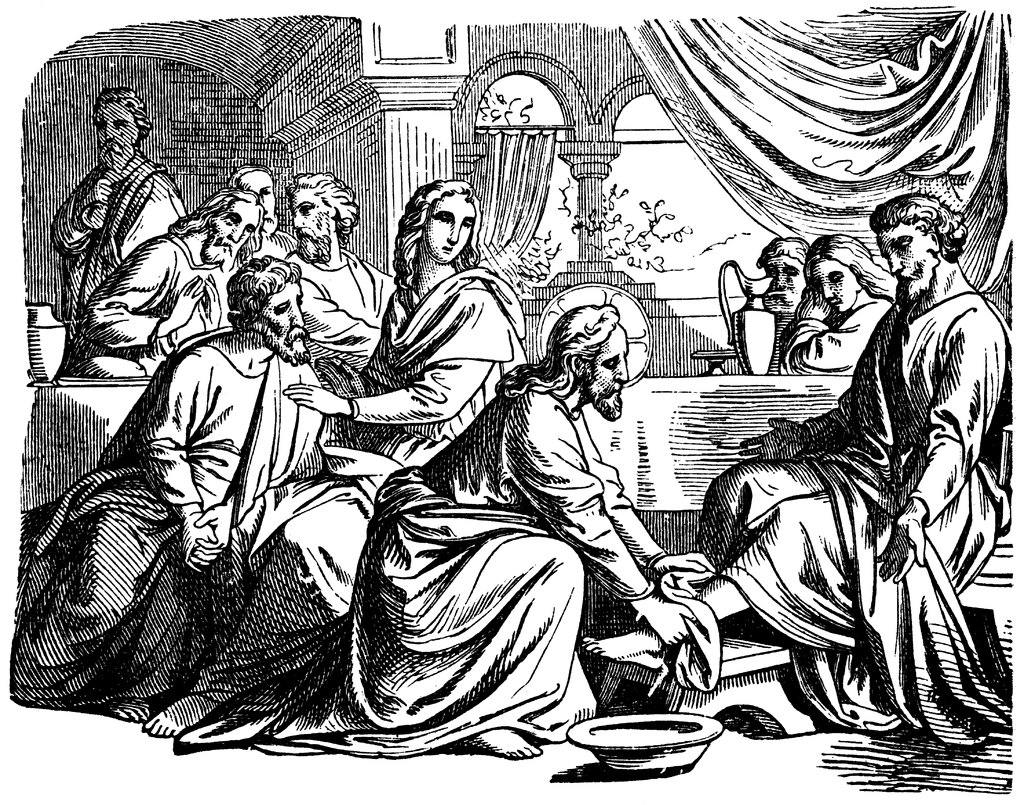
But we must not forget that every bishop and priest was first ordained a deacon, and that some bishops still wear the deacon’s dalmatic when they officiate at (pontifical) high Masses. The deacon in ancient days was a servant, and the appointment of the deacons in our reading today should remind us at once of the episode at the Last Supper, when Christ washed the feet of His Apostles, and mandated that His ministerial priesthood be a government of service to the Church.
In order that the priests of the early church could be free to preach, teach and proclaim the Gospel, they shared out their responsibility of care and service to these seven good men. They did not give up this responsibility, for they could not. It is tied up to their being, as it is to the being of the priests of the Church today, acting as fathers of the greater family of the Church, and ideally demonstrating a self-sacrificial love. A love akin to the Love that hung upon the Cross.
“At this time, as the number of the disciples increased, complaints were brought against those who spoke Hebrew by those who spoke Greek; their widows, they said, were neglected in the daily administration of relief. So the Twelve called together the general body of the disciples, and said, ‘It is too much that we should have to forgo preaching God’s word, and bestow our care upon tables. Come then, brethren, you must find among you seven men who are well spoken of, full of the Holy Spirit and of wisdom, for us to put in charge of this business, while we devote ourselves to prayer, and to the ministry of preaching.’ This advice found favour with all the assembly; and they chose Stephen, a man who was full of faith and of the Holy Spirit, Philip, Prochorus, Nicanor, Timon, Parmenas, and Nicolas, who was a proselyte from Antioch. These they presented to the Apostles, who laid their hands on them with prayer.”
Acts of the Apostles, 6: 1-6 [link]

